Used sailboat brands: what each builder costs you as a buyer
By Itzhak Fuhrman·Built and maintains Knotworth's cost model·Updated 11 September 2026
Search "sailboat brands" and you get new-boat marketing. The current page one is a magazine's boats of the year list, Beneteau's own site, a thirteen-year-old ranking, an alphabetical directory and two charter blogs.
None of that helps you, because you are not buying a new boat. Almost nobody is.
The question a used buyer actually has is different: which builders are good to buy secondhand, and what does each one cost me after I own it? That is a question about parts availability, documented weaknesses and resale behaviour, and it is not what brand pages are written about.
This section answers it, one builder at a time.
How these guides are organised
Two levels. A brand hub for each builder covers what is true across the whole range. A model page exists only where a specific boat has enough of its own documented history to justify one, which is far rarer than the internet suggests.
There are thousands of production sailboat models. Wikipedia's list of manufacturers alone runs to hundreds of yards.
Writing a page for each would produce exactly the kind of filler that makes the web worse: the same six paragraphs with the numbers swapped. So there is a rule.
A model earns its own page only when we can write three things that are true of that boat and false of its siblings, and when enough people search for it by name to justify the research.
Roughly six to ten models pass that test today. Everything else lives as a section inside its brand hub, where it belongs.
That rule is what keeps this section from sprawling. A page only gets created when there is something to put in it.
The brands covered
Eight American and European builders whose used boats come up most often in the under-$100,000 market. Coverage is being built out brand by brand, deepest where the fleet is largest.
| Builder | What they built | Why a used buyer cares |
|---|---|---|
| Catalina | America's largest sailboat builder. Value-built coastal cruisers, enormous fleets | Parts are unusually easy to find even though the factory has been idle since October 2025. Known faults are documented across the whole range |
| Beneteau | The largest production builder in the world. Modern coastal cruisers | Volume means choice and a liquid resale market. Build is to a price and to a modern spec |
| Island Packet | Heavy, shoal-draft American cruisers, and the only builder here still trading | Offshore stability numbers on a shoal draft, and the factory in Largo can still support a 1990 hull |
| Hunter | High-volume American production cruisers, often innovative | Cheap to buy, mixed reputation, and specific structural details worth knowing before you offer |
| Cape Dory | Carl Alberg full-keel classics, out of production since 1992 | Offshore stability numbers at lengths nothing else reaches, and the founder still holds the moulds |
| Westsail | Heavy-displacement double-enders, the archetypal 1970s cruiser | Famous, slow, strongly built, and carrying a reputation that moves the price in both directions |
| Tartan | Better-built American performance cruisers | Higher build quality than the volume brands, at a price that reflects it |
| Jeanneau | Beneteau's sister brand since 1995, the second-largest production builder | A deep used fleet and liquid resale, built to a price, with mild-steel keel bolts to look at first. Includes a real Sun Odyssey 42 DS listing worked through the pre-check |
Coverage is deepest on Catalina first because it is the largest coherent used fleet in the American market, and because its models are the ones a first buyer actually looks at.
Catalina
Catalina Yachts built more sailboats than any other American yard. Production paused in October 2025 and the ownership has been disputed since, which sounds worse for buyers than it is. Catalina Direct is a separate company, still trading, and still supplying parts.
Four models have their own guides.
| Model | Built | Typical asking price | Best for |
|---|---|---|---|
| Catalina 22 | ~15,000 since 1969 | $2,500 to $7,000 | Learning, trailering, a first keelboat |
| Catalina 27 | 6,662, 1971 to 1991 | $1,000 to $19,000 | A first cruising boat with headroom |
| Catalina 30 | ~6,400, 1974 to 2008 | $15,000 to $30,000 | Coastal cruising and weekending |
| Catalina 36 | 2,305, 1982 to 2005 | $18,000 to $99,000 | Real accommodation and passage-making speed |
Each guide prices what commonly fails on that boat, using published parts prices and yard rates rather than round numbers.
How the four compare on paper
These are the standard design screens, computed from published figures rather than copied. They tell you what kind of boat each one is, and the comparison is more useful than any single number.
| Catalina 22 | Catalina 27 | Catalina 30 | Catalina 36 | |
|---|---|---|---|---|
| Capsize screening | 2.26 | 1.86 | 2.0 | 1.93 |
| Comfort ratio | 12.7 | 24.8 | 24.8 | 26.6 |
| Sail area / displacement | 17.8 | 15.2 | 15.1 | 14.6 |
| Ballast / displacement | 32% | 39% | 42% | 40% |
| Hull speed | 5.9 kn | 6.25 kn | 6.7 kn | 7.4 kn |
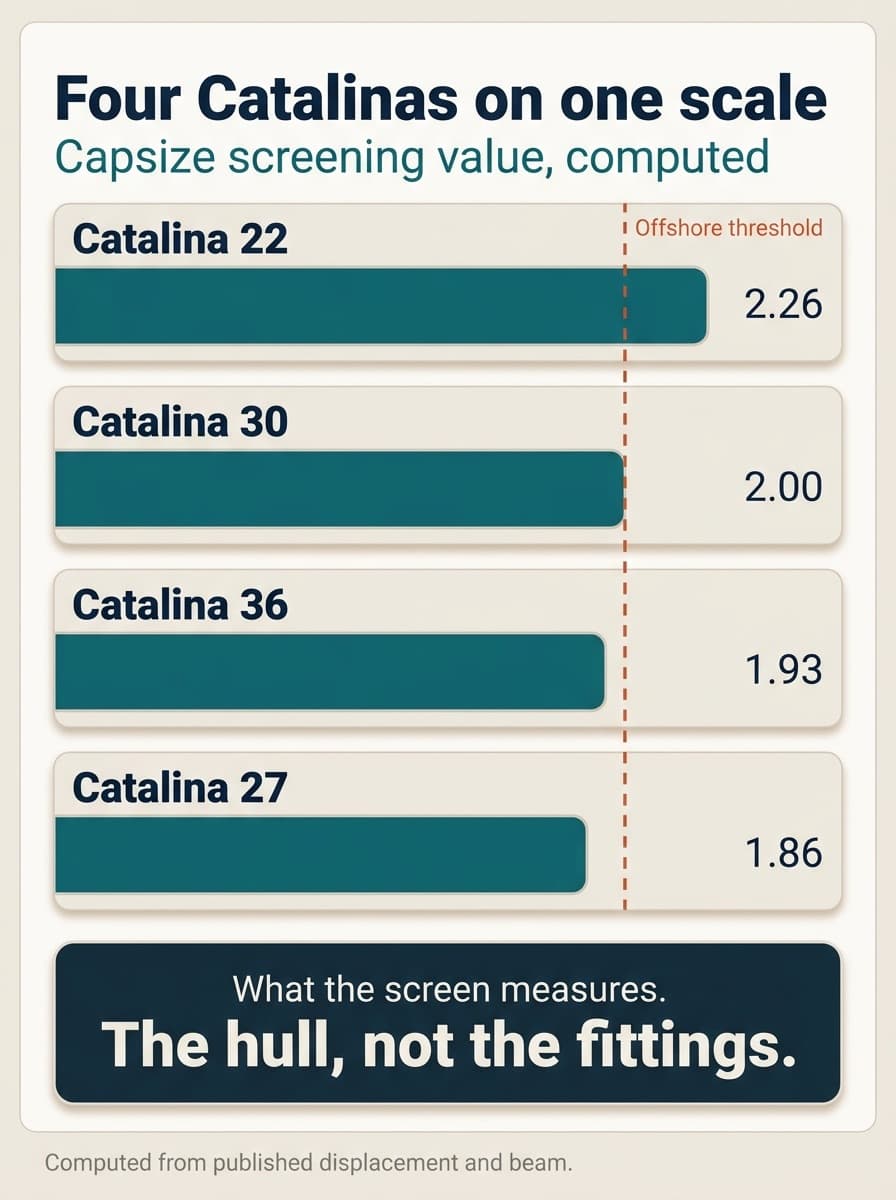
Below 2.0 on capsize screening is the conventional offshore threshold, so on hull form the 27 and the 36 pass and the 22 and 30 do not.
That is not the same as saying two of them are offshore boats. The screens measure the shape of the hull, not the quality of the fittings bolted to it, and on the Catalina 27 in particular the hardware tells a very different story from the number.
The design ratios guide explains what each screen does and does not tell you, and the free calculators will run them for any boat you are looking at.
What these pages are for
They exist to tell you what to ask about a specific boat before you spend money going to see it. Model-class knowledge is public and free. What it is worth on the boat in front of you is the part nobody writes down.
Forty years of owners have documented what goes wrong with these designs, on association forums, in magazine reviews and in parts catalogues. That knowledge is genuinely public, and these pages collect it and put prices against it.
What none of it tells you is whether this boat, the one in the listing you have open, has had the work done.
That gap is the entire problem. A listing tells you what the seller wants to say. It is silent on the rig age, the keel joint, the deck core and the through-hulls, and those silences are where the money is.
So the pattern on every page here is the same. What the model is, what commonly breaks, what each fix costs, and what to ask before you book a flight.
Then, when you have a specific listing, the free pre-check reads that boat's specification and flags which of the known issues the advertisement has stayed quiet about.
Start here
- New to this? The true-cost guide explains why the asking price is the smallest number in a used boat purchase, and how to price the rest.
- Going offshore? Best bluewater sailboats is the shortlist: five ocean-proven monohulls with real asking prices, all starting under $65,000.
- Got a boat in mind? Go to its brand hub and read the known faults before you contact the seller.
- Ready to travel? The survey cost guide breaks down what a survey day actually costs and what it does and does not cover.
Paste the URL. The free pre-check reads that boat's specs, runs her design numbers, and flags what the ad leaves out. No card until you unlock a full report.
FAQ
What is the best sailboat brand?+
There is no single answer, because the brands solve different problems. For a first used boat with cheap parts and a large fleet, Catalina is the obvious American answer. For offshore work, heavier builders such as Island Packet and Westsail are the relevant comparison, and they cost more to buy and to keep.
What are some popular sailboat brands?+
In the American used market the volume builders are Catalina, Beneteau, Hunter and Jeanneau, with Tartan and Cape Dory occupying the better-built end. Catalina alone built more than 15,000 Catalina 22s and over 6,600 Catalina 27s, which is why they dominate the affordable secondhand market.
What are some older boat brands?+
Many of the best-known American builders no longer produce boats, including Westsail, Cape Dory and Pearson, and Catalina paused production in 2025. That matters far less than people assume when a strong independent parts supplier and an active owners' association exist, which is exactly the situation for Catalina.
What are the most affordable sailboat brands?+
Catalina and Hunter built the largest volumes at the lowest prices, so their older boats are the cheapest way into keelboat ownership. A Catalina 22 can be bought for under $5,000, though on a hull that cheap the sails, outboard and trailer are usually worth more than the boat.
Do these guides cover catamarans?+
No. This section covers monohulls only. Multihull buying is a different market with different costs, different survey requirements and different berthing economics.