Tartan sailboats: what the builder does, and what one costs you
By Itzhak Fuhrman·Built and maintains Knotworth's cost model·Updated 11 September 2026
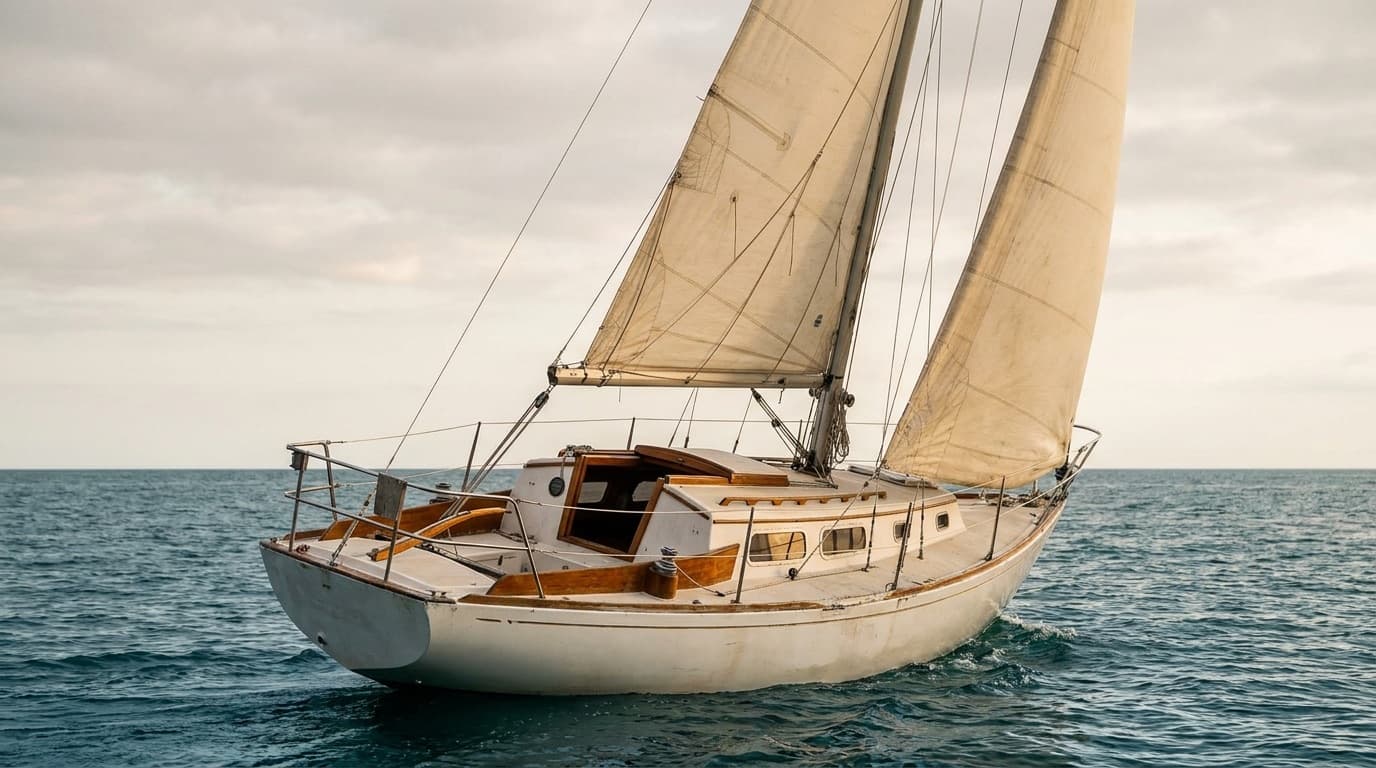
Most of the builders covered in this section have one identity. Tartan has two, and confusing them is the single most expensive mistake you can make with this name.
A Tartan 30 from 1975 and a Tartan 4000 from 2015 share a badge and almost nothing else: different designers, different construction, different materials, different buyers and prices an order of magnitude apart.
This page separates them, because the used market does.
Are Tartan sailboats good boats?
Yes, and by reputation among owners, brokers and reviewers consistently better built than the volume production brands. The older boats are Sparkman & Stephens designs from the era when S&S was the most respected office in yachting. The modern ones use epoxy laminates and carbon rigs, which is genuinely premium construction.
The design lineage is the brand's whole story and it splits cleanly in two.
The Sparkman & Stephens era, roughly 1961 to the late 1980s. Charlie Britton commissioned S&S to design the first Tartan, the 27, with hull number one launched in spring 1961. It was among the first premium yachts built in fibreglass, and it helped prove that composite construction could match the wooden yachts of the day for strength and performance.
For three decades the architects were S&S. That is the same office behind Dorade and a long line of offshore-proven designs, and it shows in the way these boats are proportioned: moderate beam, balanced ends, sensible rigs.
The Tim Jackett era, roughly the 1990s onward. For the four decades since, one designer has drawn the boats. Modern Tartans moved to epoxy laminates and carbon fibre rigs, which is expensive, light and stiff, and which puts them in a different market segment entirely.
Against the rest of this section: on build reputation a Tartan sits above a Beneteau or a Hunter; on the design ratios she is faster than a Cape Dory or an Island Packet; and she is priced accordingly at both ends of its own range.
Is Tartan still in business?
Yes, building in Painesville, Ohio, but the ownership has changed three times in under two years. Seattle Yachts sold the company to Michael Reardon in September 2025, and in January 2026 a group led by Jon Duer, owner of Tartan's long-time rigging supplier Great Lakes Rigging, bought it from him. The new owners say they will finish the boats in build and then limit production to 8 to 12 a year, and in July 2026 they announced a new Tartan 27.
That recency is the honest headline, and it deserves a buyer's caution rather than alarm.
What it means for a used buyer: factory support, parts and drawings depend on a company that has been through several hands recently. That is a materially weaker support picture than Island Packet, which has had stable ownership since 2017 and has grown under it.
It is a stronger picture than Catalina, which stopped building in October 2025 and changed hands again in July 2026 with no restart date yet, and than Westsail, which has been gone since 1981.
What it does not mean: the boats are unaffected. A 1978 Tartan 30 was a Sparkman & Stephens design built well, and it remains one regardless of who owns the moulds now. Corporate turbulence matters for parts and for resale sentiment, not for the hull under your feet.
Buying an older Tartan, treat it as you would any out-of-production classic: the owner community and the general marine trade will supply most of what you need.
The two Tartan markets
The name spans an unusually wide price range because it spans two eras of construction. Modern carbon-rigged Tartans trade far higher on brokerage than the older fibreglass models, and the two are not really competing for the same buyer.
The classic market. S&S-designed boats from the 1960s through the 1980s, in the 27 to 37 foot range, are, in owner and surveyor accounts, among the better-built boats available at classic-boat prices. They are the reason Tartan appears in this section at all: a buyer with a modest budget can get a genuinely well-designed hull.
The modern market. Epoxy hulls, carbon spars, contemporary interiors. These are premium cruiser-racers competing with the top of the production market, and they are priced there.
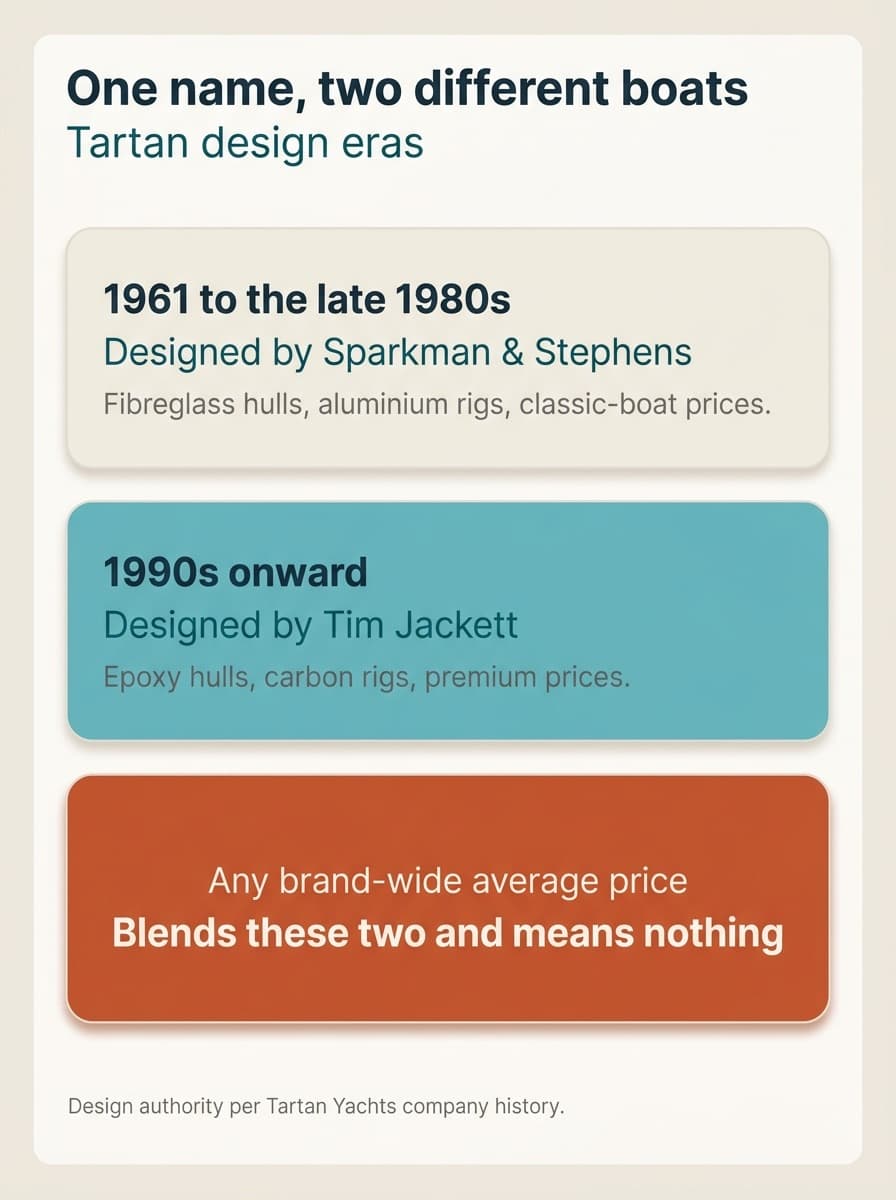
Why this matters when you search. Brand-wide price data blends the two, so any single "what does a Tartan cost" figure is close to meaningless. Filter by era before you draw any conclusion about value, exactly as you should with the Cape Dory 28 sailboat and powerboat.
The true-cost guide sets out how to price the catch-up bill on either, working from 10 to 15% of the boat's value per year for ongoing ownership.
One era-specific cost note: a carbon rig is not a conventional rig. Inspection, insurance and replacement all work differently and cost more, and a surveyor who is comfortable with aluminium spars is not automatically comfortable with carbon ones. Budget for a rigger who is.
The range, and why no model gets its own guide
Dozens of models across sixty-five years in two design eras. No Tartan model reaches the search volume that would justify its own guide, and the brand term itself at 480 a month is the smallest in this section.
| Era | Models | Notes for a buyer |
|---|---|---|
| The first, 1961 | Tartan 27 | S&S design, hull one launched spring 1961. The boat that started the company and one of the first premium fibreglass yachts |
| S&S classics, 1960s to 1980s | Tartan 30, 34, 37 and others | The affordable end. Well-proportioned, moderate, properly designed hulls |
| Transition, 1990s | Various | Design authority passes from S&S to Tim Jackett |
| Modern Tartans, 2000s onward | Three- and four-digit models | Epoxy laminates and carbon rigs. Premium construction at premium prices |
The promotion rule, applied. A model earns its own guide when the bare model name draws at least 500 US searches a month and we can write three things true of it and false of its siblings. No Tartan model registers meaningful volume against that bar.
That is the expected result for a builder with modest production spread across many models and two eras, and it is exactly the case a brand hub handles better than a set of thin model pages.
What to check before you buy one
Establish the era first, because it determines everything else you should look at. On an S&S classic, the checks are the standard ones for a well-built boat of that age. On a modern Tartan, the rig is a specialist item.
The survey cost guide breaks the survey day down line by line.
On an older S&S Tartan:
- Deck core moisture, especially around fittings
- Chainplates and their attachment, plus any bulkhead staining beneath them
- Keel joint and keel bolts
- Original engine, its age and its access
- Standing rigging age against the usual ten-year life
- Blistering, and whether the hull has been barrier coated
On a modern Tartan:
- Who has inspected the carbon rig, when, and to what standard
- What the insurer requires for a carbon spar, and at what premium
- Epoxy laminate condition and any repair history, which is specialist work
- Everything on the list above as well
Ask, before you travel:
- Which era is she, and who designed her?
- Is the rig aluminium or carbon, and who last inspected it?
- Any grounding history, and what was repaired?
- When was the standing rigging last replaced?
- Any factory involvement in her history, and under which ownership?
None of those is answered in a typical listing. All of them change the number you should offer.
How Knotworth reads a specific Tartan
This page describes the builder. The product reads the boat. Paste a listing URL and the free pre-check pulls that hull's specification, runs her design numbers, and flags which of the known issues above the advertisement is quiet about.
Tartan is the clearest case in this section of a brand name that tells you almost nothing on its own. Two boats, same badge, forty years and a construction revolution apart.
The design numbers are what separate them, and they are computable from published figures for any specific hull. The design ratios guide explains what each screen means and the free calculators will run them.
After that it is history: who owned her, what she has hit, and what has been renewed. Those omissions become the questions, the questions become answers, and the answers become a number you can negotiate on.
Paste the URL. The free pre-check reads that boat's specs, runs her design numbers, and flags what the ad leaves out about the era, the rig and the history. No card until you unlock a full report.
FAQ
Are Tartan sailboats good boats?+
Yes, and better built than the volume production brands. Older Tartans are Sparkman & Stephens designs from the era when S&S was the most respected design office in yachting, and modern ones use epoxy laminates and carbon rigs, which is genuinely premium construction.
Who designed Tartan sailboats?+
Sparkman & Stephens for the first three decades, beginning with the Tartan 27 in 1961, and Tim Jackett for the four decades since. Which of those drew your boat matters more than the model number.
Is Tartan still in business?+
Yes, building in Painesville, Ohio, though the ownership has changed three times since 2025. The most recent change was in January 2026, when a group led by Jon Duer of Great Lakes Rigging, a Tartan supplier, bought the company and set production at 8 to 12 boats a year.
What was the first Tartan?+
The Tartan 27, commissioned by Charlie Britton from Sparkman & Stephens in autumn 1960, with hull number one launched in spring 1961. It was one of the first premium yachts built in fibreglass.
Why do Tartan prices vary so much?+
Because the name covers two different products. Older fibreglass S&S designs sell at classic-boat prices, while modern carbon-rigged Tartans trade far higher on brokerage. Any brand-wide average blends the two and is not useful.
Is a carbon rig a problem on a used boat?+
Not a problem, but a specialism. Inspection, insurance and replacement all differ from an aluminium spar and cost more, so budget for a rigger who works with carbon and check what your insurer will require before you commit.