Catalina 27 buyer's guide: what she is, what she costs, what breaks
By Itzhak Fuhrman·Built and maintains Knotworth's cost model·Updated 12 October 2026
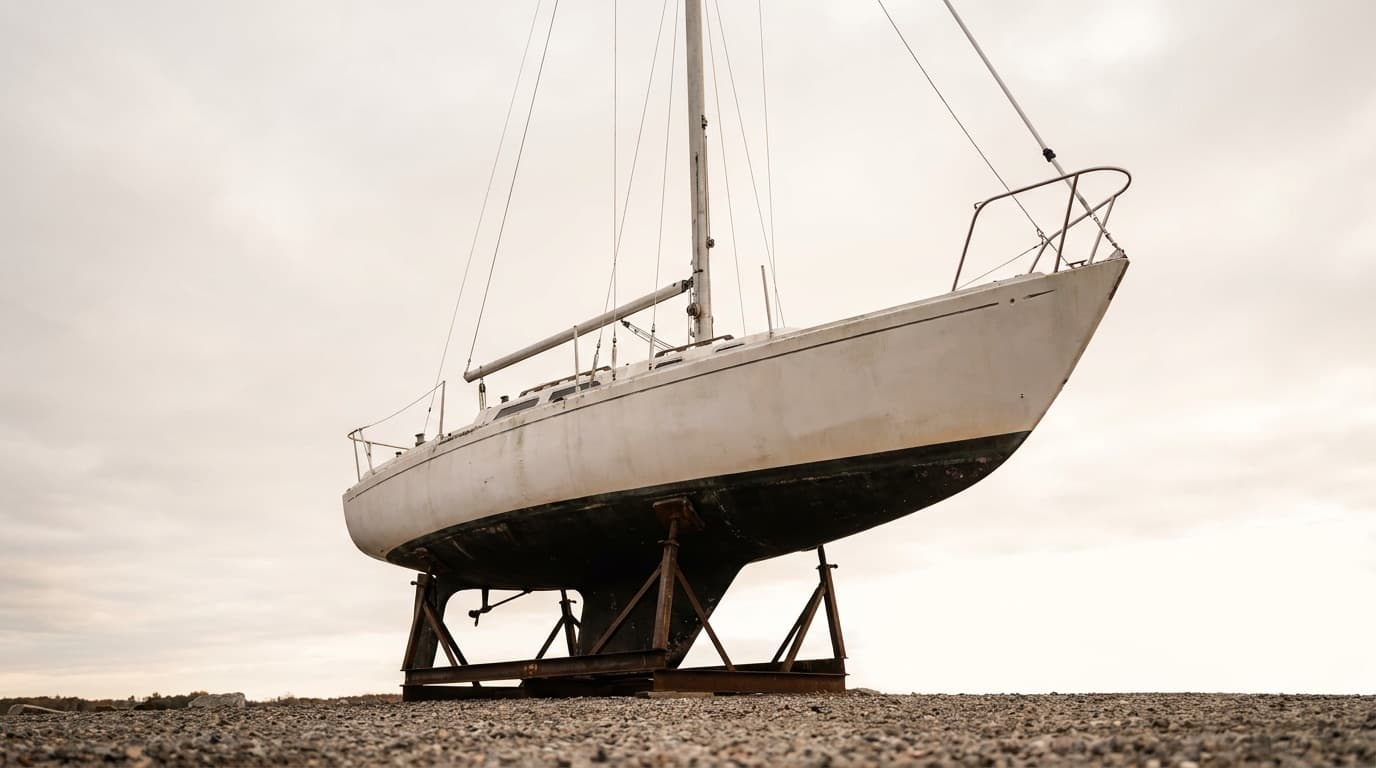
Catalina 27 specifications
| Specification | Figure |
|---|---|
| Length overall | 26 ft 10 in |
| Waterline length | 21 ft 9 in |
| Beam | 8 ft 10 in |
| Draft | 4 ft 0 in fin keel |
| Displacement | 6,850 lb |
| Ballast | 2,700 lb lead, 39% |
| Sail area | 342 sq ft standard rig; a tall rig was offered |
| Rig | Masthead sloop · I 34.5 ft |
| Hull | Fin keel, spade rudder, solid fibreglass hull |
| Auxiliary | Atomic 4 petrol, Universal diesel, or an outboard well on early boats (see the engine section below) |
| Built | 1971 to 1991, 6,662 hulls |
| Designer | Frank Butler and Bob Finch |
Source: sailboatdata. Catalina quoted slightly different displacement figures across the production run; treat the numbers as nominal.
Practical Sailor's review of this boat opens by calling Catalinas "cheaply made boats, with lots of corners cut in places they shouldn't be cut," and then recommends buying one anyway. It compares her to a Volkswagen: "It's basic, but it will get you where you want to go."
That is a fair summary, and it is also useless as a buying guide, because the corners that were cut are not evenly distributed. Two of them have cost owners their masts.
This guide is about which corners matter. What has actually failed on Catalina 27s, what the fixes cost at published 2026 prices, and which engine turns a cheap boat into an expensive one.
Is a Catalina 27 a good boat?
Yes, as a first cruising boat on protected or coastal water, and she is a real step up from a trailerable. She has standing headroom, an enclosed head and sleeps five. She is lightly built, she is under-canvassed, and several original fittings need upgrading before you trust the rig.
The design ran essentially unchanged for twenty-one years, which is itself the endorsement. Frank Butler and Robert Finch got the proportions right the first time, and Catalina sold 6,662 of them.
What you are buying is interior volume for the money. What you are giving up is build quality, and Practical Sailor is not subtle about it.
SpinSheet's review puts the same point structurally: the hull "may fracture from impacts that would leave a heavier built boat with only a scratch." She suits "first time buyers and sailors moving up to their first cruising boats" in protected or near-shore water.
That is the honest brief. Within it she is genuinely good, and the fleet size means you never have to accept a bad one.
What are the common issues with the Catalina 27?
Two rig failures dominate the list and both have published retrofit kits. The original lower shroud chainplate U-bolts have failed and put rigs over the side, and the cast aluminium spreader sockets have "cost several rigs". Between them the parts come to about $384.
This is the section the listing will not write for you.
| Known issue | What it means, and what it costs |
|---|---|
| Lower shroud chainplate U-bolts | Practical Sailor: "A number of the original fittings have failed, causing the rig to go over the side." Check whether the boat has been upgraded. Chainplate U-bolt upgrade kit $288.58 |
| Cast aluminium spreader sockets | "Failures of the cast sockets have cost several rigs." They should be replaced with the later stainless fabrications. Spreader bracket retrofit $95.00 |
| Leaking chainplates into the bulkhead | SpinSheet records leaking chainplates deteriorating the bulkheads they bolt to, which is how a rig failure starts quietly. A wet bulkhead is a structural repair, not a sealant job |
| Through-hulls | "Gate valves screwed onto pipe nipples glassed into the hull, a poor practice." Proper seacocks cost in the region of $260 to $500 each installed, and there are several |
| No backing plates anywhere | Original stanchions, rails and deck hardware were fitted without them, so expect gelcoat cracking around every fitting on an older boat |
| Deck delamination | SpinSheet notes the deck is plywood cored. Water through unbacked hardware rots it. Local repairs are affordable, a full recore is not |
| Hull to deck joint leaks | Recurring owner complaint. Usually a nuisance, occasionally the reason the bulkhead is wet |
| Weak secondary bonding | SpinSheet flags the tabbing where furniture and structure attach to the hull. Worth pressing on hard |
| Icebox drain skin fitting | Reviewers note it is sited so water runs back into the icebox when she heels. A design fault, not wear |
| Electrical panel siting | Originally on the face of the port quarterberth, exposed to companionway spray and bilge water. Practical Sailor recommends relocating it on older boats |
| Poor fuel tank installations | Documented on early inboard boats. Treat any original tank installation as an inspection item |
| Standing rigging age | Roughly a ten-year life. Materials for a 27-footer run $700 to $1,000, a professional re-rig $2,500 to $3,500 |
Sources: Practical Sailor for the chainplate, spreader socket, through-hull, backing plate and electrical panel findings; SpinSheet for the hull layup, bonding, chainplate leaks and fuel tanks; Catalina Direct catalogue prices, checked August 2026. Assumption: a boat that has not already had the work done.
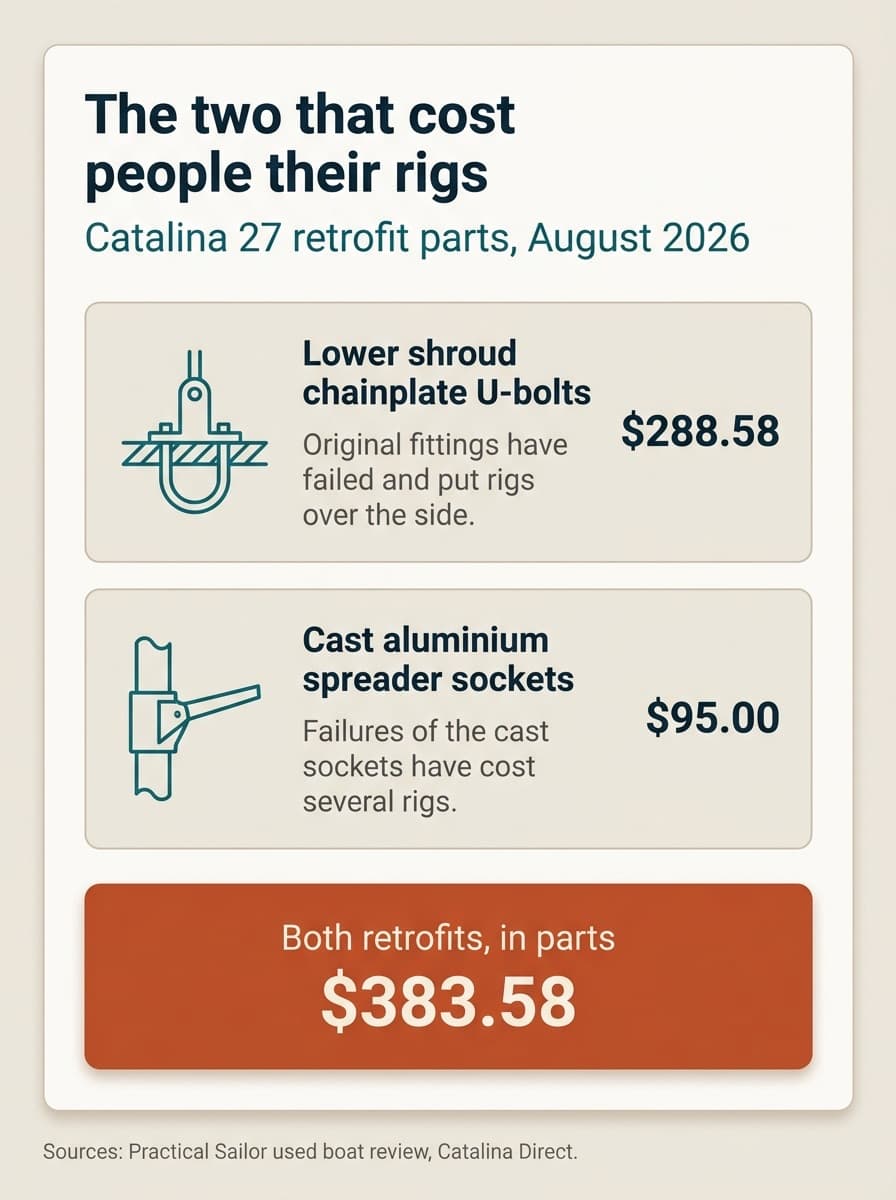
Read the first two rows again, because they are unlike anything on the Catalina 30 or 22 list. These are not wear items that get worse slowly. They are original fittings with a record of sudden failure, and the fix for both is under $400 in parts.
A seller who has done that work will tell you, because it is the cheapest brag in boating. Silence is information.
Got a Catalina 27 listing open right now? Paste it. The free pre-check reads that specific boat’s year and equipment list and flags which of these the ad has quietly said nothing about.
Free on every boat, no card. You only pay to unlock a full report.
Which Catalina 27 engine should you look for?
Look for a Universal diesel, accept an Atomic 4 if the access does not put you off, and avoid the Petter diesel fitted in the late 1970s. Practical Sailor is unambiguous: with the Petter "the boat is grossly underpowered," parts are hard to find, and "we would definitely avoid" it.
Four powerplants appeared over the run and they are not equivalent.
| Engine | Years | Verdict |
|---|---|---|
| Outboard in a well | From 1971, dropped 1989 | Works. Awkward. Getting the engine in and out of the well "is a chore" and cockpit remote controls are "a must" |
| Universal Atomic 4 | 1973 onward | Petrol. Reliable and well supported, but access is dire. Practical Sailor rates engine accessibility "one or less" out of five, and notes "oil changes require major contortions" |
| Petter diesel | Late 1970s | Avoid. Grossly underpowered and parts are scarce |
| Universal diesel, 11 or 14 hp | Later boats | The one to want |
This matters more than it sounds. A repower on a 27-footer is a five-figure job on a boat that may be worth $8,000, so the engine is not a specification line, it is most of the purchase decision.
It also explains the price spread better than the build year does. A 1984 boat with a Universal diesel and a 1984 boat with a tired Petter are not the same asset.
Poor access has a second cost. Maintenance that is physically unpleasant tends not to get done, so on an Atomic 4 boat the hours matter less than the service history.
What does a Catalina 27 cost?
Listings run from about $1,000 to $19,000 for the identical design. YachtWorld's current range is $4,900 to $19,000, a 1984 boat with a diesel asks $19,000, and Reddit carries a 1973 offered at $1,000. Nineteen to one, same designer, same hull.
| Asking price | The boat |
|---|---|
| $1,000 | 1973, offered on a forum. A project, priced as one |
| $5,950 | Used broker listing, Georgia |
| $19,000 | 1984, diesel, broker listing, California |
Asking prices, August 2026. The gap is not condition alone. It is engine, rig upgrades, deck core and whether the chainplate work has been done.
That is the whole argument of this site in three rows. On the Catalina 30 the build year explains most of the spread. Here it explains almost none of it.
Now price the gap. A boat at the bottom of that range that needs a re-rig ($2,500 to $3,500), four seacocks ($1,040 to $2,000) and the two rig retrofits ($384) has consumed $3,900 to $5,900 before anything is improved.
Which is why the asking price is the least useful number in a listing, and why the true-cost guide exists. The number that matters is the asking price plus the catch-up bill, and the free pre-check is built to estimate the second half.
How fast does a Catalina 27 go, and how seaworthy is she?
Hull speed is 6.25 knots and she rates PHRF 204, which is unremarkable and honest. Her capsize screening value is 1.86, below the conventional 2.0 offshore threshold and better than a Catalina 30's. That number flatters her, and it is worth understanding why.
| Ratio | Value | Reading |
|---|---|---|
| Capsize screening | 1.86 | Below 2.0. Better than the Catalina 30's 2.0 |
| Comfort ratio | 24.8 | Moderate. Twice the Catalina 22's 12.7 |
| Displacement / length | 297 | Moderate to heavy. She is not a light boat for her length |
| Sail area / displacement | 15.2 standard, 16.2 tall rig | Under-canvassed. Sluggish in light air |
| Ballast / displacement | 39% | Stiff |
| Hull speed | 6.25 knots | how it is calculated |
Computed from displacement 6,850 lb, ballast 2,700 lb, waterline 21.75 ft, beam 8.83 ft and sail area 341.77 sq ft as published. The design ratios guide explains each screen and the free calculators will run them for a specific boat.
Here is the part nobody writes down. The hull form screens well and the hardware does not.
A narrow beam on a heavy hull gives a good capsize number, and the Catalina 27 earns hers honestly. But the failures on this boat are not hull-form failures. They are chainplates that have let go, spreader sockets that have cost rigs, gate valves on pipe nipples, no backing plates, and a layup that fractures on impacts a heavier boat shrugs off.
So the ratios say coastal-capable and the build says protected water until the retrofits are done. Both are true. The screens measure the shape of the boat, not the quality of the parts bolted to it, and this is the clearest example in the Catalina range of that distinction mattering.
Treat 1.86 as permission to take her offshore only after the rig work has a receipt.
Which Catalina 27 should you buy?
Later is better because the fittings improved, a Universal diesel beats everything else, and the deep keel with the tall rig is the configuration that actually sails. Principal dimensions never changed across the run, so you are choosing options, not generations.
Keels. Standard fin at 4'0". A shoal draft wing keel at 3'0" arrived in 1979. The deep keel points better and the wing is harder to free if you ground her.
Rigs. Standard masthead sloop, or a taller rig adding about 24 square feet and raising the mast roughly two feet. SpinSheet calls the deep keel and tall rig combination the fastest configuration, and with an SA/D of 15.2 in standard trim you will want the extra sail anywhere light.
Steering. Tiller on early boats, wheel optional later. On a 27-footer the tiller is not a downgrade and it is one less system to fail.
Years. No sharp break points, but reviewers record that the boat's weak fittings were progressively improved, so a later hull is more likely to have arrived with the better parts rather than needing them. Production ended in 1991, when the redesigned Catalina 270 replaced her.
What to check before you buy one
Go up the mast or get someone to, look behind the chainplate covers, taste the bulkhead for damp, and find out which engine is in her. Those four cover most of the money and all of the danger.
Practical Sailor's own advice is worth repeating: get a normal marine survey, and separately "look for a knowledgeable Catalina 27 owner to go over the boat with you." On a fleet this size that person is findable, and free.
The survey cost guide breaks the survey day down line by line, and it is money that should be spent on a boat that has already survived the questions below.
Ask, before you travel:
- Have the lower shroud chainplate U-bolts been upgraded, and is there a receipt?
- Are the spreader sockets the original castings or the stainless replacements?
- Any staining or softness in the bulkheads where the chainplates pass through?
- Which engine is fitted, and if it is a diesel, which one?
- Are the through-hulls still gate valves on pipe nipples?
- When was the standing rigging last replaced?
- Any soft spots in the deck, particularly around unbacked hardware?
- Where is the electrical panel, and has it ever been wet?
None of those is answered in a typical listing. All of them change the number you should offer. They are the model-specific lines in the full inspection checklist, which covers what to settle before you travel and what to check aboard.
How Knotworth reads a specific Catalina 27
This page describes the model. The product reads the boat. Paste a listing URL and the free pre-check pulls that hull's specification, runs her design numbers, and flags which of the known issues above the advertisement is quiet about.
Everything here is true of Catalina 27s in general. None of it tells you about the one you are looking at, and on this model the difference between a $5,950 boat and a $19,000 boat is mostly invisible in photographs.
A 1979 boat advertised as "diesel, runs well, ready to sail" has not told you whether that diesel is the Petter, whether the chainplates were ever upgraded, or what the bulkheads look like behind the covers. Those omissions become the questions, the questions become answers, and the answers become a number you can negotiate on.
Paste the URL. The free pre-check reads that boat's specs, runs her design numbers, and flags what the ad leaves out about the rig, the engine and the through-hulls. No card until you unlock a full report.
FAQ
Is a Catalina 27 a good boat?+
As a first cruising boat on protected or coastal water, yes. She has standing headroom, an enclosed head and sleeps five, and 6,662 were built so parts and knowledge are easy to find. She is lightly built, and Practical Sailor describes Catalinas of this era as cheaply made with corners cut.
What are the common issues with the Catalina 27?+
The two serious ones are the original lower shroud chainplate U-bolts, which have failed and put rigs over the side, and the cast aluminium spreader sockets, which have cost several rigs. Beyond those: gate valves instead of seacocks, no backing plates on deck hardware, plywood deck core delamination, leaking chainplates rotting the bulkheads, and hull to deck joint leaks.
How much does a Catalina 27 sailboat cost?+
Listings run from about $1,000 for a project to $19,000 for a well-equipped diesel boat, with YachtWorld showing $4,900 to $19,000. The engine and the rig upgrade history explain more of that spread than the build year does.
How fast does a Catalina 27 go?+
Hull speed is 6.25 knots and she rates around PHRF 204. Her sail area to displacement ratio of 15.2 in standard rig makes her sluggish in light air, which is why the tall rig with the deep keel is the configuration to look for.
How many people can fit on a Catalina 27?+
She sleeps five, with a V-berth forward, a convertible salon and a quarterberth, plus an enclosed head. Six is comfortable in the cockpit for daysailing.
Which Catalina 27 engine is best?+
The Universal diesel in 11 or 14 hp form. The Atomic 4 is well supported but access is poor enough that Practical Sailor rates it one out of five, and the late-1970s Petter diesel should be avoided outright as grossly underpowered with scarce parts.
Is a Catalina 27 a bluewater boat?+
Her capsize screening value of 1.86 sits below the 2.0 offshore threshold, which is better than a Catalina 30's. The hardware does not match the hull form though, so she is a coastal boat unless the chainplates, spreader sockets and through-hulls have all been upgraded.