Sailboat survey cost (2026): what a pre-purchase survey really runs
By Itzhak Fuhrman·Built and maintains Knotworth's cost model·Updated 11 September 2026
Ask three sailors what a survey costs and you will get three numbers, all of them right. The per-foot rate is genuinely simple. What catches buyers out is everything that has to happen around the survey before the surveyor can do the job, most of which lands on the buyer's card on the same day.
This guide gives the per-foot answer first, then totals a realistic survey day on a 35-footer using published yard and surveyor rate cards. Every figure below links to the source that publishes it, so you can check whether it still says what we say it says, and whether it comes from your coast.
One thing worth settling before you read on. The survey is the point at which a boat stops being a browsing exercise and starts costing real money. Deciding which boat deserves that money is a separate problem, and it is the one the free pre-check is built to solve. The inspection checklist covers what to check yourself before paying for a survey.
It also sits inside a bigger budget. If you are still working out what the whole boat will cost you, start with how much a sailboat costs and come back here when you have a shortlist.
Two kinds of reader land on this page, and they need different numbers. If you already own the boat and your insurer has asked for a survey at renewal, you want the insurance condition and value rate, which is the cheaper of the two, and the section Can you get boat insurance without a survey? further down answers your question directly. If you are buying, every other section on this page is about the pre-purchase survey, the fuller and dearer product, and about the day of costs that surrounds it. The two are priced differently, scoped differently, and paid for by different people, so do not carry a number from one into a budget for the other.
How much does a boat survey cost?
A pre-purchase survey costs $20 to $35 per foot of boat length in 2026, so roughly $700 to $1,225 on a 35-footer. Insurance surveys run cheaper at $15 to $28 per foot. Most surveyors also set a minimum fee, which means small boats pay more per foot than the headline rate suggests.
The per-foot convention is near-universal in North America, and the published rate cards cluster tightly once you separate the survey types.
Discover Boating puts the general rule at $20 to $25 per foot and notes that minimum charges often push small vessels above it. Boston Marine Surveyors publish $28 to $30 per foot for a pre-purchase survey including the sea trial, and $22 to $24 for an insurance survey. San Diego Marine Surveyors list $25 to $35 per foot pre-purchase and $20 to $28 for an insurance condition and value survey.
Owner reports track the same band. A Hull Truth thread from January 2024 puts a basic survey at $500 to $700 on boats of 28 to 33 feet, and a Sailing Anarchy thread from July 2025 reports $30 per foot for an out-of-water pre-purchase survey on a 42-foot sailboat.
| Survey type | Typical 2026 rate |
|---|---|
| Pre-purchase (condition and value) | $20 to $35 per foot, most rate cards $25 to $30 |
| Insurance condition and value | $15 to $28 per foot |
| Appraisal for finance or estate | Often a set fee, around $22 to $24 per foot |
| Engine survey | Quoted separately, per engine |
| Damage survey | Quoted per job, scope-dependent |
Rates rise on the coasts with the highest yard costs and fall inland, and a surveyor who has to drive two hours to a remote yard may bill the travel. Boston Marine Surveyors state they charge no travel fee; plenty of others do, so ask.
What does the survey fee actually buy?
A pre-purchase survey buys a few hours of trained attention and a written report, usually within one to three days. The surveyor sounds the hull for delamination, checks the rig, tests systems, reads moisture, and assigns a condition and a value. It is an inspection, not a warranty and not a guarantee.
The scope is broader than most first-time buyers expect and narrower than they hope. The surveyor will percussion-test the hull, look at chainplates and standing rigging, check through-hulls and seacocks, run electrical and plumbing systems, note safety-gear compliance and give an opinion on market value. San Diego Marine Surveyors quote a one to three day turnaround on the written report.
What the survey does not do is dismantle anything. Panels stay on, the engine is not opened, and the surveyor works with what is accessible on the day. That is why the report is full of phrases like "recommend further investigation": it is an honest account of the limits of a visual inspection, not hedging.
For sailboats specifically, ask whether the rig inspection includes going up the mast. Many pre-purchase surveys inspect the rig from the deck, and a deck-level look at nineteen-year-old standing rigging tells you very little. An aloft inspection is usually a separate line.
The report will also assign a value, which is worth reading sceptically. A surveyor's valuation reflects the boat as she sits, not what she will cost you to bring up to your standard, and those are different numbers. The true-cost guide covers the gap.
The survey is the expensive part, so the question worth answering first is which boat deserves it. Paste a listing and the free pre-check tells you before you book anything.
Free on every boat, no card. You only pay to unlock a full report.
What does a survey day cost in total?
On a 35-foot sailboat, budget $1,300 to $1,900 for the day before any engine survey. The surveyor is the largest line but not the only one: the short haul, the yard's environmental and admin fees, oil analysis and a title search all land on the buyer, and they add up to roughly a third of the total.
This is the number that matters, and it is the one page-one results consistently leave out. They quote the per-foot fee and stop, which is fine if you are a surveyor publishing your own rates and misleading if you are a buyer building a budget.
The haul-out is the big missing line, and it is the buyer's bill. San Diego Marine Surveyors state this plainly: generally, the buyer pays for the haul-out.
Yards publish these rates too. Monterey Bay Boatworks charge $13.50 per foot to 35 feet with a $375 minimum, which covers a two-strap haul, high-pressure wash, shoring and four free days, plus a $1.50 per foot environmental fee.
Their hold-in-straps service, which is what a survey short-haul usually is, carries the same $375 minimum for up to an hour, then $50 per quarter hour. That clock matters: a surveyor who finds something worth investigating can turn a one-hour slot into a three-hour bill.
| Line item | 35-foot sailboat, 2026 |
|---|---|
| Pre-purchase survey at $25 to $35 per foot | $875 to $1,225 |
| Short haul or hold in straps | $280 to $500, minimums common around $375 |
| Yard environmental and admin fees | $50 to $140 |
| Oil sample analysis | About $75 per sample |
| USCG abstract of title (lien search) | About $55 |
| Sea trial | Often included, sometimes billed separately |
| Surveyor travel | $0 to a few hundred, varies by firm |
| Realistic total before engine survey | $1,300 to $1,900 |
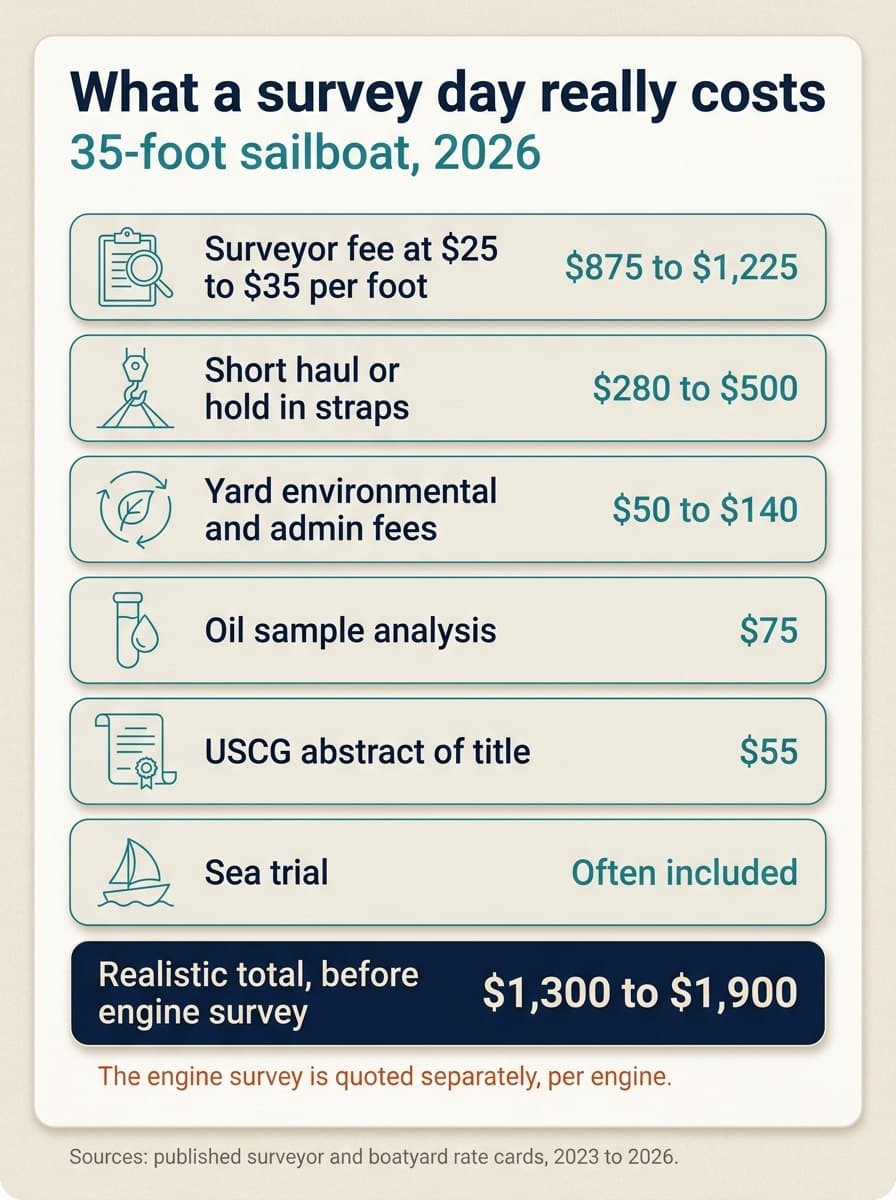
The engine survey sits outside that total deliberately. It is quoted per engine and San Diego Marine Surveyors describe it as running above the other survey types. Get it quoted rather than budgeted from a rule of thumb, because diesel survey pricing varies more than anything else on this list.
Assumption behind the table: one 35-foot monohull, one short haul at a yard with published rates, no aloft rig inspection and no specialist testing. Add the aloft inspection and a compression test and the day moves toward the top of the band.
Who pays for a boat survey?
The buyer pays for a pre-purchase survey and for the haul-out that makes it possible. The seller pays when the survey is for their own insurance or an estate valuation. The buyer commissions the surveyor directly, which is what makes the report theirs.
The logic is straightforward once you see who the report belongs to. A pre-purchase survey is commissioned by the buyer, addressed to the buyer, and used by the buyer to decide and to renegotiate. That independence is the whole product, and it is the reason you should never accept the seller's or the broker's surveyor recommendation without checking their accreditation yourself.
Accreditation is the one credential worth insisting on. The two recognised bodies in North America are the Society of Accredited Marine Surveyors and the National Association of Marine Surveyors, both of which maintain membership standards and searchable directories.
An older survey supplied by the seller is worth reading and worth nothing as a substitute. It was commissioned by someone whose interests are opposed to yours, and it describes the boat as it was, not as it is.
Is a boat survey worth it on a cheap boat?
On a boat under about $15,000, a full survey can approach ten percent of the purchase price, which is why the question comes up constantly on sailing forums. The honest answer is that the survey is insurance against the refit bill, not against the purchase price, and the refit bill does not shrink because the boat was cheap.
This is where the arithmetic gets uncomfortable. A $1,500 survey day on a $12,000 boat feels absurd until you price the failure case: standing rigging on a 35-footer is a high-four-figure to five-figure job whether you paid $12,000 or $60,000 for the boat, and so is a saildrive, a set of sails or an osmosis treatment.
The reasonable compromise many buyers reach is to inspect hard themselves first, ask the seller the questions that would knock the boat out, and only commission the survey on the candidate that survives all of it. That sequencing is the point. A survey is a confirmation step, not a screening step, and using it as a screening step is what makes it feel expensive.
Some of the screening is free and takes minutes. Running the boat's numbers through the design ratio calculator tells you whether she suits the sailing you plan before you spend anything at all, and a mission mismatch is the cheapest possible no.
Some buyers on cheap boats commission a partial survey instead: hull and rig only, no sea trial, no engine. It costs less and it covers the two things that are most expensive to put right. Ask your surveyor whether they will scope one.
Can you get boat insurance without a survey?
Sometimes, on newer and smaller boats. Most insurers require a current condition and value survey once a hull passes a certain age, commonly around 20 to 30 years, and many require one at renewal thereafter. The threshold varies by insurer, boat type and cruising area.
An insurance survey is a different and cheaper product from a pre-purchase survey. It is scoped to what the underwriter cares about, principally structural condition, safety systems and market value, and Boston Marine Surveyors price theirs at $22 to $24 per foot against $28 to $30 for a pre-purchase.
The practical planning point for a buyer is that if the boat is old enough to need an insurance survey, you may be paying for two surveys in the same season unless you arrange things well. Ask your surveyor whether the pre-purchase report can be written to satisfy your insurer, and ask your insurer what they will accept, before you book either.
What to do before you book the survey
Do the remote work first. Confirm the boat's specs are what the listing claims, price the systems the listing quietly does not mention, and put the knock-out questions to the seller. A survey confirms a decision you have already reasoned your way to; it is an expensive way to discover the rig is original.
Nearly everything that makes a boat a bad buy is visible before anyone hauls it. Rigging age, sail age, engine hours, osmosis history, whether the tanks have been replaced, whether the electronics predate the current owner: all of it is knowable by reading the listing carefully and asking the seller directly.
The listing's silences matter more than its claims. A listing that does not mention the standing rigging has told you nothing about the standing rigging, and "recently serviced" is not a date. Those gaps are the questions worth asking before you spend $1,500 finding out.
This is exactly the sequence Knotworth automates. Paste the listing URL and the free pre-check returns the specs, the design ratios and the flags. The full report then prices the work the listing implies and generates the seller questions that close the gaps.
You can see what that output looks like on a real boat in the sample report, and how the figures are assembled on the methodology page. Then you book the survey on the boat that survived.
Paste the listing URL. The free pre-check reads the specs and design numbers and flags what the ad does not say, so the survey day goes to the right boat. No card until you unlock a full report.
FAQ
How much does it cost to have a sailboat surveyed?+
Budget $20 to $35 per foot for a pre-purchase survey, so about $875 to $1,225 on a 35-footer at 2026 rates. Add the short haul, yard fees and any oil analysis and a realistic survey day totals $1,300 to $1,900 before an engine survey, which is quoted separately per engine.
Is a boat survey worth it?+
On any boat you intend to insure, finance or sail offshore, yes, and most insurers and lenders require one anyway. The value is not the pass or fail; it is the itemised list of what needs doing and what it costs, which is usually worth more in renegotiation than the survey fee.
Can I do my own boat survey?+
You can and should inspect thoroughly yourself, and a careful buyer catches a great deal. What you cannot do is produce an accredited report that an insurer or lender will accept, or carry professional liability for the opinion. Self-inspection narrows the field; the survey confirms the finalist.
Who pays for a boat survey?+
The buyer pays for a pre-purchase survey and, in nearly all cases, for the haul-out as well. The seller pays when the survey exists for their own insurance, financing or an estate valuation. Commissioning it yourself is what makes the report independent.
What is the difference between a pre-purchase and an insurance survey?+
A pre-purchase survey is the fuller inspection, usually out of the water and often including a sea trial, and it costs more. An insurance condition and value survey is scoped to what the underwriter needs and typically runs $5 to $10 per foot cheaper.
Does the survey price include the haul-out?+
Almost never. The surveyor's per-foot fee covers their time and report; the yard bills the haul separately and the buyer pays it. On a 35-footer expect $280 to $500 for a short haul, with minimum charges around $375 common.
How long does a boat survey take?+
Most surveys take three to six hours on the boat depending on size and complexity, plus the sea trial where one is included. San Diego Marine Surveyors quote one to three days for the written report to arrive.