How much does a sailboat cost? A buyer's true-cost guide (2026)
By Itzhak Fuhrman·Built and maintains Knotworth's cost model·Updated 12 October 2026
Search this question and Google hands you two brokerage listing sites, a Reddit thread from 2018, and a guide written by a company that would rather rent you a boat. Every editorial result on page one is published by someone with a boat to sell you or a charter to book.
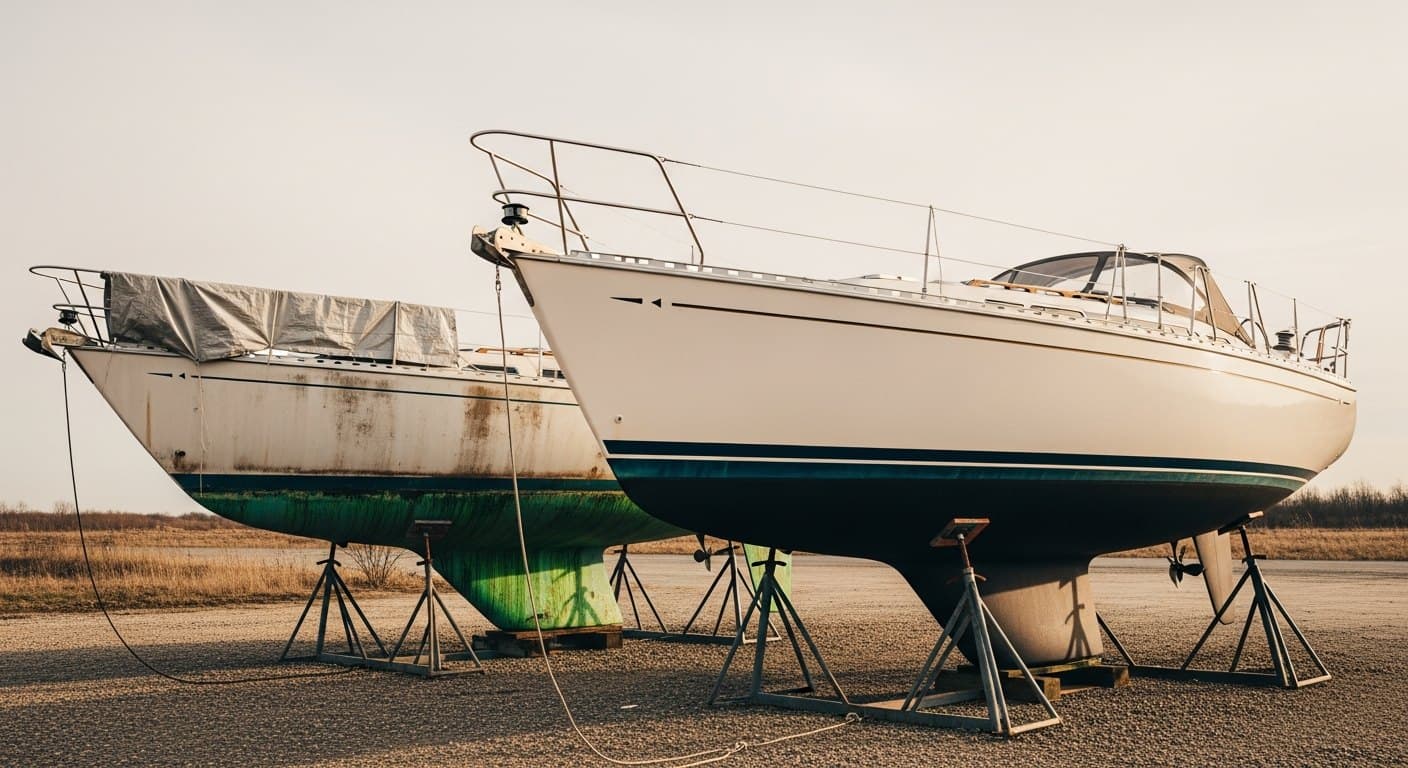
That matters, because the sell side has no reason to tell you the part that actually decides whether a boat is affordable. Two 36-footers of the same model and year, moored a hundred metres apart, can differ by $40,000 in what they will genuinely cost you. Almost none of that difference shows up in the asking price.
One has fifteen-year-old standing rigging, tired sails and an engine with a weeping seal. The other was refitted three seasons ago. Both are advertised as "well maintained".
This guide gives the real asking prices first, because that is what you asked for, and then the two numbers the listing sites leave out: the catch-up bill and the annual running cost. Every figure is a range with its assumption stated and a link to its source. Where this sits in the whole purchase is set out in buying a used sailboat, which puts the seven decisions in the order that saves money.
If you already have a boat in mind, you can skip the reading. Paste her listing URL and the free pre-check runs all of this against that specific boat.
How much does a sailboat cost?
Used sailboats span an enormous range. Budget boats run roughly $1,000 to $15,000, mid-range cruisers $15,000 to $100,000, and anything above $100,000 sits in luxury territory. Age and condition move a boat within those bands far more than length does.
Those bands come from GetMyBoat's 2024 price guide, and they are a fair map of the market's shape. They are also close to useless for buying a particular boat, which is the recurring problem with price guides written from the sell side.
New boats sit far above all of it. Broker Seattle Yachts put a 22-foot sailboat at close to $30,000 brand new against roughly $5,500 for the same boat built in the late 1970s, and a new 30-foot Hanse 315 at $100,000 to $150,000. The same pattern holds at every size: a boat two decades old asks a fraction of what her replacement costs new.
The pattern in every one of those pairs is identical. Depreciation does most of the pricing work in the first two decades, and after that condition takes over completely.
How much does a 30 foot sailboat cost?
A used 30-footer typically asks between $15,000 and $30,000, with the spread driven almost entirely by build year and refit history. A 25-footer sits roughly between $5,000 and $25,000, and a 40-footer between $70,000 and $200,000. New boats of the same length cost three to five times as much.
The clearest published example is one model at three build years. Seattle Yachts list a Catalina 30 at $15,000 for a 1977, $25,000 for a 1982 and $29,000 for a 1993. Same designer, same length, same accommodation, nearly double the price across sixteen model years.
| Length | Typical used asking price | Sourced examples |
|---|---|---|
| 22 ft | About $5,500 used; about $30,000 new | Late-1970s hull about $5,500; new about $30,000 |
| 25 ft | Roughly $5,000 to $25,000 | Interpolated between the 22 ft and 30 ft data points |
| 30 ft | $15,000 to $30,000 used | Catalina 30: $15,000 (1977), $25,000 (1982), $29,000 (1993) |
| 40 ft | $70,000 to $200,000 | J/105 at ten years about $70,000; Valiant 40 about $75,000; Beneteau Oceanis 41 (2015) about $178,000 |
| 45 ft | $200,000+ | Jeanneau 45 Sun Odyssey (2000) under $200,000 |
Source: asking prices as published by Seattle Yachts in February 2022, except the 25 ft row, which is interpolated between their 22 ft and 30 ft figures rather than sourced directly. Assumption: US brokerage asking prices, monohulls unless noted, before survey and before any work.
Treat those as a shape, not a quote. They are four years old, they are asking prices rather than sale prices, and the used market has moved since. What has not changed is the ordering, and the ordering is the useful part.
Asking prices by model, and the arithmetic that turns one into a buyer's number, are in the guide to what a used sailboat is worth.
All of this is the general case. If you want the arithmetic for one specific boat - that hull, that year, that asking price - paste its listing and the free pre-check does it.
Free on every boat, no card. You only pay to unlock a full report.
Why do two identical boats cost different amounts?
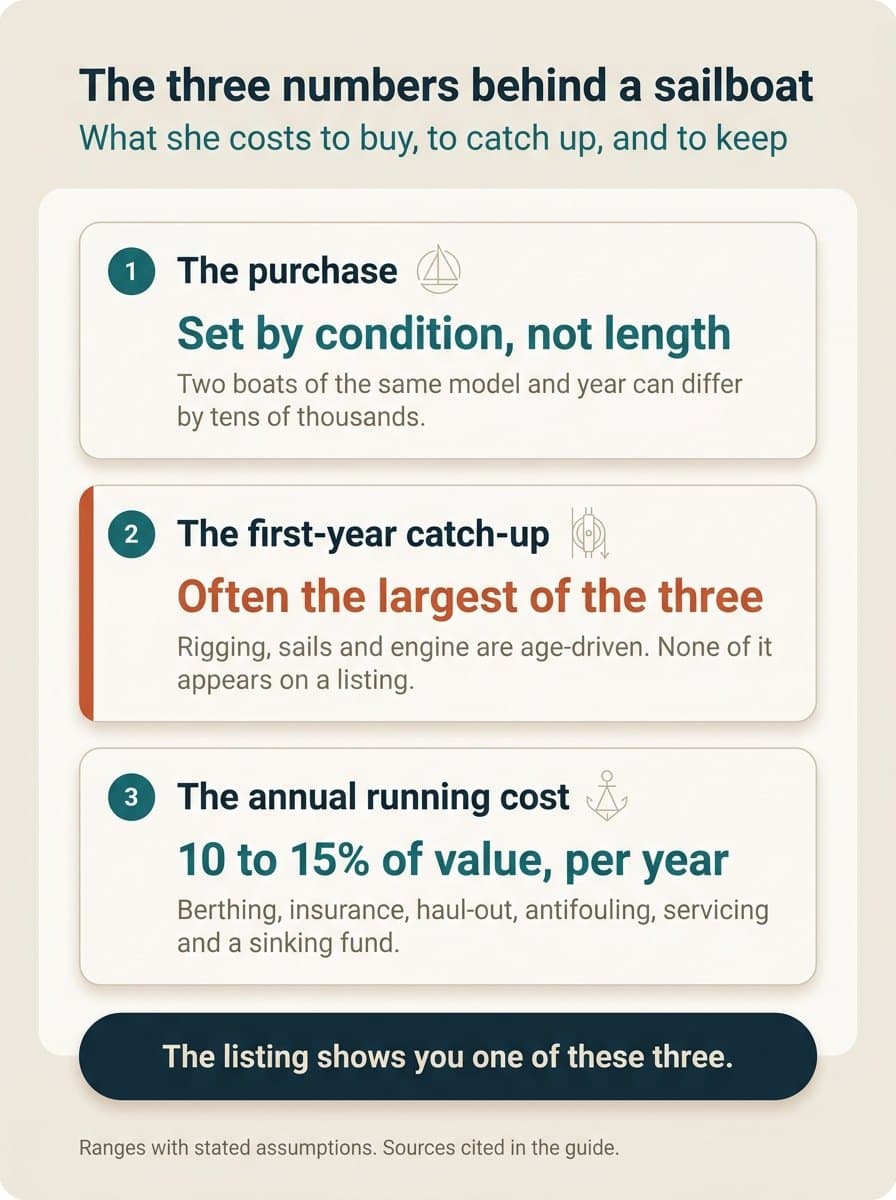
Because you are not really buying a hull, you are buying a maintenance position. Two boats of the same model and year differ by whatever the previous owners did or did not do to the rig, the sails, the engine and the hull below the waterline. That gap routinely runs to tens of thousands.
Look again at the Catalina 30 row. Sixteen model years produced a $14,000 spread on an identical design, and that is before you account for two boats of the same year in different condition.
A boat priced 30% under her sisterships is not a bargain. She is a boat carrying a deferred refit the seller has decided not to pay for. Sometimes that is a good trade, when the discount genuinely exceeds the work, and the only way to know is to price the work.
This is the arithmetic Knotworth exists to do. Paste a listing URL into the free pre-check and it reads that boat's own specification, computes her design numbers, and flags the systems the advertisement stays quiet about.
It is the difference between "30-footers go for about $25,000" and "this 30-footer is asking $25,000 and carries $18,000 of work you have not been told about". Only the second sentence helps you decide anything.
Before any of that is worth doing, settle whether the boat suits you at all. The design ratios guide covers whether she fits the sailing you actually plan, and a boat that fails on mission is not worth pricing.
What is the first-year catch-up bill?
The catch-up bill is everything the previous owner deferred, and on a boat of 15 to 25 years it is routinely the largest number in the purchase. Standing rigging, sails and the engine are the three that hurt. All three are driven by age rather than use, so a lightly sailed boat is not exempt.
This is the number no listing will ever show you.
Standing rigging has a working life of roughly ten years in the eyes of most insurers and riggers, and replacement on a 30-footer runs about $6,300 to $10,100 based on Sailboat Cruising's ownership breakdown.
Cruising sails last ten to fifteen years and cost around $5,000 to $7,600 or more per sail. A diesel replacement at twenty to twenty-five years runs $12,600 to $18,900 and up.
| System | Typical life | Replacement cost, parts and yard labour, 30-footer |
|---|---|---|
| Standing rigging | About 10 years | $6,300 to $10,100 |
| Running rigging | About 10 years | $1,900 to $3,800 |
| Cruising sails | 10 to 15 years | $5,000 to $7,600+ per sail |
| Engine | 20 to 25 years | $12,600 to $18,900+ |
| Batteries | 4 to 7 years | $630 to $2,500+ |
Source: Sailboat Cruising, which publishes these in pounds (£5,000 to £8,000 for rigging, and so on). Converted here at about 1.26 dollars to the pound. Assumption: a 30-foot monohull, professional yard labour, no structural work. US yard rates differ from British ones, so treat the ordering as firmer than the absolute figures.
Now hold that table against the price table above. The $15,000 Catalina 30 from 1977 is $14,000 cheaper than the 1993 boat, and is also far more likely to be carrying every line in the replacement table at once.
Rigging does not fail because it looks bad. It fails because it is old, which is why a clean survey report and a cheap boat are not the same thing.
Knotworth's paid report is this table applied to one specific boat. It parses what the listing claims, keeps "not mentioned" separate from "done", and returns a costed range per system with the assumption behind each one. You can see the output on a real boat in the sample report, and how each range is built on the methodology page.
What does it cost to buy a sailboat, beyond the price?
Budget $2,000 to $4,000 in transaction costs on a mid-size boat before any repairs and before sales tax, which can exceed that band on its own. The survey and its haul-out are the largest lines and the buyer pays both. Then add sales tax or VAT, registration, insurance binding, and delivery if the boat is not where you are.
None of these appear until the deal is real, which is why they surprise first-time buyers.
| Transaction cost | 35-foot sailboat |
|---|---|
| Pre-purchase survey at $25 to $35 per foot | $875 to $1,225 |
| Short haul for the survey | $280 to $500, minimums around $375 common |
| Engine survey | Quoted per engine, separately |
| Sales tax, VAT or import duty | Highly jurisdiction-dependent |
| Registration and documentation | $55 for a USCG title abstract, plus state fees |
| First-year insurance binding | 0.5% to 1.5% of insured value per year |
| Delivery or transport | Quoted per mile or per passage |
The survey lines are covered in full, with published rate cards from Discover Boating and working surveyors, in the sailboat survey cost guide. Read it before you commit to a boat, because the survey day is the first genuinely large cheque in the process and it is entirely possible to spend it on the wrong candidate.
Insurance runs 0.5% to 1.5% of the boat's value annually according to Sailboat Cruising, with cruising area, hull age and your own experience all moving the number.
What will she cost you to keep?
Budget 10 to 15% of the boat's value per year, covering berthing, insurance, haul-out, antifouling, servicing and a reserve for the big replacements. Older boats sit at the top of that band and newer ones below it. Berthing is the largest line and the most local, so it is the one worth getting a real quote for.
That is deliberately a rule of thumb rather than a line-by-line budget. Ongoing ownership cost is a different question from what a boat costs to buy, it depends far more on where you keep her than on which boat you choose, and a page of national averages would not survive contact with your own marina.
The two figures worth carrying into a purchase decision are these. Berthing runs roughly $10 to $35 per foot per month in mid-tier US markets and $50 to $100 in premium ones, and insurance runs 0.5 to 1.5% of insured value. Both are charged whether you sail or not.
Length drives nearly every one of those lines, which is worth knowing before you fall for a size you cannot afford to keep. The free design ratio calculators turn a listing's dimensions into the numbers that predict how she will actually behave, so you can weigh what a bigger boat costs against what she gains you.
Is owning a sailboat worth it?
Financially, no. A sailboat is a depreciating asset with a running cost of 10 to 15% of its value per year, and every honest source says so. The question worth asking is not whether it returns money but whether you will use it enough to justify the number, which is a use question rather than a price question.
The people who regret it are rarely the ones who paid too much. They are the ones who bought more boat than they sail, then paid the berth, the insurance and the annual haul on a boat that left the dock four times a year.
A smaller boat you sail every week is a better purchase than a bigger boat you visit. The per-foot lines in the table above are the reason, and they are charged whether you sail or not.
Which is why Knotworth's report ends in an explicit go or no-go rather than a number. The recommendation weighs the true cost against the sailing you said you plan to do, and a mismatch between the two produces a no-go even on a well-priced boat.
It is always advice, never a wall. Every no-go shows its reasons and an explicit option to proceed anyway, because it is your boat, your budget and your call. We would just rather you made it with the whole number in front of you.
How Knotworth prices a specific boat
Paste a listing URL and the free pre-check returns the boat's specs, design ratios and any knock-out flags at no cost. One payment per boat unlocks the full true-cost report, the seller questions and the negotiation case. There is no subscription, and an easy rejection is always free.
Everything above is a market average. Buying is a decision about one specific hull, and the loop below is how the general becomes the particular.
- Paste the listing URL. The pre-check reads the advertisement and the model's published design data, computes every ratio, and returns mission fit plus any knock-out. Free, always, because nobody should pay to be told a boat is obviously wrong.
- Unlock the full report. The parser separates what the listing claims from what it stays silent about, then prices each system as a range with its assumption. The result is the all-in number: asking price plus work plus taxes and fees.
- Ask the seller the right questions. The gaps become a generated set of questions aimed at exactly what you were not told: rigging age, engine hours, tank history, the things a listing omits on purpose.
- Recompute as answers arrive. Every answer you log updates the estimate. A real quote you paste always overrides our model, because your rigger's number beats ours.
- Get a final go or no-go, and a negotiation case. With the true cost settled, you have a documented argument for your offer rather than a feeling about it.
The whole loop is one payment per boat. Recomputes are unlimited, the seller round-trips are unlimited, and there is never a charge for the boats you reject.
What it is not: a survey, a valuation, or tax and legal advice. It cannot see inside a hull. It tells you which boat is worth paying a surveyor to look at, and the about page sets out who writes these numbers and where each one comes from.
What the cost pages in this cluster cover
This is the hub for the cost side of buying a used sailboat. Each page below goes deep on one line, with sources cited and every figure given as a range with its assumption.
- Sailboat survey cost: what a pre-purchase survey costs per foot in 2026, what the full survey day totals once the haul-out and yard fees are in, who pays for what, and what to settle before you book one. (live)
- Cost of owning a sailboat: the annual running budget line by line, including berthing, insurance, haul-out, antifouling, servicing and the sinking fund most owners forget. (planned)
- Living on a sailboat: what the liveaboard budget actually looks like, and the costs that change when the boat becomes the address. (planned)
- Standing rigging replacement cost: the single largest age-driven bill on most cruising boats, and how to read a rigging age off a listing. (planned)
- Sailboat insurance cost: what drives the premium, and why hull age and cruising area matter more than the value insured. (planned)
Paste a listing URL and the free pre-check reads the specs, runs the design ratios and flags the systems the ad stays quiet about. Unlock the full report and every flag becomes a costed range with its assumption stated.
FAQ
How much would a 30 ft sailboat cost?+
A used 30-footer generally asks between $15,000 and $30,000, with build year doing most of the work. Seattle Yachts published a Catalina 30 at $15,000 for a 1977, $25,000 for a 1982 and $29,000 for a 1993. A new 30-footer such as the Hanse 315 was $100,000 to $150,000.
How much does a 25 ft sailboat cost?+
Expect roughly $5,000 to $25,000 used, depending almost entirely on age and condition. For reference, a late-1970s 22-footer was published at about $5,500 and a five-year-old J/22 at $9,000, while a 1990s 30-footer reached $29,000. A 25-footer sits between those points.
How much does a 40 foot sailboat cost?+
Typically $70,000 to $200,000 used. A ten-year-old J/105 was published at about $70,000 and an older Valiant 40 at about $75,000, while a 2015 Beneteau Oceanis 41 asked about $178,000. New 40-footers run several times those figures.
Is sailing a cheap hobby?+
Not once you own the boat. Chartering or club sailing is genuinely inexpensive because you pay only for time on the water. Ownership adds berthing, insurance, haul-out and a sinking fund that together run 10 to 15% of the boat's value every year, whether you sail or not.
Is a sailboat cheaper than a boat?+
Cheaper to run than a comparable powerboat, generally, because fuel is a minor line rather than the dominant one. Sails and rigging offset some of that, and a cruising sailboat carries more systems per foot than a powerboat of the same length, so the gap is smaller than new sailors expect.
Is owning a sailboat worth it?+
Never as an investment. It is worth it when you use it enough to justify 10 to 15% of its value per year, which usually means buying a smaller boat you sail weekly rather than a larger one you visit. The regret almost always comes from size, not from price.
Can you live on a 40 foot sailboat?+
Comfortably, for one or two people, and it is one of the most common liveaboard sizes. The constraints are rarely space. They are marina liveaboard permissions, which many harbours limit or ban outright, plus tankage, power, and the fact that every maintenance job now happens where you live.