Catalina 36 buyer's guide: what she is, what she costs, what breaks
By Itzhak Fuhrman·Built and maintains Knotworth's cost model·Updated 12 October 2026
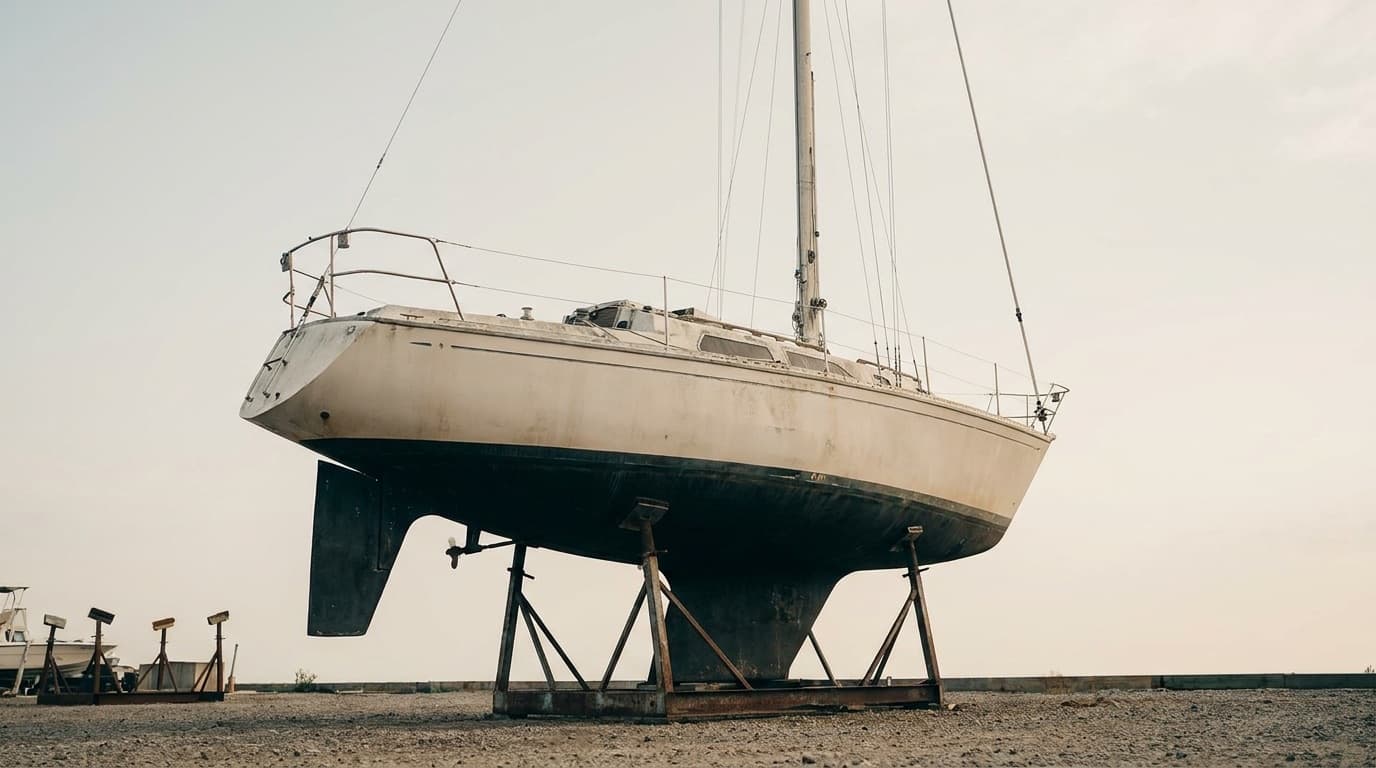
Catalina 36 specifications
| Specification | Figure |
|---|---|
| Length overall | 36 ft 4 in |
| Waterline length | 30 ft 3 in |
| Beam | 11 ft 11 in |
| Draft | 5 ft 10 in fin keel; shoal and wing keels were offered |
| Displacement | 13,500 lb |
| Ballast | 6,000 lb lead, 44% |
| Sail area | 545 sq ft |
| Rig | Masthead sloop · I 44.75 ft |
| Hull | Fin keel, spade rudder, solid fibreglass hull, cored deck |
| Tanks | Water 72 gal · Fuel 25 gal |
| Auxiliary | Universal diesel (see the engine section below) |
| Built | 1982 to 2006, original series 1,766 hulls per sailboatdata, MkII from 1995 |
| Designer | Frank Butler |
Source: sailboatdata, original-series record. MkII figures differ slightly.
Practical Sailor surveyed more than sixty Catalina 36 owners and the verdict came back consistent: structurally sound, seaworthy, fast enough. Owners like these boats.
That is a genuinely good review, and it is also why the 36 needs a buyer's guide more than the smaller Catalinas do. This is a $50,000 decision on a boat everyone agrees is fine.
The money is not in whether the model is good. It is in which of the 2,305 you buy, and there is one option on this boat that quietly costs people two thousand dollars and more in the first shallow harbour they meet.
Is the Catalina 36 a good boat?
Yes, and by a wider margin than her smaller sisters. She is quick for a cruising boat, she has real accommodation, and the owner surveys come back positive. The compromises are in fittings and finish rather than in structure.
Practical Sailor recorded 7.1 knots to windward under a double reef and 8 to 8.5 knots on a broad reach in 15 to 30 knots on Puget Sound. That is a boat that sails, not a floating apartment.
The Catalina 36/375 International Association is active and technical, which matters more than it sounds. Four decades of owners have documented the failures, and the association forum is where they are discussed honestly.
The reservations are consistent and small-scale. Chainplates leak, and so do the ports.
The joinery is "only average" and cabinet corners do not always fit squarely. The engine's port side is a "difficult chore" to reach.
Practical Sailor's summary is that buyers wanting a moderately priced production boat "should definitely check out this retooled version." Built to a price, and used honestly.
What are the common problems with the Catalina 36?
One is specific to the shoal-draft boat and expensive: the rudder hangs almost as deep as the wing keel, so the keel does not protect it. The rest are chainplates, ports and deck core, which is the standard list for a production boat of this age.
This is the section the listing will not write for you.
| Known issue | What it means, and what it costs |
|---|---|
| Shoal-draft rudder depth | On the wing keel boat the rudder sits within about two inches of keel depth. One owner: "my rudder is only 2 inches shorter than my wing keel." Association members record rudders destroyed backing in shallow water. A Foss Foam replacement was quoted at $2,080 plus $175 crating and $150 shipping in 2016, before haul-out and fitting |
| Chainplates leaking | The single most common owner complaint in the Practical Sailor survey, needing "annual inspection or rebedding". Lower shroud loads run through tie rods into reinforced hull areas, so a wet chainplate is a load-path question, not just a drip |
| Rudder support damage from grounding | Reported by association members on later open-transom boats, where the rudder bearings sit closer together than on the early closed-transom hulls. A moderate grounding is enough |
| Ports and windows leaking | Windows overlap the fibreglass by only 1.5 inches. Earlier boats had them screwed to the exterior cabin sides. Newer boats leak less, but this is still where water gets in |
| Deck core | Earlier boats are plywood cored, later ones balsa. Plywood is the more water-prone of the two, so the build year changes the risk |
| Hull to deck joint leaks | A recurring owner complaint across the fleet and across Catalina generally |
| Blistering | Reported on older hulls in warmer climates. A barrier coat is a haul-out-scale job |
| Standing rigging and stays | Corroded or badly tensioned stays are a route to a lost mast that owners and surveyors document on older Catalinas. Ten-year working life, and the listing rarely says |
| Cockpit non-skid | Practical Sailor: "wet, slick cockpit seats make tending sail controls difficult when heeled more than 10°" |
| Short stanchions | 24 inches, about five inches lower than preferred on an oceangoing boat. Worth knowing before you plan anything ambitious |
| Genoa inboard track | Judged "at least 1' too short for sailing hard on the breeze with a double reef" |
| Engine access | Companionway steps and aft stateroom panels come out, and the port side stays awkward. Maintenance that is unpleasant tends to get skipped |
Sources: Practical Sailor's Catalina 36 Mk II review, based on responses from more than sixty owners, and the Catalina 36/375 International Association technical forum for the rudder depth issue. Rudder pricing is a 2016 quote, quoted as 2016 money.
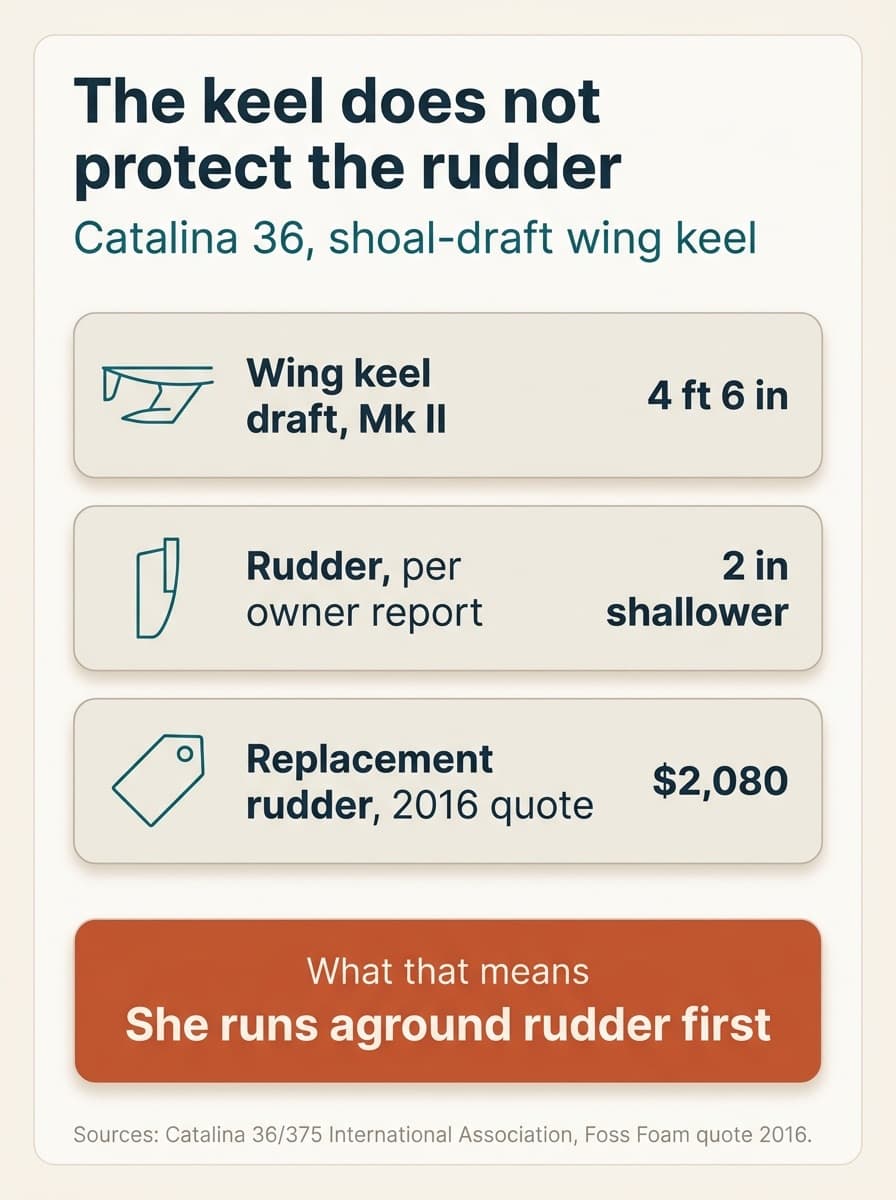
The first row deserves a second look, because it is a design consequence rather than a wear item.
On most fin-keel boats the keel is the deepest thing on the hull, so it takes the ground first and the rudder survives. Give the same hull a shoal wing keel and you have raised the keel without raising the rudder.
The result is a boat that runs aground rudder-first. Owners on the association forum discuss having "the bottom 10 inches or so of rudder cut off and glassed over" as a fix, and others counter that it would change how well she sails.
That is an unresolved trade, not a solved problem, and it belongs in your offer.
Got a Catalina 36 listing open right now? Paste it. The free pre-check reads that specific boat’s year and equipment list and flags which of these the ad has quietly said nothing about.
Free on every boat, no card. You only pay to unlock a full report.
How much does a Catalina 36 cost?
Between $18,000 and $99,000. YachtWorld currently lists 28 boats from $18,000 to $97,500 and Boat Trader 68 boats from $17,918 to $99,140, with a Mk II at $75,000. That is a five-fold spread on one design.
| Source | Boats listed | Asking price range |
|---|---|---|
| YachtWorld | 28 | $18,000 to $97,500 |
| Boat Trader | 68 | $17,918 to $99,140 |
August 2026. Ninety-six boats on the market at once, which is the practical argument for patience. You are never looking at the last one.
The Mk I and Mk II split explains much of that range, and refit history explains most of the rest. A 1985 boat and a 2003 boat are the same hull with twenty years of gear between them.
At these numbers the arithmetic changes from the smaller Catalinas. A survey on a 36-footer, a flight, a hotel and a haul-out is a real four-figure commitment before you have made an offer, and you will make that commitment on the strength of a listing.
Which is exactly the decision the free pre-check exists to inform, and the true-cost guide sets out how to price the catch-up bill that follows.
How fast is a Catalina 36, and is she safe offshore?
She rates PHRF 140 to 150 and hull speed is 7.4 knots, which makes her the quickest boat in this range by a distance. Her capsize screening value is 1.93 in fin-keel trim, below the offshore threshold. She is a strong coastal boat and a marginal offshore one, and the reasons are on deck rather than in the hull.
| Ratio | Fin keel | Wing keel | Reading |
|---|---|---|---|
| Capsize screening | 1.93 | 1.97 | Both below the 2.0 threshold |
| Comfort ratio | 26.6 | 25.0 | Moderate. The most seakindly boat in the range |
| Displacement / length | 242 | 227 | Moderate |
| Sail area / displacement | 14.6 | 15.2 | Under-canvassed on paper, quick in practice |
| Ballast / displacement | 40% | 43% | Stiff |
| Hull speed | 7.4 knots | 7.4 knots | how it is calculated |
Computed from displacement 15,000 lb fin and 14,100 lb wing, ballast 6,000 lb, waterline 30.25 ft, beam 11.92 ft and sail area 554.63 sq ft as published. The design ratios guide explains each screen and the free calculators will run them for a specific boat.
Compare the range. The Catalina 22 screens at 2.26, the Catalina 30 at 2.0, the Catalina 27 at 1.86 and the 36 at 1.93. On hull form alone the 27 and the 36 are the two that pass.
The 36 is the one that can carry the stores, the tankage and the crew to make that theoretical number mean something, which is why she is the Catalina people actually take offshore.
Then read the deck. Stanchions five inches short of the oceangoing standard, cockpit seats that go slick past ten degrees of heel, chainplates that want annual attention, and ports that overlap the fibreglass by an inch and a half.
None of that is disqualifying and all of it is a project. She is an excellent coastal boat that can be prepared for more, which is a different sentence from "she is an offshore boat".
Which Catalina 36 should you buy?
The Mk II from 1994 if the budget reaches, the deep fin keel almost regardless, and a later hull for the balsa deck core. The hull shape never changed across twenty-three years, so you are choosing the deck, the interior and the keel.
Mk I, 1982 to 1994. 1,766 hulls, the bulk of the affordable fleet. Plywood deck core. Early boats have the closed transom, which puts the rudder bearings further apart and is, in association forum discussion, the more robust arrangement.
Mk II, 1994 to 2005. 539 hulls. Larger cockpit, different cabin ports, a walk-through transom, new deck and interior, and a Universal 35 hp diesel. Newer boats have the semi-elliptical rudder and balsa core.
Keels. Fin at 5'3" on the Mk I and 5'10" on the Mk II. Wing at 4'2" and 4'6". The wing costs you pointing ability, and on this hull it also removes the keel's protection of the rudder. If your water is deep enough for the fin, take the fin.
Rigs. Masthead sloop, with an optional tall rig about two feet higher. Worth having in light air, as always on this range.
The 34 is not a smaller 36 with less room, incidentally. It is a different, lighter design, and the 36 carries noticeably more boat for the money if you can berth her.
What to check before you buy one
Measure the rudder against the keel if she is a wing-keel boat, get behind every chainplate, and moisture-meter the deck knowing whether it is plywood or balsa. Then find out whether she has ever been hard aground.
The survey on a 36-footer is a serious line item, which the survey cost guide breaks down properly. At this price point the survey is not the expensive part of the trip. Getting there is.
Ask, before you travel:
- Which keel is fitted, and how deep does the rudder sit relative to it?
- Has she ever been grounded, and was the rudder or its bearings checked afterwards?
- Is the deck core plywood or balsa, and where are the soft spots?
- When were the chainplates last rebedded, and are the tie rods sound?
- Do the ports leak, and have they been rebedded or replaced?
- When was the standing rigging last replaced?
- Mk I or Mk II, and closed or walk-through transom?
- What does the engine's port side look like, and who was the last person to see it?
None of those is answered in a typical listing. All of them change the number you should offer. They are the model-specific lines in the full inspection checklist, which covers what to settle before you travel and what to check aboard.
How Knotworth reads a specific Catalina 36
This page describes the model. The product reads the boat. Paste a listing URL and the free pre-check pulls that hull's specification, runs her design numbers, and flags which of the known issues above the advertisement is quiet about.
The 36 is where this matters most in the Catalina range, because it is the boat people buy from photographs and a phone call. There is a well-read thread on r/sailing titled "Remind me that buying a 1986 Catalina 36 sight unseen in..." and it has over two hundred comments for a reason.
A 1988 boat advertised as "shoal draft, great for the Chesapeake, well maintained" has told you the one thing that makes her rudder vulnerable and dressed it as a feature. It has not told you whether she has been aground, what the chainplates look like, or whether the deck is dry.
Those omissions become the questions, the questions become answers, and the answers become a number you can negotiate on. Or a decision not to book the flight.
Paste the URL. The free pre-check reads that boat's specs, runs her design numbers, and flags what the ad leaves out about the keel, the rudder and the deck. No card until you unlock a full report.
FAQ
Is the Catalina 36 a good boat?+
Yes. Practical Sailor surveyed more than sixty owners and found the boats structurally sound, seaworthy and fast enough, recording 8 to 8.5 knots on a broad reach. The complaints are about fittings and finish rather than structure: leaking chainplates, leaking ports and average joinery.
What are the common problems with the Catalina 36?+
Leaking chainplates that need annual attention, leaking ports, deck core saturation on the plywood-cored earlier boats, and hull to deck joint leaks. On the shoal-draft wing keel version the rudder sits within about two inches of the keel depth, and owners have destroyed rudders backing in shallow water.
How fast is a Catalina 36?+
She rates PHRF 140 to 150 with a hull speed of 7.4 knots. Practical Sailor recorded 7.1 knots to windward under a double reef and 8 to 8.5 knots on a broad reach in 15 to 30 knots of wind.
How much does a Catalina 36 cost?+
Used boats ask roughly $18,000 to $99,000. YachtWorld currently lists 28 from $18,000 to $97,500 and Boat Trader 68 from $17,918 to $99,140, with the Mk I and Mk II split and refit history explaining most of the spread.
What is the difference between the Catalina 34 and the Catalina 36?+
They are separate designs rather than two sizes of one boat. The 36 is heavier and carries substantially more accommodation and tankage, which is why she is the one people take further afield, and she costs more to berth accordingly.
What is the difference between the Catalina 36 Mk I and Mk II?+
The Mk II arrived in 1994 with a larger cockpit, different cabin ports, a walk-through transom and a new deck and interior. The hull shape is unchanged. Practical, buyer-relevant differences are the balsa deck core instead of plywood, the semi-elliptical rudder and the Universal 35 hp diesel.
Is a Catalina 36 a bluewater boat?+
Her capsize screening value of 1.93 sits below the 2.0 offshore threshold and she has the size to carry stores and crew, so she is the Catalina most often taken offshore. The deck fittings tell a coastal story though, with 24-inch stanchions, chainplates needing annual attention and slick cockpit seats, so treat offshore as a refit project rather than a starting condition.