Catalina 30 buyer's guide: what she is, what she costs, what breaks
By Itzhak Fuhrman·Built and maintains Knotworth's cost model·Updated 12 October 2026
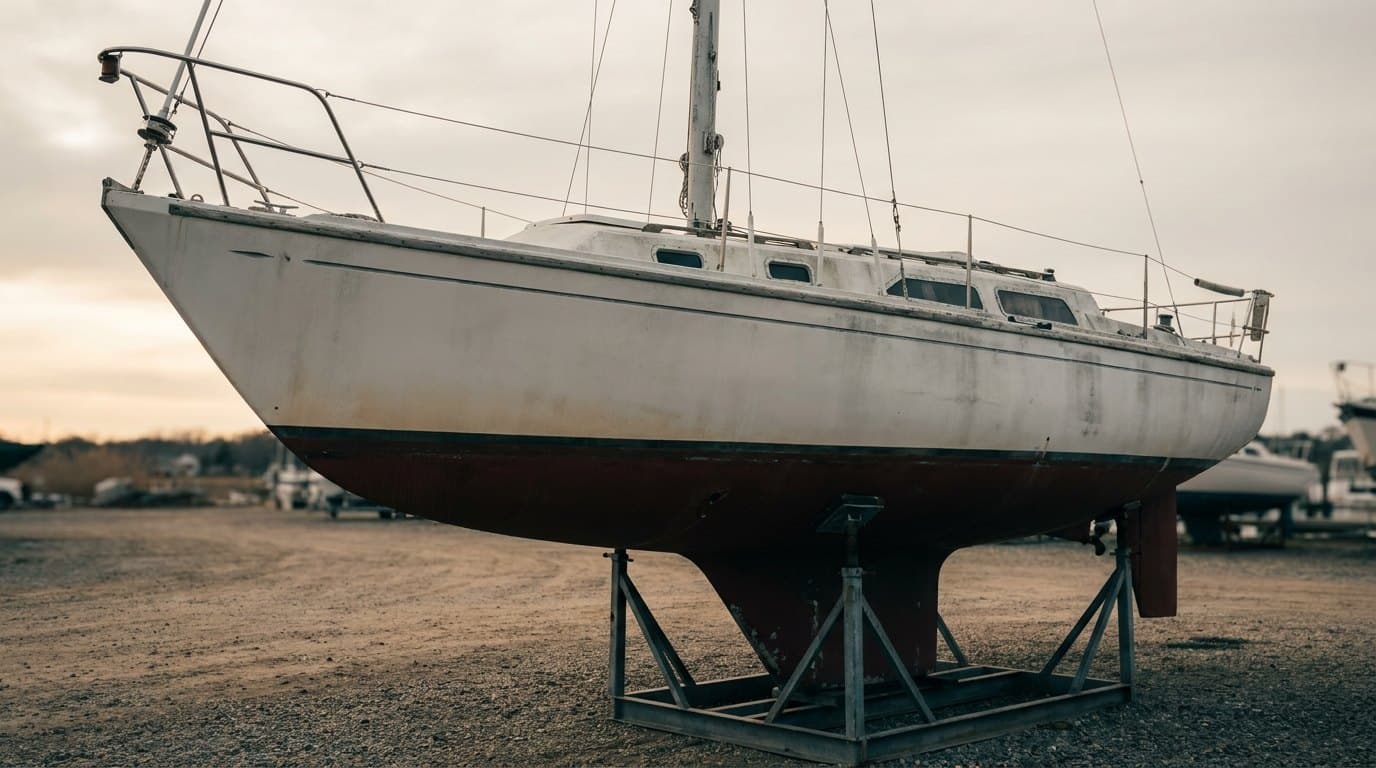
Catalina 30 specifications
| Specification | Figure |
|---|---|
| Length overall | 29 ft 11 in |
| Waterline length | 25 ft 0 in |
| Beam | 10 ft 10 in |
| Draft | 5 ft 3 in fin keel · about 3 ft 10 in shoal keel |
| Displacement | 10,200 lb |
| Ballast | 4,200 lb lead, 41% |
| Sail area | 446 sq ft standard rig; the tall rig adds about 10% |
| Rig | Masthead sloop · I 41.0 ft standard |
| Hull | Fin keel, spade rudder, solid fibreglass hull, cored deck |
| Tanks | Water 43 gal · Fuel 21 gal |
| Auxiliary | Atomic 4 petrol on early hulls, Universal diesels later (see the engine section below) |
| Built | 1976 to 2008, about 6,430 hulls across the original, MkII (1986) and MkIII (1994) series |
| Designer | Frank Butler |
Source: sailboatdata; shoal draft from the worked example listing below.
There are more Catalina 30s on the water than any other 30-footer ever built, which means two things for you as a buyer. There is always another one for sale, so you never have to fall in love with a bad example. And forty years of owners have documented exactly what goes wrong with them.
This guide is the second part. What the design does well, what it does badly, what commonly fails, and what each of those failures costs to put right.
Every figure is a range with its assumption stated. Where a number comes from a published source it is linked, and where the honest answer is "get a quote", the page says so.
Is the Catalina 30 a good boat?
Yes, for coastal cruising, club racing and weekending, which is what she was designed for. She is unusually stiff for her size, she has more interior volume than almost any rival of her era, and parts are trivially easy to find. She is a poor choice for offshore passages.
Frank Butler's design brief was volume and value, and the boat delivers both. A ballast to displacement ratio of 0.42 is high, which is why she stands up to her sail plan and feels solid to a nervous new owner. SpinSheet's used boat review calls her a "very stiff boat under sail".
The tradeoff is speed. Her sail area to displacement ratio is 15.1 in standard rig, which is under-canvassed by modern standards and sluggish in light air. SpinSheet judges her "likely a bit slower" than a Pearson 30 or Ericson 30 of the same era.
The optional tall rig adds 60 square feet and lifts SA/D to 17.1. It is worth seeking out if you sail anywhere light.
She also develops noticeable weather helm as she heels, which Practical Sailor describes as "a not uncommon trait of wide boats such as the Catalina 30". It is a nuisance rather than a fault, and it is manageable with rig tune and reefing early.
What are the common problems with the Catalina 30?
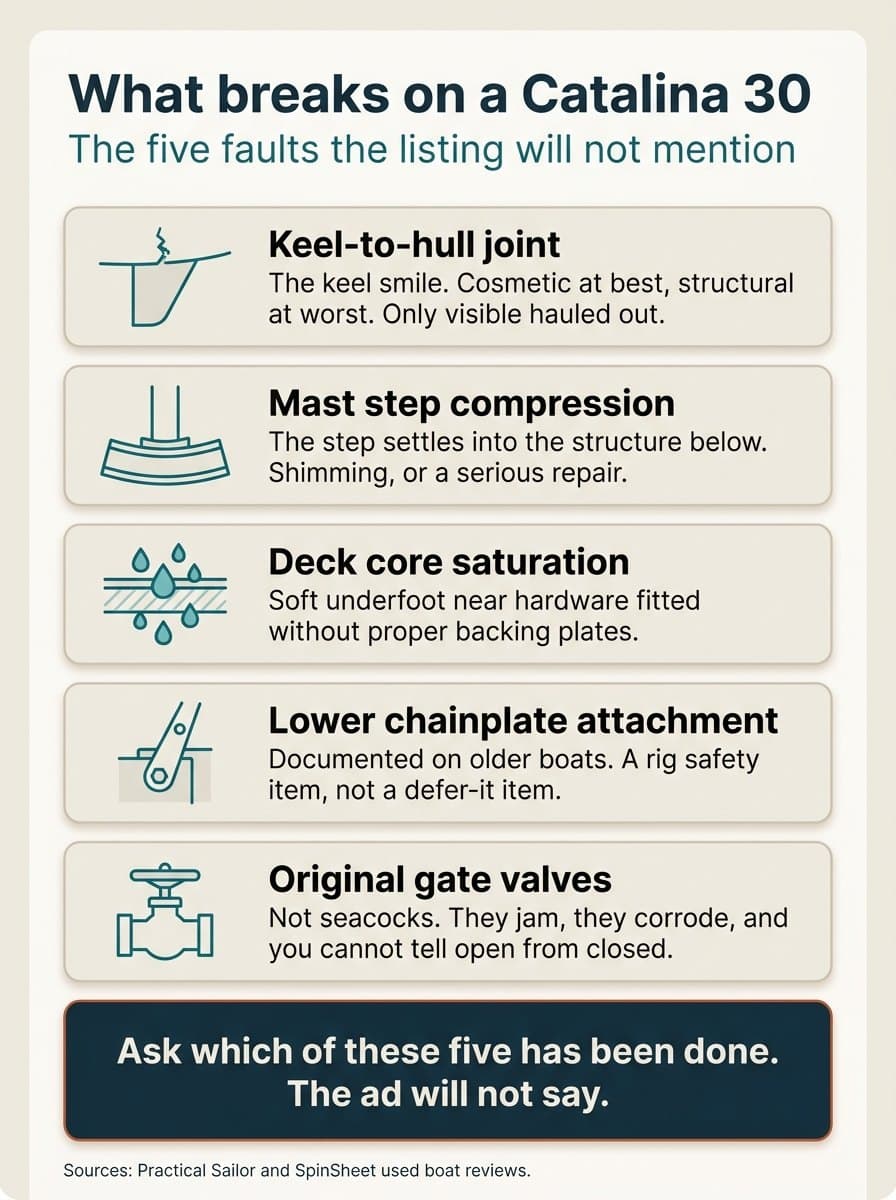
Five recur across the fleet: keel-to-hull joint leaks, mast step compression, deck core saturation, lower chainplate attachment failure on older boats, and original gate valves instead of proper seacocks. None is unusual for a boat of this age. All of them are expensive if you inherit them unknowingly.
This is the section the listing will not write for you.
| Known issue | What it means, and what it costs |
|---|---|
| Keel-to-hull joint leaks and separation | The "keel smile". Cosmetic at best, keel-bolt and structural work at worst. Get it looked at hauled out. Yard quote territory |
| Mast step compression fatigue | The step compresses into the structure below. Ranges from shimming to a significant structural repair |
| Deck core saturation | Soft spots underfoot around deck hardware. Localised repairs are affordable; a full recore is a project that can exceed the boat's value |
| Lower chainplate attachment failure | Documented on older boats. A rig safety item, not a defer-it item |
| Original gate valves | Not seacocks. Prone to jamming and corrosion, and you cannot tell open from closed. Replacement is routine and should be assumed on unmodified boats |
| Original rudder | Redesigned by the builder because the original made her "a bear to handle" under power. Many boats were retrofitted. Ask which one is fitted |
| Wooden spreaders | Fail with age. Practical Sailor recommends aluminium airfoil replacements |
| Small-diameter shrouds | Stretch, making headstay tension hard to hold. Beef-up kits existed for the lower shrouds |
| Closed-body turnbuckles | Seize. Replace with open-body |
| Deck hardware without backing plates | Fitted with large washers rather than proper backup plates. Aluminium backing plates recommended for stanchions, pulpits and cleats |
Sources: Practical Sailor and SpinSheet. Assumption: a boat that has not already had the work done, which on an unmodified older hull is the safe assumption until the seller says otherwise.
Read that list against the age of the boat you are looking at. Standing rigging has a working life of roughly ten years, so on a hull from the 1980s or 1990s the question is not whether the rig has been replaced but how many times, and the listing almost never says.
The true-cost guide prices the age-driven replacements that apply to any boat of this vintage. What makes the Catalina 30 easier than most is that parts are unusually easy to source, even now that the builder has stopped trading.
Got a Catalina 30 listing open right now? Paste it. The free pre-check reads that specific boat’s year and equipment list and flags which of these the ad has quietly said nothing about.
Free on every boat, no card. You only pay to unlock a full report.
What is the average price of a Catalina 30?
Between $15,000 and $30,000 for most used examples, driven almost entirely by build year. Broker Seattle Yachts published a 1977 at $15,000, a 1982 at $25,000 and a 1993 at $29,000. Sixteen model years, nearly double the price, identical design.
| Build year | Published asking price |
|---|---|
| 1977 | $15,000 |
| 1982 | $25,000 |
| 1993 | $29,000 |
Source: Seattle Yachts, February 2022. Asking prices, not sale prices, and four years old. Treat the ordering as firmer than the figures.
That spread is the whole argument of this site in one row. Same designer, same length, same accommodation, and the price difference is age and condition. A boat at the bottom of the range is not a bargain by definition; she is a boat carrying more of the list above.
Which is why the asking price is the least useful number in a listing. What matters is the asking price plus the work she needs, and the second half is what the free pre-check exists to estimate.
Is a Catalina 30 a bluewater boat?
No. Her capsize screening value works out at almost exactly 2.0, right on the conventional offshore threshold rather than comfortably below it, and she was designed and built for coastal work. People have made long passages in them, which is not the same as the boat being suited to it.
Running her published numbers through the standard screens:
| Ratio | Value | Reading |
|---|---|---|
| Capsize screening | 2.0 | On the threshold, not below it |
| Ballast / displacement | 0.42 | Stiff, and genuinely good |
| SA/D, standard rig | 15.1 | Under-canvassed |
| SA/D, tall rig | 17.1 | Moderate |
| Hull speed | 6.7 knots | how it is calculated |
Computed from displacement 10,200 lb and beam 10'10" as published by SpinSheet, and a 25-foot waterline for the hull speed. The design ratios guide explains what each screen does and does not tell you, and the free calculators will run the full set once you have the waterline length for the specific boat.
The honest framing: the hull is stiff and the fleet is huge, but the deck hardware backing, the gate valves, the chainplate history and the companionway drop-board retainers are all coastal-grade details. Practical Sailor specifically recommends widening the drop-board retainers "to secure boards during knockdowns", which tells you what the original standard assumed.
Can she cross an ocean? Boats of this type have, which is a statement about the crews more than the hulls.
Would a surveyor and an insurer be relaxed about it? Not without a refit costing more than the boat is worth.
Which Catalina 30 should you buy?
Later is better, tall rig is better if you sail in light air, and the engine matters more than anything else on the options list. The Mk III from 1994 brought a wider aft hull, a transom boarding platform and hull-side ports. Before that the design ran virtually unchanged for twenty years.
Keels. Standard draft 5'3". A shoal-draft fin at 4'4" arrived in 1977, and a winged keel at 3'10" in 1988. Shoal versions give up windward performance; the wing keel is also harder to get off if you ground her.
Rigs. Standard masthead sloop, or the tall rig with 60 more square feet. In light-air sailing areas the tall rig is the one to hold out for.
Engines, and this is the big one. Five were fitted over the production run: the Atomic Four petrol engine, the Universal 5411, the Yanmar YSB12, the Universal Model 18 and the Universal Model 25. Practical Sailor is blunt that the Yanmar YSB12 and Universal 5411 are underpowered, with the Model 18 only slightly better, and identifies the Atomic Four and the Universal Model 25 as the desirable options.
That matters commercially. A repower is a five-figure job on a boat worth $20,000, so an underpowered original engine is not a detail, it is a large part of the true price. The engine sits midship under the dinette seat, which makes access better than most but the compartment was designed around the Atomic Four, and owners report the diesels are a tight fit.
What to check before you buy one
Get her hauled. The keel joint, the deck core and the rudder are the three things you cannot assess in the water, and they are three of the five expensive failures. Then ask the seller the questions the listing left out, because on a boat this old the silences cost more than the claims.
The survey day runs roughly $1,300 to $1,900 on the 35-footer the survey guide prices, a little less on a 30-footer, once the short haul and yard fees are in, which the survey cost guide breaks down line by line. That is real money, and it should be spent on a boat that has already survived the questions.
Ask, before you travel:
- When was the standing rigging last replaced, and by whom?
- Which engine is fitted, and what are the hours?
- Has the rudder been changed to the redesigned one?
- Are the through-hulls still the original gate valves?
- Has the keel joint ever been opened up, and is there a yard invoice?
- Any soft spots in the deck, particularly around stanchions and the mast step?
None of those questions is answered in a typical listing. All of them change the number you should offer. They are the model-specific lines in the full inspection checklist, which covers what to settle before you travel and what to check aboard.
Worked example: a real Catalina 30 listing through the pre-check
A 1988 Catalina 30 MkII, tall rig, asking $24,595, Universal M-25XPB with 1,514 hours, the seller's headline being an annually maintained engine and a transmission in excellent shape. Free verdict: worth a closer look, nothing ruling her out for the profile. Paid report: about twice the sticker, all-in. The question that matters most is the age of the standing rigging, because on this boat it is a third of the asking price.
What the listing says. Model year 1988, four berths, diesel, fibreglass. The engine is the story the seller wants to tell: annually maintained, transmission excellent. Sails are mentioned. Standing rigging, running rigging and the bottom are not.
What the pre-check pulled out of it, free. Specification from the listing (waterline 25 ft, beam 10.83 ft, draft 3.83 ft, displacement 10,200 lb, ballast 4,200 lb) matched to the Catalina 30 MkII reference record, with sail area 505 sq ft taken from the reference. Two data disagreements were shown rather than merged. The listing's length field had come through as 2.92 ft against the reference 29.92, and the draft of 3.83 ft against a reference 5.25 ft, which the tool read as likely a different keel, shoal against deep. Both flags are correct and both are worth having: the first is a dirty listing field, the second tells you which keel you are looking at.
Design numbers: sail area to displacement 14.9, labelled under-powered, which is the honest reading of a Catalina 30 in light air even with the tall rig; ballast ratio 41%; displacement to length 291; comfort ratio 25; capsize screening 2.00, which it called offshore-favorable; hull speed 6.7 knots. Reading: mainstream production cruiser, the sweet spot for coastal work, easy to sail and easy to sell on.
For a 38-year-old boat it flagged four systems likely due:
- Standing rigging, 26 years past the 12-year interval, listing silent.
- Sails, 28 years past the 10-year interval, mentioned but undated.
- Running rigging, 31 years past the 7-year interval, listing silent.
- Barrier coat, 26 years past the 12-year interval, listing silent.
Engine: moderate hours. 1,514 is low-to-moderate for a diesel of this age, and the tool asked for the service records rather than taking the seller's word.
What remains unknown. Whether the rig has ever been replaced. Which keel she has and whether the keel joint shows the Catalina smile. Deck core moisture around the chainplates and the mast step. Whether the fuel tank is original. The listing is silent on all of it, which on a 1988 boat means nothing either way.
Which question matters most. When was the standing rigging last replaced. Not because it is the most dangerous unknown, but because of proportion. From the true-cost guide, a re-rig runs $6,300 to $10,100. On a $24,595 boat that is a quarter to a third of the price. If it was done ten years ago with an invoice, the boat is cheap. If nobody knows, the boat is not $24,595, she is $24,595 plus a rig.
How the answer changes the assessment. With a dated rig invoice: sails at $5,000 to $7,600 each, running rigging at $1,900 to $3,800, a survey at $25 to $35 a foot plus a short haul, and you are looking at roughly $10,000 to $17,000 on top of the asking price for a sound coastal boat with a good engine. Without one, add the rig and the number roughly doubles, which is the whole argument of the price section above: two 1988 Catalina 30s can differ by the cost of the boat.
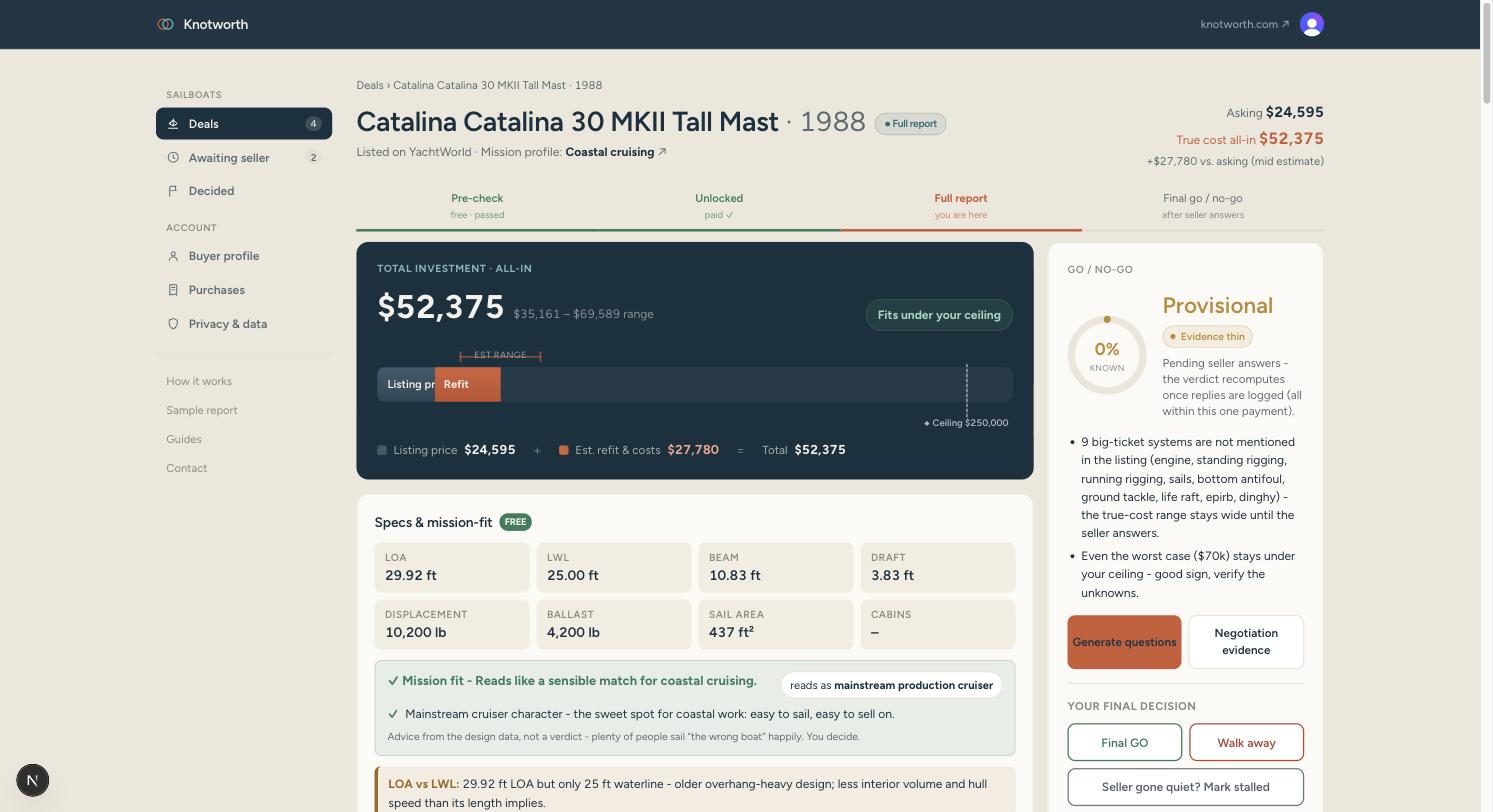
What the $39 unlock added. The full report priced her at $52,375 all-in, range $35,161 to $69,589, against $24,595 asking. In other words the boat costs about twice the sticker, and the report shows exactly where: bottom paint assumed due at purchase ($960 to $2,160, the only line it called due now), an engine reserve of up to $14,400 until service records prove the seller's claim, standing rigging to $7,200, sails to $5,500, running rigging to $3,000, ground tackle to $2,000, Florida sales tax $1,476, registration and documentation about $975, a survey and haul-out sized to 30 feet ($1,047 and $494 at the top), first-year insurance under $400, and a 25% contingency of $6,149 for what the survey finds on a 38-year-old hull. Its verdict was provisional: nothing rules her out, even the worst case sits far under the ceiling, and nine big-ticket systems are simply not mentioned, so the range stays wide until the seller answers.
The condition read is where the seller's headline met the tool. "Annually maintained engine" and "transmission in excellent shape" were logged as mentioned but undated, claims rather than facts, and left in the engine reserve until an invoice appears. The Doyle stack pack was filed under canvas, not sails. The model-specific faults came with sources and seller questions attached: the wooden compression post and deck sag around the mast step (more common on hulls before the MkII, which moved to a metal support in 1986), rudder moisture and stock corrosion, the plywood spacer in the keel-to-hull joint, and leaking windows above a cored deck. Those four are the ones this page lists too, which is reassuring in both directions.
The seller message asked seven questions ranked by money at stake: engine hours and records, whether the rig is the original 1988 wire, the age of main and genoa, halyards and sheets, whether the compression post and mast step have been inspected for rot, the maintenance log, and any prior survey. Eight more were held back.
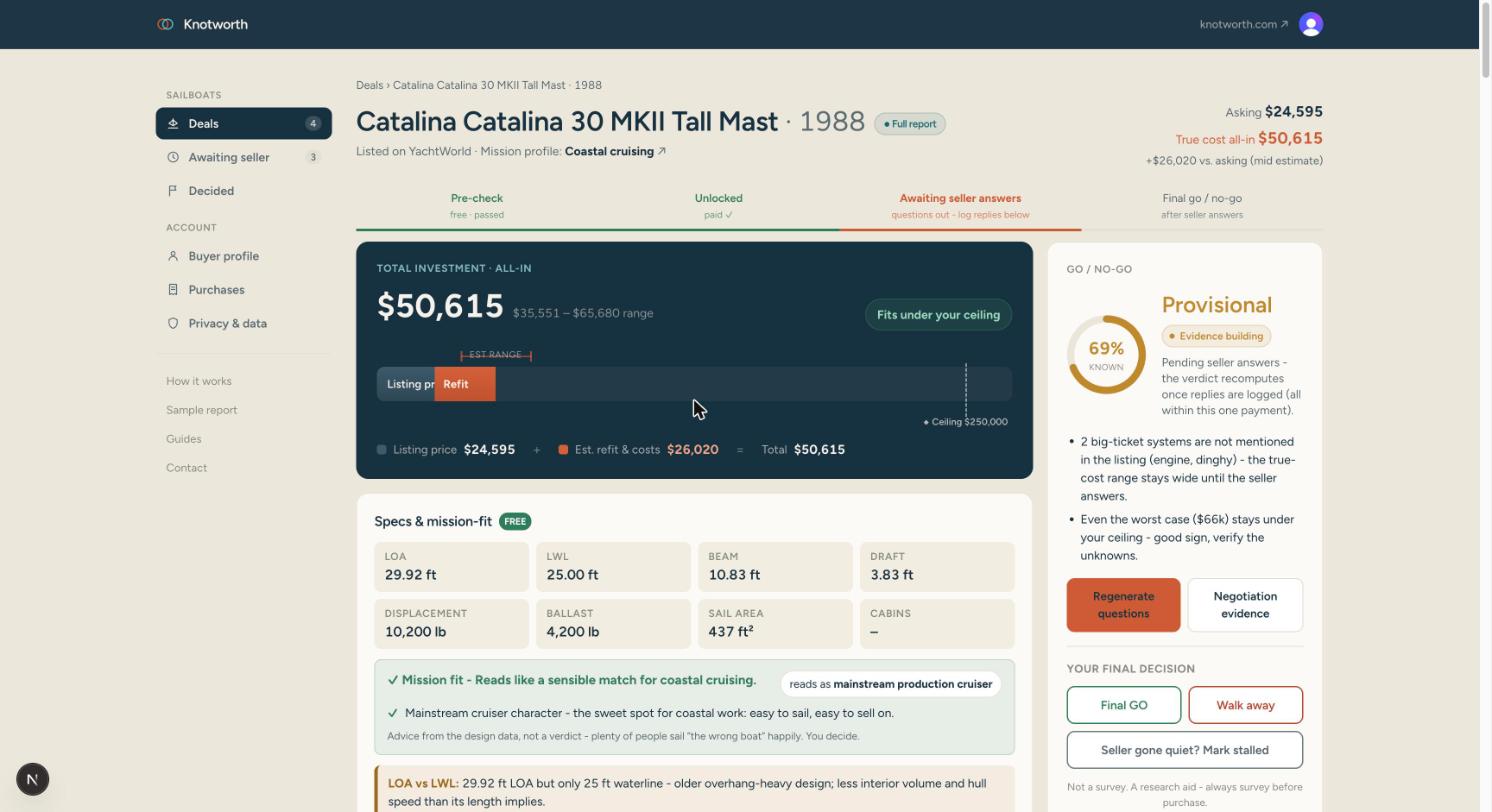
What the seller's answers did to the number. The reply below is illustrative. We did not contact the broker; it is written the way a careful private owner of a thirty-year-old boat usually answers, some paper, some memory, one honest admission.
Rig replaced spring 2019 by a local rigger, invoice available. Halyards done at the same time, sheets older. Mainsail is a 2016 Doyle with the stack pack; the genoa is original, recut around 2010, tired, budget for a new one. Engine 1,514 hours, serviced every spring by the owner with parts receipts, injectors rebuilt 2022 by a diesel shop, invoice available. Bottom painted spring 2024. Never barrier coated as far as he knows, last surveyor saw no blisters. Compression post and mast step checked by a surveyor in 2021 for insurance, no rot, report available. Anchor a 20 lb Danforth with 30 ft of chain, original. No life raft, no EPIRB. Fuel tank original aluminium, no leaks. No log, a folder of receipts.
Logged as round one, the report recomputed. The all-in moved to $50,615, range $35,551 to $65,680, and the share of the boat that was known went from 0% to 69%. The rig became done 2019 at high confidence and dropped out of the range entirely. The halyards were credited as done but carried a small age-based reserve, seven years against a six-year interval. The 2016 mainsail and the 2024 bottom paint each kept a small condition reserve rather than a replacement. The genoa the seller called tired became needs work, due now, $1,050 to $1,925, and the older sheets $1,020 to $1,500. The injector rebuild was credited. Life raft and EPIRB were logged as not aboard, the anchor as original. The contingency fell from 25% to 20%.
Two things did not move, and the report said why. The engine reserve stayed at up to $14,400, because "serviced every spring by me" is a recollection with parts receipts, not a shop record, and the engine is the single largest number on the boat. And a new line appeared: barrier coat, never done as far as the owner knows, $0 to $7,200 until a surveyor looks at the bottom. The question tracker showed seven of fifteen resolved and two answered but needing a document.
The negotiation pack built a first-offer case of $1,530 to $3,000: the older sheets as a confirmed item, the halyards as age-based. It refused to count the genoa yet, on the grounds that the seller's admission is a recollection until seen, and it refused to count the engine. Verdict: provisional, evidence building, two big-ticket systems still not mentioned, engine and dinghy, and the worst case comfortably under the ceiling.
The resulting next step. Book the viewing, and take two things with you: the report's viewing checklist, which now runs to sixteen items built from this boat's own claims, and the two questions still worth money, the engine shop records and whether the hull has ever been barrier coated. Then take the full inspection checklist below decks, and look at the keel joint and the compression post first. A 1988 Catalina 30 with a 2019 rig and a rebuilt injector pump is a good boat at $24,595 if the engine records exist. Without them she is a good boat at about $20,000.
This listing is one of three compared side by side in what a used sailboat is worth.
How Knotworth reads a specific Catalina 30
This page describes the model. The product reads the boat. Paste a listing URL and the free pre-check pulls that hull's specification, runs the design numbers, and flags which of the known issues above the advertisement is quiet about.
Everything on this page is true of Catalina 30s in general. None of it tells you about the one you are looking at, and the gap between those two things is where money is lost.
A 1985 boat advertised as "well maintained, new sails 2019" has told you about the sails and nothing about the rig, the keel joint, the deck core or the through-hulls. Those omissions become the questions, the questions become answers, and the answers become a number you can negotiate on.
Paste the URL. The free pre-check reads that boat's specs, runs her design numbers, and flags which of the known Catalina 30 issues the ad stays quiet about. No card until you unlock a full report.
FAQ
Is the Catalina 30 a good boat?+
For coastal cruising, weekending and club racing, yes. She is stiff for her size with a ballast ratio of 0.42, unusually roomy below, and parts are easy to source from a fleet of roughly 6,400 hulls. She is slow in light air in standard rig and she is not built for offshore work.
What are the common problems with the Catalina 30?+
Keel-to-hull joint leaks, mast step compression fatigue, deck core saturation, lower chainplate attachment failures on older boats, and original gate valves rather than proper seacocks. Wooden spreaders and small-diameter shrouds are also documented weak points.
Is a Catalina 30 a bluewater boat?+
No. Her capsize screening value is almost exactly 2.0, on the conventional offshore threshold rather than below it, and the deck hardware, through-hulls and companionway details are all coastal-grade. She is a capable coastal cruiser, which is what she was designed to be.
Can a Catalina 30 cross the Atlantic?+
Boats of this type have done it, but that is a statement about the people aboard more than the boat. Doing it responsibly would mean a refit costing more than the hull is worth, and both a surveyor and an insurer would want to see it.
What is the average price of a Catalina 30 boat?+
Most used examples ask $15,000 to $30,000. Seattle Yachts published a 1977 at $15,000, a 1982 at $25,000 and a 1993 at $29,000 in 2022. Build year and refit history drive nearly the whole spread.
How many Catalina 30s were built?+
Roughly 6,400 by the end of 1997, with production running from 1974 to 2008. It is the most-built 30-foot sailboat in history, which is why there is always another one for sale and why parts remain easy to find.
Which Catalina 30 engine is best?+
Practical Sailor rates the Atomic Four petrol engine and the Universal Model 25 diesel as the desirable options, and describes the Yanmar YSB12 and Universal 5411 as underpowered. Since a repower is a five-figure job on a boat worth around $20,000, the engine fitted is a large part of the real price.