Hunter sailboats: what the builder was, and what one costs you now
By Itzhak Fuhrman·Built and maintains Knotworth's cost model·Updated 11 September 2026
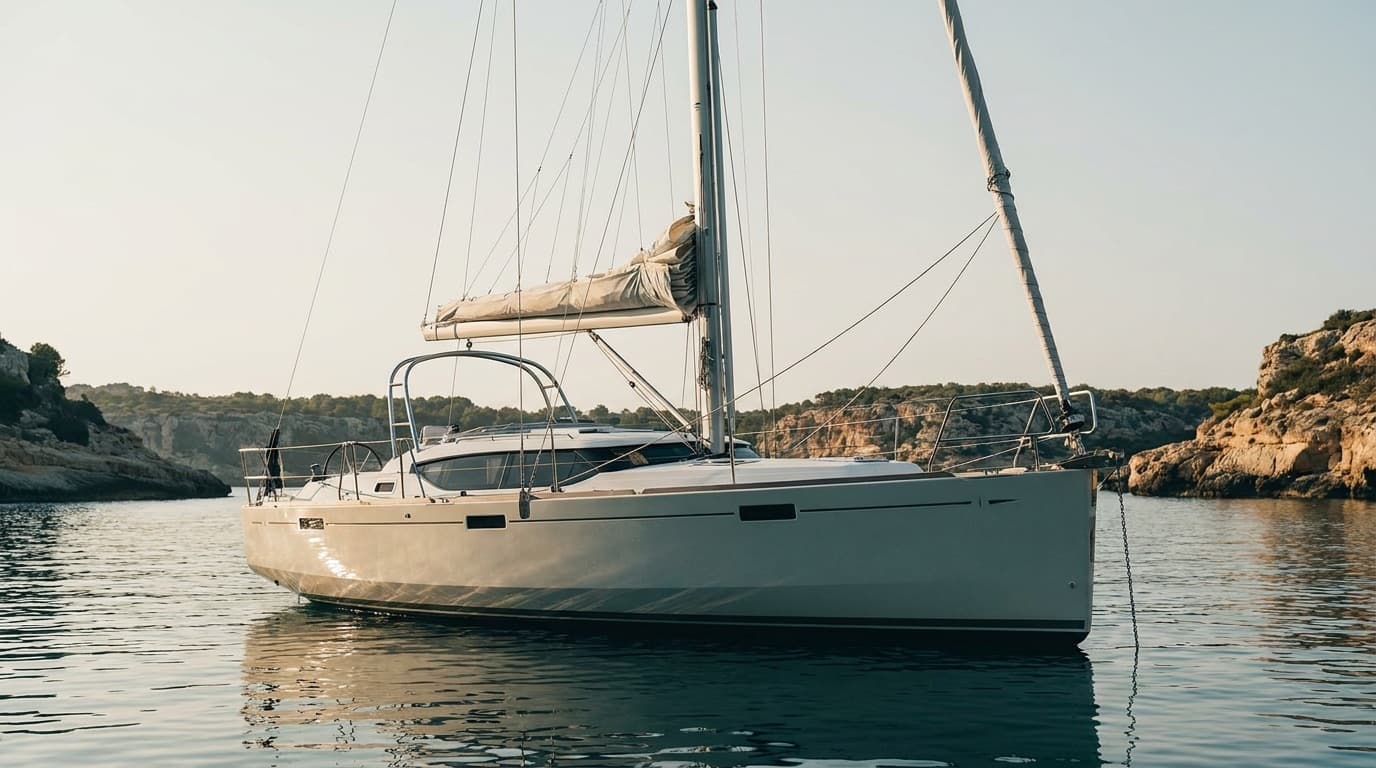
Hunter is the most argued-about brand among the builders covered in this section. The insults are well worn: dock condo, plastic production boat, floating apartment.
They are also mostly beside the point. Nobody buys a Hunter expecting a Westsail, and the people who own them are, by and large, happy.
What actually matters when you buy one is narrower and much more useful. Hunter's quality was not constant. There are two specific periods where the boats got worse, both are documented, and both are invisible unless you know the years.
Are Hunter sailboats any good?
Yes, for what they are: roomy, well-equipped coastal cruisers at the lowest prices in this section. They are lightly built by the standards of the heavier classics in this section, with a distinctive rig and enormous interiors. They are not offshore boats and they hold value less well than anything else covered here.
Hunter's proposition was always volume for money. More cabin, more headroom, more berths and more included equipment per dollar than the competition, on a boat you can buy for the price of a car.
Three design signatures define the range and all three are buyer-relevant:
The B&R rig. Hunter's boats commonly use a Bergstrom and Ridder rig, which uses swept-back spreaders and diagonal bracing and has no backstay. That frees the mainsail roach and simplifies the rig. It also means you cannot adjust headstay tension the conventional way, and downwind the boom cannot be squared off as far without hitting the swept shrouds.
The stainless cockpit arch. The signature Hunter feature, carrying the mainsheet clear of the cockpit. Excellent for the people sitting under it, and a genuine consideration for boom and bimini geometry.
Bow hollow and stern reflex hull forms, which Hunter adopted to improve performance from a beamy, volume-driven hull.
Rob Mazza, who joined in 1991, produced the Hunter 29.5 and its larger successor the 336, which owners on the Hunter forums consistently rate among the better boats in the range.
The honest summary: for weekending, coastal cruising and living aboard at a dock, a Hunter gives you more boat for less money than anything else here. For open water, look at the bluewater shortlist instead.
Which Hunter years should you be careful about?
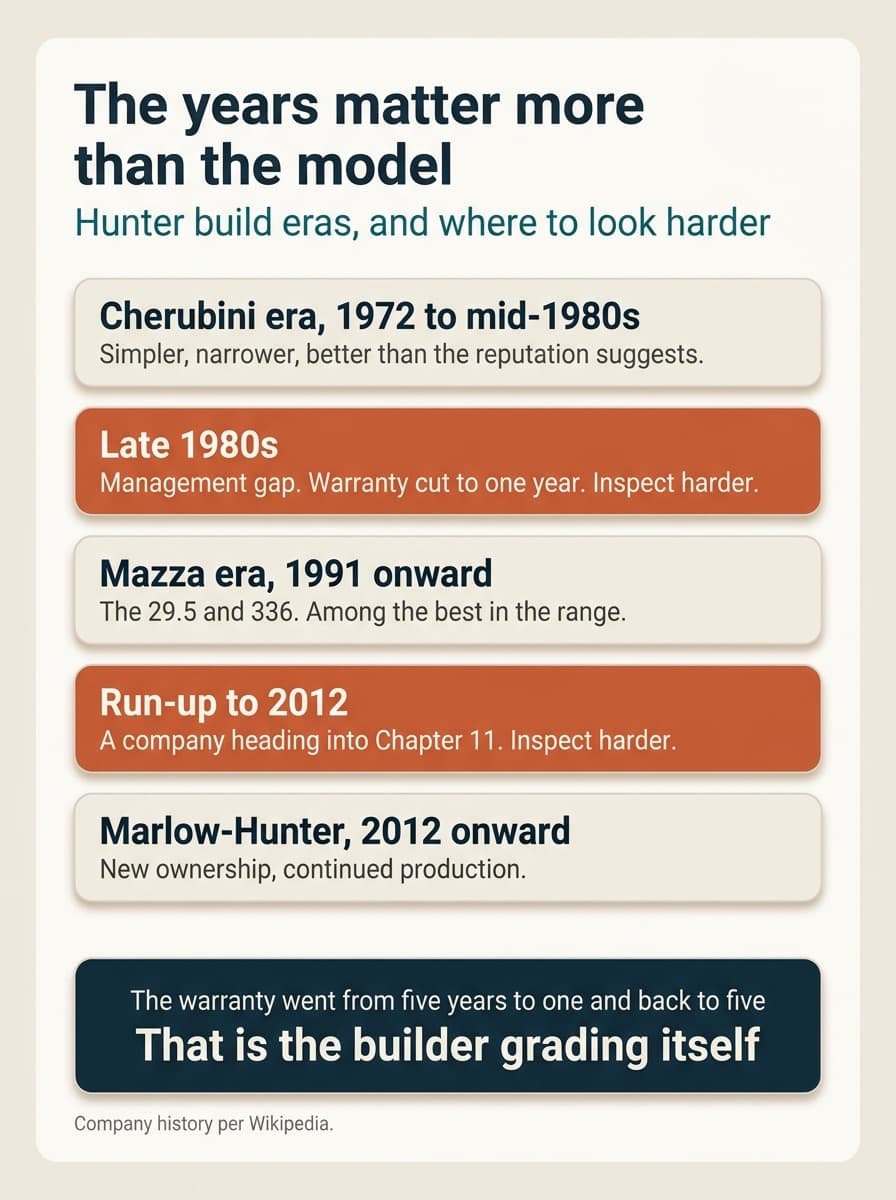
Two periods. The late 1980s, when founder Warren Luhrs stepped back from day-to-day leadership and quality fell far enough that the warranty was cut to one year. And the run-up to the 2012 bankruptcy. Everything either side of those is more consistent.
This is the section the listing will not write for you, and it is the most useful thing on this page.
1988 and the management gap. Warren Luhrs paused his ocean racing involvement in 1988 and delegated operations to management. The result, as Wikipedia's company history records it, was inferior quality, a warranty cut to one year, and poor customer service.
Luhrs returned to direct leadership, restructured, and extended the warranty back to five years, which is about as clear a signal as a manufacturer ever gives about its own product. A company does not quintuple its warranty exposure unless it believes something has changed.
So the warranty length of the era is a proxy for the build quality of the era, and it is public.
2012 and Chapter 11. Hunter Marine filed for Chapter 11 bankruptcy in 2012 and was acquired in August 2012 by David E. Marlow, owner of Marlow Yachts, becoming Marlow-Hunter, LLC.
As with Westsail, boats built while a company is running out of money deserve extra scrutiny, though we have found no published fault pattern for the run-up to 2012. The usual assumption that a later hull is a better hull does not hold across a bankruptcy.
What this means in practice. Two Hunter 34s of different years are not the same purchase, and the difference is not in the brochure. Establish the build year first and read everything else through it.
Looking at one particular Hunter? Paste its listing. The free pre-check reads that hull’s year, specs and equipment against everything above, rather than leaving you to apply the general case yourself.
Free on every boat, no card. You only pay to unlock a full report.
Do they still make Hunter sailboats?
Yes, as Marlow-Hunter, LLC, after David Marlow bought the company out of Chapter 11 in August 2012. Production continued with models around 31, 33, 37 and 40 feet, and dealers who have carried the brand for decades still support it.
The original company traces back further than most people realise. Hunter Marine was founded in Alachua, Florida in 1973 by the Luhrs family, who had been building boats on the New Jersey coast for generations and were producing over a thousand powerboats a year before pivoting to sail.
John E. Cherubini designed the early boats, starting with a 25-foot sloop. Over a hundred distinct models followed.
For a used buyer the practical consequence is good: this is not an orphaned brand. Parts, dealer knowledge and a very large owner community all exist, and the boats were built in numbers that keep comparables plentiful.
Can you cross an ocean in a Hunter?
People have, and it is not what the boats were designed for. Hunters are beamy, lightly built coastal cruisers with large interior volume, shoal-ish draft and a rig configuration that suits reaching and daysailing more than heavy weather.
The question appears in Google's own People Also Ask box for this brand, which tells you how often it gets asked.
The honest answer has three parts.
The hull form. Beam-driven volume is the opposite of what produces a low capsize screening value. Compare the numbers on the bluewater shortlist, where every boat sits below 2.0, or the Cape Dory 28 at 1.71 on a 28-foot hull.
The rig. A B&R rig with no backstay is simple and strong in normal use. Offshore, the inability to tune headstay sag conventionally and the limits on squaring the boom downwind are real handicaps on long passages.
The fit-out. Large windows, big cockpits and volume-first interiors are coastal design decisions. None is disqualifying and all of them are things you would want to address.
So: capable of it in the hands of a good crew, in a good season, after preparation. Not designed for it, and not the cheapest route to it, because the preparation costs more than the price difference to a boat that already suits the job.
The range
Over a hundred models across fifty years, from trailerable daysailers to forty-something cruisers. No Hunter model reaches the search volume that would justify its own guide, with the best at 210 a month.
| Era | Representative models | Notes for a buyer |
|---|---|---|
| Cherubini years, 1972 to mid-1980s | Hunter 25, 27, 30 | The early boats. Simpler, narrower and generally better regarded than their reputation suggests |
| Late 1980s | Various | The management-gap period. One-year warranty era. Inspect harder |
| Mazza years, 1991 onward | Hunter 29.5, 336 | Rated by owners among the better boats in the range |
| Three-digit era, late 1990s to 2012 | 306, 356, 380, 40 | Big volume, arches, B&R rigs, the classic modern Hunter |
| Marlow-Hunter, 2012 onward | 31, 33, 37, 40 | Post-bankruptcy production under new ownership |
The promotion rule, applied. A model earns its own guide when the bare model name draws at least 500 US searches a month and we can write three things true of it and false of its siblings. The best Hunter terms are hunter 34 at 210, hunter 40 at 90 and hunter 356 at 70.
The second test fails too. With over a hundred models iterating on the same volume-first formula, the buyer-relevant facts are the eras and the rig, not the model number, which is precisely what this hub is for.
What do Hunter sailboats cost?
$5,500 to $249,000 across the brand, with 384 boats listed on Boat Trader and a comparable range on YachtWorld. That bottom figure is the lowest entry price of any builder in this section.
Broker asking prices from Boat Trader and YachtWorld, August 2026, covering the whole Hunter range including the largest and newest boats.
Two things follow from that range and both matter.
Hunters are the cheapest way into a big interior. If your requirement is standing headroom, a real galley and a proper aft cabin at the lowest possible purchase price, this brand wins and it is not close.
They depreciate, and they keep depreciating. Unlike a Cape Dory, which reached its price floor decades ago, a production Hunter continues to lose value. Buy accordingly and do not treat the purchase as an asset.
The true-cost guide sets out how to price the catch-up bill, and the working figure for annual ownership across this site is 10 to 15% of the boat's value per year.
Note the asymmetry that creates. On a $20,000 Hunter, a new suit of sails and a rigging renewal can approach the purchase price, and unlike on a heavier classic you will not get that money back on resale.
What to check before you buy one
Establish the year and read it against the two weak periods. Then the rig, because the B&R configuration has its own wear pattern, and then the deck and window seals, because large window apertures in a production deck are where water gets in.
The survey cost guide breaks the survey day down line by line. On a boat that can be bought for $15,000, that cost is a serious share of the purchase price, which is an argument for asking the free questions first.
Ask, before you travel:
- What year is she, and does she fall in the late-1980s or pre-2012 windows?
- Is the rig a B&R, and when were the swept shrouds and diagonals last inspected?
- Any play or corrosion where the cockpit arch meets the deck?
- Do the large windows and hatches leak, and have they been rebedded?
- Any soft spots in the deck, especially around fittings?
- When was the standing rigging last replaced?
- Has she been a liveaboard, and for how long?
- Is this a Hunter Marine boat from Florida, or the unrelated British Hunter?
None of those is answered in a typical listing. All of them change the number you should offer.
How Knotworth reads a specific Hunter
This page describes the builder. The product reads the boat. Paste a listing URL and the free pre-check pulls that hull's specification, runs her design numbers, and flags which of the known issues above the advertisement is quiet about.
The Hunter question is almost never "is this a good model". It is "is this a good example of a model built in a year when the company was building well".
A Hunter 34 advertised as "roomy, well maintained, turnkey" has told you nothing about which of those years she came from, what the rig has had done, or whether the windows leak.
Those omissions become the questions, the questions become answers, and the answers become a number you can negotiate on. On a boat this affordable, the negotiation is often the whole margin.
Paste the URL. The free pre-check reads that boat's specs, runs her design numbers, and flags what the ad leaves out about the year, the rig and the deck. No card until you unlock a full report.
FAQ
Are Hunter sailboats any good?+
For coastal cruising, weekending and living aboard at a dock, yes, and they deliver more interior volume per dollar than anything else in this section. They are lightly built, they are not offshore boats, and they depreciate more than the heavier classics.
When did Hunter sailboats go out of business?+
Hunter Marine filed for Chapter 11 bankruptcy in 2012. It was acquired in August 2012 by David E. Marlow of Marlow Yachts and continues as Marlow-Hunter, LLC.
Do they still make Hunter sailboats?+
Yes, as Marlow-Hunter, with production continuing on models around 31, 33, 37 and 40 feet. Dealers who have carried the brand for decades still support it, so this is not an orphaned marque.
Which Hunter years should I avoid?+
Two periods deserve extra scrutiny. The late 1980s, when founder Warren Luhrs stepped back and quality fell far enough that the warranty was cut to one year before he returned and restored it to five. And the run-up to the 2012 bankruptcy, on the same principle that applies to any builder running out of money.
What is a B&R rig?+
A Bergstrom and Ridder rig, used on many Hunters, with swept-back spreaders and diagonal bracing and no backstay. It allows a larger mainsail roach and simplifies the rig, at the cost of conventional headstay tuning and of squaring the boom fully downwind.
Can you cross the ocean in a Hunter sailboat?+
People have, but the boats were designed for coastal work. The beamy volume-first hull, the B&R rig and the large window apertures are all coastal decisions, so an ocean passage means preparation that usually costs more than the price gap to a boat already suited to the job.
How much does a used Hunter sailboat cost?+
From about $5,500 to $249,000 across the whole range, with 384 boats listed on Boat Trader. That lower figure is the cheapest entry point of any builder covered in this section.
Is Hunter Marine the same as the British Hunter Boats?+
No. This guide covers Hunter Marine of Alachua, Florida, founded 1973 and now Marlow-Hunter. Hunter Boats is a separate British builder with its own owners' association, and the two are unrelated.