Catalina sailboats: a used buyer's guide to the brand
By Itzhak Fuhrman·Built and maintains Knotworth's cost model·Updated 11 September 2026
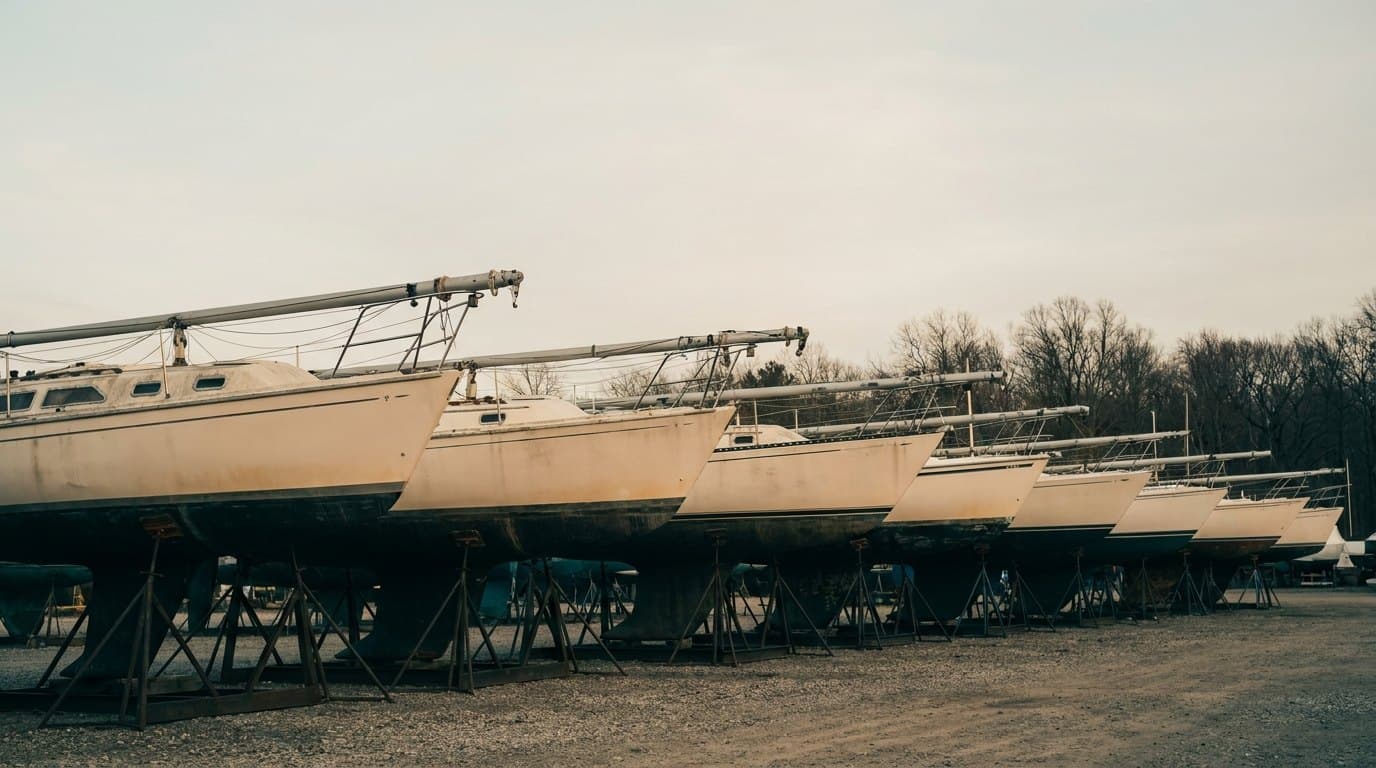
Catalina was the front door to sailing in North America for fifty years. Frank Butler founded the company in Hollywood, California in 1969, and it went on to build more than 80,000 monohull sloops from eight to fifty-four feet. More people learned to sail on a Catalina than on anything else.
That story ended recently and messily, which is why the most-asked question about the brand right now is whether it still exists. It mostly does not. The more useful question, if you are looking at a twenty-year-old Catalina 30, is what that actually changes for you.
Short answer: less than the headlines suggest, and this page explains why. Catalina is one of the builders covered in this section, and it is the one with the largest used fleet in the American market.
Are Catalina sailboats still in business?
Not building, as of September 2026, but no longer headed for the scrapyard either. The Butler estate sold the company in April 2025 to a buyer who could not make payroll; production stopped in October 2025; the estate auctioned the plant's contents in June 2026; and in July 2026 a new group led by Catalina's former president Patrick Turner bought the Catalina and True North brands, saying production will stay in Largo, Florida. No restart date has been published.
The sequence, from trade press at the time:
| When | What happened |
|---|---|
| 30 Apr 2025 | Daedalus Yachts founder Michael Reardon acquires Catalina Yachts and True North from the Butler estate; plant, staff and dealers to continue |
| 15 Oct 2025 | Production pause announced, framed as temporary, existing orders to be filled |
| Oct 2025 | Trade press confirms production stopped; the owner misses payroll and is evicted from the Largo plant |
| 21 May 2026 | Butler estate announces auction of the plant's contents, including nine boats in various stages of completion, from 9 June |
| 1 Jul 2026 | C & T Composites, led by former Catalina president Patrick Turner, acquires the Catalina and True North brands; production to stay in Largo; schedules and model plans "in the coming months" |
Treat any claim about the brand's future as unsettled until boats leave the plant again. What is settled is that nobody has built a new Catalina since October 2025, and that the people who now own the name ran the company before the 2025 sale.
What does that mean if you are buying a used Catalina?
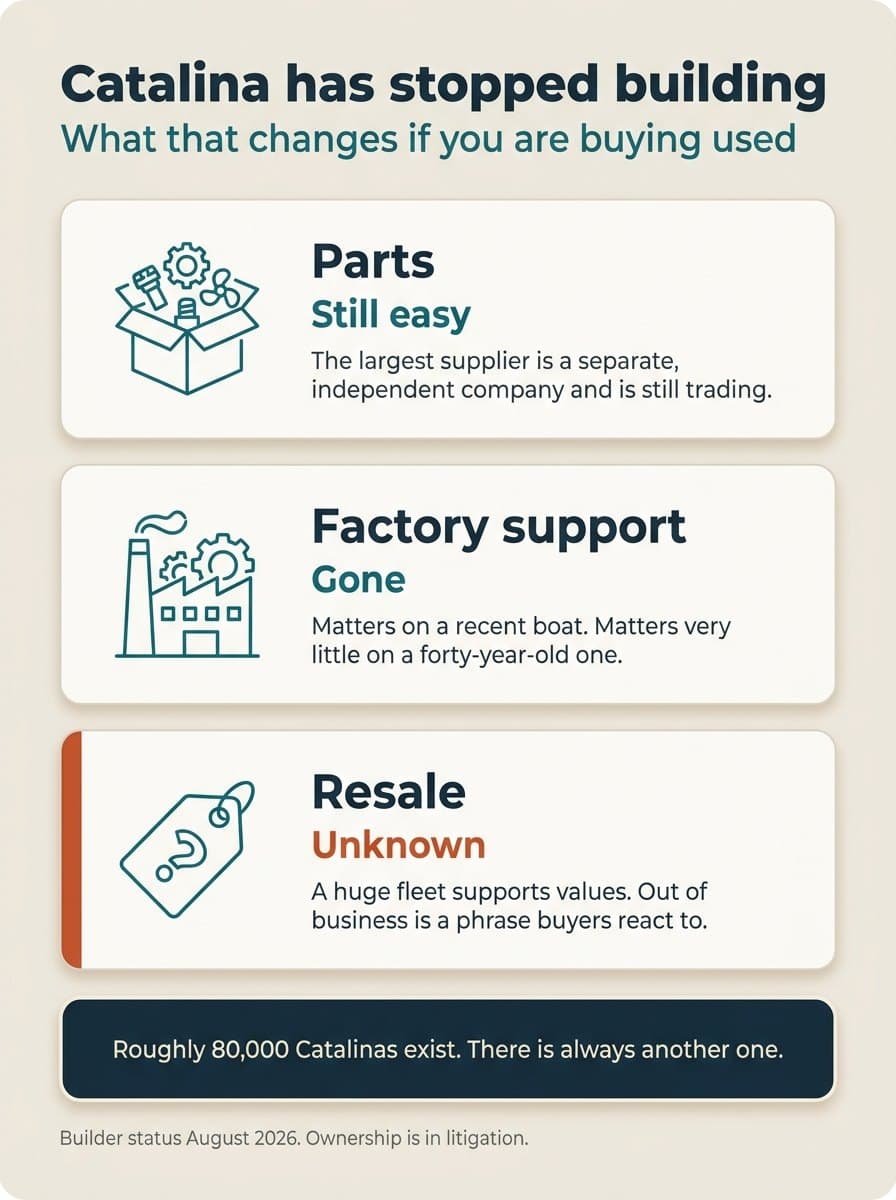
Three things, and only one of them is bad. Parts remain unusually easy to get because the main supplier is independent, and factory support is gone but matters only on recent boats. Resale is the genuine unknown, uncertain for the first time in the brand's history.
Parts: still the brand's biggest advantage. Catalina Direct describes itself as the largest supplier of Catalina parts in the country, and it is a separate company from Catalina Yachts, still trading in 2026 with model-specific catalogues down to individual hatches and interior fittings. That distinction is the single most useful fact on this page. The builder's collapse did not take the aftermarket with it.
That matters more than brand loyalty ever did. On a forty-year-old boat, the practical question is whether you can buy a replacement port light without fabricating one, and for a Catalina the answer is still yes. For a lot of defunct 1970s builders it is no.
Factory support: absent since October 2025, and largely irrelevant on an old boat. If you are buying a 2019 Catalina 425 this is a real problem. If you are buying a 1985 Catalina 30, the factory stopped caring about your boat decades ago and nothing has changed.
Resale: the honest unknown. Nobody can tell you yet how a year-long factory shutdown and a change of owner affect a used Catalina's value over the next decade. The fleet is enormous and the aftermarket is healthy, both of which support values.
Against that, "out of business" is a phrase buyers react to. We will not pretend to know which wins, so price accordingly and do not assume Catalina values will behave as they always have.
Looking at one particular Catalina? Paste its listing. The free pre-check reads that hull’s year, specs and equipment against everything above, rather than leaving you to apply the general case yourself.
Free on every boat, no card. You only pay to unlock a full report.
Are Catalina sailboats any good?
Yes, for what they were built to do. Catalina's brief was volume and value for coastal cruising, and the boats deliver interior space, stiffness and ease of handling at a price no import matched. They were not built for offshore work, and the build standard reflects the price.
Understanding the brief explains almost every Catalina strength and weakness at once. Butler built boats a family could afford, sail without drama, and keep at a local marina.
Wide beam gives volume below, generous ballast gives stiffness, and simple masthead sloop rigs are cheap to maintain.
The consequences are equally consistent. Wide hulls develop weather helm as they heel, and reviewers and owners report deck hardware fitted with large washers rather than proper backing plates.
Original through-hulls were often gate valves rather than seacocks, and interior joinery is production-grade throughout.
None of that is a scandal. It is what a value-built coastal cruiser looked like in 1985, and it is priced into the used market. It just means the survey matters, and it means you should read "well maintained" in a listing as the beginning of a conversation rather than the end of one.
Known traits across the Catalina range
Several Catalina issues are brand traits rather than model faults, which is useful because it means you can check for them on any boat in the range. The keel-to-hull joint, deck core saturation around hardware, mast step compression and original gate valves recur across models and decades.
- Keel-to-hull joint. The "keel smile" is the best known Catalina trait. Cosmetic at best, structural at worst, and only assessable hauled out.
- Deck core around hardware. Deck fittings installed without proper backing plates let water into the core over decades, a pattern Practical Sailor and owners describe on the 30 and owners repeat on the 22, 27 and 36. Soft spots underfoot are the tell.
- Mast step compression. Reported by owners across models, and detailed on each model page.
- Gate valves. Original through-hull hardware on many boats. Assume replacement is due on any unmodified older hull.
- Wooden spreaders on older boats, which fail with age.
Every one of those is checkable, none is a reason to avoid the brand, and all of them are cheaper to find before you buy than after.
Which used Catalina should you look at?
The classic two-digit models are the used-market backbone, and the number is the length in feet. The 22 is the most-produced trailerable in America, the 30 the most-built 30-footer in history, and the 27 and 36 are the practical steps either side of it.
| Model | Who she suits |
|---|---|
| Catalina 22 | First boat, trailerable, learn-to-sail. Enormous fleet and class association |
| Catalina 27 | First keelboat, weekending, tight budget |
| Catalina 30 | Coastal cruising for a couple or family. The default used 30-footer |
| Catalina 36 | Longer coastal cruising with standing headroom everywhere and a real aft cabin |
Later three-digit models (310, 315, 320, 355, 380, 425, 445) are the modern range, generally better finished and considerably more expensive on the used market. Note that the number is not the length on those: the Catalina 315 is 33 feet.
Everything Catalina built was a monohull sloop, so the brand never presents the multihull question at all.
How much does a used Catalina cost?
A used Catalina 30 asks roughly $15,000 to $30,000 depending almost entirely on build year. Smaller models sit below that and the modern three-digit range well above it. Across the brand, age and refit history drive the price far more than model does.
The clearest illustration comes from a single model at three build years. Broker Seattle Yachts published a Catalina 30 at $15,000 for a 1977, $25,000 for a 1982 and $29,000 for a 1993. Same design, nearly double the price.
That is the pattern to expect across the range, and it is why the asking price tells you so little. What you actually pay is the asking price plus whatever the previous owner deferred, and on a boat of this age that second number is usually the bigger one. The true-cost guide works through how to size it.
What to check on any used Catalina
Haul her out, because the keel joint and the deck core are the two expensive faults you cannot judge afloat. Then ask the seller about rigging age, engine hours and through-hulls, because those are the three things listings routinely omit.
The survey day itself runs roughly $1,300 to $1,900 on a 30-footer once the short haul and yard fees are counted, broken down in the survey cost guide. Spend it on a boat that has already survived the questions, not on the first one you liked the photos of.
Paste the listing URL. The free pre-check reads that boat's specs, runs her design numbers, and flags which of the known Catalina issues the advertisement stays quiet about.
FAQ
Are Catalina sailboats still in business?+
Not building, as of September 2026. The Butler estate sold the company in April 2025, production stopped in October 2025 when the buyer could not make payroll, the estate auctioned the plant's contents in June 2026, and in July 2026 a group led by former Catalina president Patrick Turner bought the brand with plans to keep production in Largo, Florida. No restart date has been published.
Does the shutdown make a used Catalina a bad buy?+
Not on its own. Roughly 80,000 hulls exist and Catalina Direct, the largest parts supplier, is a separate independent company still trading in 2026. Factory support has been absent since October 2025 and may or may not return under the new owner, which matters on recent boats and very little on older ones. The genuine unknown is resale.
Are Catalina sailboats any good?+
For coastal cruising, weekending and learning, yes. They offer more interior volume and stiffness per dollar than almost anything of their era. They are value-built rather than offshore-built, and details such as deck hardware backing and original gate valves reflect that.
How much does a Catalina boat cost?+
A used Catalina 30 typically asks $15,000 to $30,000, with build year driving most of the spread. Smaller models such as the 22 sit well below that; the modern three-digit range sits well above. Age and refit history matter more than which model you choose.
Is a Catalina 22 a good first sailboat?+
It is one of the most common first boats in America, and the reasons are sound: trailerable, forgiving, cheap to keep, with an enormous fleet, an active class association and easy parts. The same age-driven checks apply as on any forty-year-old boat. The Catalina 22 buyer's guide prices what those checks find.
What are the common problems with a Catalina 22?+
The brand traits apply: keel-to-hull joint issues, deck core saturation around unsupported hardware, and original through-hull valves. On swing-keel boats the keel pivot and lifting mechanism are the model-specific items worth inspecting closely, and the Catalina 22 buyer's guide costs each one.
Can you still get parts for a Catalina?+
Yes. Catalina Direct is independent of the builder, still trading, and stocks model-specific parts down to hatches and interior fittings. Parts availability remains one of the strongest practical arguments for buying a used Catalina rather than a comparable boat from a defunct builder with no aftermarket.