Catalina 22 buyer's guide: what she is, what she costs, what breaks
By Itzhak Fuhrman·Built and maintains Knotworth's cost model·Updated 12 October 2026
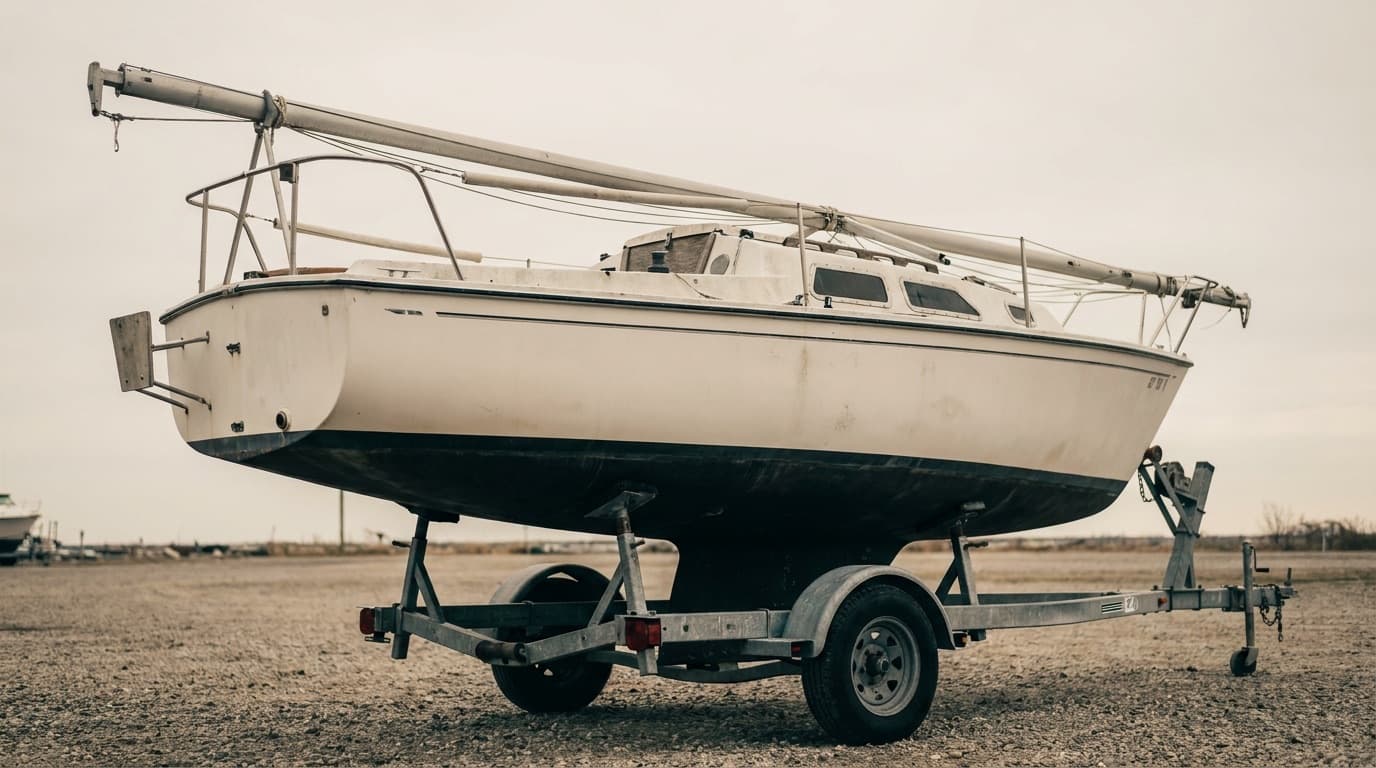
Catalina 22 specifications
| Specification | Figure |
|---|---|
| Length overall | 21 ft 6 in hull; 23 ft 10 in over pulpit and rudder |
| Waterline length | 19 ft 4 in |
| Beam | 7 ft 8 in |
| Draft | Swing keel 2 ft 0 in up, 5 ft 0 in down · Fin keel 3 ft 6 in · Wing keel 2 ft 6 in |
| Displacement | 2,490 lb swing keel (800 lb cast-iron keel) · 2,250 lb fin keel (550 lb ballast) |
| Sail area | About 212 sq ft, main plus 100% foretriangle |
| Rig | Masthead sloop · I 25.8 ft, so the mast stands about 25 ft above the waterline; the mast itself is a shade under 25 ft and trailers on deck |
| Towing weight | About 3,300 to 3,600 lb all-up: boat, single-axle trailer and gear. Owners quote 2,250 to 2,490 lb for the boat and 850 to 900 lb for a typical trailer |
| Auxiliary | Outboard on a transom bracket, 5 to 7 hp recommended |
| Built | 1969 to 2025, roughly 15,000 hulls across the original, MkII (1995) and Sport (2003) series. Production has been paused since October 2025; the brand changed hands in July 2026 with no restart date announced |
| Designer | Frank Butler |
| New, for reference | Catalina 22 Sport listed around $42,900 base in 2024, before trailer, outboard and options |
Sources: sailboatdata for hull dimensions and rig; the Catalina 22 National Sailing Association technical manual for the swing-keel displacement and keel weight; towing weights from owner reports on the association and sailboatowners.com forums, not a factory figure. The ratio table further down uses the original swing-keel figures.
Every buyer's guide to this boat tells you the same three things. It is the most-built sailboat ever, it is forgiving to learn on, and it is cheap.
All three are true. None of them helps you choose between the $2,499 boat and the $7,000 boat parked next to it, which is the only decision you actually have to make.
This guide is about that decision. What commonly fails on a Catalina 22, what each fix costs at published 2026 prices, and why the cheapest listing on the page is very often the most expensive boat on it.
Is the Catalina 22 a good first sailboat?
Yes, and for reasons that survive scrutiny. She is stable and predictable, she is small enough that mistakes are cheap, roughly 15,000 were built so there is always another one for sale, and the class association has been documenting fixes for fifty years. She is slow, she is cramped, and she is not a boat to grow old with.
Practical Sailor's used boat review is direct about the trade: "for those to whom price is all-important, the Catalina 22 is appealing but it's lacking in performance."
That is the honest verdict. You are buying accessibility, not sailing performance.
What makes her a good first boat is not the hull, it is the fleet. Fifteen thousand owners have already found every weakness and written the fix down. The Catalina 22 National Sailing Association maintains a technical manual running to over 700 pages, written by owners for owners.
Very few boats at this price come with that. It is the single strongest argument for choosing this model over a cheaper unknown from a builder nobody supports.
What are the common problems with a Catalina 22?
The swing keel system is the one that is unique to this boat, and it is the one buyers underestimate. The pivot pin, the hanger castings and the lifting cable all wear, all live underwater, and all need the boat hauled to inspect. The rest of the list is standard for a fiberglass hull of this age.
This is the section the listing will not write for you.
| Known issue | What it means, and what it costs |
|---|---|
| Keel pivot pin and hanger wear | The pin wears the hole oval and the keel starts to move in the trunk. The pin itself is trivial money. The bronze hanger casting kit with a new pin and bolts is $265.95. An elongated hole in the keel casting is a machine shop or welding job, not an epoxy job |
| Keel hanger bolts loosening or seizing | Named explicitly by Practical Sailor. The correct torque on the 5/16"-18 stainless bolts is about 12 ft-lbs, which is low, and owners over-torque them. Threaded weldment $16.61 |
| Keel lifting cable failure | The wire pennant is a wear item and owners report replacing it more than once. Cable assembly $107.43, full lifting hardware maintenance kit for pre-1995 boats $155.19. Access means hoisting the boat, so the labour costs more than the part |
| Hull to deck joint | A plywood-reinforced flange bonded with polyester slurry and self-tapping fasteners. Practical Sailor is unimpressed by it. Owners report separation showing at the bow |
| Deck core saturation | Water enters through stanchion bases, chainplates and the mast partner and rots the core. Tap the whole deck and listen for a dull thud. Local repairs are affordable, a full recore exceeds the value of the boat |
| Mast step compression | The load path runs down through a wooden beam to the step below, and owners report that decades of compression deform or crack it. Easy to spot once you know to look |
| Hull blistering | Owners report it on earlier hulls, reducing year by year, close to absent by the mid-1980s. A pre-1980 boat that has never been barrier-coated should be assumed to need it |
| Kick-up rudder wear | The class association advises cleaning and polishing the locking mechanism every four or five years in fresh water and more often in salt. A new high-performance kick-up rudder with tiller runs $1,295 |
| Petrol tank stowed in the cabin | Early boats put a portable gasoline tank inside a cabin locker. Practical Sailor calls it a design flaw, corrected on later boats. Move the tank on deck whatever the boat's age |
| The trailer | Bearings, bunks, tyres, lights and brakes all age faster than the boat, and a trailer that cannot be legally towed makes a trailerable boat immovable. Inspect it as carefully as the hull |
Sources: Practical Sailor for the keel hanger, hull-deck joint and fuel tank findings; Catalina Direct catalogue prices, checked August 2026. Assumption: a boat that has not already had the work done, which on an unmodified older hull is the safe assumption until the seller says otherwise.
Note what the swing keel items have in common. Every one of them is invisible with the boat in the water and invisible with the keel down.
If you are looking at a swing keel boat and the seller cannot show you a keel-up inspection or a yard invoice, you do not yet know what you are buying.
Got a Catalina 22 listing open right now? Paste it. The free pre-check reads that specific boat’s year and equipment list and flags which of these the ad has quietly said nothing about.
Free on every boat, no card. You only pay to unlock a full report.
What does a Catalina 22 cost to buy?
Most usable boats ask $2,500 to $7,000. But on a hull this cheap the equipment is worth more than the boat, and a $3,000 listing with tired sails, a dead outboard and a doubtful trailer is comfortably more expensive than a $7,000 boat with all three sorted.
| Build year | Recent asking price |
|---|---|
| 1977 | $3,000 |
| 1981 | $6,200 |
| 1985 | $2,499 |
| 1985 | $3,500 |
| 1987 | $7,000 |
Asking prices from broker and by-owner listings, August 2026. Note that the two 1985 boats are $1,000 apart and the 1977 boat asks more than one of them. On this model the year barely predicts the price, because condition and equipment do all the work.
That is the opposite of the Catalina 30, where build year drives nearly the whole spread. Here is why.
| Item | New replacement cost, part only, before shipping or fitting |
|---|---|
| Mainsail | $765 standard, $930 coastal cloth |
| Working jib | $505 standard, $635 coastal cloth |
| 150% genoa | $720 standard, $865 coastal cloth |
| Furling jib | $760 to $870 |
| 6 hp long shaft outboard | $1,830 |
| 6 hp Sail Pro long shaft, high thrust with alternator | $2,010 |
| Keel hanger casting kit with pin and bolts | $265.95 |
| Keel cable assembly | $107.43 |
| Kick-up rudder with tiller | $1,295 |
| Replacement trailer | Quote. Four figures |
Sail prices from The Sail Warehouse, outboard prices from Online Outboards, keel parts from Catalina Direct, rudder from RudderCraft. All checked August 2026.
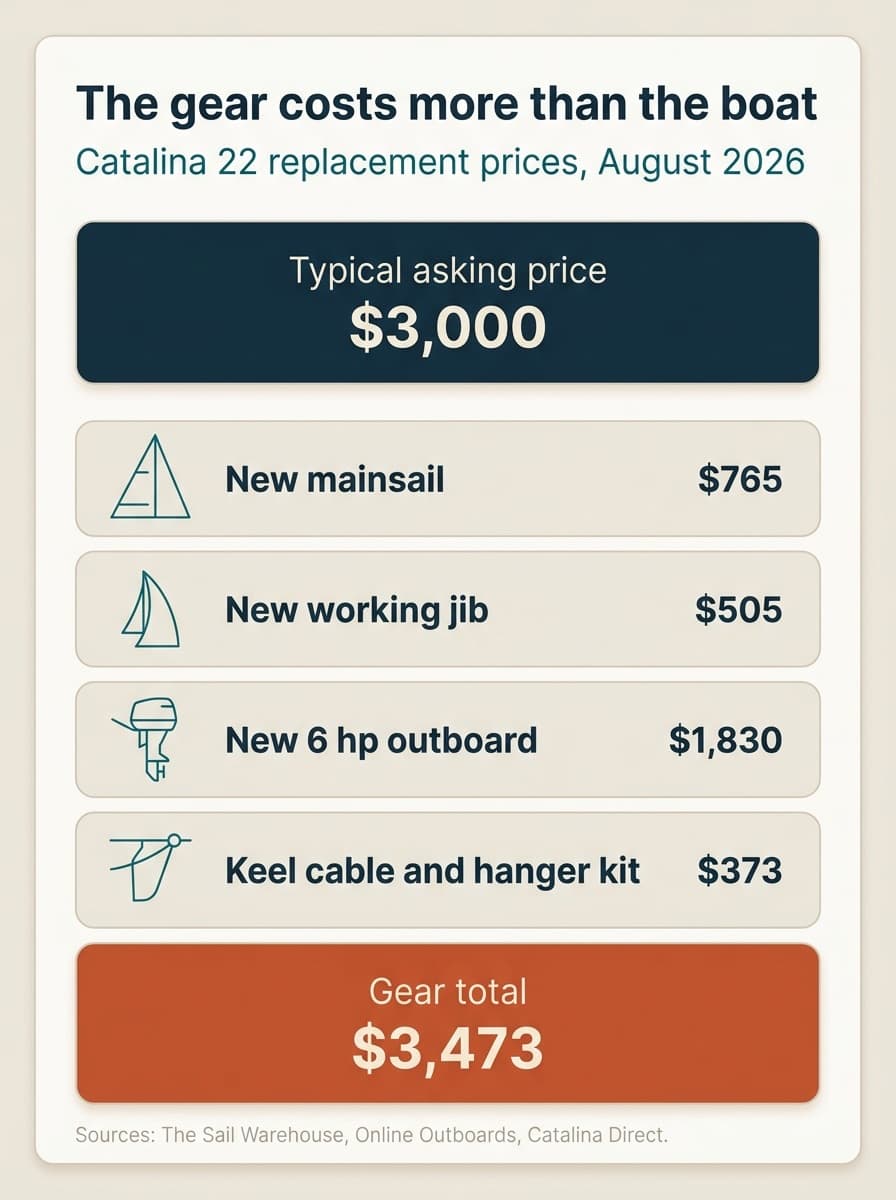
Add a mainsail, a jib and an outboard and you are at $3,100 before touching the boat. That is more than the asking price of two of the five listings in the table above.
This is the whole argument of this site, and on a Catalina 22 it is unusually stark. The asking price is the smallest number in the transaction.
A boat advertised at $2,499 with sails "that need replacing soon" and an outboard "that runs" is not a $2,499 boat. It is a $5,500 boat with the bill deferred, and the true-cost guide explains how to price that catch-up bill on any hull.
New, for reference, the Catalina 22 Sport was listed around $42,900 in 2024, base boat before trailer, outboard and options. The used market is not competing with that. It is competing with itself.
How seaworthy is a Catalina 22?
She is a coastal and inland boat, and the numbers say so plainly. Her capsize screening value is 2.26, well above the conventional offshore threshold of 2.0, and her comfort ratio of 12.7 is about as low as a cruising hull gets. Sheltered water, daysailing and overnighting. Not open water.
Running the published figures for the original swing keel boat through the standard screens:
| Ratio | Value | Reading |
|---|---|---|
| Capsize screening | 2.26 | Above the 2.0 offshore threshold. Coastal only |
| Comfort ratio | 12.7 | Very low. She is light and she moves quickly in a chop |
| Displacement / length | 154 | Light displacement |
| Sail area / displacement | 17.8 | Moderate. Better than most people expect |
| Ballast / displacement | 32% | Modest. Reef early |
| Hull speed | 5.9 knots | how it is calculated |
Computed from displacement 2,490 lb, ballast 800 lb, waterline 19.33 ft, beam 7.67 ft and sail area 204.75 sq ft as published for the original boat. Later variants are lighter, so their numbers are slightly worse, not better.
The design ratios guide explains what each screen does and does not tell you, and the free calculators will run the full set for the specific boat you are looking at.
Read against the Catalina 30's capsize value of almost exactly 2.0, the picture is clear. The 30 is a coastal cruiser sitting on the offshore threshold. The 22 is not near it, and was never meant to be.
That is not a criticism. It is a 21-foot boat that a beginner can single-hand and tow home behind a mid-size car, and the design does exactly that.
Which Catalina 22 should you buy?
Later is better and the keel choice matters more than the year. There are four generations across a fifty-year run, and the swing keel that defines the model is also the source of its most expensive failures.
Generations.
| Version | Years | What changed |
|---|---|---|
| Original | 1969 to 1986 | The classic boat. 21'6" hull, 2,490 lb, 800 lb ballast. Most of the used fleet |
| New Design | 1986 to 1995 | Wing keel option introduced |
| Mark II | 1995 to 2004 | Lighter at 2,290 lb, fin keel at 3'6", wing at 2'6", improved interior |
| Sport | 2004 to present | Fairer molds, 2,380 lb, 550 lb ballast, swing keel |
Keels, and this is the real decision.
The swing keel is what makes the boat trailerable and shoal-capable, drawing 5 feet down and about 1'8" up. It is also the pivot pin, the hanger castings, the cable and the trunk, all of which wear and all of which need a haul-out to inspect.
The fin keel removes that entire failure category and gives up the ramp launching and the shallow gunkholing. If you keep the boat in a slip and never trailer it, the fin keel is the easier ownership.
The wing keel, from 1986, splits the difference on draft and is harder to free if you run aground.
Be honest with yourself about trailering before you pay for the swing keel. Owners on r/sailing consistently report that stepping and unstepping the mast is enough work that many trailer-sailors end up leaving the boat on a mooring anyway.
If that is going to be you, you have bought the swing keel's maintenance bill and none of its benefit.
What to check before you buy one
See the keel up and out of the water, walk the whole deck listening for soft spots, run the outboard from cold, and inspect the trailer as if you were buying the trailer. Those four cover most of the money at risk on a boat in this price range.
A full survey on a 21-footer is a smaller job than on a cruising boat, but the survey cost guide is worth reading before you decide to skip it. On a $3,000 boat the survey is a meaningful share of the purchase price, which is exactly why the free questions below should come first.
Ask, before you travel:
- Has the keel ever been dropped for inspection, and is there an invoice?
- When was the lifting cable last replaced?
- Does the keel wobble in the trunk with the boat on the trailer?
- How old are the sails, and were they the ones that came with the boat?
- Will the outboard start from cold, in front of me, today?
- Is the trailer titled, road legal, and when were the bearings last packed?
- Any soft spots underfoot, especially around the mast and the stanchion bases?
- Where does the fuel tank live?
None of those is answered in a typical listing. All of them change the number you should offer. They are the model-specific lines in the full inspection checklist, which covers what to settle before you travel and what to check aboard.
How Knotworth reads a specific Catalina 22
This page describes the model. The product reads the boat. Paste a listing URL and the free pre-check pulls that hull's specification, runs her design numbers, and flags which of the known issues above the advertisement is quiet about.
Everything on this page is true of Catalina 22s in general. None of it tells you about the one you are looking at, and on a boat where the gear is worth more than the hull, that gap is the whole purchase.
A 1983 boat advertised as "sails great, comes with trailer" has told you nothing about the sails, the cable, the pivot pin or whether the trailer can be towed home. Those omissions become the questions, the questions become answers, and the answers become a number you can negotiate on.
And on a boat this cheap, the pre-check often says the same useful thing: do not fly to see this one.
Paste the URL. The free pre-check reads that boat's specs, runs her design numbers, and flags what the ad leaves out about the keel, the sails and the outboard. No card until you unlock a full report.
FAQ
Is a Catalina 22 a good first sailboat?+
Yes. She is stable, forgiving and small enough that mistakes are cheap, and with roughly 15,000 built there is always another one for sale. The class association's technical manual runs past 700 pages, so almost every problem you will meet has a documented fix.
What are the common problems with a Catalina 22?+
The swing keel system is the model-specific one: pivot pin and hanger wear, loosening hanger bolts, and lifting cable failure. Beyond that, deck core saturation, the hull to deck joint, mast step compression, blistering on pre-1980 hulls, and kick-up rudder wear.
How much does a Catalina 22 cost?+
Used boats ask roughly $2,500 to $7,000, with condition and equipment mattering far more than build year. New, the Catalina 22 Sport was listed around $42,900 in 2024.
How seaworthy is a Catalina 22?+
She is a coastal and inland boat. Her capsize screening value of 2.26 sits above the conventional 2.0 offshore threshold and her comfort ratio of 12.7 is very low, which is what you would expect from a 2,490 lb trailerable design.
How many people can fit on a Catalina 22?+
Four to six for daysailing in the cockpit, and realistically two adults for sleeping aboard. The interior has a V-berth forward, a convertible dinette and a port berth, with a portable head and a slide-away galley.
Should I buy a swing keel or a fin keel Catalina 22?+
Swing keel if you genuinely will trailer and launch from ramps or sail shallow water. Fin keel if the boat will live in a slip, because it removes the pivot pin, hanger and cable failures entirely.
Did Catalina boats go out of business?+
Catalina Yachts stopped building in October 2025 after a failed sale, and in July 2026 a group led by its former president bought the brand with no restart date published yet. It matters less for this model than you would expect, because Catalina Direct is a separate company and still supplies parts, and the owners' association carries the technical knowledge. The Catalina brand hub has the full picture.