Best bluewater sailboats: five proven monohulls under $100,000
By Itzhak Fuhrman·Built and maintains Knotworth's cost model·Updated 11 September 2026
Search this question and you will be told to buy an Amel 55, an Oyster 575 or a Hallberg-Rassy 48.
Those are magnificent boats. They also cost more than a house, and the same search results page carries a People Also Ask box asking "what are the best bluewater sailboats under $100,000?"
That is the whole problem in one screen. The demand is for boats people can buy and the supply is articles about boats they cannot.
So this list has a hard rule. Every boat on it is a monohull with a real ocean record, and every one of them has examples asking under $65,000 right now. Prices are from live broker listings, checked in August 2026, and the stability numbers are computed rather than copied.
Where we have a full guide to a boat it is linked, and the rest of the sailboat guides cover the builders alongside. If your budget stops short of this list, the Cape Dory 28 screens at 1.71 for a fraction of it.
What makes a sailboat bluewater capable?
Three things, in order: a hull shape that resists capsize and recovers from it, a structure and deck that keep water out when it is breaking over you, and gear you can maintain yourself a thousand miles from help. Only the first is visible in a specification table.
The standard screens are the capsize screening value and the comfort ratio.
Capsize screening compares beam to displacement. Below 2.0 is the conventional offshore threshold, and lower is better. It is a crude proxy but it separates wide light coastal hulls from narrow heavy ocean ones quickly.
The comfort ratio, Ted Brewer's half-serious index, estimates motion at sea. A coastal production 30-footer sits near 25. Everything on this list is between 27 and 43.
The design ratios guide explains what each screen does and does not tell you, and the free calculators will run them for a specific boat.
Now the caveat that matters more than any of it. These numbers describe the hull, not the boat.
A hull with a capsize value of 1.6 and forty-year-old chainplates is not an offshore boat. The screens cannot see the rigging age, the through-hulls, the deck core or the state of the tanks, and those are what actually stop people.
Which is why every entry below tells you what breaks, not just what floats.
The five
Contessa 32 - the cheapest way onto a proven hull
Asking $14,093 to $43,930. Capsize screening 1.79, comfort ratio 27.6, ballast ratio 46%, angle of vanishing stability 155°.
In the 1979 Fastnet a storm of near-hurricane strength capsized a quarter of the fleet and killed fifteen people. Of the 58 boats in the smallest class, one finished the race: a Contessa 32 called Assent.
No other boat on this list has a single credential that clean. David Sadler drew a narrow, heavy, deep-ballasted fin-keeler with a skeg-hung rudder, and over 750 were built.
She is also the smallest and the most cramped, and her 24-foot waterline means slow passages. The American market is thin, with most examples in the UK and Canada, so budget for the delivery or the shipping.
The trade is stark and honest. This is the least money on this page and the most proof.
Westsail 32 - built like a tank, sails like one
Asking $25,000 to $50,000, averaging $42,450 across four listings. Capsize screening 1.63, comfort ratio 42.5, displacement to length 419.
The Westsail's reputation is summed up by its own owners: built like a tank, and unfortunately it sails like one too. A sail area to displacement ratio of 13.9 is the lowest here by a distance.
What you get for that is a full-keel double-ender that tracks like a train and carries enormous stores, with a comfort ratio of 42.5, the highest on this page. Satori famously survived the 1991 Perfect Storm after her crew was taken off.
The trap is the kit. Roughly 830 were built and about 400 of those were sold as kits for owners to finish. The quality of an owner-finished boat varies from professional to alarming, and a listing photograph of a nice interior tells you nothing about the tabbing behind it.
The Westsail 32 guide covers how to tell one from the other.
On a Westsail, find out who finished her before you find out anything else.
Pacific Seacraft 37 - the craftsmanship pick
Asking $50,000 to $165,000, with a 1994 boat recently reduced to $65,000. Capsize screening 1.71, comfort ratio 34.2, ballast ratio 38%.
W.I.B. Crealock's design is the craftsmanship pick by reputation among surveyors and owners, and the price range shows it. Sixteen were listed at the time of writing, from $50,000 to $165,000, which is the widest spread here.
Note the underbody. This is a fin keel with a skeg-hung rudder, not a full keel, so she sails appreciably better than the traditional double-enders while screening almost as well.
The reason to read the whole range rather than the cheapest listing: on a boat with this build reputation, a $50,000 example and a $140,000 example differ mostly by refit history, not by hull. Work out which one you are actually being offered.
Tayana 37 - the most available, and the least standard
Asking $29,000 to $77,000, averaging $40,000 across eleven listings. Capsize screening 1.64, comfort ratio 40.3, ballast ratio 36%.
Robert Perry drew her, 588 were built, and Practical Sailor describes her as "designed for one purpose, to go places in relative comfort." With eleven on the market she is the easiest boat here to actually go and see.
She is also the one where the model name tells you the least, and Practical Sailor is explicit about why: "Every boat was custom built, so there has never been a standard interior."
Rig, engine, interior and tankage all vary between hulls. Cutter or ketch, wood or aluminium spars, Yanmar or Perkins or Volvo.
Known faults are specific and worth pricing. The standard 90-gallon fuel tank sits under the V-berth and puts 650 pounds in the bow when full, and there is "no provision for easy access to the oil dipstick," which means the oil does not get checked.
Factory wooden masts carried "a large knot on the forward side of the mast just at spreader level," and the boom's outhaul slide "frequently distorts or explodes."
Practical Sailor's own advice is the right advice: join the owners association and read the back newsletters before you buy.
Valiant 40 - the fast one, and the hull number that costs $30,000
Asking $45,000 to $69,900, averaging $48,000 across three listings. Capsize screening 1.75, comfort ratio 34.0, displacement to length 256, hull speed 7.8 knots.
Perry's Valiant 40 invented the performance cruiser: a boat that screens like an ocean boat and still makes decent passage times. Around 200 were built between 1973 and 1992, and it is the quickest hull on this page.
Then there is the resin. From 1976 the yard used a resin sold as Hetron, and it caused extensive non-osmotic blistering of hulls, decks and cabin structures on boats built between 1976 and 1981.
The affected boats are hull numbers 120 to 249. Wikipedia records that "many of the blisters have returned on 'blister boats' despite major repairs."
This is the single clearest example on this entire site of why a model page is not enough. Two Valiant 40s of the same age, same rig, same equipment, same photographs. One has a hull number inside that range and one does not, and that fact is worth tens of thousands of dollars.
The listing will not tell you the hull number. Ask for it before you ask anything else.
Shortlisted one of these? Paste its listing. The free pre-check reads that particular boat - not the model’s reputation - against what an ocean passage actually asks of her.
Free on every boat, no card. You only pay to unlock a full report.
How the five compare
All five screen below the 2.0 offshore threshold, all five have entry-level examples under $65,000, and they differ mostly in how fast they get there and how much they cost to keep.
| Boat | Asking range | Capsize | Comfort | D/L | Ballast | Hull speed |
|---|---|---|---|---|---|---|
| Contessa 32 | $14,093 to $43,930 | 1.79 | 27.6 | 307 | 46% | 6.6 kn |
| Westsail 32 | $25,000 to $50,000 | 1.63 | 42.5 | 419 | 36% | 7.0 kn |
| Pacific Seacraft 37 | $50,000 to $165,000 | 1.71 | 34.2 | 338 | 38% | 7.1 kn |
| Tayana 37 | $29,000 to $77,000 | 1.64 | 40.3 | 337 | 36% | 7.5 kn |
| Valiant 40 | $45,000 to $69,900 | 1.75 | 34.0 | 256 | 34% | 7.8 kn |
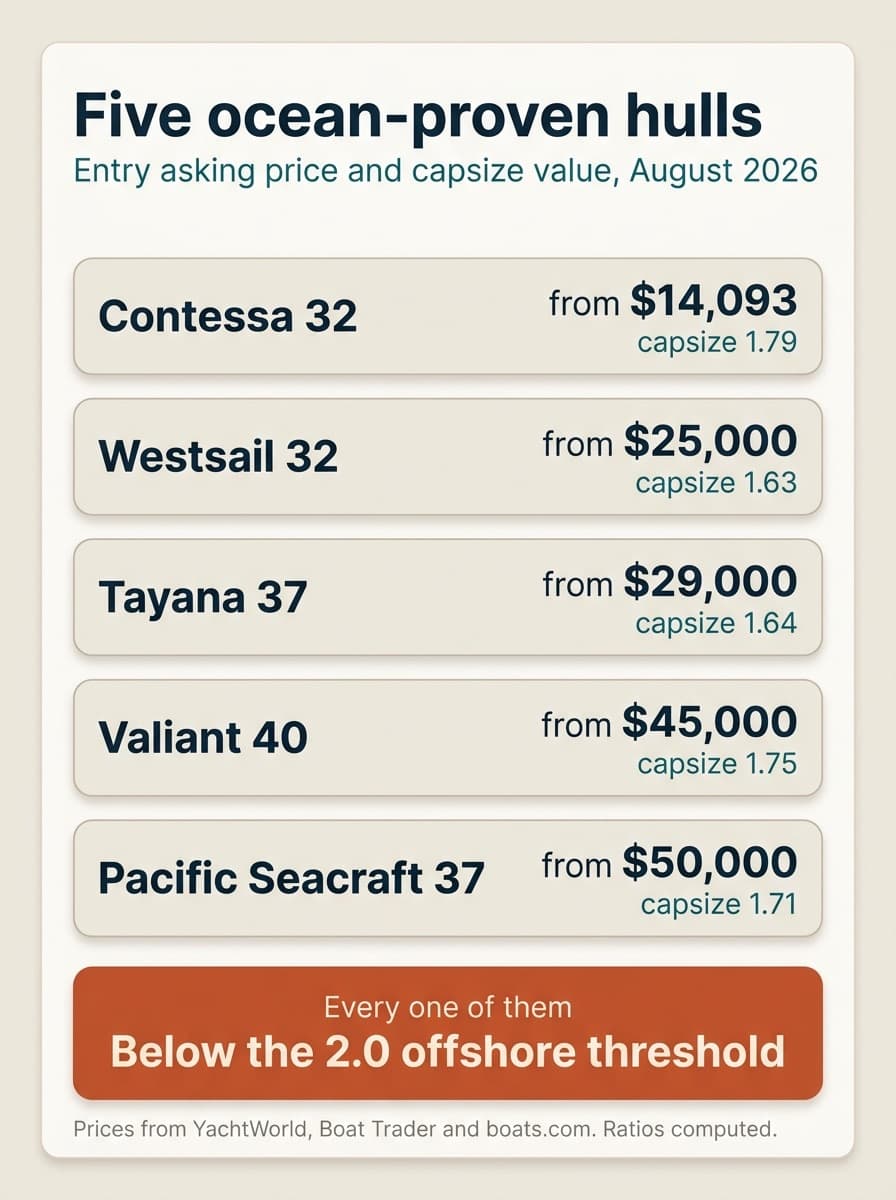
Asking prices from YachtWorld, Boat Trader and boats.com, August 2026. Ratios computed from published displacement, waterline, beam and ballast figures.
Two notes on method, because the numbers should be checkable. Published sail areas are not all on the same basis, some being 100% foretriangle and some total, so sail area ratios are indicative rather than strictly comparable across boats. And the computed Valiant 40 figures come out at 1.75 capsize and 34.0 comfort against published values of 1.74 and 34.29, which is the sort of agreement that tells you the arithmetic is sound.
For comparison, the Catalina 30 screens at 2.0 and the Catalina 36 at 1.93. Good coastal cruisers, and you can see the gap.
What size boat do you need to cross an ocean?
Smaller than the internet suggests. The Contessa 32 on this list has a 24-foot waterline and finished the 1979 Fastnet when boats twice her value did not. Thirty-two to forty feet is the practical range for a couple, and the limit is usually stores and motion, not safety.
Bigger boats are faster, drier and carry more, which shortens passages and makes them more comfortable. Bigger boats also cost more at every single line: berth, haul-out, antifouling, sails, ground tackle, insurance.
The real constraint is that you have to sail her shorthanded when you are tired. A 40-footer that exhausts a couple is less safe than a 32-footer they can handle.
Read the comfort ratio column above as the motion column. That is where length genuinely buys you something.
What a bluewater boat costs after you buy her
Every boat on this list is thirty to fifty years old. The purchase price buys the hull. The offshore-readiness is a separate budget, and on a $40,000 boat it is routinely a five-figure one.
None of these prices is the cost of the boat. They are the cost of starting.
A forty-year-old hull with a good capsize number still needs standing rigging within its ten-year life, through-hulls you would trust in a gale, tankage that has been opened and inspected, and ground tackle sized for anchoring off somewhere with no marina.
The true-cost guide explains how to price that catch-up bill on any hull, and the rule of thumb it lands on is that annual ownership runs 10 to 15% of the boat's value per year before you have crossed anything.
Then there is the survey, which on a boat you intend to take offshore is not optional and is not cheap. The survey cost guide breaks the day down line by line.
The honest framing: a $45,000 Valiant 40 and a $45,000 Valiant 40 with a blistered hull and twelve-year-old rigging are the same listing price and about $30,000 apart in one-off blister repair and re-rigging.
How Knotworth reads a specific listing
This page tells you which designs are worth your time. The product tells you what one particular boat is worth. Paste a listing URL and the free pre-check reads that hull's specification, runs her design numbers, and flags what the advertisement has stayed quiet about.
Every boat on this list is a good boat in the abstract and a completely unknown quantity in particular.
The Westsail might be a professionally finished hull or an owner's kit. The Tayana has no standard interior, so the model tells you almost nothing. And the Valiant's entire value can turn on a hull number that appears nowhere in the advertisement.
That gap between the design and the boat is the whole reason this site exists. The page creates the question, and the product answers it for the specific hull in front of you.
Most usefully, it often answers it with: do not book the flight for this one.
Paste the URL. The free pre-check reads that boat's specs, runs her stability numbers, and flags what the ad leaves out. No card until you unlock a full report.
FAQ
What are the best bluewater sailboats under $100,000?+
The Contessa 32, Westsail 32, Tayana 37, Valiant 40 and Pacific Seacraft 37 all have examples asking under $70,000 as of August 2026, and all five screen below the 2.0 capsize threshold. The Contessa 32 starts around $14,000 and the Tayana 37 has the most boats on the market.
What is the best sailboat for bluewater cruising?+
There is no single answer, because the designs optimise differently. The Westsail 32 is the toughest and the slowest, the Valiant 40 is the fastest, the Pacific Seacraft 37 is the best built and the Contessa 32 is the cheapest proven hull. The Tayana 37 is the easiest to find.
What is the best boat size for blue water sailing?+
Thirty-two to forty feet suits most couples. Smaller boats have crossed oceans routinely, including the Contessa 32 with her 24-foot waterline, and the practical limits are stores and motion rather than safety. Bigger boats are faster and drier but cost more on every line of the budget.
Are bluewater boats any good for coastal sailing?+
They work, but they are compromised for it. Heavy full-keel designs like the Westsail 32 are slow in light air, awkward to manoeuvre under power and expensive to berth for their length, so a coastal cruiser is a better boat for coastal sailing.
What is the safest boat to sail around the world?+
Safety is mostly about preparation, crew and gear rather than the model on the transom. That said, a low capsize screening value, a high angle of vanishing stability, a small strong cockpit and a protected rudder all help, and the Contessa 32's 155° AVS with its 1979 Fastnet record is the clearest evidence on this list.
Do these guides cover catamarans?+
No. This list is monohulls only. Multihull buying is a different market with different stability mathematics, different survey requirements and different berthing costs.