Island Packet Yachts: what the builder does, and what one costs you
By Itzhak Fuhrman·Built and maintains Knotworth's cost model·Updated 11 September 2026
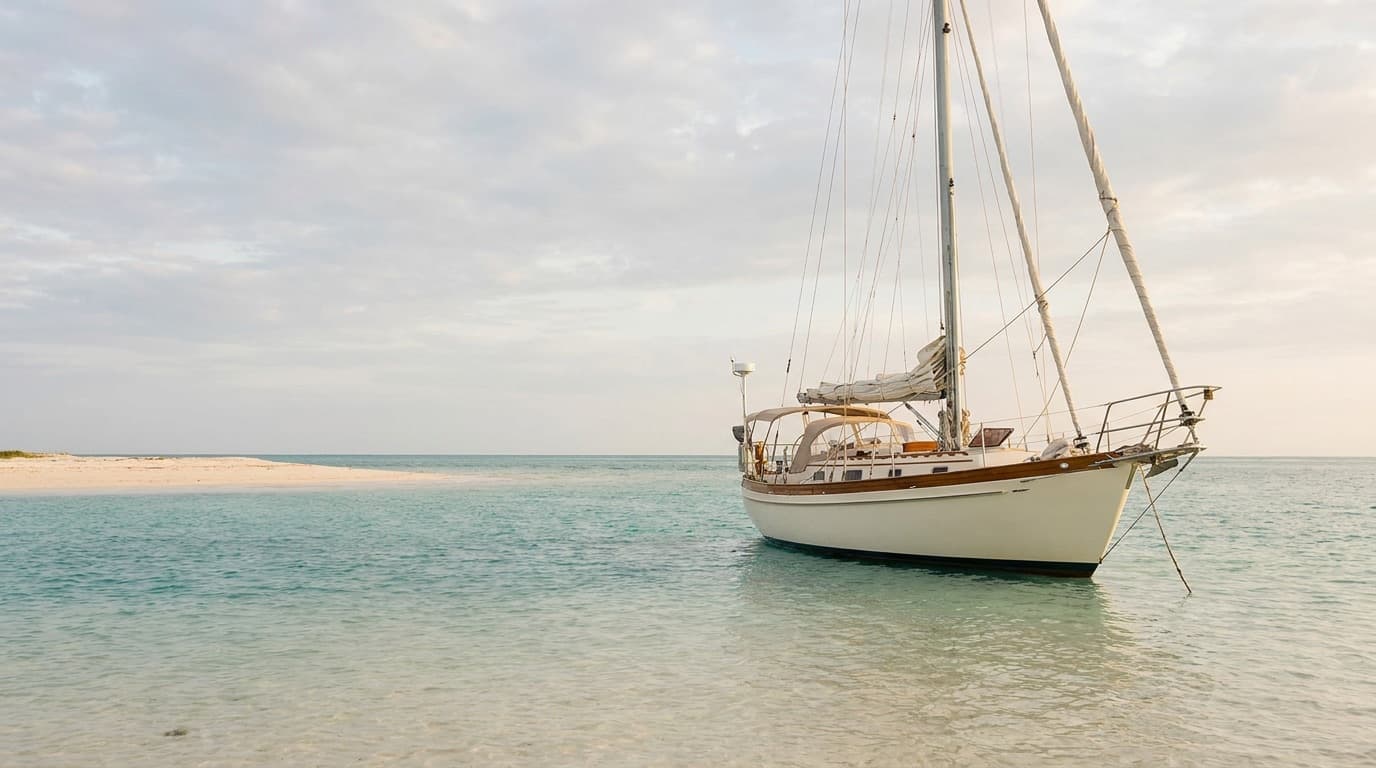
Island Packet is the odd one out among the builders covered in this section, and the reason is simple. The other two are gone.
Catalina paused production in 2025 and its ownership is disputed. Westsail went bankrupt in 1977 and closed for good in 1981. Island Packet is still making boats, in the same town, under the same name, with the same design language.
That changes what you are buying and what you should pay for it. It also puts a sharper edge on the one thing that can undo the premium, which is a chainplate detail on the older hulls that you cannot see.
Is an Island Packet a good boat?
Yes, and the design achieves something unusual: offshore stability numbers on a shoal draft. Run the Island Packet 35 and you get a capsize screening value of 1.85 and a ballast ratio of 46% on a draft of just 4 feet 6 inches. Almost nothing else does both.
| Island Packet 35 | Value | Reading |
|---|---|---|
| Capsize screening | 1.85 | Below the 2.0 offshore threshold |
| Comfort ratio | 31.0 | High. A heavy, easy-motioned hull |
| Ballast / displacement | 46% | Very high. Stiff and self-righting |
| Displacement / length | 289 | Heavy displacement |
| Sail area / displacement | 15.2 | Modest. She is not a light-air flyer |
| Draft | 4'6" | The point of the whole exercise |
Computed from displacement 17,500 lb, ballast 8,000 lb, waterline 30 ft, beam 12 ft and sail area 639.31 sq ft as published. The design ratios guide explains each screen and the free calculators will run them for a specific boat.
Compare that draft against the boats on our bluewater shortlist. The Westsail 32 draws 5'0", the Tayana 37 draws 5'8" and the Valiant 40 draws 6'0". The Island Packet 35 draws 4'6" and still screens below 2.0.
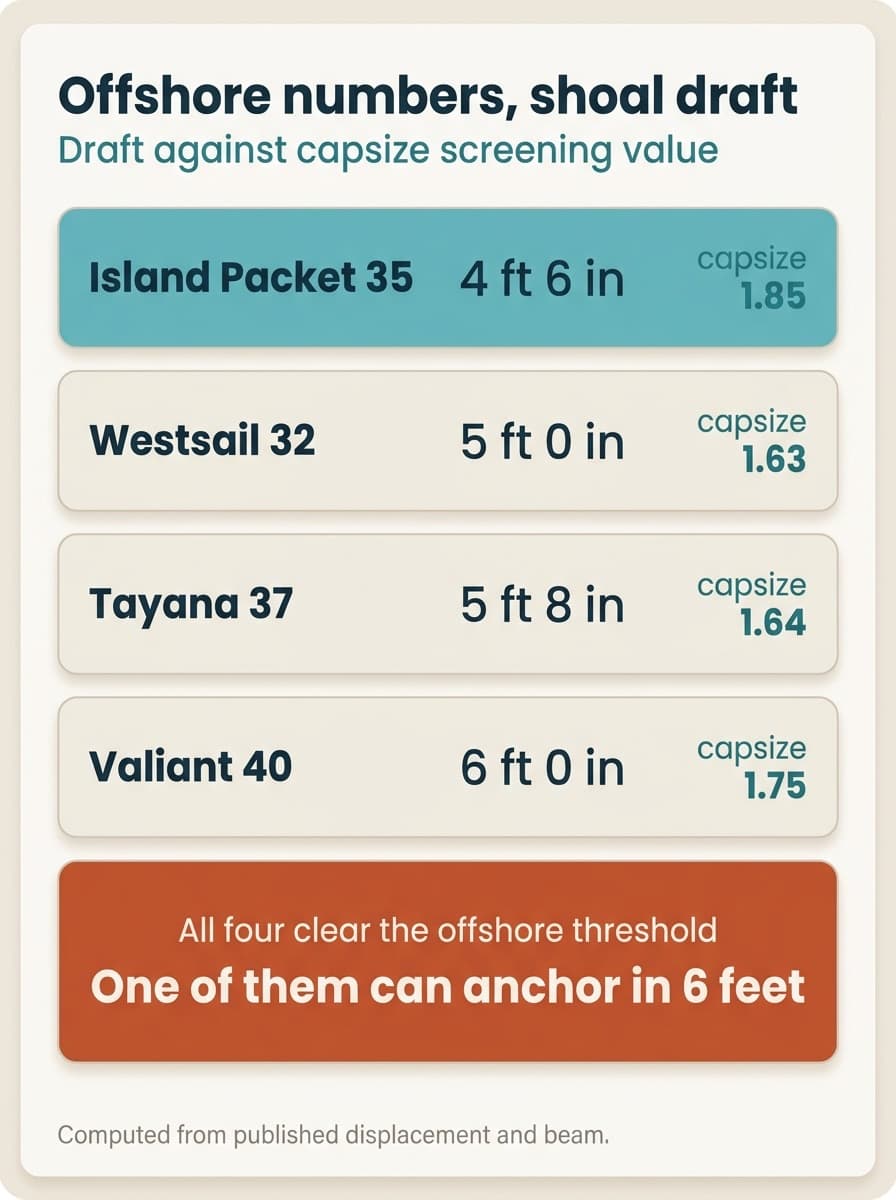
Bob Johnson's Full Foil Keel is how. It is a long shoal keel shaped as a foil rather than a slab, carrying a lot of lead low and wide instead of deep, so the boat gets its stiffness from ballast weight rather than ballast depth.
The rest of the brand signature is consistent across forty-five years: cream-coloured hulls, cutter rigs often carrying a Hoyt Jib Boom to make the staysail self-tending, heavy build, generous tankage, and interiors finished in teak.
The honest limitation is speed. These are heavy boats with modest sail area ratios, and they are slow in light air. You buy an Island Packet to be comfortable and to get into thin water, not to win anything.
Is Island Packet still in business?
Yes. Hake Yachts acquired the parent company in April 2016, and in January 2017 Darrell and Leslie Allen took ownership, having been the San Diego dealer for over twenty-five years. The firm has grown from 13 employees to more than 50 and still builds in Largo, Florida.
The corporate name is Traditional Watercraft, Inc. The Largo site runs to five acres with 52,000 square feet of covered production space, and the yard now builds Island Packet and Seaward.
It is not a legacy operation coasting on a name. The IP349 took SAIL's Domestic Boat of the Year in 2019 and the IP439 took Cruising World's Best Full-Size Cruiser in 2021.
Why this matters when you are buying a 1990 boat: factory support, drawings, moulded parts and institutional memory all still exist. On a Catalina you rely on an independent parts specialist. On a Westsail you rely on a parts company and an owners' association. Here you can call the builder.
That is worth real money, and it is a large part of why Island Packets sell for two to three times what a comparable-length production cruiser of the same age fetches.
It is also why the next section matters so much. A premium brand with a hidden structural issue is a more expensive mistake than a cheap brand with an obvious one.
Looking at one particular Island Packet? Paste its listing. The free pre-check reads that hull’s year, specs and equipment against everything above, rather than leaving you to apply the general case yourself.
Free on every boat, no card. You only pay to unlock a full report.
What are the common problems with an Island Packet?
One issue dominates on 1980s and 1990s boats: chainplates made of 304 stainless and embedded in the fibreglass laminate. Stainless steel needs oxygen to stay passive. Sealed inside wet glass, it corrodes where nobody can see it, and the owners' association and surveyors report failures.
This is the section the listing will not write for you.
| Known issue | What it means, and what it costs |
|---|---|
| Embedded 304 stainless chainplates | On 1980s and 1990s hulls the chainplates were laminated into the structure. Deck leaks let water collect in glass pockets around concealed metal, which drives crevice corrosion, and some have failed. The fix owners make is to refit them externally, through-bolted to laminated and encapsulated pads. External chainplates on an older Island Packet are the single best sign you can see from the dock |
| Rudder delamination | Foam-cored rudders on older models including the 35 and the 350 have developed voids, deformation and skin delamination. Reported by owners and in the reviews cited below across several models and worth a specific look, hauled |
| Deck core moisture | Turns up regularly in pre-purchase surveys on boats of this age. Localised repairs are affordable, a recore is not |
| Chainplate deck leaks | Even where the chainplates are sound, owners commonly report needing to re-bed them to stop water getting in. The leak is what starts the corrosion, so a boat with dry chainplates has been looked after |
| Standing and running rigging age | Ten-year working life. On a 1990 hull the question is how many times it has been done |
| Seacocks, wiring and electronics | The standard ageing list. Tired seacocks and dated wiring show up routinely |
Sources: owner-association and surveyor discussion of the 304 stainless chainplate issue and the external refit; Practical Sailor's Island Packet reviews and SpinSheet's Island Packet 35 review for rudder and deck findings. Assumption: a boat that has not already had the work done.
Read that first row against the price. An Island Packet 35 asks $44,500 to $90,650. A chainplate refit is not a small job on a boat where the old ones are buried in structure.
So on any Island Packet built before about 2000, the first question is not the engine or the sails. It is: have the chainplates been done, and can I see them?
The range
Roughly two dozen sailing models since 1980, in two eras. Two-digit model numbers through the mid-1990s, three-digit ones after. No single model reaches the volume that would justify its own guide here, so this hub covers the range and each model gets a section rather than a page.
| Model | Years | Notes for a buyer |
|---|---|---|
| 26 Mk I and Mk II | 1980, 1982 | The first boats. Small, rare, and the earliest construction |
| 29 | 1981 to 1997 | Long run, so hulls vary considerably by year |
| 31 | 1983 to 1989 | Popular small cruiser. Firmly in the embedded-chainplate era |
| 27 | 1984 to 1992 | Reviewed by Practical Sailor. A lot of boat for the length |
| 38 | 1986 to 1995 | The bigger two-digit cruiser, 390 searches a month |
| 35 | 1988 to 1994 | 178 built. The highest-volume search term and the model we ran the numbers on |
| 32 | 1989 to 1995 | Fixed keel or centreboard |
| 44, 40, 37, 45 | 1991 to 1995 | The larger end of the two-digit era, small production runs |
| 350, 320, 380, 370, 360 | 1996 onward | The three-digit era. Later chainplate practice, higher prices |
| 420, 440, 445, 460, 465, 485 | 1999 onward | Large cruisers. Well into six figures used |
| 349, 439 | 2018, 2021 | Current production. Award winners |
Out of scope, deliberately. Island Packet also built the Packet Cat 35, a catamaran, and the SP Cruiser and Estero, which are motorsailers, plus two powerboats. This section covers monohull sailboats only, so none of those appear above.
Why no model pages. Our rule is that a model earns its own guide when the bare model name draws at least 500 searches a month in the US and we can write three things true of it and false of its siblings. The Island Packet 35 tops out at 480, the 38 at 390, the 31 and 27 at 260 each.
More to the point, the second test fails harder than the first. These models differ mainly by length. The chainplate story, the Full Foil Keel, the rudder question and the shoal-draft proposition are all brand-level facts, which is exactly what a brand hub is for.
What does an Island Packet cost?
Across the whole range, $20,500 to $735,000. The sweet spot for a used ocean-capable boat is the two-digit era: an Island Packet 35 asks $44,500 to $90,650, with 1989 and 1990 boats clustering around $44,500 to $54,900.
| Asking price | The boat |
|---|---|
| $44,500 | 1989, Treasure Island, Florida |
| $49,000 | 1990, Highland Beach, Florida |
| $54,900 | 1989, South Beach, Florida |
| $75,000 | 1989, Melbourne, Florida |
| $79,900 | 1994, Panama City, Florida |
| $90,650 | Top of the current Island Packet 35 range |
Broker asking prices from YachtWorld, Boat Trader and boats.com, August 2026.
Look at the 1989 boats. There are three of them at $44,500, $54,900 and $75,000, a spread of nearly 70% on the same model in the same year in the same state.
That spread is not the year and it is not the length. It is refit history, and on this brand the most expensive item on that list is invisible from a photograph.
The true-cost guide sets out how to price the catch-up bill on any hull, working from 10 to 15% of the boat's value per year for ongoing ownership. On an Island Packet the purchase premium buys you a better boat, not a lower running cost.
What to check before you buy one
Look at the chainplates first and decide everything else afterwards. Then the rudder, hauled, and the deck. On a brand this well built, the failures are specific rather than general.
The survey cost guide breaks the survey day down line by line. On a pre-2000 Island Packet, make sure the surveyor is specifically briefed on the embedded chainplate issue, because it is not something a general once-over will catch.
Ask, before you travel:
- Are the chainplates original and embedded, or have they been refitted externally?
- If refitted, by whom, in what year, and is there an invoice?
- Have the chainplates ever leaked, and when were they last re-bedded?
- Has the rudder been inspected or rebuilt, and is there any sign of delamination?
- Any deck core moisture, and where?
- When was the standing rigging last replaced?
- Fixed keel or centreboard, and if centreboard, does it work?
- Has the factory in Largo ever done work on her?
None of those is answered in a typical listing. All of them change the number you should offer.
How Knotworth reads a specific Island Packet
This page describes the builder. The product reads the boat. Paste a listing URL and the free pre-check pulls that hull's specification, runs her design numbers, and flags which of the known issues above the advertisement is quiet about.
Three 1989 Island Packet 35s, same state, asking $44,500, $54,900 and $75,000. One of those is a bargain, one is fairly priced and one is a chainplate refit waiting to happen, and the photographs will not tell you which.
That is the gap this product exists to close. The page creates the question, and the pre-check answers it for the specific hull in front of you, often with the most valuable answer of all: do not book the flight for this one.
Paste the URL. The free pre-check reads that boat's specs, runs her design numbers, and flags what the ad leaves out about the chainplates, the rudder and the rig. No card until you unlock a full report.
FAQ
Is an Island Packet a good boat?+
Yes, and unusually so for shoal-water cruising. An Island Packet 35 has a capsize screening value of 1.85 and a ballast ratio of 46% on a draft of only 4 feet 6 inches, which is a combination very few designs achieve. The trade is speed, since these are heavy boats with modest sail area.
Is Island Packet still in business?+
Yes. Hake Yachts acquired the parent company in 2016 and Darrell and Leslie Allen took ownership in January 2017, growing the yard from 13 to over 50 employees. It still builds in Largo, Florida, and the IP439 won Cruising World's Best Full-Size Cruiser in 2021.
What are the common problems with an Island Packet?+
The main one is on 1980s and 1990s hulls, where chainplates of 304 stainless were embedded in the laminate. Water from deck leaks collects around the concealed metal and causes hidden crevice corrosion, and some have failed. Rudder delamination on older models and the usual deck core moisture are the other recurring items.
How much does a used Island Packet cost?+
From $20,500 to $735,000 across the whole range. An Island Packet 35 from the late 1980s or early 1990s asks roughly $44,500 to $90,650, with refit history explaining most of that spread.
Why are Island Packets more expensive than other used cruisers?+
Heavy construction, high ballast ratios, generous tankage and a builder that is still trading and can still support the boats. Factory support on a thirty-five-year-old hull is rare and it is priced in.
Which Island Packet should I buy?+
For most buyers the two-digit models from the late 1980s and early 1990s offer the most boat for the money, with the 35 and the 38 the most searched. Whichever you choose, the chainplate question matters more than the model number.
Is the Island Packet a newspaper or a boat?+
Both names exist. The Island Packet is also a daily newspaper serving Hilton Head Island and Bluffton, South Carolina. This guide is about Island Packet Yachts, the sailboat builder in Largo, Florida.