Beneteau sailboats: what the builder does, and what one costs you
By Itzhak Fuhrman·Built and maintains Knotworth's cost model·Updated 12 October 2026
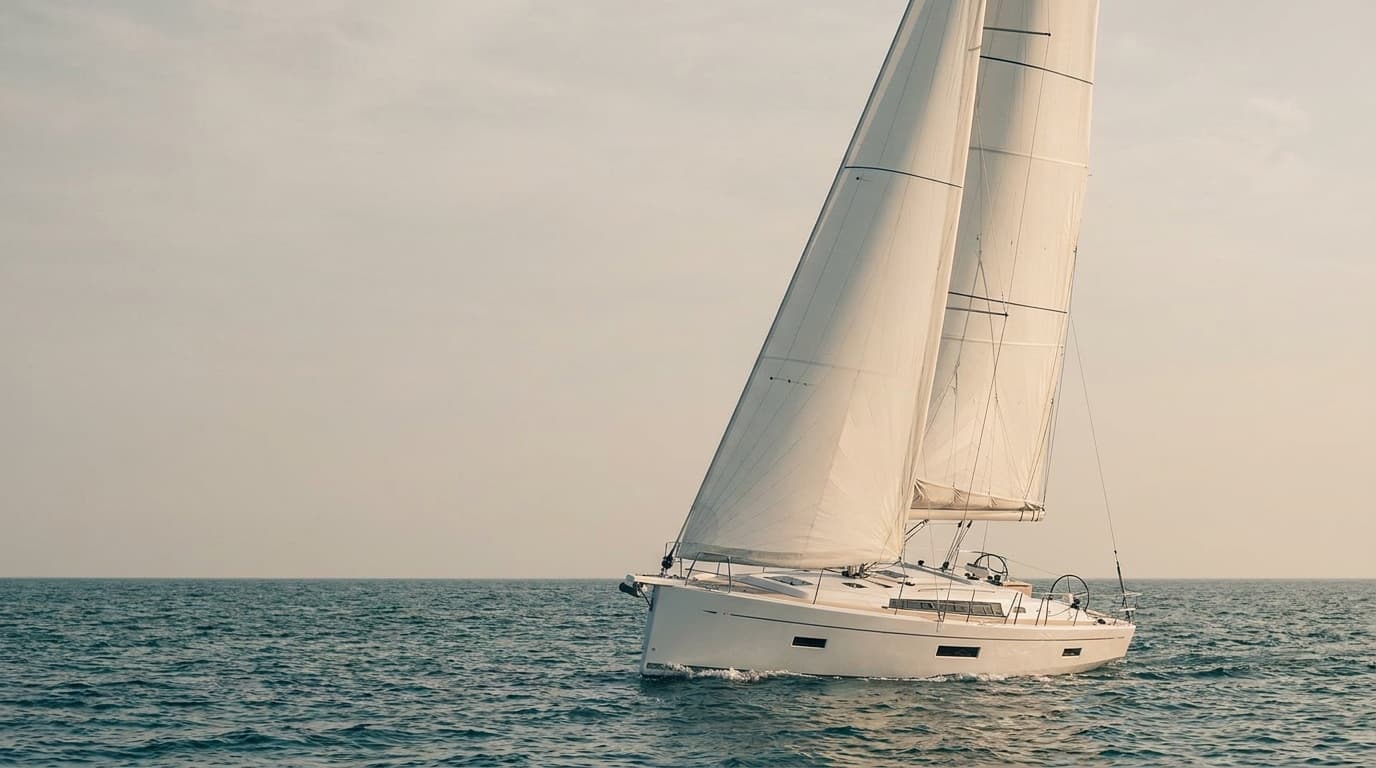
Search this brand and Beneteau answers you. Three of the top ten results are beneteau.com, and the company has been marketing boats since 1884, so it is good at it. It is also the largest of the builders covered in this section, by a long way.
What the first page does not contain is anyone independent answering the question the search results themselves show people asking: "what are the common problems with Beneteau sailboats?"
That question has a real answer, it is more specific than the internet's usual sneering about production boats, and it changes which questions you ask a seller.
Are Beneteau sailboats good quality?
They are well engineered, comfortable, quick for their type and built efficiently to a price. They are not heavily built, and they are not offshore boats in standard trim. A summary that recurs on owner forums is also the fairest: nothing particularly robust, but a lot of comfort for the money.
Beneteau's proposition has been consistent for decades. You get more interior volume, more light, more speed and more modern systems per dollar than almost anyone else can deliver.
The trade is structural mass. These are light boats by the standards of the bluewater shortlist, with fin keels, spade rudders and laminates that, by the standards of the heavier boats on that list, are engineered to be sufficient rather than generous.
That is a legitimate engineering choice for the coastal and charter sailing most owners actually do, and it is why a Beneteau sails better in ten knots than a Westsail ever will.
It is also why the Catalina comparison is closer than the Island Packet one. Both Beneteau and Catalina build value-engineered coastal boats. Beneteau does it with more style and more speed, and rather more of them.
What you are not buying is the Cape Dory or Westsail proposition of heavy scantlings and low capsize numbers. If you want that, buy that.
What are the common problems with Beneteau sailboats?
One structural theme dominates, and it is about how the boat is built rather than how it wears. The hull's stiffness comes from a separately moulded structural grid bonded into the hull, the keel bolts to that grid, and the bond between grid and hull is not visible during a survey.
This is the section the listing will not write for you.
How the boat is put together, in one paragraph. Modern production sailboats, Beneteau included, use an inner moulding or "pan" system. The structural grid, an egg-crate of longitudinal and transverse members, is moulded separately and bonded into the hull, and it carries the mast, rigging and keel loads into the structure.
The keel then bolts through the flanges of that grid rather than directly to a solid hull laminate. On a Beneteau 40, that is eleven bolts.
Why this matters to a buyer, and it is not what the internet usually says. The system is not inherently weak. It is efficient, it is used industry-wide, and the overwhelming majority of these boats never have a problem.
The issue is inspectability. As marine surveyors note of moulded integral grid systems, the internal hull surface cannot be seen once the grid is in, and those areas are routinely written up as "inaccessible" in survey reports.
So if a boat has been aground hard, the bond between grid and hull can shear, and the damage may not be visible from outside or inside. The documented case is Cheeki Rafiki, a Beneteau First 40.7 lost in the North Atlantic in May 2014 with four crew. The UK Marine Accident Investigation Branch found the keel had detached, that the boat had grounded several times between 2007 and 2011 with inspections and repairs after some of them, and that in yachts built with a bonded internal grid the bond can fail in a way that is hard to detect (MAIB report).
| Known issue | What it means, and what it costs |
|---|---|
| Grid-to-hull bond after grounding | The structural bond can shear without visible external damage. Repairs after a grounding must address the grid, not just the gelcoat. This is the reason grounding history matters more on this brand than on almost any other |
| Keel bolts and the keel joint | Rust staining around the keel bolts or a persistently wet bilge is a serious signal, not a nuisance. On older boats surveyors advise dropping the keel to inspect properly, which is a yard-scale job |
| Aft bulkhead tabbing | Check it from behind the furniture in the aft cabin, where owners report finding problems that the finished interior hides |
| Rudder and steering play | Play at the helm and in the rudder bearings is a recurring owner complaint. Cheap to diagnose, not always cheap to fix |
| Deck core moisture | Standard for age, and the interior liner makes tracing leaks harder than on a boat with an exposed deckhead |
| Corrosion at chainplates, rigging and winches | The usual metal-and-salt story on a boat of any age |
| Liner-hidden systems generally | The clean moulded interior that makes these boats pleasant to live in is the same thing that makes wiring, plumbing and structure hard to inspect and to repair |
Sources: marine surveyor commentary on moulded integral grid systems at yachtsurvey.com, owner reports of grid-liner separation and keel-bolt issues on Sailboat Owners Forums and SailNet. Assumption: a boat whose history you do not yet know.
The single question to ask. Has she ever been aground, and if so, what was done about it and by whom?
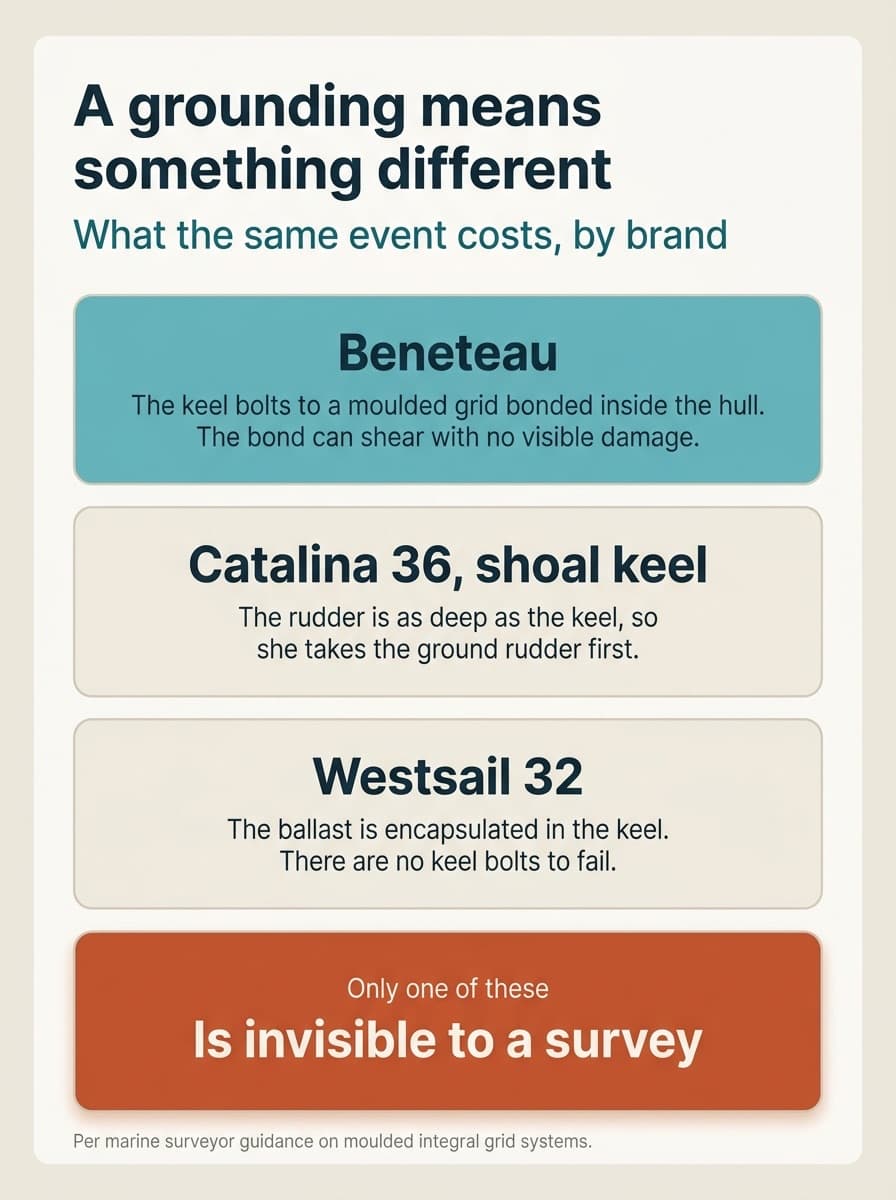
On a Westsail the ballast is encapsulated inside the keel and there are no keel bolts to fail. On a Catalina 36 with the shoal keel, a grounding takes the rudder first. On a Beneteau, a grounding is a question about a bond you cannot see.
Three brands, three different consequences of the same event, and only one of them is answered by looking at the boat.
Looking at one particular Beneteau? Paste its listing. The free pre-check reads that hull’s year, specs and equipment against everything above, rather than leaving you to apply the general case yourself.
Free on every boat, no card. You only pay to unlock a full report.
Where are Beneteau boats made, and does it matter?
France, and for thirty-four years also Marion, South Carolina. The US plant opened in 1986, built over 8,700 boats, and closed in September 2020 with production moving back to France. A used American Beneteau from that window is a real thing and worth identifying.
Beneteau was founded in 1884 at Croix-de-Vie by shipwright Benjamin Bénéteau, building sailing trawlers. His grandchildren Annette Bénéteau Roux and André Bénéteau moved the company to fibreglass in the 1960s.
Today it is a public company on Euronext, and Groupe Beneteau owns a long list of other names including Jeanneau, the catamaran brand Lagoon, plus Excess, Delphia, Four Winns, Wellcraft, Scarab and Glastron.
For a used buyer the build-origin point is practical rather than patriotic. A boat built in Marion for the American market and a boat shipped from France may differ in fit-out, in electrical standards and in what the original dealer supplied.
Neither is better. It is simply a question worth asking, and one that almost never appears in a listing.
The range, and why no model gets its own guide
More than sixty models across the modern range alone, organised as families rather than one-offs. No single Beneteau model reaches the search volume that would justify a page, which is a direct consequence of how the range is structured.
| Range | Introduced | What it is |
|---|---|---|
| Oceanis | 1986, seven generations | The cruising line and the bulk of the used fleet. Volume, light and comfort |
| First | 1976, six generations | The performance line. The First 30 was Beneteau's first sailing yacht in 1977, with nearly 3,000 built in various guises |
| Oceanis Yacht | Modern | The large end of the cruising range |
| Sense | 2010 | Modern cruising, aft-cockpit layouts |
| Figaro | Long-running | One-design offshore racing. Figaro 3 is current |
| First SE | Modern | Lifting keel and removable rudders |
The promotion rule, applied. A model earns its own guide here when the bare model name draws at least 500 US searches a month and we can write three things true of it and false of its siblings.
The best-performing Beneteau model terms are beneteau 40 at 210, beneteau 423 at 170, beneteau 393 at 170, beneteau first 36.7 at 140 and beneteau 361 at 110. Nothing is close.
That is not an accident of measurement. Beneteau's naming runs in families and generations, the models iterate rather than diverge, and the buyer-relevant facts, meaning the grid, the keel attachment, the liner and the build origin, are brand-level facts.
Which is exactly the case a brand hub exists to serve.
What does a used Beneteau cost?
The honest answer is that a single brand-wide range is meaningless across forty years and sixty models. What matters more is depth of market: 1,186 Beneteau sailboats were listed on YachtWorld alone at the time of writing, more than any other brand in this section by a wide margin.
That depth is Beneteau's real advantage to a used buyer, and it works in three ways.
You never have to accept a bad one. Nine Oceanis 361s, six Oceanis 393s and comparable numbers across the popular models were listed at the time of writing. If a boat's grounding history is vague, walk away and look at the next one.
Comparables are easy. Pricing a Westsail 32 means reasoning from four listings. Pricing a Beneteau means reasoning from dozens, so the market price is a real number rather than an estimate.
Resale is liquid. These boats sell. That matters more than most first-time buyers expect, because the day you want out is the day liquidity becomes the whole story.
The countervailing point is depreciation. A volume production boat from a builder still making new ones depreciates the way a car does, unlike a Cape Dory which reached its floor decades ago.
The true-cost guide sets out how to price the catch-up bill on any hull, and the working figure for annual ownership across this site is 10 to 15% of the boat's value per year.
What to check before you buy one
Establish the grounding history first, because on this brand it is the question the survey cannot fully answer. Then the keel bolts, the bulkhead tabbing behind the aft-cabin joinery, and the rudder bearings.
The survey cost guide breaks down what a survey day costs. On a Beneteau, brief the surveyor specifically on the grid and keel attachment, and read the report for the word "inaccessible" rather than skimming past it.
Ask, before you travel:
- Has she ever been aground, at what speed, and what was done afterwards?
- Is there a yard invoice for any grounding repair, and did it address the structural grid?
- Any rust staining around the keel bolts, or a bilge that never seems to dry?
- What does the aft bulkhead tabbing look like behind the furniture?
- Any play at the helm or in the rudder bearings?
- Was she built in Marion, South Carolina, or in France?
- How many owners, and was she ever in charter?
- When was the standing rigging last replaced?
None of those is answered in a typical listing. All of them change the number you should offer.
Worked example: a real Oceanis 41 listing through the pre-check
A 2014 Oceanis 41, shoal keel, asking $185,000 on the US East Coast, 1,462 engine hours, described as lovingly looked after and professionally maintained. Free verdict: worth pursuing; paid report worst case $33,000 over the ceiling; after one round of documented seller answers, provisional, worst case under the ceiling. The question that matters most is whether she has ever touched bottom, and this is the brand where that question is hardest to answer from a survey.
Which Oceanis 41. Finot-Conq's design, built from 2011 to 2015 and then renamed the 41.1. This is the original. The reference record gives a deep draft of 7.15 ft; the listing says 5.08 ft and the ballast, 5,527 lb, matches the shoal-keel figure exactly, so she is the shoal-draft version. The pre-check flagged the draft disagreement rather than merging it, which is the right behaviour and a reminder that "Oceanis 41" describes two keels.
What the listing says. Model year 2014, Yanmar 3JH5CE 40 hp with 1,462 hours, aft cockpit, swim platform, two cabins. Sails and running rigging are mentioned in the text. The standing rigging and the bottom are not.
What the pre-check pulled out of it, free. Specification from the listing (LOA 41 ft, waterline 37.83 ft, beam 13.75 ft, displacement 18,624 lb, ballast 5,527 lb, sail area 883 sq ft from the reference). Design numbers: sail area to displacement 20.1, which it labelled powered-up, ballast ratio 26.2%, displacement to length 154, comfort ratio 24, capsize screening 2.06, hull speed 8.2 knots. Its reading: light performance cruiser, quick and responsive, a sensible match for coastal cruising, and an ambitious first boat.
For a 12-year-old boat it flagged four systems likely due:
- Standing rigging, right at the 12-year mark, listing silent.
- Sails, two years past the 10-year interval, mentioned but undated.
- Running rigging, five years past the 7-year interval, mentioned but undated.
- Barrier coat, right at the 12-year mark, listing silent.
Engine: moderate hours, ask for the service records.
What remains unknown. Grounding history, and with it the condition of the bond between the moulded grid and the hull, which is the structural theme of this whole page. Whether the keel bolts have been torqued and inspected. What is behind the aft cabin joinery. None of that is in a listing, and the pre-check does not pretend otherwise.
Which question matters most. Has she ever grounded hard, and what did the yard do about it. On most brands that is one question among several. On a Beneteau it is the question, because a sheared grid bond is invisible from outside the hull, so the seller's answer and the yard's paperwork are the only evidence you will get before you own her. The rigging and sails are real money, but they are known money.
How the answer changes the assessment. A clean answer, meaning no grounding, or a grounding followed by a documented yard inspection of the grid, turns this into a catch-up-cost boat. From the true-cost guide ranges, which are sized for a 35-footer: standing rigging $6,300 to $10,100, running rigging $1,900 to $3,800, a cruising sail $5,000 to $7,600 each, a survey at $25 to $35 a foot plus the haul. On a 41-footer, budget $18,000 to $28,000 on top of the asking price before improvements. A vague answer on grounding is not a discount conversation. With more than a thousand Beneteau sailboats listed at any one time, it is a reason to look at the next one.
What the $39 unlock added. The full report priced her at $256,411 all-in, range $229,379 to $283,443, against $185,000 asking. On this run the condition read found nothing dated in the text it could use, so all six costed systems sat as unknowns: engine reserve to $17,436 until records confirm, standing rigging to $13,284, sails to $9,800, running rigging to $5,796, ground tackle to $3,350, bottom paint assumed due at $1,956 to $3,840. Sales tax at 6% added $11,100, the survey and haul-out sized to 41 feet about $2,100, and a 15% contingency $27,750. Before a single question was asked, the conservative case sat at $283,443, $33,000 above a $250,000 ceiling, and the conservative case is what the verdict tests. A well-kept 2014 Oceanis 41 asking $185,000 is a $250,000 boat until somebody produces paper.
It then wrote seven questions to the broker: engine hours and records, whether the rig is the original 2014 wire, the age of main and genoa, halyards and sheets, the model-specific electrical failures owners report (bow thruster solenoid, bilge pump, condensation pump), the maintenance log, and any prior survey. Five more were held back for round two.
What the seller's answers did to the number. The reply below is illustrative. We did not contact the broker; it is written the way a well-documented owner's reply reads, so you can see what paper does to the range.
Standing rigging fully replaced August 2023 by a named rigger, invoice available. Halyards and sheets done at the same time. Engine serviced every spring by the yard, last March 2026 at about 1,440 hours, records in the binder, never rebuilt. Main and genoa are the original 2014 Neil Pryde sails, inspected and restitched in 2022. Rocna 25 kg with 200 ft of 3/8 chain, new 2022. Bottom painted April 2025. Never grounded hard, no keel or grid repairs. Insurance survey 2022, report available. Simrad handset replaced under warranty in 2015, no other failures. Log and receipts available.
Logged as round one, the report recomputed. The all-in moved to $229,372, range $220,198 to $238,546, a range about a third as wide. Rigging, halyards, chain, bottom paint and the engine service were credited as done with a year against each. The keel bolts line was logged from the grounding answer at high confidence. The two original sails stayed where they were, original, due now, and became the negotiation case: $2,025 to $7,350 for mainsail and genoa together, class age-based, remedy "price reduction, or documentation that clears it". The contingency fell from 15% to 10% as the share of the boat that was known rose from nothing to 57%.
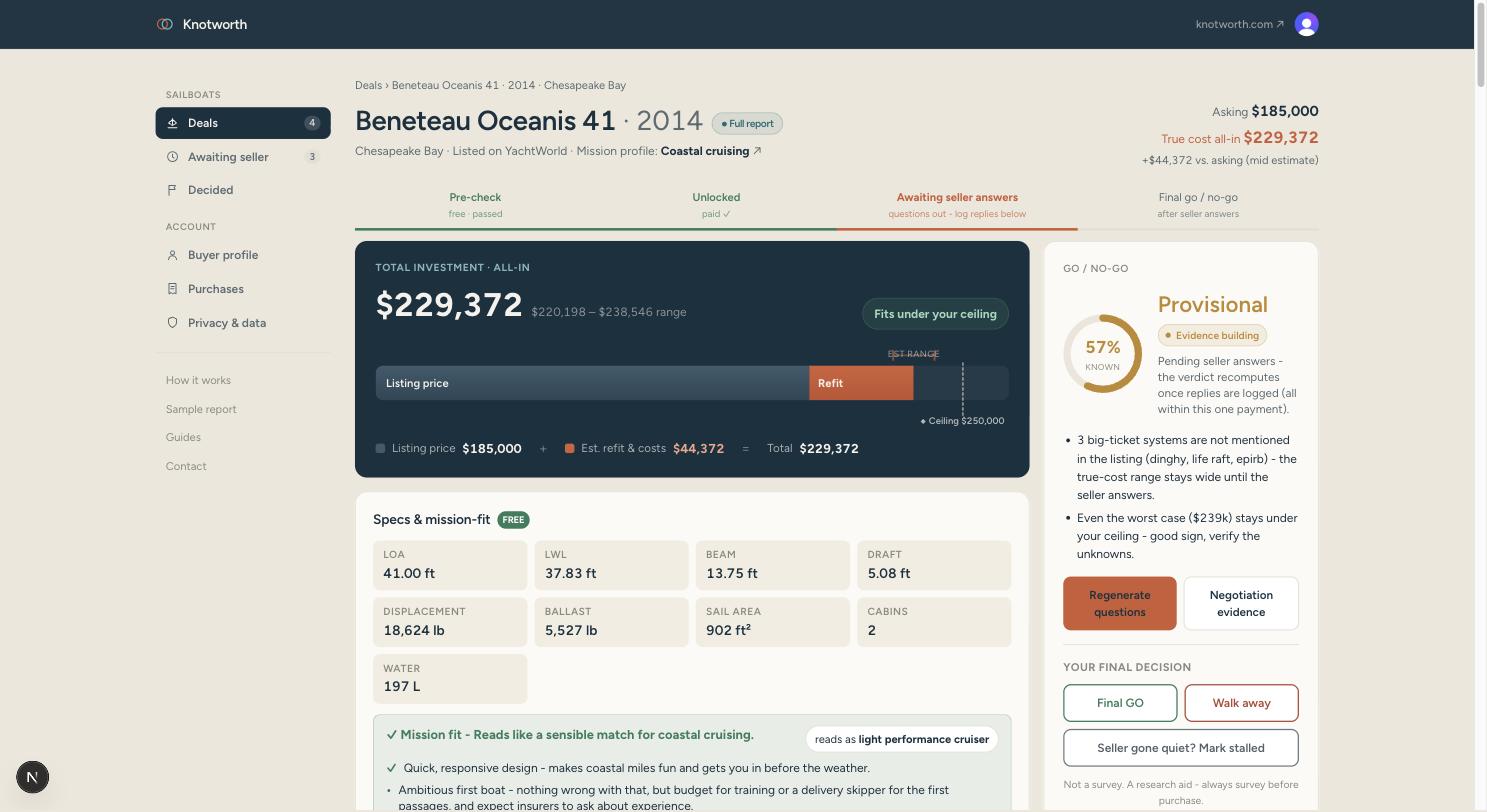
The verdict read provisional: even the worst case, $238,546, stays under a $250,000 ceiling. Same boat, same asking price, same buyer. The only thing that changed was that the seller answered seven questions with dates and paper, and that is worth about $27,000 off the mid estimate, $45,000 off the worst case, and a decision.
The resulting next step. Book the survey, with the report's surveyor brief in hand and the two sails as the opening of the price conversation. The grounding question is the one to press before the haul: the seller's word is logged, the yard's paperwork is what clears the grid bond, and a vague answer here would send this back to we'd pass in one recompute. With more than a thousand Beneteau sailboats listed at any one time, that is a comfortable position to negotiate from.
This listing is one of three compared side by side in what a used sailboat is worth.
How Knotworth reads a specific Beneteau
This page describes the builder. The product reads the boat. Paste a listing URL and the free pre-check pulls that hull's specification, runs her design numbers, and flags which of the known issues above the advertisement is quiet about.
On most brands, the model tells you most of what you need. On this one, the model tells you a great deal and the history tells you the rest, and only one of those appears in an advertisement.
A 2004 Oceanis described as "immaculate, one owner, always professionally maintained" has told you about the varnish. It has not told you whether she has ever touched bottom, what the yard did about it, or whether anyone has looked behind the aft cabin joinery this decade.
Those omissions become the questions, the questions become answers, and the answers become a number you can negotiate on.
Paste the URL. The free pre-check reads that boat's specs, runs her design numbers, and flags what the ad leaves out about the keel, the grid and the rig. No card until you unlock a full report.
FAQ
Are Beneteau sailboats of good quality?+
They are well engineered and built efficiently to a price, delivering more interior volume, speed and comfort per dollar than most rivals. They are not heavily built and they are not offshore boats in standard trim, which is a legitimate design choice for the coastal sailing most owners do.
What are the common problems with Beneteau sailboats?+
The structural theme is the moulded grid that is bonded into the hull and carries the keel bolts. It is not inherently weak, but the bond cannot be seen during a survey, so a hard grounding can shear it without visible damage. Beyond that: keel bolt corrosion, aft bulkhead tabbing, rudder and steering play, deck core moisture, and systems hidden behind the interior liner.
Where are Beneteau boats manufactured?+
In France, and from 1986 to September 2020 also in Marion, South Carolina, where over 8,700 boats were built before production moved back to France. A used American-built Beneteau from that window may differ in fit-out and electrical standards.
Is Jeanneau owned by Beneteau?+
Yes. Groupe Beneteau owns Jeanneau, along with the catamaran brand Lagoon and others including Excess, Delphia, Four Winns, Wellcraft, Scarab and Glastron.
How much does a used Beneteau sailboat cost?+
There is no meaningful single range across forty years and more than sixty models. What matters more is depth of market: 1,186 Beneteau sailboats were listed on YachtWorld alone, so comparable boats are easy to find and market pricing is a real number rather than a guess.
What are the best Beneteau models to buy used?+
The Oceanis range accounts for most of the used cruising fleet and the First range for the performance boats. Rather than chasing a specific model number, filter on history: a boat that has never been aground hard, with rigging renewed this decade, beats a nominally better model with an unknown past.
Can you sail a Beneteau offshore?+
People do, and Beneteau's own Figaro range is built for offshore racing. A standard Oceanis is designed for coastal and charter work though, so treat offshore use as a preparation project and resolve the grounding and keel-attachment questions before you commit to anything demanding.