Cape Dory sailboats: what the builder was, and what one costs you now
By Itzhak Fuhrman·Built and maintains Knotworth's cost model·Updated 11 September 2026
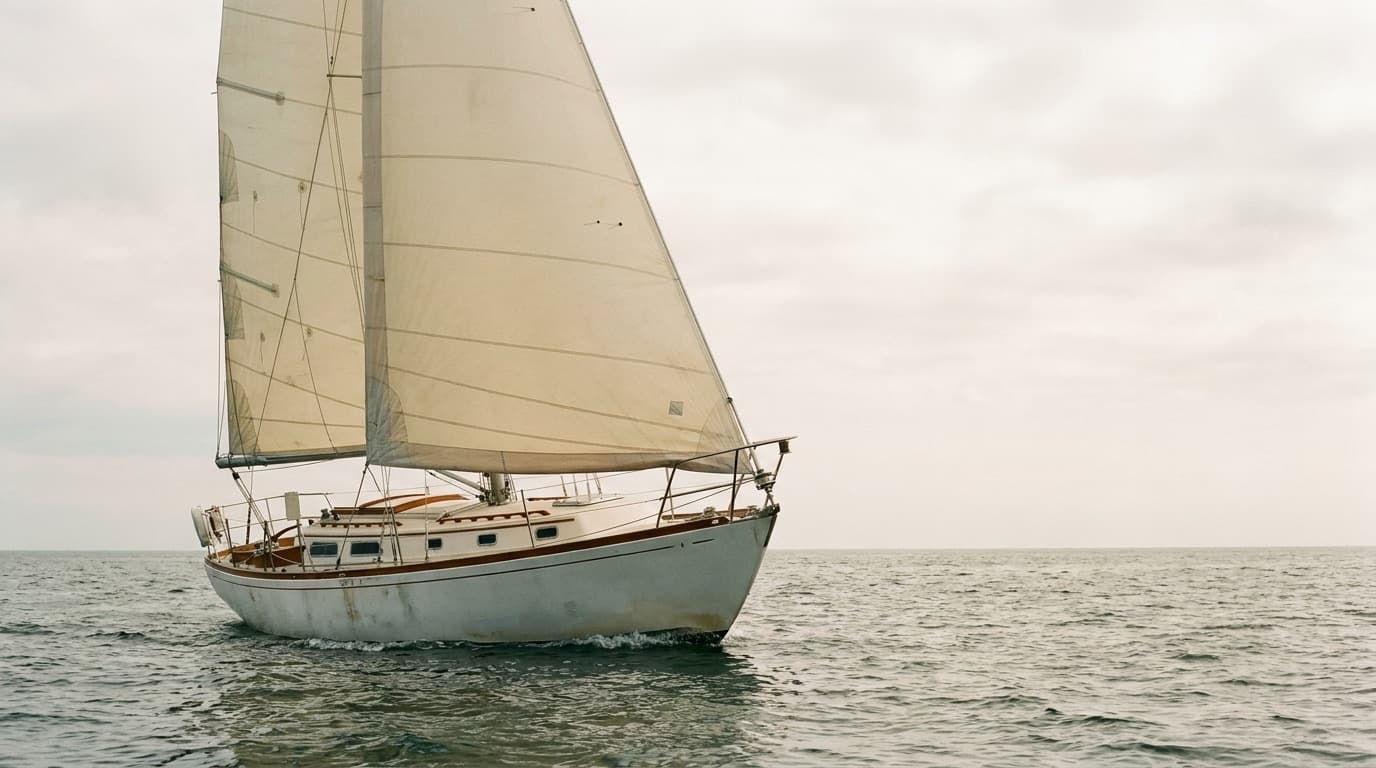
Every brand in this section has an ending. Catalina paused production in 2025 and went into litigation. Westsail went bankrupt owing $10 million.
Cape Dory has the only ending that reads well. The company closed in 1992, its designs passed through a shipyard that itself closed in 1996, and then the founder bought his own hull moulds back and has been building semi-custom boats from them ever since.
For a buyer that is not sentiment. It is the difference between an orphaned hull and a supported one, and it is why these boats hold their money the way they do.
Is a Cape Dory a good boat?
Yes, with a specific and consistent character. Carl Alberg drew every one of them narrow, heavy and full-keeled, so they screen unusually well for their length, they are seakindly, and they are smaller inside than anything else the same size on the dock.
The design signature is easy to spot and never varied much: simple lines, narrow beam, full keel with the rudder attached to it, moderate rig, and a great deal of teak.
Run the numbers on a Cape Dory 28 and the effect is obvious. She screens at a capsize value of 1.71 with a comfort ratio of 31.5, on a 28-foot hull. Those are figures you would expect from a boat seven feet longer.
The mechanism is beam. At about 0.32 times her length, the Cape Dory 28 is proportionally narrower than a Catalina 30 at 0.36 or an Island Packet 35 at 0.34, and a narrow hull with heavy ballast screens well and moves easily.
The bill comes due below decks. These boats have noticeably less interior volume than their contemporaries, less stowage, and less light. Alberg was designing for sea motion, not for a boat show floor.
They are also slow. Displacement to length ratios in the 300s with modest sail plans mean patient passages, and light-air days want an engine.
Who they suit: one or two people who sail in open water, who value motion and simplicity, and who genuinely do not need the space. Who they do not suit: families, entertainers and anyone whose sailing is mostly light-air afternoons.
Is Cape Dory still in business?
Not as the original company. Cape Dory Yachts ran from 1963 to 1992. Its designs went to Newport Shipyards, which closed in 1996, and founder Andrew Vavolotis then acquired the hull moulds and designs through Robinhood Marine, which builds semi-custom yachts from them.
Vavolotis started the business in Bridgewater, Massachusetts in 1963 with a small fibreglass sailing dinghy, the Cape Dory 10. Production later moved to Taunton, where the range grew into cruising yachts from 22 to 45 feet and later into powerboats, trawlers and a few commercial craft.
More than 6,000 sailboats were built across twenty-nine years.
What supports the boats today:
- Robinhood Marine, holding the original moulds and designs, which is as close to factory continuity as an out-of-production brand gets.
- The Cape Dory Sailboat Owners Association at capedorysoa.org, which covers Cape Dory and Robinhood sail and power boats.
- An active owners' forum at capedory.org, where model-by-model knowledge is discussed openly.
That is a stronger support picture than most defunct builders manage, and it is a large part of why these boats hold value.
One naming warning. A separate modern company trades as Cape Dory Cruisers, selling power catamarans and trawlers. It is not the original builder and it has nothing to do with the Alberg sailboats. Do not read its existence as the old company still trading.
Looking at one particular Cape Dory? Paste its listing. The free pre-check reads that hull’s year, specs and equipment against everything above, rather than leaving you to apply the general case yourself.
Free on every boat, no card. You only pay to unlock a full report.
The range
More than a dozen sailing models from a 10-foot dinghy to 45 feet. The Cape Dory 28 is the only one with enough search demand to justify its own guide. Everything else lives here.
| Model | Years | Built | Notes for a buyer |
|---|---|---|---|
| Cape Dory 10 | 1964 to 1983 | 2,260 | A sailing dinghy, not a cruiser. Where the company started |
| Typhoon Weekender | 1967 to 1986 | 1,982 | The 19-foot Alberg daysailer that made the name. Enormous fleet, tiny boat |
| Cape Dory 25 | 1973 to 1982 | 845 | Trailerable pocket cruiser. Well built and affordable |
| Cape Dory 27 | 1977 onward | - | Frequently named on the owners' forum as the best all-round boat the yard built |
| Cape Dory 28 | 1974 to 1988 | 389 to 500 | The one with its own guide. Offshore numbers at 28 feet |
| Cape Dory 30 | 1976 to 1986 | 363 | 480 searches a month, just under our threshold for a page |
| Cape Dory 36 | 1978 to 1990 | 165 | The serious cruiser of the range. Small fleet, strong prices |
| Larger models to 45 ft | 1980s | Small runs | Rare. Expect a long search and thin comparables |
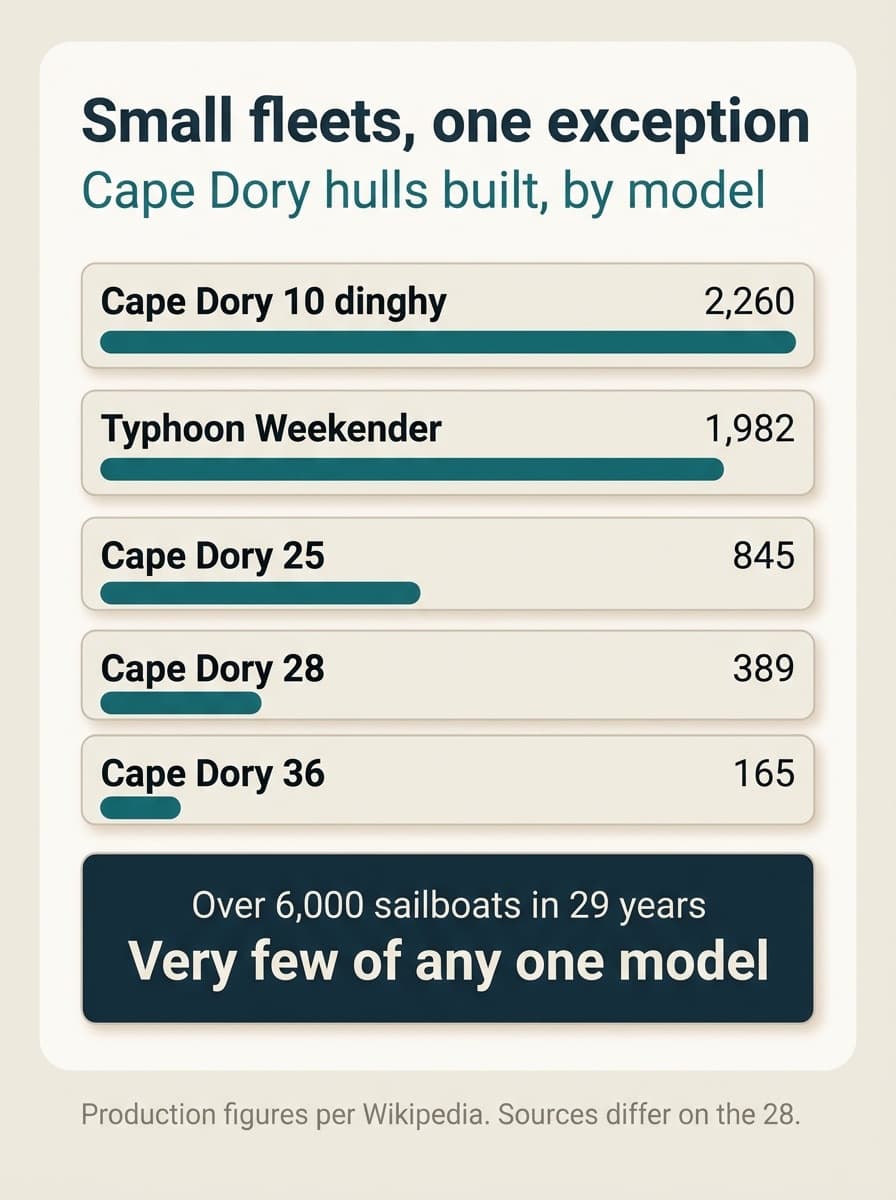
Production figures from Wikipedia. The Cape Dory 28 count differs by source, with Wikipedia giving 389 and SpinSheet nearly 500.
Why only one model page. Our rule is that a model earns its own guide when the bare model name draws at least 500 US searches a month and we can write three things true of it and false of its siblings. The 28 clears it at 720. The 30 misses at 480 and the rest are further back.
The second test is the harder one here, and it is worth being honest about. Alberg's "conservative design style seldom wavered", in SpinSheet's phrase, so a Cape Dory 30 is largely a Cape Dory 28 with more of everything.
That is exactly the situation where separate model pages become filler, and where a brand hub is the right container.
What to check on any Cape Dory
Deck fittings and chainplates first, because gelcoat crazing around hardware is the brand's most consequential tell. Then the fuel tank installation, then the deck core. These are consistent across the range because the construction was.
- Crazing around chainplates and deck hardware. On the 28, SpinSheet warns this can lead to "loss of the rig or injury". Investigate cracks rather than cosmetically filling them.
- Fuel tanks. Steel tanks rust. On the 28, SpinSheet describes aluminium tanks mounted on plywood bases with wooden cleats, which traps moisture against the metal and causes pitting and failure, and owners report the same detail on other models. A construction fault rather than wear, so assume it applies unless someone has changed the mounting.
- Deck core. Plywood and balsa. Water entering through cracked or leaking fittings is the usual route in.
- Osmotic blistering. SpinSheet calls it occasional and usually not severe on the 28, but check and price a barrier coat if it is due.
- Teak, everywhere. These boats carry a lot of exterior timber. Neglected brightwork is not structural, but restoring it is a large number of hours or a large invoice.
- Standing rigging age. Ten-year working life on hulls that are now thirty-five to fifty years old.
The survey cost guide breaks down what a survey day actually costs, and on the smaller Cape Dorys that figure is a meaningful share of the purchase price.
What do Cape Dorys cost?
Across the whole brand, $2,000 to $100,000, with 48 boats listed on Boat Trader at the time of writing. Note that those aggregate figures include Cape Dory powerboats, so filter to sail before drawing conclusions.
The sailboat picture, by size:
- Typhoon and the small boats. Low four figures upward. Often trailer-sailer money.
- Cape Dory 25 and 28. Brokers ask roughly $19,500 to $32,728 for a 28. Private sellers list comparable years at $5,500 to $12,000, the widest broker-to-owner gap on this site.
- Cape Dory 30 and 36. The serious end, and where prices hold up best because the fleets are small and the boats are genuinely capable.
Broker and private asking prices from YachtWorld, Boat Trader, boats.com and SailboatListings, August 2026.
The brand-level point is that Cape Dorys depreciate slowly and then stop. A well-kept Alberg full-keeler has been worth roughly what it is worth now for a long time, which is unusual and which cuts both ways: you will not find a bargain by waiting, and you are unlikely to lose money by buying well.
What you can still get wrong is the condition, and the true-cost guide sets out how to price that. The working figure for annual ownership across this site is 10 to 15% of the boat's value per year.
Where a Cape Dory fits
She is the small-boat answer to the same question the bluewater shortlist asks. Alberg's hulls screen like ocean boats at lengths where almost nothing else does, and they cost a fraction of a 37-footer.
For contrast, an Island Packet gives you the same seakindly heavy character with far more interior volume and shoal draft, at two to three times the money. A Catalina gives you space and speed and does not screen anywhere near as well.
A Westsail is the extreme version of the Cape Dory argument: heavier still, slower still, and unambiguously an ocean boat.
Cape Dory sits between the coastal production boats and the serious offshore ones, at a length and a price most people can actually reach.
Paste the URL. The free pre-check reads that boat's specs, runs her design numbers, and flags what the ad leaves out about the deck, the tank and the rig. No card until you unlock a full report.
FAQ
Is a Cape Dory a good boat?+
Yes, for seakeeping rather than space. Carl Alberg's narrow, heavy, full-keel designs screen unusually well for their length, with the Cape Dory 28 reaching a capsize screening value of 1.71 on a 28-foot hull. They are slow and noticeably smaller inside than their contemporaries.
Is Cape Dory still in business?+
Not as the original company, which ran from 1963 to 1992. The designs went to Newport Shipyards, which closed in 1996, and founder Andrew Vavolotis then acquired the hull moulds and designs through Robinhood Marine, which still builds semi-custom yachts from them.
Who designed Cape Dory sailboats?+
Carl Alberg was the principal designer, and his style barely changed across the range: simple lines, narrow beam, full keel with an attached rudder, moderate rig and a lot of teak.
How many Cape Dory sailboats were built?+
More than 6,000 across twenty-nine years, from the Cape Dory 10 dinghy at 2,260 units and the Typhoon Weekender at 1,982, down to the Cape Dory 36 at 165.
Which Cape Dory should I buy?+
The 28 has the most search interest and its own full guide, the 27 is repeatedly named on the owners' forum as the best all-rounder the yard built, and the 30 and 36 are the serious cruisers. Whichever you pick, the deck-fitting crazing and the fuel tank installation matter more than the model number.
What do Cape Dory sailboats cost?+
From about $2,000 for the smallest boats to $100,000 at the top of the brand, though those aggregate figures include Cape Dory powerboats. A Cape Dory 28 sailboat asks $19,500 to $32,728 through brokers and $5,500 to $12,000 privately.
Is Cape Dory Cruisers the same company?+
No. Cape Dory Cruisers is a separate modern business selling power catamarans and trawlers. It is unrelated to the Alberg sailboats covered here.