Westsail sailboats: what the builder was, and what one costs you now
By Itzhak Fuhrman·Built and maintains Knotworth's cost model·Updated 24 August 2026
Westsail is the rare builder whose story is better known than its boats. A young couple with no boatbuilding experience bought a set of moulds, sold America a dream, and went spectacularly broke doing it.
For a buyer that history is not trivia. It tells you which years to be careful about, why so many of these boats were finished in driveways, and why a company that has been dead since 1981 still has a working parts supply.
This page covers what is true across the range, and Westsail is one of the builders covered in this section. The Westsail 32 has its own guide, because it is the only model with a fleet large enough to justify one.
What happened to Westsail?
It went bankrupt in the spring of 1977 owing around $10 million, restarted under new management, and closed for good in 1981. The boats were selling well the whole time. The company simply could not build them profitably.
The lineage starts with Colin Archer's Norwegian rescue boats, adapted by William Atkin in 1928 into a 32-foot pleasure design called Eric, and refined into Thistle with a bermuda rig and a flush deck.
In 1969 Larry Kendall commissioned William Crealock to convert Thistle to fibreglass. Crealock "did not touch the lines, as they wanted to keep the basic Atkin design." The resulting Kendall 32 sold modestly and the company went insolvent in two years.
In February 1971, Snyder and Lynne Vick bought the moulds. He was a young electrical engineer. By most accounts the couple knew little about sailing and nothing about boatbuilding, and they saw a dream worth selling.
They were right about the dream. Relaunched as the Westsail 32 in 1972, the boat became a national phenomenon, helped enormously by a 1973 Time magazine feature that turned it into shorthand for quitting your job and sailing away. The company's quarterly magazine, Windbag, reached over 5,000 subscribers.
They were wrong about the manufacturing. Despite strong sales and a technical profit the firm could not stay solvent, and announcing the larger 42 and 43 in 1974 made the cash flow worse.
Bankruptcy came in spring 1977, owing roughly $10 million to suppliers, employees, the government and to customers who had paid deposits for boats that were never built. Production limped on under new management until 1981.
Why this matters to you as a buyer: on most builders a later hull is a better hull, because the yard learned. Here the last four years of production came out of a bankrupt company, and owners consistently report the quality problems concentrate in that period.
The usual rule is inverted. On a Westsail, check the year against the bankruptcy.
Can you still get parts for a Westsail?
Yes, more easily than a builder forty-five years dead would suggest. Westsail Parts Company still trades on the original name and stocks model-specific parts, and the Westsail Owners Association holds hull records, technical archives and a for-sale forum. Neither is the builder, and neither is going anywhere.
This is the question that decides whether an orphaned brand is a bargain or a trap, and almost nobody writes it down.
What exists today:
- Westsail Parts Company at westsail.com, which supplies parts and carries brokerage listings.
- The Westsail Owners Association at westsail.org, which keeps hull-by-hull history, technical articles and a members' for-sale forum including unfinished kit boats.
- A large, unusually engaged owner community, a legacy of the kit programme. People who built their own boat tend to know how it goes back together.
Set against that, the honest limitation: most of what fails on a fifty-year-old boat is not brand-specific anyway. Standing rigging, engines, through-hulls, sails and electronics are all generic marine trade items, and no builder's parts counter was ever going to supply them.
The brand-specific risk is narrower than people assume, and it scales with fleet size, which brings us to the range.
Looking at one particular Westsail? Paste its listing. The free pre-check reads that hull’s year, specs and equipment against everything above, rather than leaving you to apply the general case yourself.
Free on every boat, no card. You only pay to unlock a full report.
The range, and why only one model gets its own guide
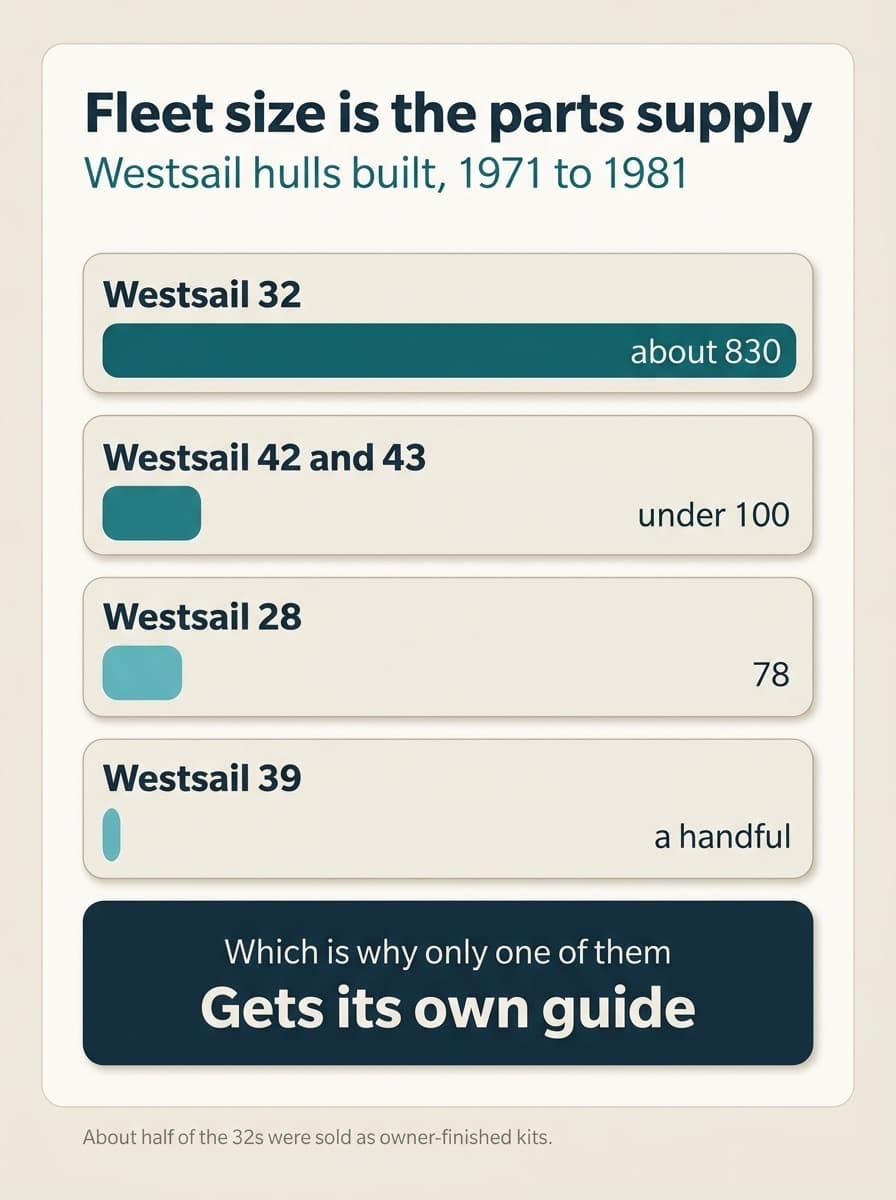
Westsail built five sailing models. The 32 accounts for roughly 830 hulls and everything else is in the dozens. Fleet size is the parts supply and the knowledge base, so within one brand the 32 is genuinely better supported than its siblings.
| Model | Years | Built | What she is |
|---|---|---|---|
| Westsail 32 | 1971 to 1980 | ~830, about half as kits | The icon. Full-keel double-ended cutter, 19,500 lb. The only one with a large fleet |
| Westsail 28 | 1975 to 1979 | 78 | 28'3", 13,500 lb, full keel cutter. Early boats were revised with more ballast and more sail |
| Westsail 42 | from 1974 | Under 100 across 42 and 43 | Centre cockpit. 42'11" LOA, 32,000 lb, 11,000 lb ballast |
| Westsail 43 | from 1974 | Under 100 across 42 and 43 | The same hull mould as the 42, with an aft cockpit instead |
| Westsail 39 | late production | Small | Rarely seen. Treat as a one-off for parts purposes |
After the company closed, a firm called Jomarco built three more 42s and six more 43s from the moulds.
Now apply that to buying. 78 Westsail 28s exist. There is no meaningful market to compare against, few owners to ask, and any model-specific part is a hunt.
The 32 is the opposite: 830 hulls, an active association, a parts specialist and a steady flow of boats for sale, so you can afford to walk away from a bad one.
That is why this section has one Westsail model page and not five. A page on the Westsail 43 would be the same six paragraphs with different numbers, which is the thing we refuse to publish.
What to check on any Westsail
The hull is the least of your worries and that is unusual for the age. Check who finished her, check the year against the 1977 bankruptcy, and check the exposed spars that a sloop does not have.
The Owners Association's own position is that the boats "have never had any serious problems with the fibreglass lamination," beyond the blistering that has affected almost every fibreglass hull of the era. That matches what surveyors report.
So the risks sit elsewhere:
- Factory or kit? About half of all Westsail 32s were owner-completed. This changes the value of the boat more than any other single fact, and it is almost never in the listing.
- What year, relative to 1977? Late boats came out of a company in bankruptcy.
- The bowsprit and the boomkin. Two load-bearing timber structures a sloop does not have, both exposed, both carrying rig loads.
- The engine. Original Atomic 4 petrol engines are still out there. A diesel conversion is a five-figure job on a boat worth $35,000 to $45,000.
- Deck core and chainplates. Standard for the age. On these boats the chainplates are bolted outside the hull, so at least you can see them.
- The berth length. Every Westsail carries appendages well beyond her nominal length. See the Westsail 32 guide for what that costs annually.
What do Westsails cost?
Across the whole range, $25,000 to $110,000. The 32 sits at the bottom of that at $25,000 to $50,000, and the bigger boats carry the top of it.
Broker asking prices from YachtWorld and Boat Trader, August 2026.
Two things drive price inside the range and neither is the year. The first is who finished the boat. The second is what has been renewed this decade, since standing rigging, sails and engines all have finite lives and all of them are past due on an untouched hull.
The true-cost guide sets out how to price that catch-up bill, and the working figure for annual ownership is 10 to 15% of the boat's value per year.
For heavy full-keel boats there is a wrinkle worth knowing. They are cheap to buy and not proportionally cheap to keep, because berthing, hauling and antifouling all scale with size and weight rather than with purchase price.
A $30,000 Westsail 32 and a $90,000 modern 32-footer cost roughly the same to haul out.
Where a Westsail fits
She is a serious ocean boat at the price of a coastal one, and she is slow. If you are going somewhere, that trade is excellent. If you are daysailing at weekends, it is a bad one.
The Westsail 32 has the lowest capsize screening value and the highest comfort ratio of the five boats on our bluewater shortlist, and the lowest sail area ratio of the five. Those three facts are the same fact.
For contrast, a Catalina 30 of similar size and price is faster, roomier, lighter and much easier to sell, and it is not a boat to cross an ocean in.
Choose the mission first. The Westsail rewards one kind of sailing and punishes the other.
Paste the URL. The free pre-check reads that boat's specs, runs her design numbers, and flags what the ad leaves out about the build, the year and the rig. No card until you unlock a full report.
FAQ
Are Westsail sailboats good boats?+
For ocean cruising, yes, and unusually so for the money. They are heavy full-keel double-enders with thick hand-laid hulls and encapsulated ballast, and the Westsail 32's capsize screening value of 1.63 is among the best available used. They are slow, which is why owners call them Wet Snails.
What happened to Westsail?+
The Westsail Corporation went into bankruptcy in spring 1977 owing roughly $10 million, restarted under new management, and ceased operating entirely in 1981. Sales were strong throughout, but the company could never build the boats profitably.
How many Westsail 32 were made?+
Roughly 830 between 1971 and 1980, of which about 400 were sold as kits for owners to finish. That makes it by far the largest Westsail fleet, against 78 Westsail 28s and under 100 of the 42 and 43 combined.
Can you still get parts for a Westsail?+
Yes. Westsail Parts Company still trades under the original name and supplies model-specific parts, and the Westsail Owners Association holds hull records and technical archives. Most of what fails on a boat this age is generic marine equipment anyway.
What is the average price of a Westsail 32?+
Broker listings run $25,000 to $50,000, averaging around $42,450 in August 2026. Across the whole Westsail range, including the 42 and 43, asking prices run to $110,000.
Which Westsail should I buy?+
The 32 for almost everyone, because the fleet is large enough that parts, knowledge and comparable boats all exist. The 28 is rare at 78 hulls and the 42 and 43 are rarer still, so factor in a harder search and thinner support.