Used sailboat value: what a used sailboat is really worth, and why the asking price is not it
By Itzhak Fuhrman·Built and maintains Knotworth's cost model·Updated 12 October 2026
Search for used sailboat value and you get two kinds of answer. One is written for sellers and tells you how to get the most for the boat you own. The other is a table of listing medians, which tells you what people are asking, not what a boat is worth.
Neither one answers the question you actually have, which is whether the boat you found on Friday night is worth the number on the listing.
This guide answers that. It gives you real asking prices for eleven popular used models, pulled from the brokerage market in October 2026. It explains what the sailboat value guides do and do not know. And then it shows the arithmetic that turns an asking price into a buyer's number, using three real listings we ran through our own pre-check and paid report.
To a buyer, a used sailboat is worth her asking price plus the cost of every dated system the listing does not account for (rigging, sails, engine, bottom), plus the purchase costs of tax, survey and haul-out. On production boats over twenty years old that total runs from a quarter more than the asking price to double it.
How much is a used sailboat worth in 2026?
On the US brokerage market in October 2026, a used production cruiser asks roughly $10,000 to $25,000 at 27 to 30 feet, $20,000 to $60,000 at 34 to 37 feet, and $185,000 to $240,000 for a ten-year-old 41-footer. Within a single model the spread between the cheapest and the dearest listing is routinely three to five times, and that spread is the subject of this guide.
The table below is a pull of every US listing on the first page of YachtWorld's results for eleven models we have written buyer's guides for, taken on 12 October 2026. Asking prices, not sold prices. Nobody outside the brokerages publishes sold prices for sailboats, and the gap between asking and sold on an old boat is usually 10 to 20%.
| Model | US listings | Model years | Lowest | Median | Highest |
|---|---|---|---|---|---|
| Catalina 22 | 1 (see note) | 1981 | $6,200 | $6,200 | $6,200 |
| Catalina 27 | 6 | 1976 to 1985 | $4,900 | $10,199 | $19,000 |
| Catalina 30 | 26 | 1977 to 1992 | $8,900 | $15,500 | $25,000 |
| Hunter 34 | 6 | 1983 to 1997 | $11,000 | $19,430 | $35,000 |
| Cape Dory 28 | 2 | 1983 to 1985 | $22,500 | $23,250 | $24,000 |
| Catalina 36 | 24 | 1983 to 2005 | $19,000 | $32,500 | $97,500 |
| Tartan 37 | 14 | 1977 to 1990 | $19,000 | $35,000 | $89,500 |
| Westsail 32 | 4 | 1973 to 1977 | $25,000 | $42,450 | $46,950 |
| Island Packet 35 | 8 | 1989 to 1993 | $37,000 | $69,750 | $89,900 |
| Beneteau Oceanis 41 | 7 | 2012 to 2016 | $185,000 | $219,000 | $238,000 |
| Jeanneau Sun Odyssey 42 DS | 0 in the US that day | - | - | - | - |
Source: YachtWorld US listings, first results page per model, 12 October 2026. The Catalina 22 barely appears on brokerage sites; the owner-to-owner market asks $2,500 to $7,000, which the model guide covers. The Catalina 36's top price is a 2005 MkII, its bottom a 1983.
Two things in that table matter more than the medians.
The first is that age explains less than you expect. The Catalina 36 column runs from a 1983 boat to a 2005 boat, 22 model years, and the price runs five to one. The Catalina 30 column covers 15 model years and the price runs nearly three to one, with 1985 boats at both ends of it.
The second is that the cheap end of every column is not a bargain column. It is the column of boats whose rigging, sails and engine are about to become your problem. The true-cost guide prices those systems; the point here is that the market has already priced them, roughly, into the spread.
Is there a blue book or NADA guide for sailboats?
Yes. J.D. Power's boat values, the former NADA guide, lists sailboats by make, model and year, and the subscription BUC Used Boat Price Guide gives retail low and high figures with regional and condition adjustments. Both are built on year and model. Neither knows whether this boat's standing rigging is 3 years old or 30, which on a $20,000 boat is the whole price.
The guides are not useless. Surveyors and lenders use BUC, and a J.D. Power lookup will tell you quickly whether a listing is wildly out of line with the market for its year.
What they cannot do is value a specific hull. The inputs are make, model, year and a condition grade you choose yourself. Practical Sailor's guide to the price books describes BUC's adjustments for region and fresh or salt water, and that is as granular as any guide gets.
There is a structural reason for this. A new car's value is set by thousands of near-identical sales a month. A 1985 Catalina 30 is one of a few dozen on the market, each with a different engine history, a different rig date and a different owner's idea of "well maintained." The guide can give you the middle of that cloud. It cannot tell you where in the cloud your boat sits.
So use the guide for one job only: sanity. If the asking price is inside the guide's range for the year, the question is not "is this a fair price" but "what has been deferred." That is a different question, and it needs a different tool.
How fast does a used sailboat depreciate?
Steeply at first, then almost not at all. A surveyor quoted by Practical Sailor puts most of the depreciation in the first two or three years. After about twenty years a mass-produced fiberglass boat stops losing value with age and starts trading on condition alone. The year on the listing then tells you less than the invoice folder.
Yacht designer Chuck Paine's essay on what is happening to sailboat prices makes the uncomfortable version of the argument: most production fiberglass boats over twenty feet have already fallen to roughly what their lead keel is worth, because a fiberglass hull cannot be recycled and a 35-footer can cost more a year to keep than she is worth. He exempts low-volume, high-quality builders, whose boats hold value.
You do not have to accept his whole argument to see what it means for the market table above. The Catalina 30s, Catalina 36s and Hunter 34s are not depreciating any more. The $8,900 boat and the $25,000 boat are the same age. The difference is not time, it is what has been spent.
That has a practical consequence for the way you read any listing on an old boat. Stop asking what the boat has lost. Ask what the boat still needs. A 1988 hull with a 2019 rig, a 2016 mainsail and a rebuilt injector pump is a different financial object from the same hull with none of them, and the guides will give them the same number.
Why two identical sailboats are $9,000 apart
Take the Catalina 30 column from the table and ask what separates the $8,900 boat from the $25,000 one. Both are 1980s boats. Both have the same hull, the same Universal diesel in most cases, the same fin keel and the same known weak points.
The difference is a list of systems with dates on them. From the true-cost guide, at published 2026 rates:
- Standing rigging: $6,300 to $10,100 on a 30-footer, on a 12-year interval.
- Sails: $5,000 to $7,600 each, on a 10-year interval.
- Running rigging: $1,900 to $3,800.
- Engine: a rebuild or repower reserve of up to $14,400 until service records prove otherwise.
- Bottom paint and barrier coat: $960 to $2,160 for paint, up to $7,200 if the hull has never been barrier coated and a surveyor finds blisters.
Add those up and the gap between a boat with everything done and a boat with nothing done is $20,000 to $45,000 on a hull that asks $15,000. Which is why the top of the Catalina 30 column is not overpriced and the bottom of it is not a deal. They are two prices for the same boat at two points on its maintenance cycle.
Every model page in our used sailboat brands section lists which systems that particular boat is known for deferring. The job when you read a listing is to find out which of them have dates.
What is a used sailboat worth to a buyer?
The all-in number: asking price, plus the catch-up bill for every undated system, plus sales tax, survey, haul-out, registration and first-year insurance, plus a contingency for what the survey finds. On three real 2026 listings we ran through our paid report, the all-in came to 24%, 43% and 106% more than the asking price, and the asking price was the smallest unknown on all three.
We ran three live YachtWorld listings through the Knotworth free pre-check and then the $39 full report in September 2026, each under a coastal-cruising profile for two. The full write-ups, with the tool's own output, are on the model and brand pages linked below.
| Listing | Asking | All-in after one round of seller answers | Above asking | How much of the boat was documented |
|---|---|---|---|---|
| 1988 Catalina 30 MkII | $24,595 | $50,615 (range $35,551 to $65,680) | +106% | 69% |
| 2014 Beneteau Oceanis 41 | $185,000 | $229,372 (range $220,198 to $238,546) | +24% | 57% |
| 2010 Jeanneau Sun Odyssey 42 DS | $179,000 | $255,389 (range $234,386 to $276,393) | +43% | 64% |
The seller replies in each write-up are illustrative and labelled as such; the listing analysis, the pricing and the recomputation are the tool's real output.
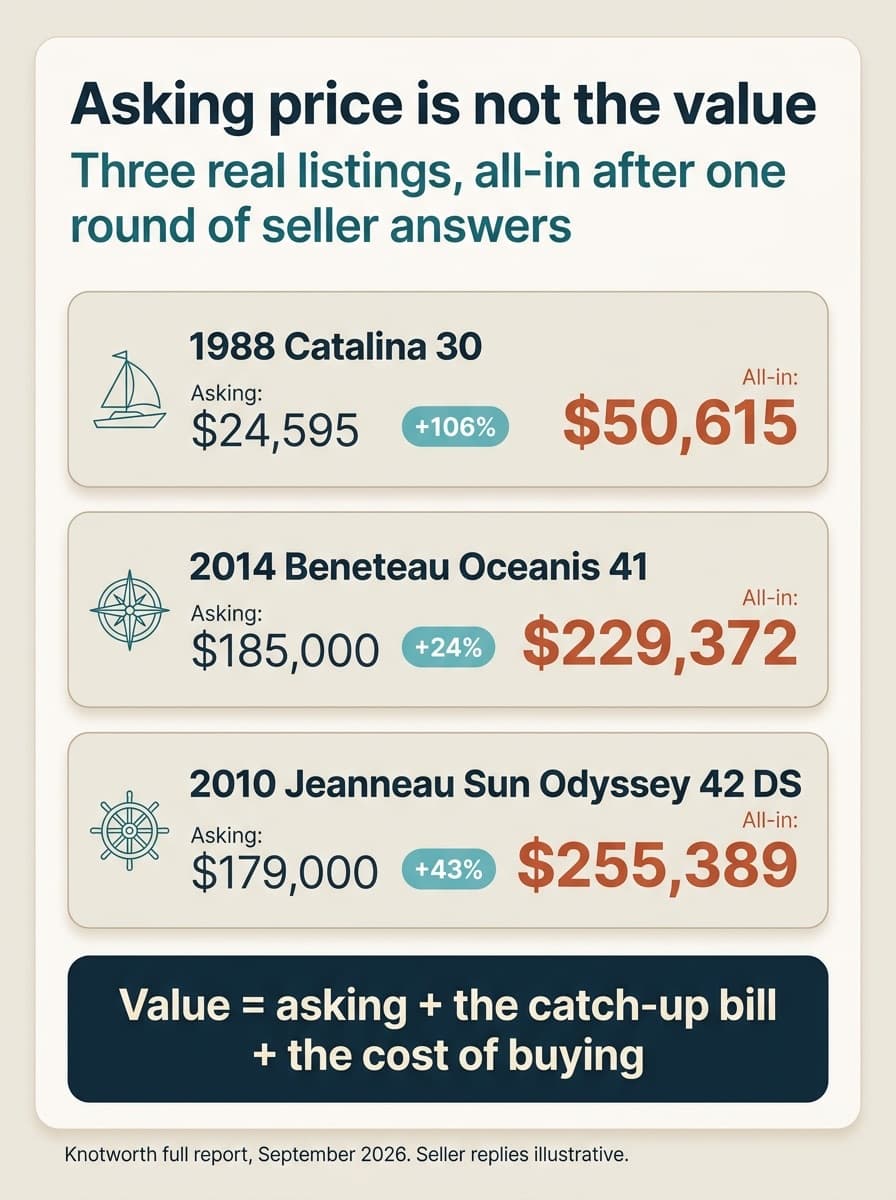
Read the right-hand columns, not the middle one. On the Catalina 30, the all-in is double the sticker because a 38-year-old boat whose listing is silent on rigging, sails, running rigging and bottom carries all four as reserves until someone produces an invoice. One dated rig invoice removed $7,200 from the range at a stroke. That is what "value" means on a boat like this: not a number, but a number with a list of things that would move it attached.
On the Oceanis 41, the opposite. A ten-year-old boat with a 2023 rig invoice, engine records and original sails had a catch-up bill of about $10,000, nearly all of it the two sails. The rest of the gap over asking was sales tax, survey and contingency, and the listing was worth close to what it asked. The report said so, with the sails as the only offer item.
The Sun Odyssey sits between them and makes the third point. At $179,000 she looked like the cheaper of the two big boats. With original rigging at sixteen years and an all-in of $255,389 against a $250,000 ceiling, she was the dearer one. Two listings $6,000 apart on asking price were $26,000 apart on value, in the opposite direction.
How to work out what a specific used sailboat is worth
The guides give you the middle of the cloud. This is how to find out where your boat sits in it. It takes an evening with the listing, not a surveyor, and it is the sequence our buying guide puts before the first phone call.
- Pull the comps for the exact model, same region. Brokerage sites filter by make and model. Note the lowest, the median and the highest, and ignore the year for now.
- List the dated systems in the listing. Standing rigging, sails, running rigging, engine hours and service, bottom paint, barrier coat, batteries, canvas. Write the date beside each one the listing gives. Most listings give two or three.
- Price every system with no date as if it is due. The true-cost guide has 2026 rates by boat length for each. This is the catch-up bill, and it is the number the guides do not have.
- Add the purchase costs. Sales tax in your state, a survey at $25 to $35 a foot plus a short haul (the survey cost guide has the rate cards), registration or documentation, first-year insurance.
- Add a contingency. We use 20 to 25% of the catch-up bill on boats over twenty years old, because the survey always finds something that was not on the list.
- Compare the all-in to your ceiling, not the asking price to the comps. A boat at the bottom of the comps with a $30,000 catch-up bill is over budget. A boat at the top with invoices for everything may be the cheapest boat on the page.
- Ask the seller for the dates, in order of money. Rigging first on an old boat, engine records second. Each answer either removes a reserve or confirms one, and the confirmed ones become the offer.
The free pre-check does steps 2 and 3 from the listing URL. Paste the ad, and it reads the specs, matches the model, lists which systems the listing is silent on, and tells you which one question is worth the most money. The $39 report does steps 4 to 7, re-computes when the seller answers, and builds the offer case from what is confirmed. That is the sailboat value calculator people are searching for, and it is why it starts from a listing rather than from a make and a year.
Have a listing open? Paste it and the pre-check does steps 2 and 3 for that boat, free.
Free on every boat, no card. You only pay to unlock a full report.
Does a used sailboat hold its value?
An old production sailboat holds her value if you buy her caught up and keep her caught up, because the market prices condition, not age. The money you spend catching up a neglected boat does not come back in full at resale. You will sell a boat with a new rig for more than one without, but not for the full cost of the rig.
That is the asymmetry that should shape what you buy. Buying the cheap boat and fixing her is a way to own a boat; it is rarely a way to come out ahead. Buying the well-kept boat at the top of the column means paying for someone else's rig at a discount, which is the best deal in the used market.
It is also why the inspection checklist is mostly about dates and paper rather than tapping the hull. The hull was sound thirty years ago. What you are valuing is everything bolted to it since.
The number to walk in with
Three things from this guide, in the order they save money.
Use the guides and the comps for sanity, not for value. If the asking price is inside the range for the model, the price is not the question.
Value is the all-in: asking, plus the catch-up bill for every undated system, plus the costs of buying. On old production boats that is 25% to 100% over asking, and the asking price is the one number you already know.
Ask the seller for dates before you ask for a discount. Every date either removes a reserve or confirms an offer item, and the confirmed items are the only discount a seller will respect.
Paste the listing URL. The free pre-check reads the specs, flags every dated system the ad is silent on, and tells you which question moves the price most. No card until you unlock the full report.
FAQ
Is there a Kelley Blue Book for sailboats?+
Not from Kelley, but there are equivalents. J.D. Power publishes the former NADA boat values, which include sailboats by make, model and year, and the BUC Used Boat Price Guide sells retail low and high values by subscription. Both price on year and model, so they cannot tell you what one specific boat is worth once she is more than a few years old.
How much is a 30-foot used sailboat worth?+
On the US brokerage market in October 2026, 30-foot production cruisers such as the Catalina 30 ask from about $9,000 to $25,000, with a median around $15,500. The spread inside that range is set by the rigging, sails and engine, not by the model year. Add the catch-up bill for whatever is undated before comparing any two of them.
What is a fair offer on a used sailboat?+
A fair offer is the asking price minus the confirmed cost of what the seller has admitted is due, not minus a percentage. If the seller says the genoa is tired and the sheets are old, those two items are the offer. Unknowns are a reason to survey, not a reason to discount, because a surveyor's finding is the only unknown a seller will negotiate on.
Do sailboats depreciate faster than powerboats?+
Slower, once the first few years are gone. Sailboats have no outdrive or big outboard to age out, and a sound fiberglass hull with a diesel has no fixed life. The result is that a 25-year-old sailboat trades on condition rather than age, while a 25-year-old powerboat is often priced on the age of its engines.
How do marine surveyors value a sailboat?+
A survey report states a fair market value and a replacement value, usually taken from BUC or J.D. Power and adjusted for the condition the surveyor found. The number is written for the insurer and the lender. It is not the all-in cost of owning the boat, which includes the catch-up work the surveyor listed on the other pages of the report.
Should I pay the asking price for a used sailboat?+
Sometimes, yes. A boat with a dated rig, dated sails, engine records and a recent bottom job at the top of her model's range can be cheaper all-in than a boat $8,000 below her with none of them. Pay for paper. The all-in number, not the asking price, is what you are comparing between boats.