Buying a used sailboat: the sequence of decisions, from shortlist to offer
By Itzhak Fuhrman·Built and maintains Knotworth's cost model·Updated 12 October 2026
Every used sailboat purchase runs through the same seven decisions. The difference between a good purchase and an expensive lesson is almost never knowledge. It is sequence.
The buyer who visits a boat before checking the rigging age has already spent the flight. The buyer who commissions a survey before doing their own viewing has spent a thousand dollars learning what their own hands would have told them.
This page is the order. Each decision below says what you are deciding, what it costs to decide it, and where on this site the detail lives.
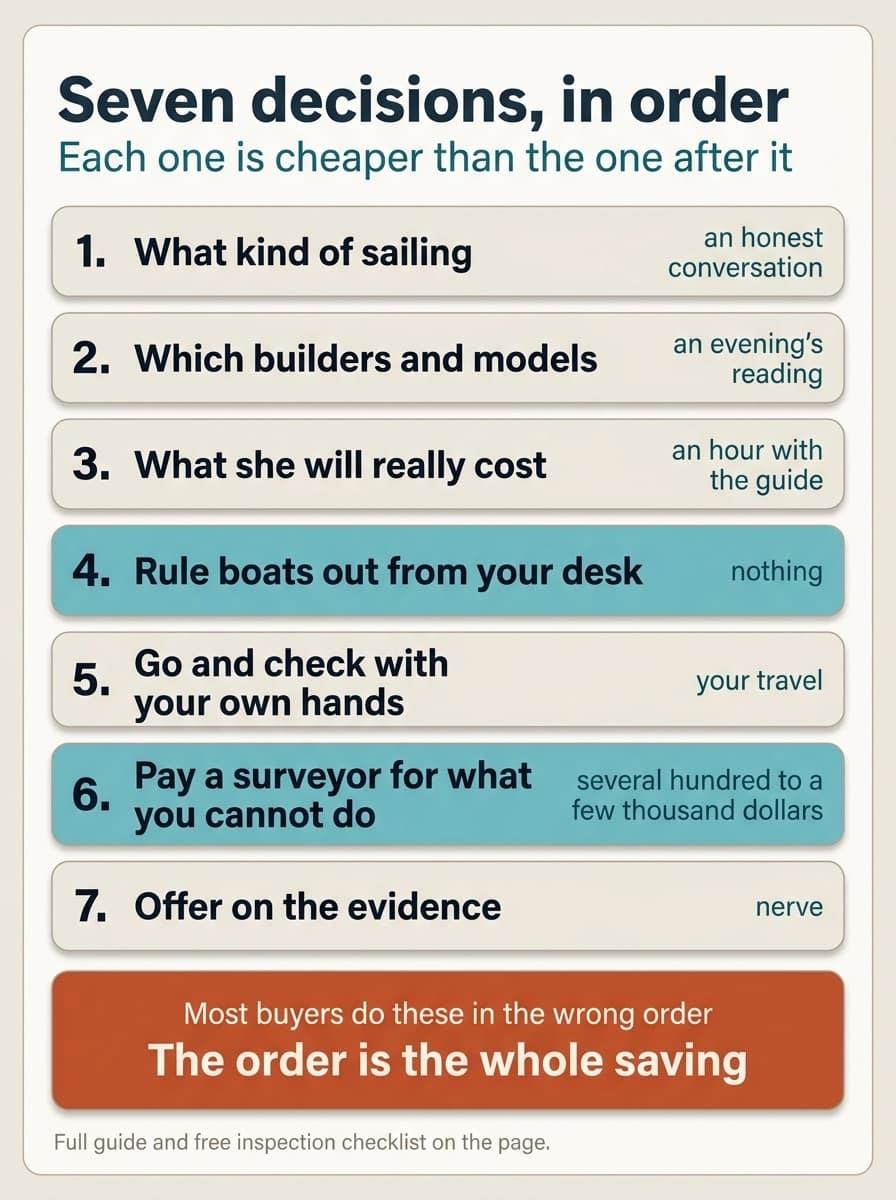
1. What kind of sailing are you actually going to do?
Coastal weekends, a liveaboard at a dock, or open water. This decides everything after it, and it is the decision most buyers skip because the answer they want is "all of it". Costs: an honest conversation. Decides: which kind of boat to look at.
A boat that is excellent for one of those is usually compromised for the others. The heavy full-keel cruiser that shrugs off a gale is slow and cramped for a Sunday afternoon. The roomy production boat that is perfect for a family weekend is not what you want in a gale.
Be specific about the sailing you will do in the first two years, not the sailing you imagine in the tenth.
If open water is genuinely the plan, start with the bluewater shortlist, which lists five proven ocean hulls that can be bought for under $65,000. If it is coastal, the Catalina, Beneteau and Hunter guides cover the boats most people actually buy.
The design ratios guide explains the numbers that separate one kind of boat from another, and why a 28-footer can screen as an ocean boat while a 36-footer does not.
2. Which builders and models belong on your shortlist?
Two or three builders, and within them the models with a fleet large enough that parts, knowledge and comparable boats exist. Costs: an evening's reading. Decides: what you search for.
The brand matters more than most buyers think, because the things that cost money are brand-level facts: whether parts still exist, whether the builder is still trading, what the known construction weaknesses are across the range, and how the boats hold value.
The sailboat guides cover seven builders on exactly those questions, and the model pages beneath them cover the boats with enough of their own history to justify one. Read the brand hub before the model page, and read the model page before you read a single listing.
One rule of thumb from the research behind those pages: fleet size is the parts supply. A model with 6,000 hulls built is a different ownership proposition from one with 78, however good the 78 were.
3. What will she really cost?
Not the asking price. The asking price plus the catch-up bill for everything the listing is quiet about, plus ten to fifteen percent of her value every year to keep her. Work this out before you look at a single boat, because it sets your real budget. Costs: an hour with the guide. Decides: your true ceiling.
This is the step that changes what you can afford, usually downward.
A $30,000 boat with fifteen-year-old rigging, original through-hulls and an engine of unknown history is not a $30,000 boat. She is a $30,000 boat with a $10,000 bill attached for the rigging alone, and on a smaller boat the gear can be worth more than the hull.
The true-cost guide prices the age-driven replacements that apply to any boat of a given vintage, and lands on the rule of thumb that ownership runs 10 to 15% of the boat's value per year. Read it once and every listing you see afterwards looks different.
For the all-in method, with three real listings worked through, see what a used sailboat is worth.
4. Which listings can you rule out from your desk?
Most of them, for free. The listing, the hull number and a short email to the seller can establish the rig age, the engine's history, any grounding, and whether the model's known faults have been dealt with. Costs: nothing. Decides: whether to book the flight.
This is the step almost nobody does properly, and it is where the money is.
The inspection checklist sets out the stage one questions and what a good answer looks like. The principle behind all of them is the same: a listing that does not mention something has told you nothing about it. Every silence is a question for the seller, never a quiet assumption that the work was done.
The free pre-check automates this step. Paste a listing URL and it pulls the specification, runs the design numbers and lists which of the expensive questions the advertisement leaves unanswered. It costs nothing and it needs no card, and the most useful thing it often says is: do not fly for this one.
5. What do you check when you get there?
Everything your own eyes, hands and nose can reach. The deck, the chainplates above and below, the bilge, the through-hulls, the rudder, the engine started cold, the sails unrolled. Costs: your travel. Decides: whether she has earned a survey.
You are not trying to replace the surveyor. You are trying to decide whether to pay for one.
Stage two of the inspection checklist is the list, organised by where on the boat you are standing, with the model-specific checks from each boat's own guide. Print the PDF and take it.
If the deck is soft, the bilge is rusty and the engine smokes, you do not need a professional to tell you to walk away. If she passes your hands, she has earned the next step.
6. When do you pay for a survey, and what for?
After the boat has passed your own viewing, and only for the things you cannot do: moisture readings, the haul-out, the sea trial, the rig aloft, and a written report your insurer will accept. Costs: several hundred to a few thousand dollars. Decides: buy, renegotiate or walk.
The survey cost guide breaks the day down line by line, including the haul-out and yard fees that a surveyor's quoted rate does not mention. On a mid-size boat the real total is well over a thousand dollars.
Two rules. Your surveyor, not the seller's, accredited through SAMS or NAMS and paid by you. And do not skip it on a boat that passed stages four and five, because the things a surveyor finds are precisely the things that were invisible to you.
7. What do you offer, and on what basis?
A number built from evidence, not from the asking price. The survey's findings list, costed, is your negotiation document. Distinguish defects from uncertainties from your own preferences, and only the first two move the price. Costs: nerve. Decides: the deal.
This is the shortest section on the page because the previous six did the work.
If you priced the catch-up bill in step three, ruled out the wrong boats in step four, checked what you could in step five and paid for what you could not in step six, the offer writes itself. It is the asking price, less the documented cost of what the survey found, less a reasonable allowance for what remains uncertain.
A seller who has answered every question with a document will hold closer to their price, and should. A seller whose answers were silences has already told you where the number goes.
Where to start
With the boat you are already looking at, if there is one. If there is not, with the question in step one.
- You have a listing open right now. Run it through the free pre-check. That is step four, done in a minute, and it will tell you whether steps five and six are worth planning.
- You have a model in mind. Find it in the sailboat guides and read what breaks on it before you read what is for sale.
- You have a budget and nothing else. Start with the true-cost guide so the budget is real, then the bluewater shortlist or the brand hubs depending on the answer to step one.
- You are about to travel. Print the inspection checklist first.
Paste a listing URL. The free pre-check reads the boat's specs, runs her design numbers, and lists what the ad leaves unanswered. No card, and the result may well be "don't fly".
FAQ
How do I buy a used sailboat?+
In seven decisions, in order: decide the kind of sailing you will actually do, shortlist builders and models with fleets large enough to support, price the real cost including the catch-up bill and 10 to 15% a year to keep her, rule boats out from your desk using the listing and the seller, go and check what your own hands can reach, pay a surveyor only for what you cannot, and offer on the evidence.
What is the biggest mistake first-time sailboat buyers make?+
Doing the steps out of order. Falling for a boat before pricing what she costs, travelling to see her before checking what the seller can answer by email, and paying for a survey before doing their own viewing. Each step is cheaper than the one after it, so the order is the whole saving.
How much should I budget beyond the purchase price?+
Plan on 10 to 15% of the boat's value per year for ownership, plus a one-off catch-up bill for whatever the listing is quiet about: rigging past its ten to fifteen year life, original through-hulls, an engine without a service log. On smaller boats the gear can be worth more than the hull.
Do I need a survey on every boat?+
You need one on any boat you are seriously about to buy, after she has passed your own viewing. You do not need one on boats you can rule out from your desk or with your own hands, which is why the first five steps exist.
Should I buy a boat I have not seen?+
Not without doing step four thoroughly, and even then treat it as the exception. There is a well-known online thread titled "remind me that buying a Catalina 36 sight unseen" for a reason. The free pre-check is designed to tell you whether a boat deserves the trip, not to replace it.