Cape Dory 28 buyer's guide: what she is, what she costs, what breaks
By Itzhak Fuhrman·Built and maintains Knotworth's cost model·Updated 12 October 2026
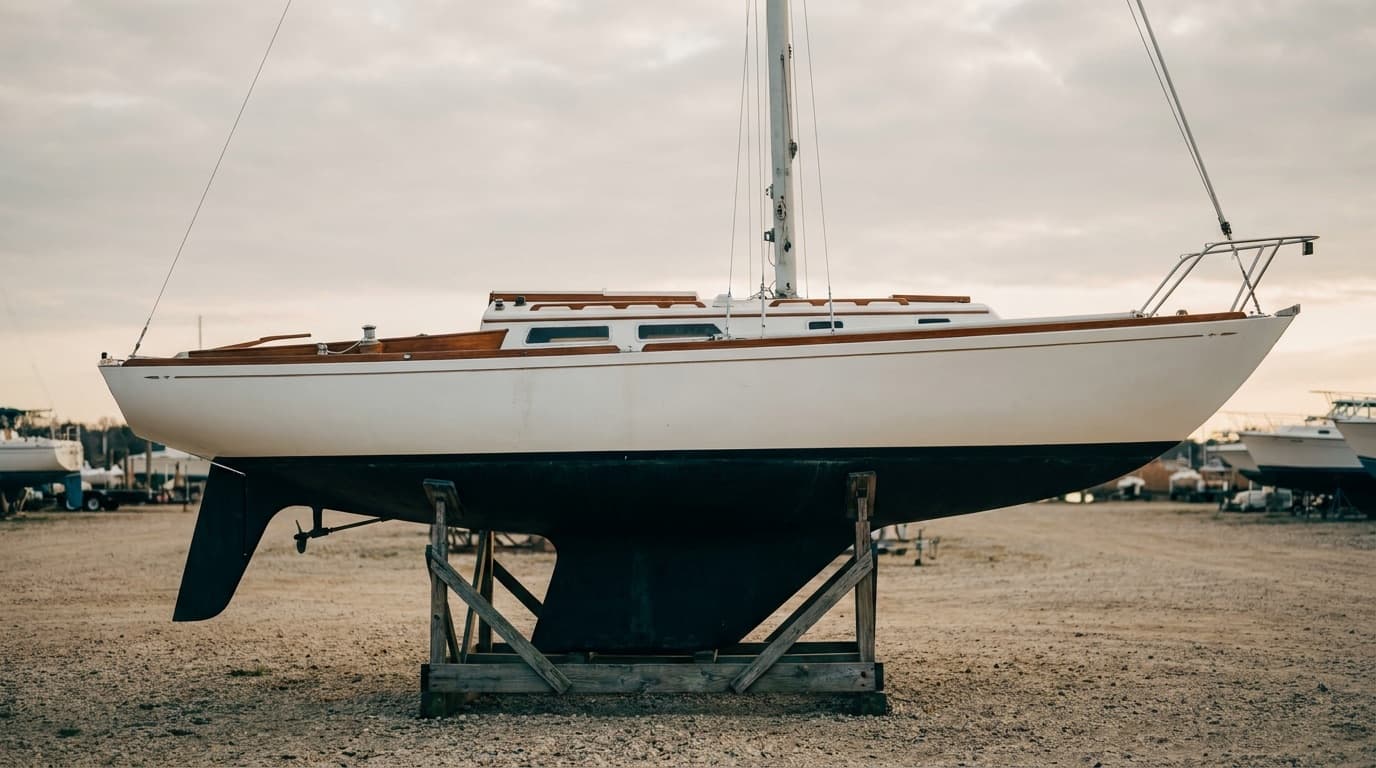
Cape Dory 28 specifications
| Specification | Figure |
|---|---|
| Length overall | 28 ft 1 in |
| Waterline length | 22 ft 3 in |
| Beam | 8 ft 10 in |
| Draft | 4 ft 0 in |
| Displacement | 9,000 lb |
| Ballast | 3,500 lb lead, 39% |
| Sail area | 404 sq ft |
| Rig | Masthead sloop · I 36.0 ft |
| Hull | Full keel with attached rudder, solid fibreglass hull, cored deck |
| Tanks | Water 60 gal · Fuel 13 gal |
| Auxiliary | Volvo MD7A 13 hp on early boats, Universal diesel later |
| Built | 1974 to 1988, 388 hulls |
| Designer | Carl Alberg |
Source: sailboatdata.
Most 28-foot boats are compromises pretending to be cruisers. This one is a cruiser pretending to be 28 feet.
Carl Alberg drew her narrow, heavy and full-keeled, and the numbers that come out the other end are the numbers of a much bigger boat. A capsize screening value of 1.71 on a 28-footer is genuinely unusual.
You pay for it in interior volume, and you pay for it in speed. Both of those are visible before you buy. What is not visible is a fuel tank installation that corrodes itself, and stress cracking around the chainplates that a surveyor described as capable of costing you the rig.
Is the Cape Dory 28 a good boat?
Yes, for coastal and near-offshore cruising by one or two people who value seakeeping over space. Her capsize screening value of 1.71 and comfort ratio of 31.5 are figures you would expect from a 35-footer. She is slow and she is cramped, and neither is an accident.
| Ratio | Value | Reading |
|---|---|---|
| Capsize screening | 1.71 | Well below the 2.0 offshore threshold. Exceptional at this length |
| Comfort ratio | 31.5 | High. She has an easy motion for a small boat |
| Displacement / length | 369 | Very heavy displacement for 28 feet |
| Sail area / displacement | 14.9 | Under-canvassed. Slow in light air |
| Hull speed | 6.3 knots | On a waterline of roughly 22 feet, how it is calculated |
| Draft | 4'0" | Shallow for a full keel |
Computed from a displacement of 9,000 lb, a beam of 8'10.5" and a length overall of 28'1.25" as published by SpinSheet, with waterline derived from the published displacement to length ratio of 369. The design ratios guide explains each screen and the free calculators will run them for a specific boat.
Here is where those numbers come from, and it is worth understanding before you view one.
She is 28 feet long and 8 feet 10 inches wide. That is a beam of about 0.32 times her length. A Catalina 30 is 0.36 and an Island Packet 35 is 0.34.
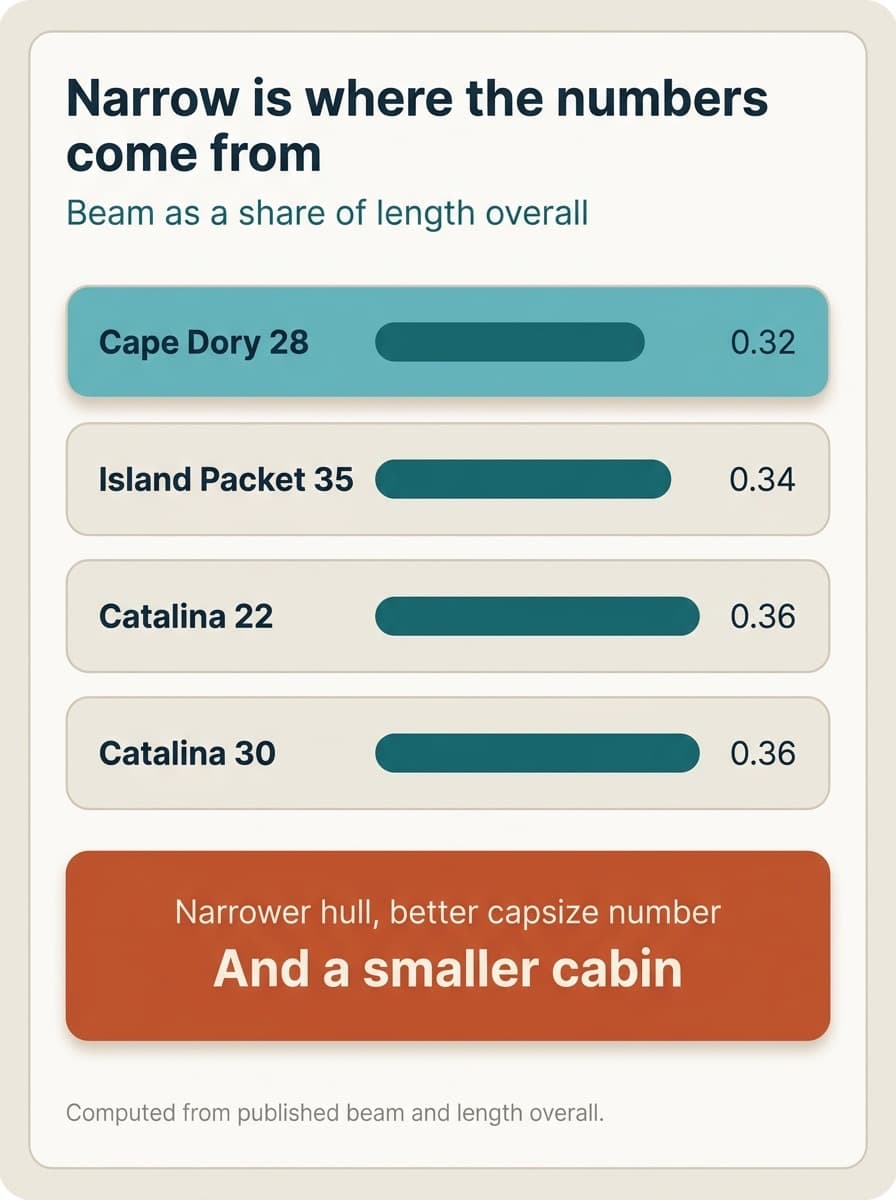
Narrow beam is most of why the capsize number is so good. It is also exactly why the interior feels tight, and no amount of clever joinery fixes a hull that is simply slimmer than its rivals.
SpinSheet's verdict is the honest framing: she suits sailors who want "a small cruiser with offshore cruising potential and classic style" and who accept less interior space than the alternatives.
Alberg's "conservative design style seldom wavered." You are buying a 1960s design philosophy executed in the 1980s, and either that appeals to you or it does not.
What are the common problems with a Cape Dory 28?
Two are specific and both are fixable if you know before you offer. The fuel tank installation corrodes itself, whether steel or aluminium, and stress cracking around the chainplates and deck hardware is the one that matters for safety.
This is the section the listing will not write for you.
| Known issue | What it means, and what it costs |
|---|---|
| Chainplate and deck hardware stress cracking | SpinSheet is blunt that cracking around the chain plates and deck hardware can lead to "loss of the rig or injury". Gelcoat crazing around fittings is the visible symptom. Investigate anything you see rather than polishing it out |
| Fuel tanks that destroy themselves | Steel tanks rust badly. Aluminium tanks were mounted on plywood bases with wooden cleats, which traps moisture against the metal and causes "pitting and, eventually, failure". This is a designed-in fault, not wear. Assume replacement on any untouched boat |
| Deck core | Plywood and balsa cored. Stress cracking lets water into the core, which "eventually weakens the structure". Walk the whole deck and listen |
| Osmotic blistering | "Occasional" below the waterline and typically not severe, but a barrier coat is a haul-out-scale job if it is due |
| The Volvo two-cylinder diesel | SpinSheet: "loud and will shake your fillings loose." Not a defect, but know what you are buying before the sea trial |
| Shaft packing gland access | "Nearly impossible for an average-sized person to reach." Routine maintenance that is physically hard tends not to get done, so check for a dripping stern gland and ask when it was last repacked |
| Standing rigging age | Ten-year working life. On a hull from the 1980s the question is how many times, not whether |
Source: SpinSheet's Cape Dory 28 used boat review. Assumption: a boat that has not already had the work done.
The fuel tank row deserves emphasis because it is unusual. Most known faults on old boats are things that wore out.
This one is a construction decision. Putting an aluminium tank on a wooden base with wooden cleats means the installation was always going to trap water against the metal, and time does the rest.
So the question is not whether the tank has aged. It is whether anyone has ever changed how it is mounted.
Got a Cape Dory 28 listing open right now? Paste it. The free pre-check reads that specific boat’s year and equipment list and flags which of these the ad has quietly said nothing about.
Free on every boat, no card. You only pay to unlock a full report.
What does a Cape Dory 28 sailboat cost?
Brokers ask $19,500 to $32,728. Private sellers ask $5,500 to $12,000 for comparable years. That gap is the largest broker-to-owner spread on this site and it is worth understanding before you decide where to shop.
| Asking price | The boat | Channel |
|---|---|---|
| $5,500 | 1977 | Private, Louisiana |
| $7,500 | 1977 | Private |
| $8,000 | 1984 | Private |
| $12,000 | Unstated year | Private |
| $19,500 | 1975 | Broker |
| $22,500 | 1985 | Broker |
| $24,000 | 1983, Ogunquit, Maine | Broker |
| $32,728 | 1985, Richmond, British Columbia | Broker |
Sail-only asking prices from YachtWorld, boats.com and SailboatListings, August 2026. Powerboat listings under the same model name are excluded, which is why these figures are lower than the aggregate ranges you will see quoted elsewhere.
Look at the two 1985 boats: $22,500 and $32,728. And look at the 1984 private listing at $8,000 against the 1983 broker listing at $24,000.
Some of that gap is genuine condition. Some of it is that a boat sold privately has not had a broker tidy the story, so the cheapest listings are where the fuel tank and the chainplate cracking are most likely to be waiting.
That is not a reason to avoid them. It is a reason to price them properly, which the true-cost guide sets out how to do, and the working figure for annual ownership is 10 to 15% of the boat's value per year.
On a $8,000 boat, a tank replacement and a rigging renewal can exceed the purchase price. The asking price is the smallest number in the transaction, and on this model it is smaller than usual.
How fast is a Cape Dory 28?
Hull speed is about 6.3 knots on a waterline of roughly 22 feet, and her sail area to displacement ratio of 14.9 means she rarely gets there in light air. Plan passages at five knots and you will not be disappointed.
She is heavy for her length at a displacement to length ratio of 369, with a full keel and an attached rudder. That combination tracks beautifully and accelerates slowly.
In a breeze she is in her element and the motion is far easier than a light 28-footer. In summer afternoons she needs her engine or her patience.
For comparison, a Catalina 30 is two feet longer, far roomier and quicker, and screens at 2.0 rather than 1.71. That is the whole trade in one sentence.
What to check before you buy one
Look hard at every fitting on deck for crazing, get under the sole to see how the fuel tank is mounted, and moisture-meter the deck. Then decide whether you can live in the space.
The survey cost guide breaks the survey day down line by line. On a boat that can be bought for $8,000 privately, the survey is a serious fraction of the purchase price, which is an argument for asking the free questions first rather than for skipping the survey.
Ask, before you travel:
- Is the fuel tank original, and what is it mounted on?
- Any gelcoat crazing around the chainplates, stanchion bases or deck fittings?
- Has the deck core been moisture-metered, and when?
- When was the standing rigging last replaced?
- Has the hull ever been barrier coated?
- Which engine is fitted, and when was the stern gland last repacked?
- Is she the sailboat or the powerboat? (Ask it plainly if the listing is vague.)
Spend an hour aboard sitting down below before you fall in love. The numbers on this boat are excellent and the volume is genuinely small, and only one of those is obvious from photographs. Take the questions above, and the full inspection checklist, with you to the viewing.
How Knotworth reads a specific Cape Dory 28
This page describes the model. The product reads the boat. Paste a listing URL and the free pre-check pulls that hull's specification, runs her design numbers, and flags which of the known issues above the advertisement is quiet about.
Two 1985 boats, one at $22,500 and one at $32,728. A 1984 at $8,000 privately. The photographs will show you three tidy classic sailboats with varnished trim.
They will not show you the fuel tank mounting, the crazing around the chainplates or whether the deck is wet. Those omissions become the questions, the questions become answers, and the answers become a number you can negotiate on.
She also appears in the Cape Dory range, where the brand-level facts about Alberg's design philosophy and what happened to the moulds are set out in full.
Paste the URL. The free pre-check reads that boat's specs, runs her design numbers, and flags what the ad leaves out about the tank, the deck and the rig. No card until you unlock a full report.
FAQ
Is the Cape Dory 28 a good boat?+
Yes, for coastal and near-offshore cruising by one or two people. Her capsize screening value of 1.71 and comfort ratio of 31.5 are figures you would normally see on a much larger boat, thanks to Carl Alberg's narrow, heavy, full-keel design. The cost is interior space and light-air speed.
What are the common problems with a Cape Dory 28?+
Stress cracking around the chainplates and deck hardware, which SpinSheet warns can lead to loss of the rig. Fuel tanks are the other one: steel tanks rust and aluminium tanks were mounted on plywood bases with wooden cleats, which causes pitting and eventual failure. Deck core moisture and occasional blistering are the standard age items.
How much does a Cape Dory 28 sailboat cost?+
Brokers ask roughly $19,500 to $32,728 and private sellers ask $5,500 to $12,000 for comparable years. Note that aggregate "Cape Dory 28" price ranges quoted elsewhere include the Cape Dory 28 powerboat, which pushes the top of the range well past $60,000.
How fast is a Cape Dory 28?+
Hull speed is about 6.3 knots on a waterline of roughly 22 feet, but a sail area to displacement ratio of 14.9 means she is slow in light air. Five knots is a realistic passage-planning figure.
How many Cape Dory 28s were built?+
Sources differ. Wikipedia records 389 built between 1974 and 1987, while SpinSheet gives nearly 500 between 1975 and 1988. Either way it is a small fleet, so expect to wait for the right one.
Is the Cape Dory 28 a bluewater boat?+
Her hull form says near-offshore: a capsize screening value of 1.71 with a full keel and attached rudder is genuinely seakindly. At 28 feet the real limits are stores, tankage and crew endurance rather than the hull, and the chainplate cracking issue should be resolved before you go anywhere demanding.
Is there a Cape Dory 28 powerboat as well?+
Yes, and it matters when you are searching. Cape Dory built a 28-foot powerboat sold as the Flybridge, Flybridge Trawler, Hardtop and Open Fisherman. Broker aggregate price data mixes the two models, so filter to sail before you draw conclusions about value.