Westsail 32 buyer's guide: what she is, what she costs, what breaks
By Itzhak Fuhrman·Built and maintains Knotworth's cost model·Updated 12 October 2026
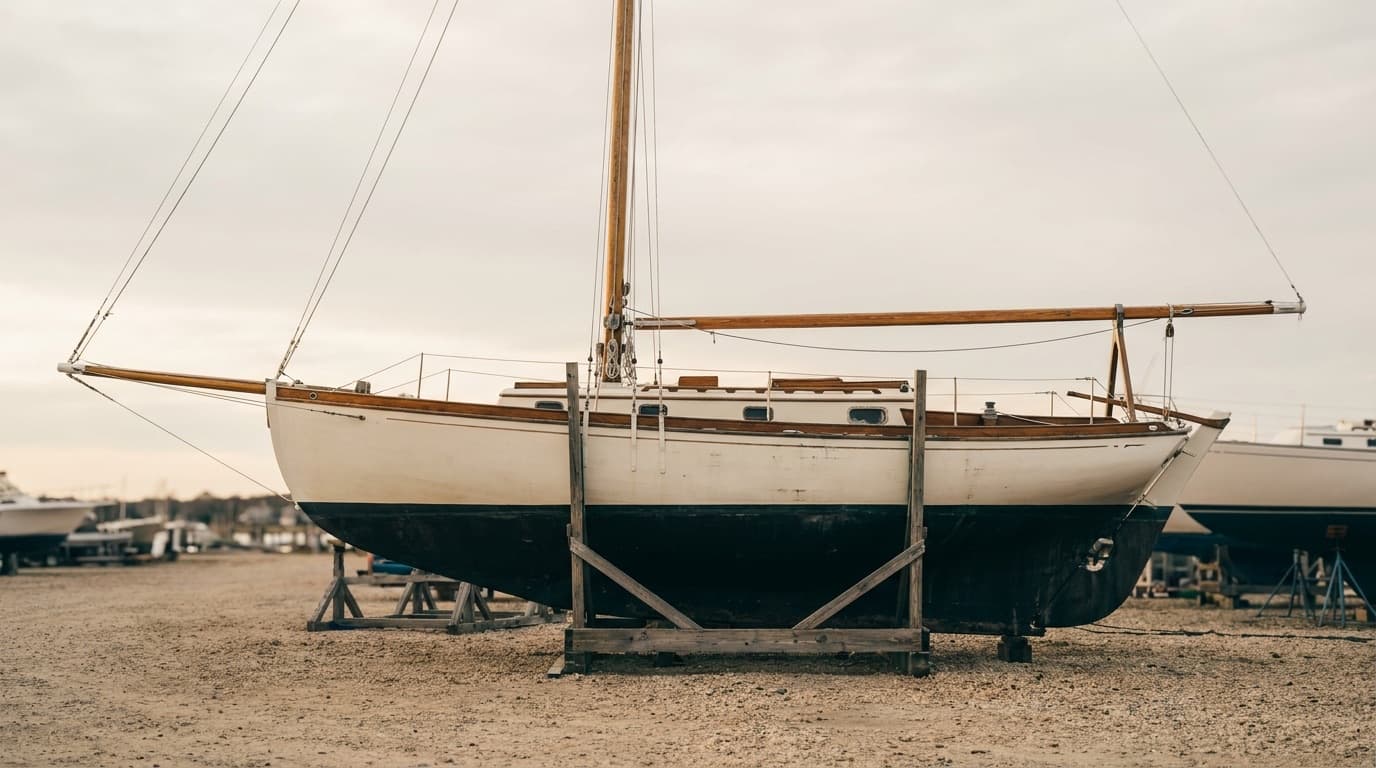
Westsail 32 specifications
| Specification | Figure |
|---|---|
| Length on deck | 32 ft 0 in; about 40 ft overall with bowsprit and boomkin |
| Waterline length | 27 ft 6 in |
| Beam | 11 ft 0 in |
| Draft | 5 ft 0 in |
| Displacement | 19,500 lb |
| Ballast | 7,000 lb lead, 36% |
| Sail area | 753 sq ft, cutter rig |
| Rig | Masthead cutter · I 44.0 ft |
| Hull | Full keel, transom-hung rudder, heavy solid fibreglass hull |
| Tanks | Water 80 gal · Fuel 42 gal |
| Auxiliary | Volvo MD2B or Perkins 4-107 (36 hp) from the factory; many repowered |
| Built | 1971 to 1981, 834 factory hulls plus owner-completed kits |
| Design | Colin Archer lineage via William Atkin's Eric, adapted by W.I.B. Crealock |
Source: sailboatdata. Kit boats vary in finish and weight; the factory figures are nominal.
Two facts about this boat are not in dispute. She is one of the toughest production hulls ever laid up, with a laminate running from half an inch to nearly an inch thick. And she is slow enough that her own owners call her the Wet Snail.
Both are well documented and neither will cost you money, because you know them before you start.
What will cost you money is quieter. About half of these boats were finished by their owners rather than the factory, the last few years of production came out of a bankrupt company, and every one of them takes up 40 feet of dock while being advertised as a 32-footer.
This guide is about those three.
Is the Westsail 32 a good bluewater boat?
Yes, and by the numbers she is the strongest case on this site. Her capsize screening value is 1.63, well under the 2.0 offshore threshold, and her comfort ratio of 42.5 is the highest of any boat we have run. The price is a sail area to displacement ratio of 13.9, which means genuinely slow passages.
| Ratio | Value | Reading |
|---|---|---|
| Capsize screening | 1.63 | Far below the 2.0 threshold. Among the best you can buy used |
| Comfort ratio | 42.5 | Exceptional. She moves slowly and predictably in a seaway |
| Displacement / length | 419 | Very heavy displacement |
| Sail area / displacement | 13.9 | Under-canvassed. This is the Wet Snail number |
| Ballast / displacement | 36% | Moderate, and it is encapsulated lead inside the keel |
| Hull speed | 7.0 knots | On a 27'6" waterline, how it is calculated |
Computed from displacement 19,500 lb, ballast 7,000 lb, waterline 27.5 ft, beam 11.0 ft and sail area 629 sq ft as published. The design ratios guide explains each screen and the free calculators will run them for a specific boat.
The construction backs the numbers up. Wikipedia records a hand-laid hull of twelve alternating layers of woven roving and chopped strand mat, and 7,000 lb of lead cast inside the keel rather than bolted on, so there are no keel bolts to fail.
Two deck details matter more than they sound. The shroud chainplates are bolted to the outside of the hull, which is a strong and inspectable arrangement and leaves clear side decks. And the cockpit is deliberately small, to limit the weight of water it can hold when a wave fills it.
Compare that with the Catalina 27, whose internal lower shroud chainplates have a documented history of failing and putting rigs over the side. Same job, opposite engineering philosophy, and you can see one of them from the dock.
The heaviness is not a bug either. Two tons of stores and water barely change how she floats, which is the whole point of a boat you intend to live on for a year.
What are common problems with a Westsail 32?
The hull is rarely the problem. What needs checking is the boomkin hardware, the deck core, the original engine and, above everything else, who built the interior.
| Known issue | What it means, and what it costs |
|---|---|
| Boomkin whisker stay tangs | Owners describe undersized tangs on the boomkin whisker stays as one of the most prolific construction faults on the design. One owner who shopped eight boats from Seattle to Key Largo reported that every one had already been refitted with properly sized tangs. Your question is whether this one has |
| Owner-finished interior | About 400 of roughly 830 boats were kits. Quality runs from professional to alarming and it is the single biggest variable in the price. See the next section |
| Late-production build quality | The company went bankrupt in early 1977 and limped on to 1981. Owners report the quality problems concentrate in those final years, which inverts the usual rule that a later hull is a better hull |
| Deck core soft spots | Standard for the age. Walk the whole deck and listen. Localised repairs are affordable, a recore is not |
| Chainplate wear | The external chainplates are easy to inspect, which is an advantage, but they are also forty to fifty years old |
| Osmosis on older hulls | Reported by owners on early boats. A barrier coat is a haul-out-scale job |
| Original Atomic 4 | Many boats still carry the petrol original and many have been converted to diesel. A conversion is a five-figure job on a $35,000 boat, so which one is fitted is a large part of the price |
| Running rigging and electronics | On a boat of this age assume the lines, sail-handling hardware and instruments are all due. Not dramatic, but it adds up |
| Bowsprit and boomkin timber | Two more exposed structures to inspect that a sloop simply does not have, and both carry rig loads |
Sources: Wikipedia for construction, kit proportion and company history; owner discussion on SailNet for the boomkin tangs, late-production quality and engine conversions. Assumption: a boat that has not already had the work done.
Note what is missing from that list. In the owner and surveyor record we found no structural failure mode: no keel joint, no mast step compression, no chainplate that has put rigs in the water.
The Westsail's risks are about who assembled her and what has aged, not about how she was designed. That is an unusual and genuinely reassuring shape for a fifty-year-old boat.
Got a Westsail 32 listing open right now? Paste it. The free pre-check reads that specific boat’s year and equipment list and flags which of these the ad has quietly said nothing about.
Free on every boat, no card. You only pay to unlock a full report.
Factory boat or kit boat, and how to tell
Roughly 400 of about 830 were sold as kits: a complete hull with the ballast in and the deck bonded on, finished by the buyer. A well-executed kit boat is indistinguishable from a factory boat. A badly executed one is a different asset at the same asking price.
The kits shipped with Ferenc Máté's From a Bare Hull, which is still the reference book on the job. Some owners were professional-grade, some were not, and some never finished at all.
The owners' association for-sale forum currently carries an unfinished kit boat.
This is the single most important question about any Westsail 32, and it is almost never in the listing.
What to look at, in order:
- The tabbing. Where bulkheads and furniture meet the hull, is the glasswork neat, continuous and properly wetted out, or is it lumpy and dry? A photograph of a pretty interior tells you nothing about what is behind it.
- The wiring. Amateur boat wiring is the most reliable tell there is. Look for tinned marine cable, proper terminals and labelled runs, not household wire and twisted joints.
- The plumbing and the through-hulls. Who installed them, and to what standard.
- The paperwork. Kit hulls carry hull numbers, and the owners' association can often trace a boat's history. Factory-completed boats are sometimes described as exactly that in the listing, and sellers who have one say so.
- The engine installation. Beds, alignment, exhaust run and fuel system on an owner-installed engine are worth a specialist's eye.
A professionally finished kit boat with documentation is a fine buy. An undocumented one at the same price is a gamble, and it should be priced as one.
What is the average price of a Westsail 32?
Broker listings run $25,000 to $50,000, with Boat Trader averaging $42,450 across four boats. Below that there is a private market: the builder's parts company has listed one at $15,500 and the owners' association carries unfinished kits.
| Asking price | The boat |
|---|---|
| $25,000 | Broker listing, 1975, Florida |
| $39,900 | 1973, Connecticut |
| $45,000 | 1977, Kentucky |
| $50,000 | Top of the current broker range |
Broker asking prices from YachtWorld, Boat Trader and boats.com, August 2026. Four boats listed on Boat Trader at an average of $42,450.
That is a narrow range by the standards of this site, and the reason is worth understanding. On the Catalina 27 the spread runs from $1,000 to $19,000 because the engine and the rig history vary enormously.
Here the hull is the hull. The spread is mostly about who finished her, what engine is in her, and whether the standing rigging and sails have been renewed this decade.
Then add the part that nobody quotes.
Why a 32-foot boat needs a 40-foot slip
The Westsail 32 is 32 feet on deck and 40 feet with her bowsprit and boomkin. You berth, haul and insure the 40 feet. At typical 2026 US rates those eight extra feet cost $1,440 to $3,360 a year, every year, before you have sailed anywhere.
A six-foot bowsprit carries the headstay and the backstay lands on a boomkin aft. Wikipedia puts the overall length with appendages at 40 feet.
Marinas charge by overall length, and where they charge by slip you still need the bigger slip. So the arithmetic is unavoidable.
| Slip rate | Extra per month | Extra per year |
|---|---|---|
| $15 per foot, inland or mid-tier | $120 | $1,440 |
| $35 per foot, upper mainstream | $280 | $3,360 |
| $50 per foot, premium waterfront | $400 | $4,800 |
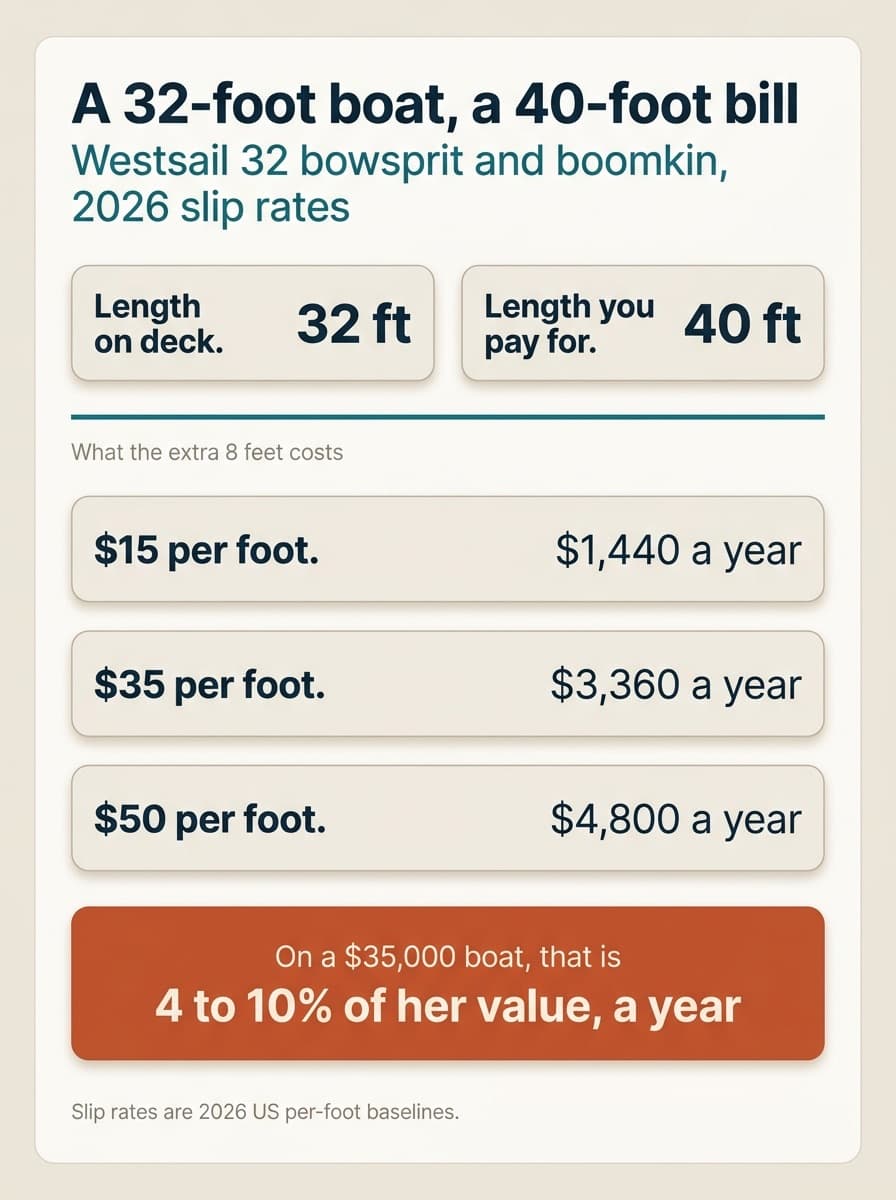
Rates are 2026 US baselines, where $15 to $35 per foot per month is typical and premium markets such as Southern California, Miami and New York run $50 and up.
Put that against the boat. On a $35,000 Westsail, the spars alone consume 4 to 10% of her value every year in dock space, which sits on top of the 10 to 15% annual ownership figure the true-cost guide works from.
This is not an argument against the boat. The bowsprit is what makes the cutter rig work and the cutter rig is part of why she is a good ocean boat.
It is an argument for knowing the number before you sign, because it is the sort of cost that does not appear anywhere in a listing and never goes away.
Is a Westsail 32 a good liveaboard boat?
For one or two people, yes, and better than her length suggests. High bulwarks, wide side decks, deep secure stowage and a hull that barely notices two tons of gear are all liveaboard virtues. The cockpit is small and the interior is dark and narrow by modern standards.
The load-carrying is the real argument. Most 32-footers settle visibly and sail badly once you put a cruising inventory aboard. This one was designed expecting it.
The counter-argument is space. She is a heavy displacement double-ender, so the beam carries well forward and aft but the usable interior is narrower than a modern 32-footer, and headroom and light are both modest.
And she is a 40-foot berth bill for a 32-foot living space, which matters more to a liveaboard paying it monthly than to anyone else.
What to check before you buy one
Establish factory or kit first, because it changes what everything else is worth. Then the boomkin tangs, the deck, the engine and the rig age. The hull itself is the least of your worries, which is not something you can say about many fifty-year-old boats.
The survey cost guide breaks the survey day down line by line, and on a boat where the build quality is the main variable, the surveyor's opinion of the joinery and systems is worth more than usual.
Ask, before you travel:
- Was she factory finished or an owner-completed kit, and is there documentation?
- Have the boomkin whisker stay tangs been upgraded?
- Which engine is fitted, is it the original Atomic 4, and if converted, by whom?
- What year is she, and if she is a late boat, what does the joinery look like?
- When was the standing rigging last replaced?
- Any soft spots in the deck, and has the hull ever been barrier coated?
- What length does your marina bill her at?
- Is there any history with the owners' association?
None of those is answered in a typical listing. All of them change the number you should offer. They are the model-specific lines in the full inspection checklist, which covers what to settle before you travel and what to check aboard.
How Knotworth reads a specific Westsail 32
This page describes the model. The product reads the boat. Paste a listing URL and the free pre-check pulls that hull's specification, runs her design numbers, and flags which of the known issues above the advertisement is quiet about.
On most boats the model tells you most of what you need. On this one it tells you about half, because a coin flip decides whether the interior in front of you was built by a factory or by a previous owner in a yard somewhere in 1978.
A 1979 boat advertised as "solid bluewater cruiser, ready to go" has not told you whether she is a kit, whether she came out of the bankrupt years, what the tangs look like, or what her real berth length is. Those omissions become the questions, the questions become answers, and the answers become a number you can negotiate on.
She is also on our bluewater shortlist, where she has the lowest capsize value and the highest comfort ratio of the five, and the lowest sail area ratio. That is the Westsail trade in one line.
Paste the URL. The free pre-check reads that boat's specs, runs her design numbers, and flags what the ad leaves out about the build, the engine and the rig. No card until you unlock a full report.
FAQ
Is the Westsail 32 a good bluewater boat?+
Yes. Her capsize screening value of 1.63 is far below the 2.0 offshore threshold and her comfort ratio of 42.5 is exceptional, with a hand-laid hull up to nearly an inch thick and 7,000 lb of lead encapsulated in the keel. The trade is speed: a sail area to displacement ratio of 13.9 makes for slow passages, which is why owners call her the Wet Snail.
What is the capsize ratio of the Westsail 32?+
1.63, computed from a displacement of 19,500 lb and a beam of 11 feet. Below 2.0 is the conventional offshore threshold, so she clears it comfortably, and she is the lowest of the five boats on our bluewater shortlist.
What are common problems with Westsail 32s?+
Undersized boomkin whisker stay tangs are the most-cited construction fault, and owners report that most boats have already been refitted with proper ones. Beyond that: deck core soft spots, osmosis on early hulls, ageing original Atomic 4 engines, and highly variable interior quality because about half of all Westsail 32s were owner-finished kits.
What is the average price of a Westsail 32?+
Broker listings run $25,000 to $50,000, with Boat Trader averaging $42,450 across four boats in August 2026. A private market exists below that, including unfinished kit boats through the owners' association.
How many Westsail 32s were built?+
Roughly 830 between 1971 and 1980, of which about 400 were sold as kits for owners to finish. The Westsail Corporation went bankrupt in early 1977 and ceased operating entirely in 1981.
Is a Westsail 32 a good liveaboard boat?+
For one or two people, yes. She carries a cruising load without changing how she sails, with deep stowage, high bulwarks and wide side decks, though the interior is narrower and darker than a modern 32-footer and the cockpit is small.
Why does a Westsail 32 need a 40-foot slip?+
She is 32 feet on deck but 40 feet including her six-foot bowsprit and her boomkin, and marinas charge by overall length. At typical 2026 US rates of $15 to $35 per foot per month, those eight extra feet cost $1,440 to $3,360 a year.