Tayana 37 buyer's guide: what she is, what she costs, and what the teak deck will cost you
By Itzhak Fuhrman·Built and maintains Knotworth's cost model·Updated 18 November 2026
Tayana 37 specifications
| Specification | Figure |
|---|---|
| Length overall | 36 ft 8 in on deck · about 42 ft 2 in including the bowsprit |
| Waterline length | 31 ft 0 in |
| Beam | 11 ft 6 in |
| Draft | 5 ft 8 in |
| Displacement | 22,500 lb (Wave Train quotes 24,000 lb; every boat was fitted out differently) |
| Ballast | 8,000 lb iron, encapsulated in the keel, 36% |
| Sail area | 861 sq ft cutter · 768 sq ft ketch |
| Rig | Masthead cutter standard, ketch optional (about 20 built); wood or aluminium spars; deck- or keel-stepped mast; I 50.8 ft, J 19.5 ft, P 45.3 ft, E 15.5 ft |
| Hull | Solid hand-laid fiberglass, scribed plank seams, long keel with cut-away forefoot, keel-hung rudder on a bronze heel fitting, canoe stern |
| Deck | Cored (end-grain softwood blocks in polyester on early boats, balsa on others), teak overlay screwed down on nearly all hulls |
| Tanks | Fuel 90 gal, black iron, under the V-berth as standard; amidships keel tank optional on later boats · Water 100 gal |
| Auxiliary | Yanmar 3QM30 (about 33 hp) standard on later boats; Perkins 4-108 and Volvo MD17C on earlier ones |
| Built | 1976 to the 1990s, available to order until about 2020; 588 by 2012, about 600 in all |
| Designer | Robert H. Perry |
Sources: sailboatdata, Wikipedia for the bowsprit length, pilothouse option and engine, Practical Sailor for the engines, rigs and tankage, Wave Train for the ketch sail area and deck core.
Darrell Nicholson of Practical Sailor wrote a whole column about how much he loathes the Tayana 37, and it is a love letter. He loathes the teak decks that leak, the bowsprit, the water tank sloshing in the bow, the iron ballast corroding out of sight, and most of all the fact that she disappears over the horizon while the look-alike boats stay in the harbour.
That is the whole buying problem in one paragraph. The Tayana 37 is one of the most proven ocean boats ever built, there are more of them for sale than any other bluewater boat on this site, and the things that are wrong with them are specific, visible and expensive. This page prices them, starting with the deck.
Is the Tayana 37 a good boat?
As an ocean boat, yes, and the record proves it. A heavy, solid hull, a long keel with the forefoot cut away, a tall cutter rig that makes her faster and more weatherly than the Westsail 32 she was built to compete with, and a smooth motion in a seaway. Her weaknesses are tenderness from the tall rig and all that teak up high, weather helm from a raked mast, and a cockpit that seats three.
Practical Sailor's review calls her a quintessential heavy-displacement cruising boat designed for one purpose, to go places in relative comfort, and credits the yard, the designer, the importer and a powerful owners' association with a production run that kept improving the boat. Charles Doane at Wave Train says there are reportedly more Tayana 37s wandering the globe at any moment than any other single type, and knows a cutter-rigged one that logged 186 miles in a day on a transatlantic.
The honest other half comes from the same two writers. She is not stiff: the ballast ratio is about 36% but the rig is tall and heavy and the teak joinery sits high, so she heels early, which Perry argues makes her motion kinder. Many owners report heavy weather helm, which comes from the mast rake the builder drew in and the stretchy Lam sails most boats left the yard with; standing the mast up and buying a decent mainsail cures most of it. And she backs up, in Practical Sailor's owner's phrase, like a drunken elephant.
Which Tayana 37 years have the teak deck problem, and what does it cost?
Nearly all of them. Wave Train says almost every Tayana 37 was built with teak decks screwed to the cored deck, and owners put the life of those decks at about twenty years, which every 1970s and 1980s hull passed long ago. A deck that has been removed, the core repaired and the surface re-glassed and painted is a solved problem. An original deck is the largest bill on the boat: owners report $17,000 to $25,000 for removal, re-glassing and non-skid on a 36 to 37-footer, and far more for new teak.
This is the named fault of the model, the way the plywood keel stub is the Catalina smile and the Hetron resin is the Valiant 40's blisters. The mechanics are simple. Each teak plank is held down by screws through the fiberglass skin into the core, and a Tayana 37 owner on the sailboatowners.com forum counted the holes at about 1,300. The bungs over the screws lift, the caulking between planks opens, and water follows the screws into the core. On the early boats the core was end-grain softwood blocks each surrounded by polyester, a Taiwanese practice meant to stop water spreading past one block; a Tayana 37 owner who rebuilt his deck reports it did not work, that the decks fail at about twenty years like any screwed deck, and that cutting the polyester out is worse than cutting the wood.
What it costs depends on what is under the teak, which nobody knows until it is off.
| What you find | What it means | Reported cost |
|---|---|---|
| Teak removed, core repaired, deck glassed and painted, with invoices | The bill has been paid. Check the moisture meter anyway around every fitting | Already in the price |
| Teak removed by the owner, glass work by a yard | The usual DIY split; owners say they saved about two thirds of the cost by doing the stripping themselves | Owner-reported about $17,000 for removal, new glass layer and non-skid on a 36-footer, with the owner doing part of the work |
| Original teak, sound, bungs tight, caulk intact | Living on borrowed time; budget the removal within the next few seasons | Yard estimates of $20,000 to $25,000 for glass decks on a 36-footer, posters warning the figure may be low |
| Original teak with lifted bungs, missing caulk, soft spots | Core is wet. Removal plus core replacement plus hardware off and on; removing the hardware alone took one couple eight days | Add the core work and the rule of thumb owners quote, about $1,000 per foot of boat for a full teak-deck job |
| New bonded teak deck from a specialist | The expensive and beautiful answer | A Cruising World writer was quoted $55,000 to $60,000 by Teak Decking Systems for a 47-footer |
Sources: owner reports in Trawler Forum threads on teak deck removal and a 36-footer's replacement cost (the $17,000 and $20,000 to $25,000 figures and the sixty hours just to strip the teak); Practical Sailor's DIY deck story for the hardware removal time; Cruising World for the specialist quote. All are owner-reported, several are powerboats of similar length and some are a decade old; get a yard to look at the deck before the offer.
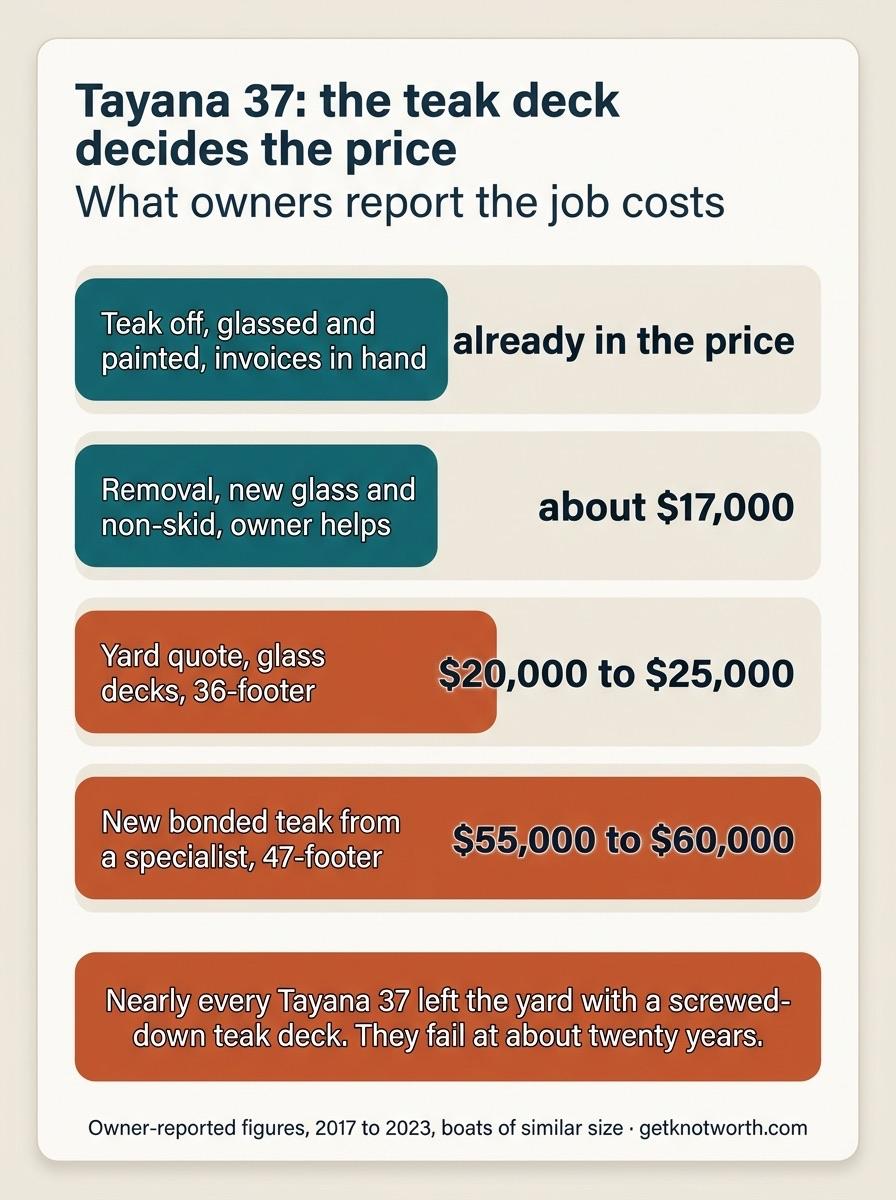
The buyer's reading is this. On a $40,000 Tayana 37 with an original deck, the deck is half the asking price again. That belongs in the offer, not in the first season's surprises, and it is why two 1979 boats can list on the same day at $29,000 and $44,900.
Looking at one right now? Paste the listing and the free pre-check lists which of these the ad is silent on.
Free on every boat, no card. You only pay to unlock a full report.
What are the problems with a Tayana 37?
After the deck: a 90-gallon black iron fuel tank in the bow that puts 650 pounds forward and eventually rusts, pre-1981 wiring and stainless of lower grade, a laminated wooden bowsprit that rots from below, a bronze rudder heel on stainless bolts, wooden spars with knots and a flimsy outhaul on early boats, a hollow bulwark joint that leaked until the yard glassed it over, and encapsulated iron ballast nobody can inspect.
| Known issue | What it means, and what it costs |
|---|---|
| Fuel tank in the bow | The standard 90-gallon black iron tank sits under the V-berth, 650 lb of fuel when full, against Perry's drawing which put it under the settees. Bow-down trim and a tank that corrodes. Later boats offered an amidships keel tank. A fabricated replacement runs about $500 to $1,500 plus labour, and the bow tank is easier to reach than most; a boat with the midships tank is worth more |
| Wiring, boats before about 1981 | Wave Train names inferior electrical wiring on early boats. A full rewire is a yard quote in the thousands; ask for the invoice if the seller says it was done |
| Stainless, same years | Lower-grade alloys in some hardware and fittings. Rust bleeding at stanchions, chainplates and sprit fittings is the tell |
| Laminated wooden bowsprit | Rots from underneath. Varnished and dry is good; painted is suspect. A new sprit is a joiner's job in the low thousands and is one of the items on the refit list of the owner above |
| Rudder heel | Bronze casting on stainless bolts; galvanic corrosion eats the bolts. Zincs are provided; check them |
| Hull-to-deck bulwark | Hollow, pierced by hawsepipes and scuppers, leaked on early boats; later boats have it glassed over from inside. Look for staining inside the bulwark and at the chainplates |
| Wooden spars and boom | Spruce masts with a massive section and, on one Practical Sailor saw, a knot at the spreaders; a boom too small for mid-boom sheeting; an outhaul slide that owners say distorts or explodes. Aluminium spars are the ones to want |
| Steering | Early boats had a Taiwanese worm-gear system that was sloppy; later boats a pedestal. Feel the helm |
| Dipstick access | None easy, so the oil goes unchecked. A cheap fix, a telling sign of how the engine was kept |
| Encapsulated iron ballast | Cast iron glassed into the hollow keel. No keel bolts to inspect, which our keel bolts guide explains, but water in the keel cavity from a grounding crack rusts the iron and swells it. Tap the keel bottom and look for cracks and rust weep |
| Age items | Standing rigging, three sails on a cutter, running rigging, canvas, electronics; the true-cost guide prices them by length |
Sources: Practical Sailor for the tank, spars, boom, outhaul, dipstick and steering; its construction notes for the bulwark, rudder heel and ballast; Wave Train for the wiring, stainless and bowsprit; the fuel tank replacement figure from the owner reports on our Pacific Seacraft 37 page.
What is not on the list matters too. No class history of hull failures, no keel bolts, no deck delamination separate from the teak, and Perry is on record that the boat has never had a consistent structural problem. The faults are the fittings and the finish of a Taiwanese yard learning its trade, and the later the boat the fewer of them it has.
How much does a Tayana 37 cost?
On the US brokerage market in October 2026, five boats built between 1976 and 1982 asked $29,000 to $69,500, median $40,000. Practical Sailor's 2026 market scan adds a 1978 boat at $75,000 and 1984 and 1985 boats at about $45,000 to $50,000. Readers of that review put a repowered, well-equipped boat at $50,000 to $80,000. The spread is the deck, the tank and the engine, in that order.
| Build year | Recent asking price | Where |
|---|---|---|
| 1976 | $29,000 | Washington, North Carolina |
| 1977 | $40,000 | Seattle, Washington |
| 1978 | $75,000 | Berkeley, California (Practical Sailor market scan) |
| 1979 | $29,000 | Beaufort, North Carolina |
| 1979 | $44,900 | Kemah, Texas |
| 1982 | $69,500 | New Bern, North Carolina |
| 1984 | $44,900 | Palm Coast, Florida (Practical Sailor market scan) |
| 1985 | $49,900 | Daytona Beach, Florida (Practical Sailor market scan) |
YachtWorld, US listings, first results page, 23 October 2026, plus the market scan in Practical Sailor's review as updated in 2026. Four more boats were listed abroad that day at $35,000 to $45,000 (Mexico, Panama, New Zealand). Wave Train's 2010 rule still holds: boats needing work under $50,000, boats loaded with offshore gear under $100,000.
Two 1979 boats, $29,000 and $44,900, on the same day. The $15,900 between them is less than a deck job, which is the arithmetic our guide to what a used sailboat is worth exists to do. From the true-cost guide at 37 feet, a 1979 boat with an original deck, bow tank, original wiring and nothing dated carries the deck, a tank, a rewire, a re-rig, three sails and a survey before the first season: $40,000 to $60,000 on a $29,000 boat. The $69,500 1982 boat with the work done can be the cheaper purchase.
Is the Tayana 37 a bluewater boat?
She is close to the definition of one. Capsize screening about 1.6, comfort ratio about 41, displacement-to-length 337, a long keel, a canoe stern for following seas and more circumnavigations than most designs have hulls. Her limits are light-air speed, a crew of two or three in the cockpit, and the maintenance that comes with that much teak. The bluewater shortlist lists her as the easiest boat on it to go and see.
| Ratio | Value | Reading |
|---|---|---|
| Capsize screening | 1.63 | Well under the 2.0 offshore threshold |
| Comfort ratio | 41 | Very high; slow, easy motion |
| Displacement / length | 337 | Heavy displacement |
| Sail area / displacement | 17.3 (cutter) | Generous for a heavy boat; she is not under-canvassed |
| Ballast / displacement | 36% | Moderate; the tall rig and high teak make her tender early |
| Hull speed | 7.5 knots | how it is calculated |
Computed from LWL 31.0 ft, LOA 36.67 ft, beam 11.5 ft, displacement 22,500 lb, ballast 8,000 lb and sail area 861 sq ft as published by sailboatdata, whose own figures match. The design ratios guide explains each screen; the free calculators run them for the boat you are looking at. Against the Westsail 32 she is five feet longer, a third faster to windward and no less seakindly; against the Pacific Seacraft 37 she is 6,500 lb heavier, slower in light air, half the price and a great deal more teak.
Which Tayana 37 should you buy?
A cutter with aluminium spars, pedestal steering, the amidships fuel tank and a deck that has already been stripped and glassed, built in the 1980s or later. Keel-stepped or deck-stepped mast is a matter of taste. The ketch (about 20 built) and the pilothouse are rare and have their fans, but the cutter balances best and resells best. A 1970s boat on wooden spars with an original deck is a project at a project price, and only a project price.
The 37 is the least standard boat on this site, which Practical Sailor says plainly: every boat was custom built, so there has never been a standard interior. Rig, spars, mast step, tank location, engine and layout all vary hull to hull. Early boats were sold as the CT 37; Perry insists they are the same boat from the same yard, and the snobbery between CT and Tayana owners is illusory. The Mark I deck is the common one; a Mark II deck exists on later boats. What changed most over the run is the quality of the fittings, which is why the year is the first filter and the deck the second.
What to check before you buy one
- The deck. Original teak or removed and glassed? Invoice, photos, and the moisture meter around every fitting, hatch and the mast partners.
- Fuel tank. Bow or amidships, black iron or replaced, and the condition of the bilge under it.
- Wiring. Year of the boat, and whether it has been rewired.
- Bowsprit. Probe the underside; painted is suspect.
- Spars and steering. Aluminium and pedestal, or wood and worm gear. Sight the mast for knots.
- Rudder heel. Look at the bronze casting, its bolts and its zinc.
- Keel bottom. Cracks and rust weep from the encapsulated iron.
- Rig, sails, engine. Which engine, its hours and records, and whether the dipstick can be reached. The inspection checklist covers the rest, and a Tayana always gets a survey by someone who has stripped a teak deck.
How Knotworth reads a specific Tayana 37
This page describes the model. The product reads the boat. Paste a listing URL and the free pre-check matches it to the Tayana 37's reference record, runs her design numbers, lists which of the known issues above the advertisement is silent on, and ranks the seller questions by money. On a Tayana 37 the deck comes first, the tank and wiring second, and the $39 report carries a deck reserve until a stripping invoice or a dry moisture survey clears it.
Paste the URL. The free pre-check reads that boat's specs, runs her ratios, and tells you whether the ad says anything about the deck. No card until you unlock the full report.
FAQ
What are the problems with a Tayana 37?+
Screwed-down teak decks that leak into the core after about twenty years, a 90-gallon black iron fuel tank in the bow, inferior wiring and stainless on boats built before about 1981, a laminated wooden bowsprit that rots from below, a bronze rudder heel on stainless bolts, and on early boats a leaking bulwark joint, wooden spars and worm-gear steering. The hull itself has no class history of structural failure.
How much does a Tayana 37 cost?+
On the US market in October 2026, boats built between 1976 and 1982 asked $29,000 to $69,500 with a median of $40,000; Practical Sailor's 2026 market scan found a 1978 boat at $75,000 and mid-1980s boats at about $45,000 to $50,000. Add $17,000 to $25,000 if the teak deck is original.
How much does it cost to remove the teak deck on a Tayana 37?+
Owners of boats this size report about $17,000 for removal, a new glass layer and non-skid with the owner doing some of the work, and yard estimates of $20,000 to $25,000; a rule of thumb quoted on the forums is about $1,000 per foot of boat for a full job. New bonded teak from a specialist was quoted at $55,000 to $60,000 on a 47-footer. All owner-reported; get a yard to look first.
Is the Tayana 37 a good bluewater boat?+
Yes. Capsize screening about 1.6, comfort ratio about 41, a solid hand-laid hull, a long keel, a canoe stern and a record that includes more circumnavigations than most designs have hulls. She is tender at first and slow in light air, and the cockpit seats three.
Tayana 37, Pacific Seacraft 37 or Cabo Rico 38?+
The Tayana 37 is the heaviest, the cheapest and the most available, with the most to check. The Pacific Seacraft 37 is 6,500 lb lighter, faster, American-built with a clean fault record, and about twice the price for the same year. The Cabo Rico 38, a Crealock full-keel cutter built in Costa Rica, sits between them in price and shares the teak-deck question with the Tayana. For a couple on a budget who will do the work, the Tayana; for a couple who want it done, the Pacific Seacraft.
What is a CT 37?+
The same boat under its first name. Ta Yang sold the Perry 37 as the CT 37 from 1976 because the CT name was already known in America, and renamed it the Tayana 37 in 1979. Perry says the two are the same boat built by the same people in the same yard.