Pacific Seacraft 37 buyer's guide: what she is, what she costs, what breaks
By Itzhak Fuhrman·Built and maintains Knotworth's cost model·Updated 23 October 2026
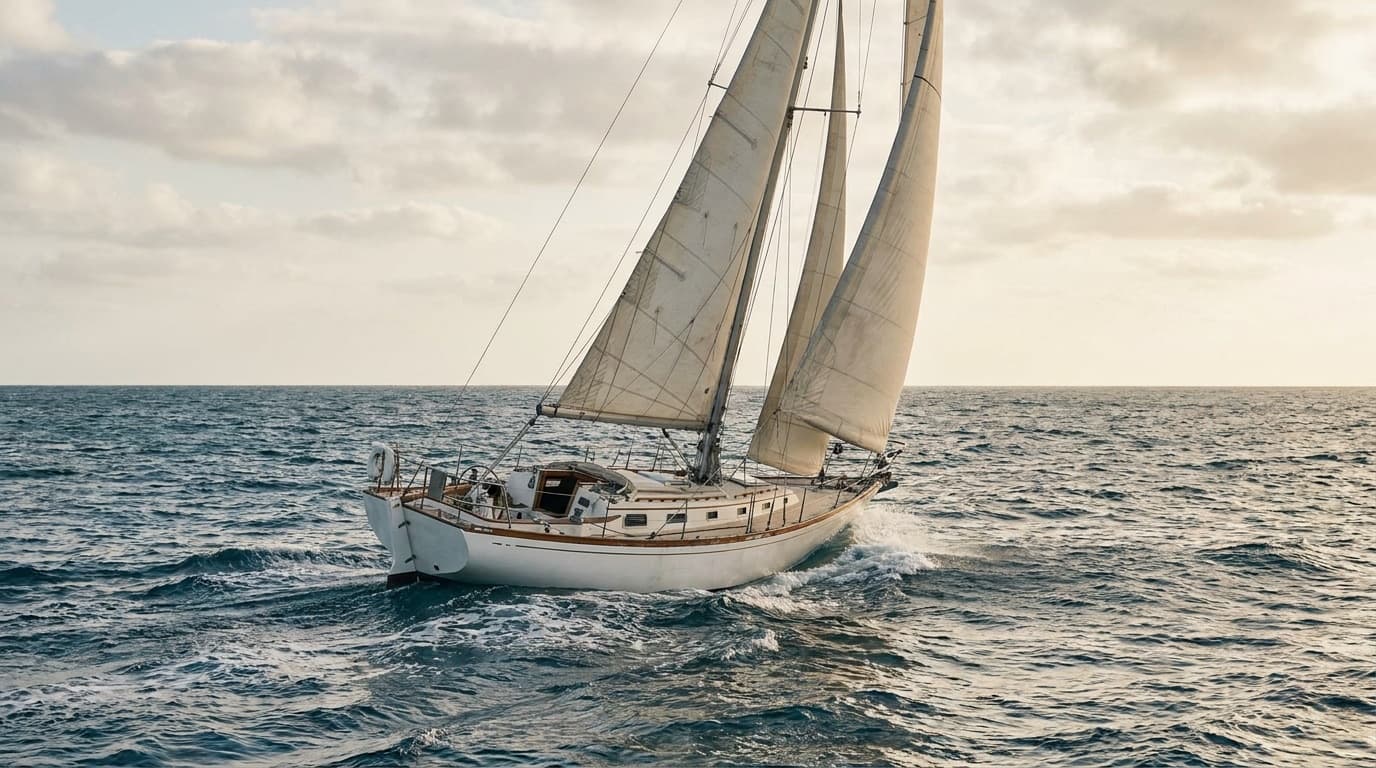
Pacific Seacraft 37 specifications
| Specification | Figure |
|---|---|
| Length overall | 36 ft 11 in |
| Waterline length | 27 ft 9 in |
| Beam | 10 ft 10 in |
| Draft | 5 ft 6 in to 5 ft 10 in standard · 4 ft 5 in to 4 ft 11 in shoal (6,400 lb ballast) |
| Displacement | 16,000 lb (16,200 lb on the factory page) |
| Ballast | 6,200 lb lead, 39% |
| Sail area | 618 sq ft, cutter |
| Rig | Cutter standard; sloop and yawl were offered · I 44.0 ft · air draft 47 ft 9 in · deck-stepped with a compression post into the main bulkhead |
| Hull | Solid fiberglass to ABS standards, vinylester skin coat from 1988, biaxial roving from 1993; external lead keel on stainless bolts; skeg-hung rudder; canoe stern |
| Deck | Plywood-cored, molded bulwark box joint under a teak caprail |
| Tanks | Fuel 40 gal (aluminium, in the bilge) · Water 95 gal |
| Auxiliary | Yanmar 4JH2E, about 50 hp, standard from the late 1980s; earlier boats Volvo 24 hp or Universal diesels |
| Built | 1978 to date. Cruising Consultants built 16 as the Crealock 37 in 1978 to 1979; Pacific Seacraft from 1980; hull 263 launched around 2001 |
| Designer | William I. B. Crealock |
Sources: sailboatdata, the factory page, Sailing Magazine for the laminate history, air draft and production figures, SpinSheet for the engine range.
Sailing Magazine's reviewer called her a swisher, not a pounder. SpinSheet's called her one of the few true bluewater cruisers that also makes sense as a weekend boat on the Chesapeake. Owners on the forums call her the boat they sold the 34 to buy.
That consensus is why a 1994 Pacific Seacraft 37 can ask $140,000 while a 1994 Catalina 36 asks a third of that, and it is also why the 37 attracts a buyer who has done the reading and is ready to pay. The job of this page is the part the reading leaves out: what a 25-to-45-year-old 37 actually needs, what it costs in 2026, and how to tell the $65,000 boat from the $140,000 boat when both were built the same year.
Is the Pacific Seacraft 37 a good boat?
By any measure that matters offshore, yes. Solid hull, plywood deck that has not delaminated in twenty-year-old boats, a liner glassed to the hull at so many points that hard groundings have not produced structural damage, a skeg rudder, raised bulwarks and 30-inch double lifelines. She tacks through about 85 degrees, averages six knots on passage and has touched double digits surfing. Her weaknesses are tankage, light-air speed downwind and a cockpit that is tight under a dodger.
Sailing Magazine's review is the one to read on construction. Few if any 37s have reported structural hull damage, even after hard groundings. Deck delamination is rarely reported despite the plywood core. The hull-deck joint is a molded box under the caprail, strong and dry. The mast is deck-stepped on a compression post tied into the main bulkhead. The ballast is external lead on stainless bolts.
SpinSheet's review covers how she sails: agile, tracks well, tacks through about 85 degrees or a little better in flat water, respectable speed except in very light air. Jack Hornor, who wrote it, surveyed boats for a living, and his list of complaints is the kind a surveyor makes: not much room under the dodger for cranking winches, a galley short of counter space, a deep sink that sloshes on one tack, and a quarter berth marketed as a double that is a single.
What are the problems with a Pacific Seacraft 37?
The aluminium fuel tank in the bilge, which corrodes from the outside where sea water reaches it; osmotic blisters on early-to-mid 1980s hulls, cosmetic but spreading if ignored; Bowmar overhead hatches that leak; water tanks molded into the liner that are hard to inspect; and 40 gallons of fuel for a boat sold as a voyager. Everything else on the list is the age of the boat, not the design.
| Known issue | What it means, and what it costs |
|---|---|
| Aluminium fuel tank in the bilge | Named by both SpinSheet and Sailing Magazine. Sea water enters through the fittings and corrodes the outside of the tank; Hornor says he prefers fiberglass tanks in that location. A replacement means getting the old tank out from under the cockpit sole, which is a yard quote, not a catalogue price. Ask whether it has been replaced and with what |
| Blisters, early to mid 1980s | Several boats with significant blistering, cosmetic rather than structural, worsening if untreated. Vinylester in the skin coat arrived in 1988. A pre-1988 hull without a barrier coat invoice should be priced as if it needs the peel |
| Bowmar hatches | Poorly built and known to leak, per Sailing Magazine. The hatches are off-the-shelf; the plywood deck core under a leaking one is the cost |
| Water tanks in the liner | Part of the hull liner, hard to reach. Taste the water, inspect what you can see, and ask about cleaning and any repairs |
| Plywood-cored deck | Durable, but plywood that gets wet rots rather than delaminating quietly. Meter around hatches, chainplate covers, stanchion bases and the mast step |
| Outboard chainplates | Through-bolted through the topsides, visible and inspectable, dependent on their bedding. Weeping below a chainplate is the tell |
| Fuel capacity | 40 gallons. Owners carry jerry cans on deck for passages. Check the deck for the chafe and the lashing points that implies |
| Engine | Late-1980s and later boats have the Yanmar 4JH series, long-lived and overpowered if anything; earlier boats had a 24 hp Volvo or a Universal and may have been repowered. A 1980s boat on its original Volvo carries a repower reserve until the records say otherwise |
| Cockpit ergonomics | Little room under the dodger for winch handles and lines led aft. Not a fault to price, but a reason to sail her before you buy |
| Age items | Standing rigging, sails (a cutter has three), running rigging, canvas, electronics. The true-cost guide prices them by length; at 37 feet the rig is the largest |
Sources: SpinSheet for the fuel tank, blisters, cockpit, galley and berth findings; Sailing Magazine for the hatches, water tanks, deck core, fuel capacity and laminate history. Assumption: a boat on which the work has not been done, which on a 1980s hull is the safe assumption until the seller says otherwise.
What is missing from that table is the point. No keel joint, no rudder bearings, no hull-deck leak, no chainplate failures, no soft decks as a class problem. On a boat that is often 35 years old, the known-problems list is a fuel tank, some hatches and the bottom paint era. That is why the price is what it is.
Looking at one right now? Paste the listing and the free pre-check lists which of these the ad is silent on.
Free on every boat, no card. You only pay to unlock a full report.
How much does a Pacific Seacraft 37 cost?
On the US brokerage market in October 2026, 1989 to 1994 boats asked $65,000 to $140,000, 1995 to 1998 boats $99,000 to $135,000, and two 2000 boats $165,000 each. Median across twelve listings: $124,450. The widest spread on this site within a single model year, and all of it is refit history.
| Build year | Recent asking price | Where |
|---|---|---|
| 1989 | $79,900 | Florida |
| 1990 | $114,000 | Washington |
| 1994 | $65,000 | Florida |
| 1994 | $129,000 | Maine |
| 1994 | $140,000 | Washington |
| 1995 | $99,000 | Maryland |
| 1995 | $119,000 | Connecticut |
| 1995 | $135,000 | Maryland |
| 1997 | $132,000 | Maryland |
| 1998 | $119,900 | North Carolina |
| 2000 | $165,000 | Maine |
| 2000 | $165,000 | Maryland |
YachtWorld, US listings, first results page, 23 October 2026. New boats were about $200,000 base in 2001 per Sailing Magazine; the factory still quotes on request.
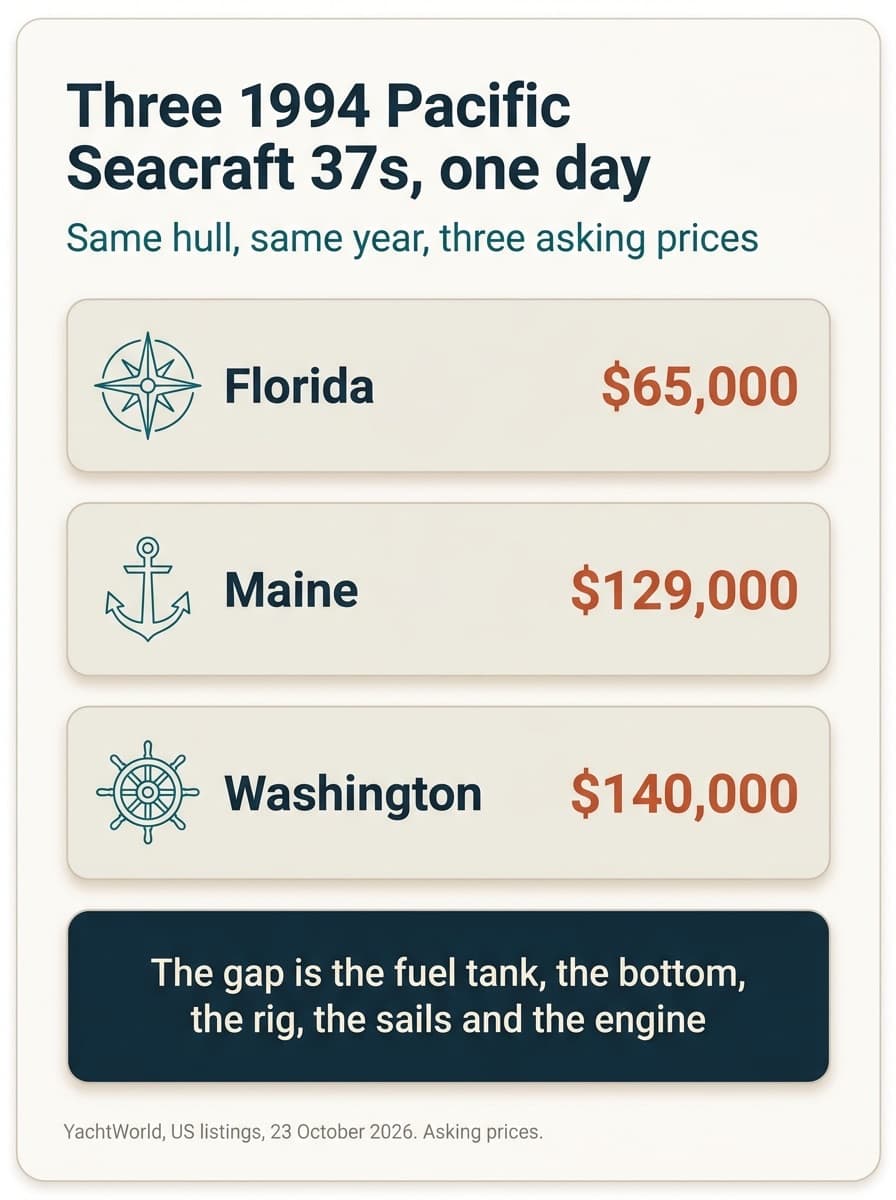
Three 1994 boats on the same day at $65,000, $129,000 and $140,000. The hulls are the same. What differs is the fuel tank, the bottom, the rig, the sails, the engine and the electronics, and whether there are invoices for each. On a 37 the all-in method in our guide to what a used sailboat is worth is not a nicety; it is the only way to compare those three listings.
From the true-cost guide at 37 feet, a 1994 boat with nothing dated carries a re-rig, three sails, running rigging, a possible repower reserve on an early engine, the fuel tank, survey and haul-out, sales tax and a contingency. That bill can be $40,000 to $60,000 on a $65,000 boat, which is how the cheap 1994 boat and the dear one meet in the middle.
Pacific Seacraft 37 or 34?
The 37 if you carry crew, want the second cabin or a cockpit that seats eight feet ten inches of people, and need the extra 20 gallons of water. The 34 if you are a couple and $60,000 matters. They have nearly identical displacement-to-length and sail-area ratios and sail the same way; Practical Sailor's reviewer would take the 37 to carry people and gear and calls the 34 more than enough for two.
The Pacific Seacraft 34 guide covers the smaller boat and the hub has the side-by-side table. One point the tables do not show: the 37 was offered as a sloop, cutter or yawl. The cutter is the one to want. SpinSheet sees little reason for the yawl, whose mizzen clutters the cockpit, and the cutter balances best under reduced sail offshore.
Is the Pacific Seacraft 37 a bluewater boat?
She is close to the definition of one. Capsize screening about 1.7, comfort ratio about 34, displacement-to-length 334, a hull that heels early and lengthens its waterline, a canoe stern for following seas, and a track record of 150-mile days and ocean crossings. The bluewater shortlist lists her for those reasons.
| Ratio | Value | Reading |
|---|---|---|
| Capsize screening | 1.72 | Well under the 2.0 offshore threshold |
| Comfort ratio | 34 | High; seakindly |
| Displacement / length | 334 | Heavy displacement; Sailing Magazine notes the number flatters her less than she sails |
| Sail area / displacement | 15.6 | Moderate; a drifter or cruising spinnaker for light air downwind |
| Ballast / displacement | 39% | Solid |
| Hull speed | 7.1 knots | how it is calculated |
Computed from LWL 27.75 ft, beam 10.83 ft, displacement 16,000 lb, ballast 6,200 lb and sail area 618 sq ft as published. The design ratios guide explains each screen; the free calculators run them for the boat you are looking at. Against the Westsail 32 and the Island Packet 35 she sits between them on weight and ahead of both to windward.
Which Pacific Seacraft 37 should you buy?
A cutter, built after 1988 for the vinylester skin coat and after about 1993 for the biaxial laminate if you can, with the Yanmar, a replaced fuel tank and a documented bottom. A 1980s boat on its original Volvo and original tank at a 1980s price can be the better buy if the survey and the yard quotes say so, and only then.
The 37 changed less over 45 years than almost any production boat, so the year buys you resin and equipment rather than a different hull. The Crealock 37s from Cruising Consultants are the same boat from the same drawings. Early Pacific Seacraft boats had smaller engines and the pre-vinylester bottom; late 1980s and 1990s boats have the Yanmar and the better laminate. The 2000 boats at $165,000 are paying for a decade of less to do.
What to check before you buy one
- Fuel tank. Original aluminium or replaced, and with what. Look at the tank top and fittings.
- Bottom. Barrier coat history and moisture readings on a pre-1988 hull.
- Hatches and the deck under them. Every Bowmar hatch; meter the plywood core around each.
- Water tanks. Taste, inspect, ask.
- Engine. Which one, how many hours, what records. An original Volvo on a 1980s boat is a repower reserve until proven otherwise.
- Chainplates. Weeping below each one.
- Rig and sails. Three sails on a cutter, running backstays if fitted, and the age of the wire. The inspection checklist covers the rest, and a boat at this price always gets a survey.
How Knotworth reads a specific Pacific Seacraft 37
This page describes the model. The product reads the boat. Paste a listing URL and the free pre-check matches it to the Pacific Seacraft 37's reference record, runs her design numbers, lists which of the known issues above the advertisement is silent on, and ranks the seller questions by money. On a 37 the fuel tank, the engine and the bottom come first, and the $39 report prices all three against the asking price before you fly to see her.
Paste the URL. The free pre-check reads that boat's specs, runs her ratios, and tells you which of the known Pacific Seacraft 37 questions the ad leaves open. No card until you unlock the full report.
FAQ
What are the problems with a Pacific Seacraft 37?+
An aluminium fuel tank in the bilge that corrodes from outside, osmotic blisters on early-to-mid 1980s hulls, Bowmar overhead hatches that leak, and water tanks molded into the liner that are hard to inspect. Structurally the boat has an unusually clean record; the rest of the list is rigging, sails and engine on the normal intervals.
How much does a Pacific Seacraft 37 cost?+
On the US brokerage market in October 2026, 1989 to 1994 boats asked $65,000 to $140,000, late 1990s boats $99,000 to $135,000, and 2000 boats $165,000. The median of twelve listings was about $124,000. The spread inside a single year is refit history, so compare all-in prices.
What is the difference between the Pacific Seacraft 34 and 37?+
The 37 has a larger cockpit and galley, 20 more gallons of water, an optional second cabin and sleeps six; the 34 has the better V-berth and helm seat, sails the same way, and costs roughly $60,000 less for the same year. For a couple the 34 is enough; for a couple with crew the 37.
Is the Pacific Seacraft 37 a good bluewater boat?+
Yes. Capsize screening about 1.7, comfort ratio about 34, solid laminate hull, skeg rudder, canoe stern, and a record of 150-mile days and ocean passages. Her limits are 40 gallons of fuel and a small crew.
What is a Crealock 37?+
The same boat under its first name. Cruising Consultants of Newport Beach built sixteen Crealock 37s in 1978 and 1979 before Pacific Seacraft bought the tooling in 1980 and renamed it. The design is Bill Crealock's and did not change.
Which engine does a Pacific Seacraft 37 have?+
Late 1980s and later boats have a four-cylinder Yanmar of about 50 hp, which SpinSheet calls slightly overpowered. Earlier boats had a 24 hp Volvo or a Universal diesel, and many have been repowered. Ask which, and ask for the records either way.