Tayana sailboats: a used buyer's guide to the Ta Yang boats
By Itzhak Fuhrman·Built and maintains Knotworth's cost model·Updated 18 November 2026
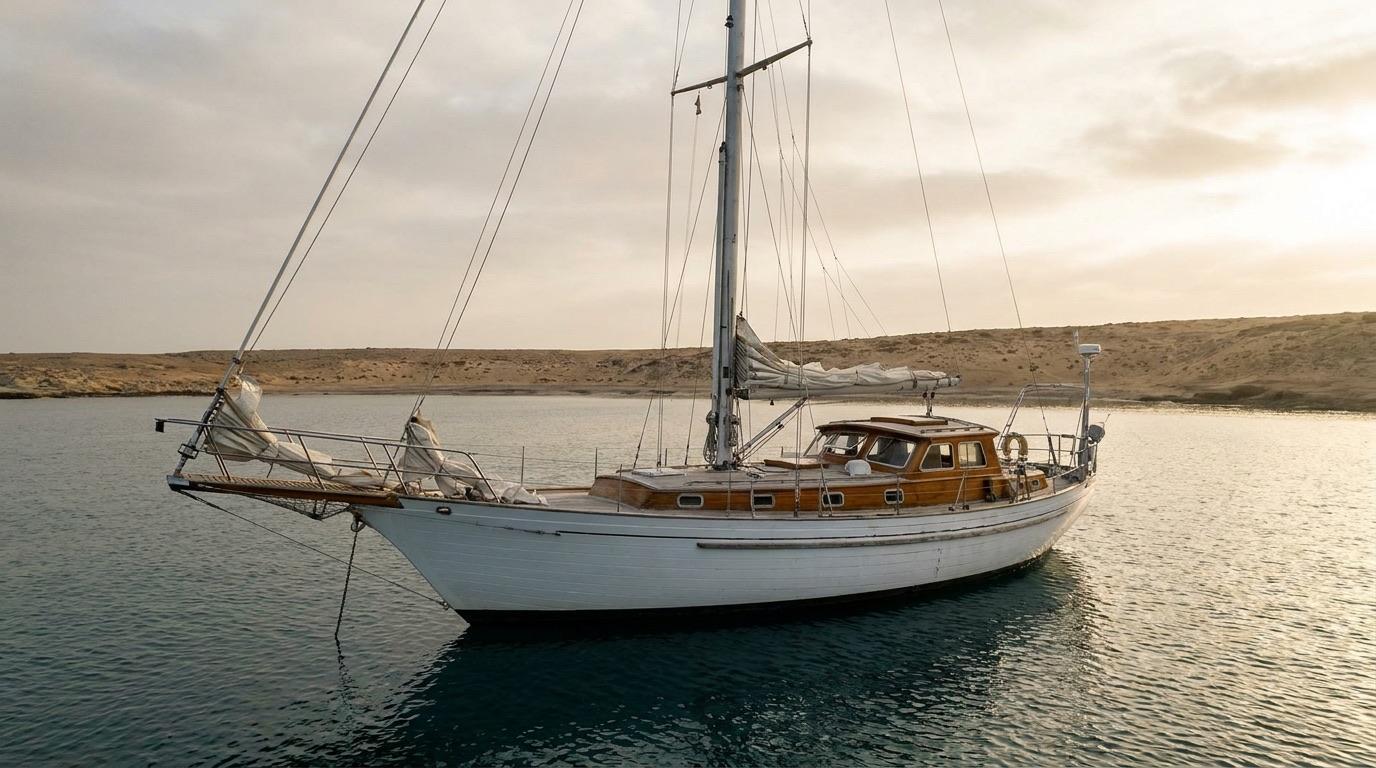
Every marina in America has one: a canoe-sterned cutter with a bowsprit, a teak deck gone grey, and a hull that looks like it was planked. That is a Tayana, or a boat built in the same Taiwanese yard under another name, and for fifty years it has been the cheapest honest way into a boat that can cross an ocean.
Cheap is the word to hold onto, because the price is low for reasons. This hub explains what Ta Yang built, why the yard's closing matters to a buyer, and the five things that go wrong on nearly every Tayana of the first twenty years. The Tayana 37 page prices the faults on the boat most people are actually looking at.
Is Tayana still in business?
Not as a working yard. Ta Yang Yacht Building, founded in Kaohsiung in 1973, had built more than 1,400 yachts by 2016 under the Tayana name and for other brands. Wikipedia and sailboatdata both record the company as closed since September 2020, and the company's own website does not answer. One US broker's 2026 guide still describes semi-custom production, but we could not confirm it. Treat the builder as gone for support purposes.
The practical consequence is the same one that applies to Westsail and the old Pearson range: there is no factory to ask about a hull number, no parts counter, and no warranty on anything. What there is instead is a long-lived owners' community. Practical Sailor's advice in its Tayana 37 review is to join the Tayana Owners Group and read the back newsletters before buying, and the group's archive at tognews.com goes back to the 1980s. That advice is worth more now than when it was written.
The company's history explains the boats. Ta Yang began as a contract builder for US importers; its first big success was Bob Perry's 37-foot double-ender, sold from 1976 as the CT 37 because the CT name was already known in America, then renamed the Tayana 37 in 1979. Robert Harris's Vancouver 42 followed, then larger Perry designs, the 48, 52 and 55, and later boats by Doug Peterson and Bill Dixon. Wikipedia's company entry has the designer list and the closure date; the sailboatdata builder record gives the years in business as 1973 to 2020.
Are Tayana boats good?
The hulls are heavy, solid hand-laid fiberglass and the joinery is as good as any production boat's. The engineering of the early years was not: Practical Sailor's recurring phrase for Taiwanese boats of the era is excellent craftsmanship with a poor understanding of the forces involved in ocean sailing. Later boats are better than early ones, and Perry rated Ta Yang one of the best yards he worked with. Buy the boat, not the brochure, and the year matters.
Charles Doane's Wave Train profile puts the strengths plainly: solid glass hull stiffened with strong bulkheads and stout floors, all deck hardware through-bolted on stainless backing plates, and a reputation as one of the most popular bluewater cruisers ever built. Practical Sailor's construction notes call the glasswork good, with neat fillet bonding and no resin slopped about, and record a ten-year hull guarantee from the builder.
The same two sources list the weaknesses, and they are the ones a buyer prices. A hollow bulwark at the hull-to-deck joint that leaked on early boats until the yard began glassing it over from inside. Wooden spars with knots in them. A fuel tank the builder moved into the bow for storage space, against the designer's drawing. Worm-gear steering copied from Edson that was later replaced with a pedestal. None of these is a reason to walk away. All of them are reasons the survey on a Tayana is not a formality.
What goes wrong on a used Tayana?
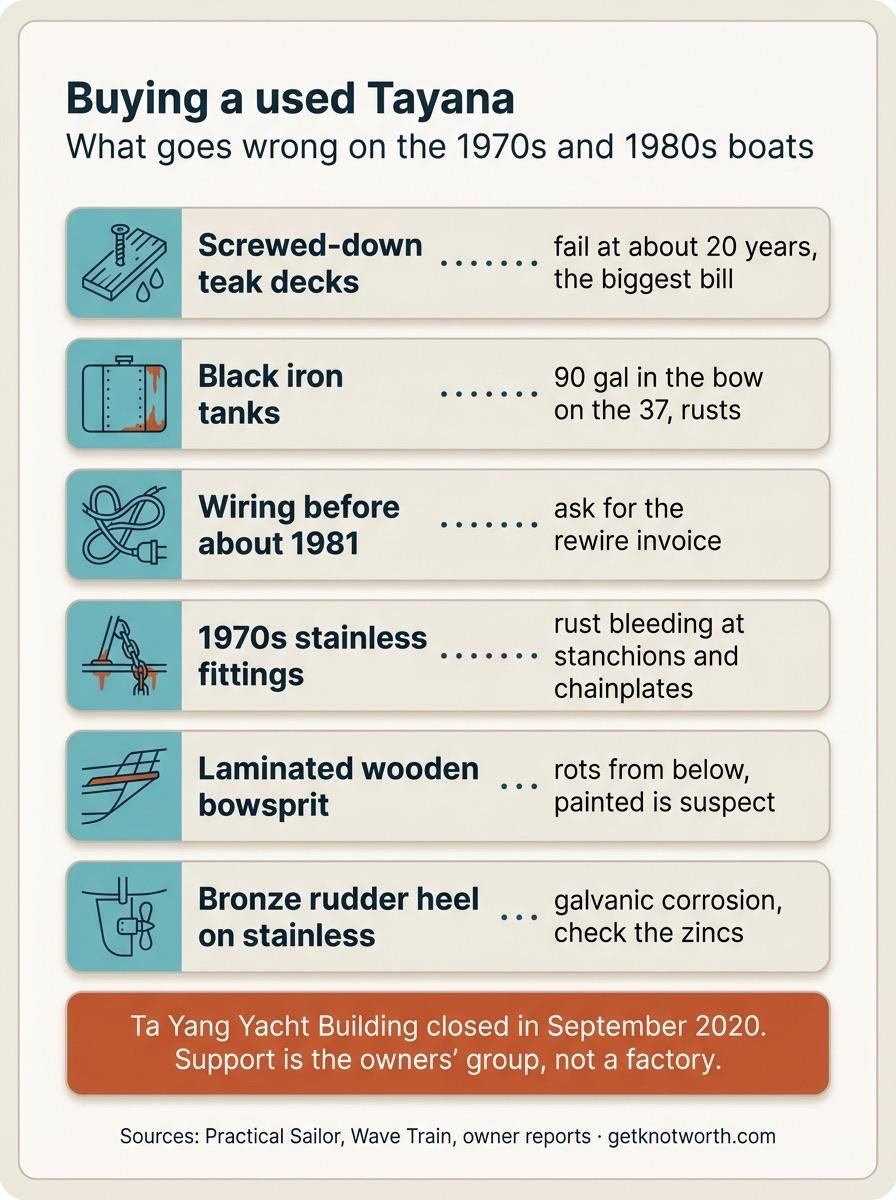
Five things, on nearly every hull built before the late 1980s: teak decks screwed through a cored deck, black iron fuel and water tanks, inferior wiring on boats built before about 1981, lower-grade stainless in some fittings of the same years, and a laminated wooden bowsprit that rots from underneath. Add the bronze rudder heel on stainless bolts, which corrodes galvanically, and the encapsulated iron ballast, which cannot be inspected.
| Known issue | What it means, and what it costs |
|---|---|
| Screwed-down teak decks | Almost every Tayana of the era has them. Each screw is a path into the core, and the core on early boats was end-grain softwood blocks set in polyester. Owners report the decks fail at about twenty years. Removal and re-glassing is the largest single bill on these boats; the Tayana 37 page has the figures |
| Black iron tanks | Fuel tanks were black iron and eventually corrode; the 37's standard tank is 90 gallons under the V-berth. Replacement is a fabricated tank plus the labour to reach it, which on the bow tank is easier than on most boats |
| Wiring before about 1981 | Doane names inferior electrical wiring on boats built before 1981. A rewire is priced by the yard, not the catalogue; a boat with a documented rewire is worth the premium |
| 1970s stainless | Inferior-grade stainless alloys in some hardware and fittings on early boats. Look for rust bleeding at stanchion bases, chainplates and the bowsprit fittings |
| Laminated wooden bowsprit | Rots from underneath if not maintained. A painted sprit is often hiding something; a varnished sprit with no moisture damage is the one to want |
| Bronze rudder heel on stainless bolts | Galvanic corrosion between the two metals eats the fastenings. Zincs are provided; check they are there and being replaced |
| Hull-to-deck joint | A hollow bulwark pierced by hawsepipes and scuppers that leaked on early boats. Later boats have the cavity glassed over from inside. Look for staining on the inside of the bulwark |
| Encapsulated iron ballast | Cast iron dropped into the hollow keel and glassed over. No keel bolts to inspect, but no way to see the iron either; a cracked keel bottom that has let water in is the finding to fear. See what that means for keel inspection |
| Wooden spars and worm-gear steering | Early boats may have spruce masts with knots and sloppy worm-gear steering. Aluminium spars and pedestal steering are the versions to look for |
Sources: Wave Train for the wiring, stainless, bowsprit, deck core and teak-deck findings; Practical Sailor's construction review for the bulwark joint, rudder heel, ballast and steering; a Tayana 37 owner on the sailboatowners.com forum for the end-grain core and the twenty-year deck life. Assumption: a boat on which the work has not been done, which on a 1970s or 1980s hull is the safe assumption until the seller produces the invoices.
Looking at one right now? Paste the listing and the free pre-check lists which of these the ad is silent on.
Free on every boat, no card. You only pay to unlock a full report.
Which Tayana?
The 37 for almost everyone: nearly 600 built, the most available bluewater boat on the US market, and the cheapest. The Vancouver 42 for a couple who want the same idea with more room and a choice of sterns. The 48 and larger boats are a different budget and a different market, with far fewer hulls and far fewer listings.
Tayana 37. Perry's double-ender, 1976 to the 1990s, about 600 built, cutter or rarely ketch, wood or aluminium spars, deck- or keel-stepped mast, pilothouse option, and an interior that was custom on every boat. The Tayana 37 page covers her in full. She is on our bluewater shortlist because she is the easiest boat on it to go and see.
Vancouver 42. Robert Harris's design, built by Ta Yang from 1979 into the 1990s, offered with a canoe stern or a transom and as a cutter or ketch; about 200 built on the figures brokers quote. The same construction era as the 37 with the same list of things to check, plus a centre-cockpit layout on many boats. Listings are a handful at any time; expect $60,000 to $120,000 asking for 1980s boats and verify against the day's market.
Tayana 48, 52 and 55. Perry centre-cockpit and pilothouse designs from the late 1980s onward, with modern underbodies and skeg rudders. These are $150,000-plus boats from a different decade of the yard, and the 1970s faults above mostly do not apply. We do not cover them in depth.
What does a used Tayana cost?
On the US brokerage market in October 2026, five Tayana 37s built between 1976 and 1982 asked $29,000 to $69,500, median $40,000. Practical Sailor's 2026 market scan found a 1978 boat at $75,000 and 1984 and 1985 boats at about $45,000 to $50,000. Readers of that review put a well-equipped, repowered boat at $50,000 to $80,000. The spread is the refit history, and on a Tayana the refit history is the deck.
| Model | Year | Recent asking price |
|---|---|---|
| Tayana 37 | 1976 | $29,000 (Washington, NC) |
| Tayana 37 | 1977 | $40,000 (Seattle) |
| Tayana 37 | 1978 | $75,000 (Berkeley, Practical Sailor market scan) |
| Tayana 37 | 1979 | $29,000 and $44,900 (North Carolina, Texas) |
| Tayana 37 | 1982 | $69,500 (New Bern, NC) |
| Tayana 37 | 1984 to 1985 | $44,900 to $49,900 (Florida, Practical Sailor market scan) |
YachtWorld US listings, first results page, 23 October 2026, plus the market scan in Practical Sailor's 2026 review. Doane's rule from 2010 still describes the market: older boats needing work under $50,000, younger boats loaded with offshore gear under $100,000.
What a used Tayana is worth to you is the asking price plus the deck, the tanks, the wiring and the rig, in that order. Our guide to what a used sailboat is worth sets out the arithmetic; the true-cost guide prices the rigging, sails and engine lines by length.
What to check before you buy one
- The deck. Original screwed teak, or removed and re-glassed? If original, how old, and what does the moisture meter say around every fitting.
- Tanks. Black iron or replaced; where the fuel tank is (bow or amidships).
- Wiring. Year of the boat, and any rewire invoice.
- Bowsprit. Varnished or painted; probe the underside.
- Rudder heel and zincs. Look at the bronze casting and its bolts.
- Spars and steering. Aluminium and pedestal, or wood and worm gear.
- Rig, sails, engine. Dates and invoices. The inspection checklist covers the rest, and a Tayana always gets a survey by someone who has surveyed teak-decked boats before.
Paste the URL. The free pre-check reads the specs, matches the model and year, and lists which of the known Tayana issues the ad is silent on, with the deck question first.
FAQ
Is Tayana still in business?+
Not as a working yard. Ta Yang Yacht Building of Kaohsiung, which built the Tayana range from 1973, is recorded by Wikipedia and sailboatdata as closed since September 2020, and its website does not respond. One broker's 2026 guide still mentions semi-custom production, which we could not confirm. Support for the boats comes from the Tayana Owners Group and its newsletter archive.
Are Tayana boats good bluewater boats?+
Yes, by record and by numbers. The 37 has a capsize screening value of about 1.6 and a comfort ratio over 40, a solid hand-laid hull, through-bolted hardware on backing plates, and more ocean miles under it than almost any production design. The caveats are age-related: decks, tanks, wiring and early fittings, not the hull.
What are the common problems with Tayana sailboats?+
Screwed-down teak decks over a cored deck, black iron tanks, inferior wiring and stainless on boats built before about 1981, a laminated wooden bowsprit that rots from below, a bronze rudder heel on stainless bolts, and on early boats a leaking hull-to-deck bulwark, wooden spars and worm-gear steering. Later boats fixed several of these at the factory.
How much does a used Tayana 37 cost?+
On the US market in October 2026, 1976 to 1982 boats asked $29,000 to $69,500 with a median of $40,000, and Practical Sailor's 2026 market scan found a 1978 boat at $75,000. The spread is the refit history, and the deck is the largest line in it.
Who built Tayana sailboats, and who designed them?+
Ta Yang Yacht Building of Kaohsiung, Taiwan, built them from 1973 to 2020. Bob Perry designed the 37, 48, 52 and 55; Robert Harris the Vancouver 36 and 42; Doug Peterson the 47; and Bill Dixon the 58 and 64. The 37 began life as the CT 37 because the CT name was better known in America in 1976.