Keel bolts on a used sailboat: what to check before you buy, what the keel smile means, and what replacement costs
By Itzhak Fuhrman·Built and maintains Knotworth's cost model·Updated 18 November 2026
No listing yet, or already own her? Pick the boat and the year to see which kind of keel and keel bolts she has.
Every surveyor's report on a thirty-year-old fin-keel boat has a line about the keel bolts, and almost every one of them says the same thing: they could not be fully inspected. That is not the surveyor being careful. It is the design. The bolts run from inside the lead or iron up through the hull stub, and the only part anyone sees is the top inch and a nut.
So a buyer judges the keel bolts the way a doctor judges a heart from the outside: by the signs. This page is the list of those signs, what each one costs when it turns out to be bad, and the one question that changes the whole bill, which is whether the keel is iron or lead.
What are keel bolts, and why can a surveyor not just look at them?
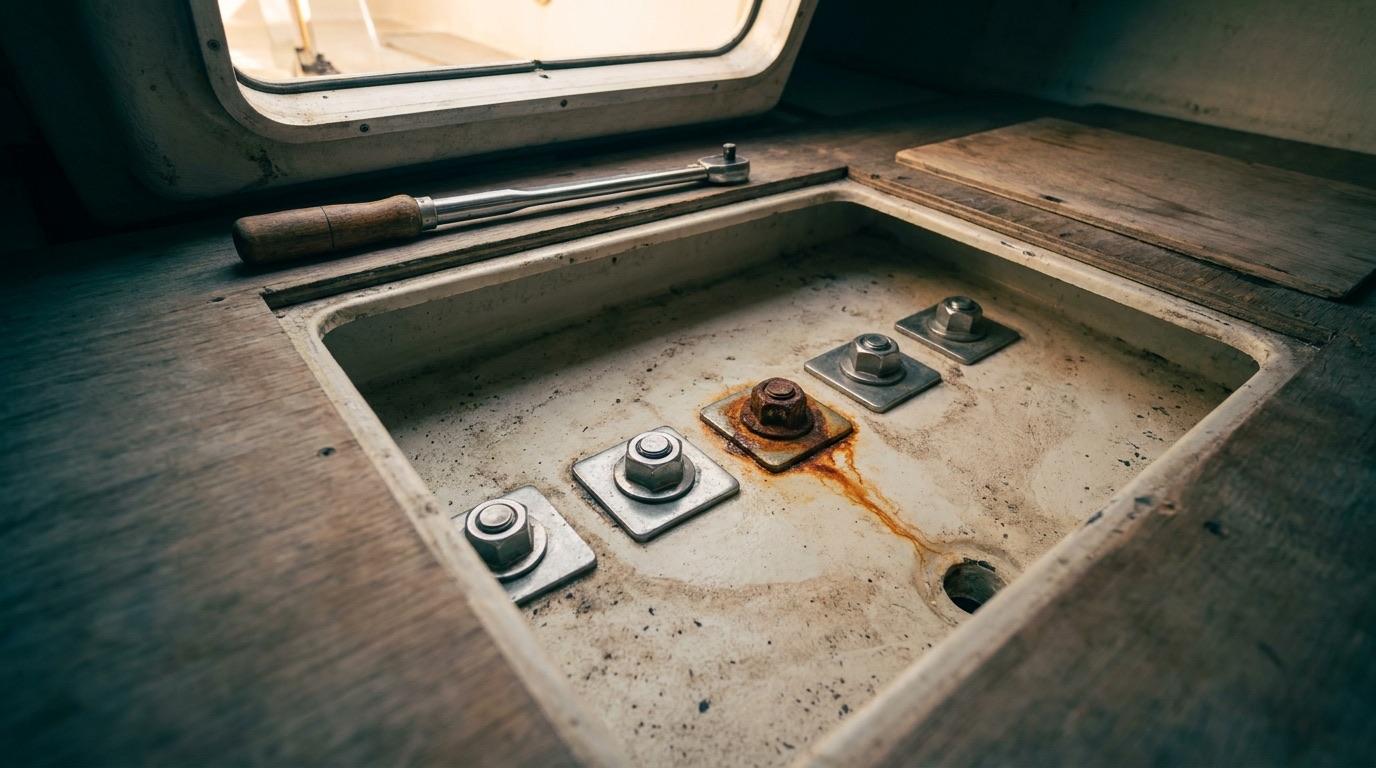
Keel bolts are the studs or bolts that fasten an external ballast keel to the hull. On a lead keel they are usually J-shaped or straight rods cast into the lead when it was poured; on a cast-iron keel they are bolts threaded into holes tapped in the iron. Both pass up through the fiberglass keel stub and are tightened with nuts and plate washers in the bilge. Only the nuts and the top of the shank are visible without surgery.
Practical Sailor's Darrell Nicholson puts it plainly in a 2022 piece on keel bolt inspection: keel bolts are still very difficult to fully inspect without some surgery. The surgery is either dropping the keel or drawing one bolt out, and neither happens on a routine pre-purchase survey.
The number of bolts varies. Practical Boat Owner's 2026 guide to checking keel bolts notes that modern production boats rarely have fewer than eight or ten. The Niagara 35 that the Bluewater Cruising Association's authors dropped the keel on had seven, four of three-quarter inch and three of one inch, holding about 5,500 pounds of lead.
A boat with an encapsulated keel has none of this. The ballast is sealed inside the hull moulding, so there are no bolts and no joint. That is true of the Westsail 32, the Cape Dory 28 and the Island Packets, and it is one reason the Westsail appears on the bluewater shortlist. Not every heavy cruiser is built that way: the Pacific Seacraft 34 and 37 carry external lead on stainless bolts. Everything below is about bolt-on keels.
Iron keel or lead keel: the question that sets the price
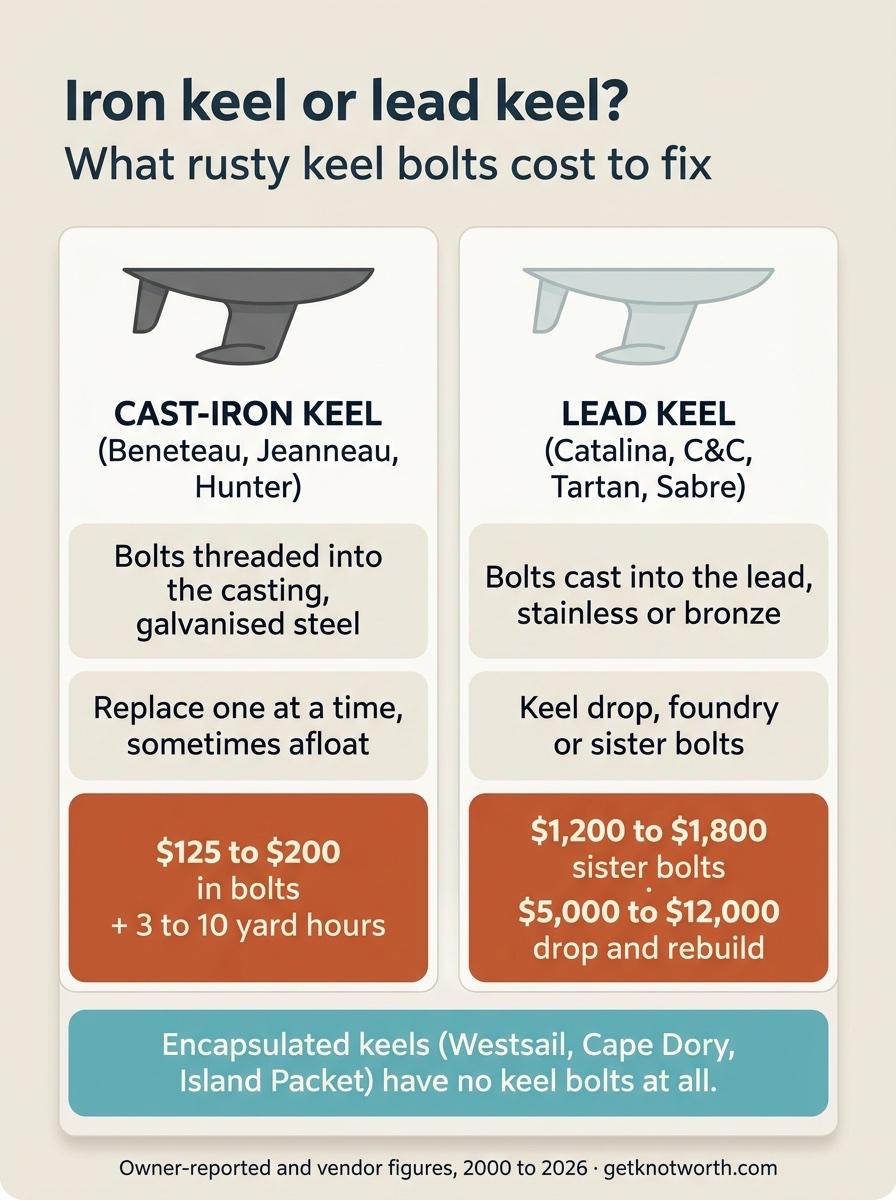
On a cast-iron keel (Beneteau, Jeanneau, Hunter, most European production boats) the bolts are galvanised or zinc-plated mild steel threaded into the casting. They rust visibly, which is bad news that is easy to read, and they can be unscrewed and replaced one at a time, sometimes in the water. On a lead keel (Catalina, C&C, Tartan, Sabre, J/Boats and most US builders) the bolts are stainless, bronze or Monel rods cast into the lead. They hide their corrosion, and replacing one means a keel drop and either a foundry or new bolts drilled alongside the old.
The difference matters because every forum quote for keel bolt work sorts into two piles once you know the keel material.
Iron keel, bolts threaded in. An owner on the sailboatowners.com forum had all eleven bolts on a 1993 Beneteau Oceanis 400 replaced by a yard for about $200 in parts and ten hours of labour, on the hard, alongside the bottom paint. Another, with a 1988 Oceanis 430, did the job himself with an impact driver and sockets. A third drew a single bolt in the water to check it and found the rust was skin deep. Replacement bolts from Beneteau were quoted at about $125 shipped in a 2013 thread where a buyer had been handed a $7,000 estimate and the forum's answer was, in short, that it is not a $7,000 job.
Lead keel, bolts cast in. Here the bolt cannot be unscrewed. MarsKeel, the Canadian keel foundry that casts for several production builders, describes the proper fix on its own site: melt the old bolt out of the lead, analyse the alloy, cast a new bolt, and re-fuse the lead around it. Its worked price example is $475 per bolt plus freight, or about $6,200 for an eight-bolt, 5,000-pound keel before the local yard's bill for dropping and refitting it. MarsKeel is a vendor, so read that as the foundry's price, not the whole job. Owners on the C&C 27 forum put a drop-and-rebed at $5,000 to $10,000; Catalina 30 owners quoted $5,000 to $12,000 for the keel drop and stub rebuild on the Catalina smile page.
| Keel | Bolts | What replacement involves | Reported cost |
|---|---|---|---|
| Cast iron (Beneteau, Jeanneau, Hunter, Bavaria, Dufour) | Galvanised mild steel, threaded into the casting | Unscrew and replace one at a time; boat can stay in the water if the joint is dry | $125 to $200 in bolts plus 3 to 10 yard hours; owner-reported $600 for four bolts (1986 First 405) |
| Lead (Catalina, C&C, Tartan, Sabre, Pearson, Valiant, Pacific Seacraft, J/Boats) | Stainless, silicon bronze or Monel rods cast in | Drop the keel; either send it to a foundry to melt out and recast the bolts, or drill and tap new "sister" bolts beside the old | Foundry $475 per bolt plus freight; sister bolts without a drop $1,200 to $1,800; drop, rebuild stub and rebed $5,000 to $12,000 |
| Encapsulated (Westsail, Cape Dory, Island Packet) | None | Nothing to replace; check the encapsulation for cracks and water instead | - |
Sources for the figures: sailboatowners.com threads from 2000, 2013 and 2015; MarsKeel; SailNet for the sister-bolt and stub-rebuild quotes. Forum prices are owner-reported and several are a decade old; yard rates have risen since. Treat them as the shape of the bill.
Looking at one right now? Paste the listing and the free pre-check lists which of these the ad is silent on.
Free on every boat, no card. You only pay to unlock a full report.
What is a keel smile?
The keel smile is a thin crack along the joint where the keel meets the hull, curving up at the ends. It appears on almost every boat with a bolt-on keel after enough seasons of the rigid keel working against the flexing hull, and on its own it is cosmetic. It becomes a keel bolt problem when it weeps rust, reopens wider each year, or sits over a stub that has gone soft.
Builders get their name attached to it. The C&C 27 Association describes the C&C smile as a slight permanent separation between the fiberglass stub and the lead keel that affects all C&Cs built in the seventies and some from the eighties; owners there have found that glass tape over the joint lasts a couple of seasons at best, and that a flexible epoxy like G/flex in the cleaned joint holds longer. Latitude 38's Elana Connor documented the same crack on a 1985 Sabre 34 and reached the same conclusion: it is a normal side effect of a bolted-on keel and it will probably come back. The Catalina version has its own story, a plywood keel stub on boats built before mid-1988, which is why it gets its own page.
What the smile tells a buyer about the bolts is this: a dry hairline over a solid stub means the joint is moving a little, as all of them do. A smile that stains rust means water is reaching the bolts. On an iron-keel boat that is the bolts' own rust, and the fix is cheap. On a lead-keel boat it is water sitting on stainless bolts with no oxygen, which is exactly how crevice corrosion starts, and the fix is not cheap.
Six signs the keel bolts need attention
Water weeping from the joint when hauled; rust stains at the nuts or running from the joint; a gap at the joint you can slip a blade into; a nut with more thread showing above it than last year; a bolt head with a quarter of its metal rusted away; and a keel that shifts or the crack that opens when the boat hangs in the slings. Any one is a reason to price the repair before the offer. Two or more on a lead keel is a reason to walk unless the price already reflects a drop.
The list comes from the people who look at keel bolts for a living. The Bluewater Cruising Association's authors list water weeping from the joint at haul-out, water entering the bilge through a bolt hole, uneven torque across the nuts, and rust from a bolt or nut as the triggers that sent them to drop their own keel. Practical Sailor adds the sign most buyers miss: if more thread shows above the nuts than it did a year ago, the bolts are almost certainly pulling out of the keel. A forum veteran's rule in a sailboatowners.com thread is to replace any bolt whose head has lost more than a quarter of its metal to rust.
| What you see | What it usually means | Iron keel | Lead keel |
|---|---|---|---|
| Dry hairline smile, no stain | Normal joint movement | Cosmetic | Cosmetic |
| Rust weeping from the joint or at the nuts | Water on the bolts | Surface rust on mild steel, usually; draw one bolt to confirm | Possible crevice corrosion you cannot see; budget a drop or a bolt pull |
| Joint gap you can slip a putty knife into | Bedding has failed or bolts have lost preload | Re-torque and rebed; check for a grounding | Rebed, which means a drop |
| More thread above a nut than before, or a nut that has sunk | Bolt stretching, pulling out, or the stub compressing | Replace that bolt | Stub inspection and probably a drop |
| Bolt head with a quarter of its metal gone | Replace it | Routine | Foundry or sister bolts |
| Keel moves on the blocks, or the crack opens in the slings | Loose bolts or a failing stub | Stop the survey and get a yard quote | Stop the survey and get a yard quote |
The Bluewater authors found something else worth knowing when they dropped the Niagara's keel: the corrosion that matters is concentrated where the bolt passes through the sump, in the inch or two that is never seen from above or below. That is why "the nuts look fine" is a true statement and not an answer.
Why stainless keel bolts are the ones to worry about
Galvanised mild steel on iron keels rusts on the surface and shows it. Silicon bronze on lead keels lasts the life of the boat. Stainless steel on lead keels is strong and common, but when it sits in trapped water without oxygen it suffers crevice corrosion, which eats the bolt from inside the stub where nobody can see. A stainless bolt can look perfect at the nut and be half gone an inch below the washer.
The materials argument is laid out by both a bolt seller and the trade press, and they agree on the shape of it. Fair Wind Fasteners, which sells silicon bronze and stainless fasteners, says bronze bolts will last the lifetime of the boat on a lead keel and warns buyers to be very wary of stainless keel bolts. Practical Boat Owner's surveyors say the same: stainless in a lead keel can suffer crevice corrosion, and galvanised steel, though it rusts, at least fails where you can see it. Practical Sailor names a high-grade stainless, Aquamet 22, as the usual choice when owners do replace. Monel and titanium are the premium answers and appear on few production boats.
For a buyer this becomes a simple sorting rule. On an iron keel, rust at the nuts is an honest signal and a cheap fix. On a lead keel with stainless bolts, the absence of rust proves nothing, which is why the inspection methods below exist.
How keel bolts are actually inspected
Four methods, in rising order of cost: a visual and tap test on the nuts and washers; a torque check against the builder's figure; drawing one bolt out for a full-length look, which Practical Boat Owner's surveyor recommends roughly every ten years and after any hard grounding; and imaging, where portable X-ray works on steel and stainless but not on bronze. None of them is part of a standard pre-purchase survey unless you ask and pay.
PBO's August 2026 guide quotes surveyor Ben Sutcliffe-Davies on the method: it is not enough to check that a bolt is tight, and tapping each nut with a ball-pein hammer picks out the one under different tension from its neighbours. Drawing a bolt means backing the nut off, jacking the bolt up a few inches on a lead keel or unscrewing it on an iron one, and looking at the whole shank. Dye penetrant kits, cheap and simple, show cracks on the exposed part.
Practical Sailor's 2011 article adds the imaging caveat: portable X-ray may be available in some areas and works for steel, but is almost useless for bronze. The Marine Accident Investigation Branch's report on Cheeki Rafiki, the Beneteau First 40.7 that lost her keel in the Atlantic in 2014, carries the hardest lesson: the bonded matrix that supports the keel bolts can break down after a light grounding in ways that are difficult to detect from inside or outside. Our Beneteau hub covers what that means for the Oceanis and First ranges.
The practical buyer's version: ask the surveyor to state the torque he checked, which nuts he tapped, and whether he recommends drawing a bolt. If the boat has grounded hard, ask for a bolt to be drawn before the offer, not after.
What to ask the seller before you travel
The keel joint is invisible with the boat in the water, so these do the first survey from your desk. The cheap answers come fast.
- Is the keel lead or iron, and are the bolts original? This sets the price of everything else.
- Has she grounded hard, and was the keel inspected afterwards? A grounding is the usual start of both a smile and a loose bolt. World Sailing now requires a keel inspection after any unintentional grounding for boats racing offshore, which tells you what the professionals think of it.
- When were the keel bolts last torqued, by whom, and to what figure? A yard invoice with a number is the answer you want.
- Has a bolt ever been drawn or replaced? If yes, ask which, when, and for the invoice.
- Is the bilge dry around the bolt heads? Standing water over stainless bolts is the crevice corrosion recipe.
- Can you send a haul-out photo of the joint and a photo of the nuts in the bilge? Most owners have both. A seller who will not is pricing a haul-out into your offer for you.
Put the answers beside the inspection checklist and give both to the surveyor.
How Knotworth reads the keel on a specific boat
The free pre-check knows which builders used iron keels with threaded bolts, which used lead with cast-in bolts, and which boats carry a known keel-stub story. Paste a listing and it tells you which pile the boat is in, flags the keel joint where the model has a history, attaches the seller questions, and carries a keel reserve in the full report until a photo, an invoice or the survey clears it.
On the 1988 Catalina 30 we ran through the report, the keel-to-hull joint came up as a model-specific fault before anyone had seen the boat. On a Beneteau Oceanis it would come up as a different item: an iron keel whose bolts can be checked cheaply, and a question about the matrix if she has grounded. Same joint, different bill, and the report prices them differently.
Paste the listing. The free pre-check tells you whether the keel is iron or lead, what that rust is likely to cost, and what to ask the seller before you book a flight.
FAQ
How tight should keel bolts be?+
To the builder's torque figure, which for most production boats is published in the owner's manual or available from the builder or an owners' association. The J/Boats table that Practical Sailor points to is a common reference for lead keels. Surveyors warn against guessing high: on a lead keel over-torquing can crush the stub, and on stainless bolts it can start a crack. If no figure exists, a yard should set it, not the buyer.
How often should keel bolts be checked?+
Look at the nuts, washers and joint at every haul-out, and after any grounding. Practical Boat Owner's surveyors suggest drawing a bolt for a full-length inspection about every ten years on a fiberglass boat, more often on a wooden one. Racing rules now require an inspection after every unintentional grounding.
Can keel bolts be replaced without removing the keel?+
On a cast-iron keel, usually yes: the bolts thread into the iron and can be unscrewed and replaced one at a time, sometimes with the boat afloat if the joint is dry. On a lead keel the bolts are cast in, so the honest answers are either a keel drop and a foundry, or drilling and tapping new sister bolts beside the old ones, which can be done without a full drop but still needs the boat hauled.
What is a keel smile, and is it serious?+
A thin crack along the hull-to-keel joint, normal on boats with a bolt-on keel after years of the rigid keel working against a flexing hull. It is cosmetic if it stays hairline, dry and the same width year to year. It is serious if it weeps rust, reopens wider, or sits over a soft stub, which on pre-1988 Catalinas means plywood in the keel stub.
How much does it cost to replace keel bolts?+
Iron keel: owners report about $125 to $200 in bolts plus 3 to 10 hours of yard labour, so a few hundred to a little over $1,000 in 2026 money. Lead keel: a foundry quotes $475 per bolt plus freight, sister bolts run $1,200 to $1,800, and a keel drop with stub rebuild runs $5,000 to $12,000 plus haul-out. All are owner-reported or vendor figures; get two quotes for the boat.
Are stainless steel keel bolts bad?+
Not bad, but hard to judge. Stainless is strong and widely used, but in trapped water without oxygen it suffers crevice corrosion that eats the shank where it cannot be seen. That is why a clean nut on a stainless bolt proves nothing and why surveyors recommend drawing one bolt rather than trusting the view from the bilge.