Valiant 40 buyer's guide: what she is, what she costs, and the hull numbers that matter
By Itzhak Fuhrman·Built and maintains Knotworth's cost model·Updated 18 November 2026
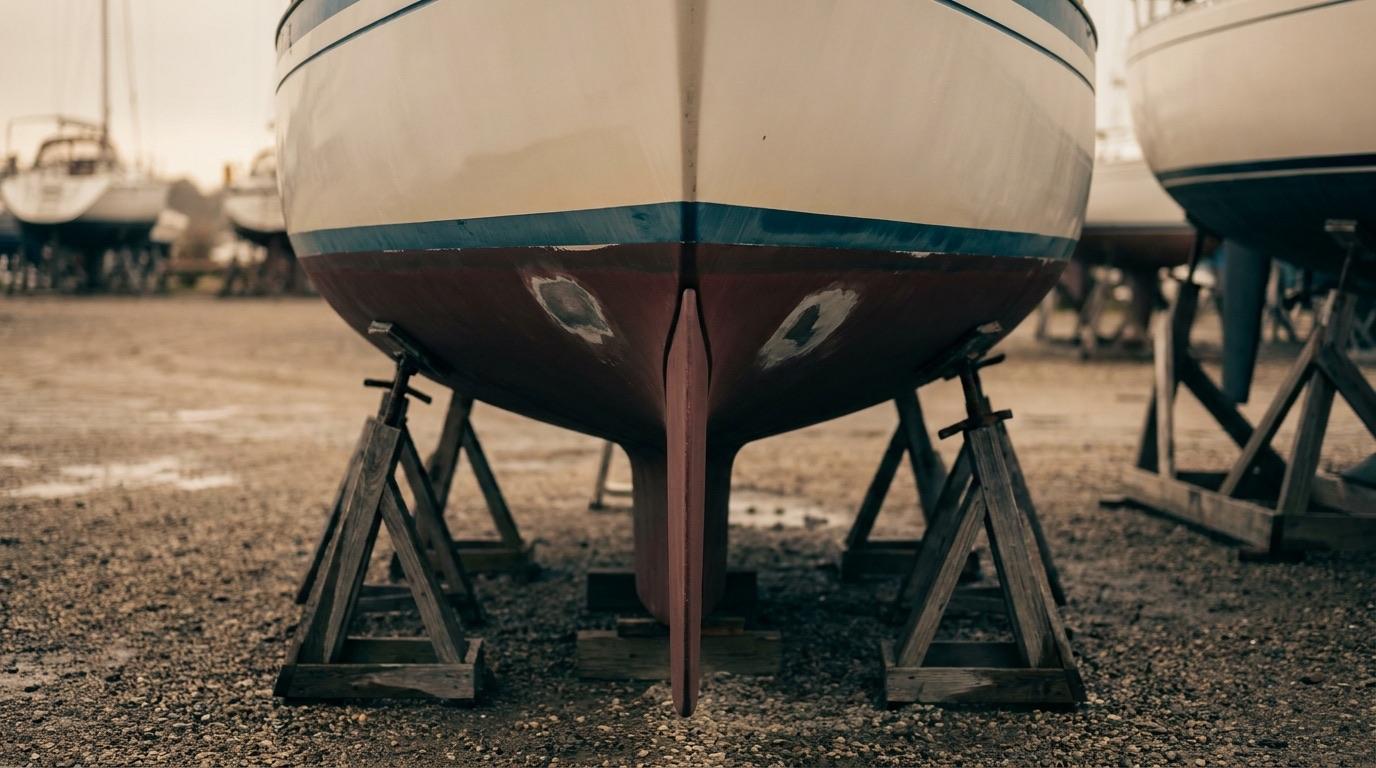
Valiant 40 specifications
| Specification | Figure |
|---|---|
| Length overall | 39 ft 11 in |
| Waterline length | 34 ft 0 in |
| Beam | 12 ft 4 in |
| Draft | 6 ft 0 in standard; shoal keels from 5 ft 2 in, specified in two-inch steps by the Texas yard; at least three boats with centreboards |
| Displacement | 22,500 lb |
| Ballast | 7,700 lb lead, 34%, an external casting on keel bolts |
| Sail area | 753 sq ft as reported by sailboatdata; 810 sq ft appears in other references on a different basis; main 306 sq ft |
| Rig | Cutter, masthead, with bowsprit; sloop on some listings |
| Hull | Solid fiberglass; fin keel; skeg of steel weldment encased in fiberglass; rudder on three bearings, foam-filled; canoe stern |
| Deck | Balsa-cored; stainless chainplate straps through the deck to knees glassed to the hull |
| Tanks | Fuel 90 gal aluminium, or 110 gal in two saddle tanks with the generator option · Water 140 gal in two polyethylene tanks under the settees (sailboatdata lists 47 and 93 gal; the Practical Sailor construction text gives the larger figures) |
| Auxiliary | Westerbeke, Perkins and Volvo diesels over the run; a 42 hp Volvo turbo on later boats |
| Built | 1973 to about 1984 by Uniflite, Bellingham, Washington; from 1984 by Valiant Yachts, Gordonville, Texas (hull 267 onward); replaced by the Valiant 42 in 1992; about 200 built |
| Designer | Robert Perry |
Sources: Practical Sailor's used boat review and its sailboatdata sidebar, SpinSheet, Wikipedia. Tankage and sail area are reported differently by the sources; ask for the boat's own figures.
Practical Sailor's reviewer says she sails as well as any fast cruiser of her size. SpinSheet's, a surveyor, says most attempts he knew to repair her blisters had failed. Both are right, and a buyer needs both sentences in the same breath.
The Valiant 40 was inducted into the American Sailboat Hall of Fame in 1997 as Cruising Sailboat of the Decade. It is the quickest boat on our bluewater shortlist and the one with the single clearest example of why a model name is not enough: two boats, same year, same rig, same photographs, and one hull number inside a range that costs tens of thousands of dollars. This page is that range in money, plus everything else a 30-to-50-year-old Valiant 40 needs, and how the brand's two builders changed what you are buying.
Is the Valiant 40 a good boat?
As a design, one of the best cruising boats America has produced: a fin keel and skeg rudder under a double-ended hull that gives passage speed without giving up motion, a true cutter rig, 140 gallons of water, and a track record of circumnavigations. As a used boat, it is two different purchases depending on the builder and the hull number, and the rest of this page is about telling them apart.
Perry drew her in 1973 as a cruising boat with a racing boat's underbody, and Wikipedia credits her with starting the performance cruiser category. Practical Sailor's construction notes read well: a solid laminate hull, an external lead keel, a steel skeg inside glass, a rudder riding on three bearings, chainplate slots V-cut so sealant can be forced in, and stainless straps bolted to knees glassed to the hull.
The honest other half, from both reviewers: the Uniflite-era boats have a broad, flared bow that is least efficient to windward in a steep chop, which SpinSheet calls her Achilles heel; the engine room sole is slippery; the PVC chain pipe jams; and the bronze seacocks are threaded straight onto the through-hulls rather than flanged, which Practical Sailor flags. She is not a gunkholer at six feet of draft. None of that is why some 40s sell for $25,000.
The blister hulls: 120 to 249
From 1976 Uniflite laid up Valiant 40s in a fire-retardant resin sold as Hetron. It reacted with the sizing on the fiberglass and produced blisters across the hull, deck and cabin top, some eight inches across, on boats built between 1976 and 1981, hull numbers 120 to 249. SpinSheet's surveyor reports repairs costing well over $12,000 in 1999 money and blisters returning within two years on most repaired boats; fewer than 20% of the boats are reported as severe. Hulls before 120, and every Texas boat from 1984, are not affected.
This is the named fault of the Valiant 40, and it is unusual in three ways. It is not osmosis: the blisters are not confined to the wet bottom and do not respond to the usual barrier coat. It is a known range: the hull number is stamped on the boat and the window is published. And it is not fatal: SpinSheet records no sinkings from it and plenty of blistered boats that kept sailing.
What a repair involves, per Wikipedia's summary and the general blister literature: peel the outer laminate, dry the hull for months, re-glass in vinylester or epoxy, barrier coat and fair. The figures for that on any 40-foot boat are not small. A forum estimate for a peel and barrier coat on a different 40-footer was $20,000 to $25,000; spot repair runs $250 to $500 per linear foot at yard rates; SpinSheet's own "well in excess of $12,000" is a 1999 number that has roughly doubled. All owner-reported or generic; none is a quote on the boat you are looking at.
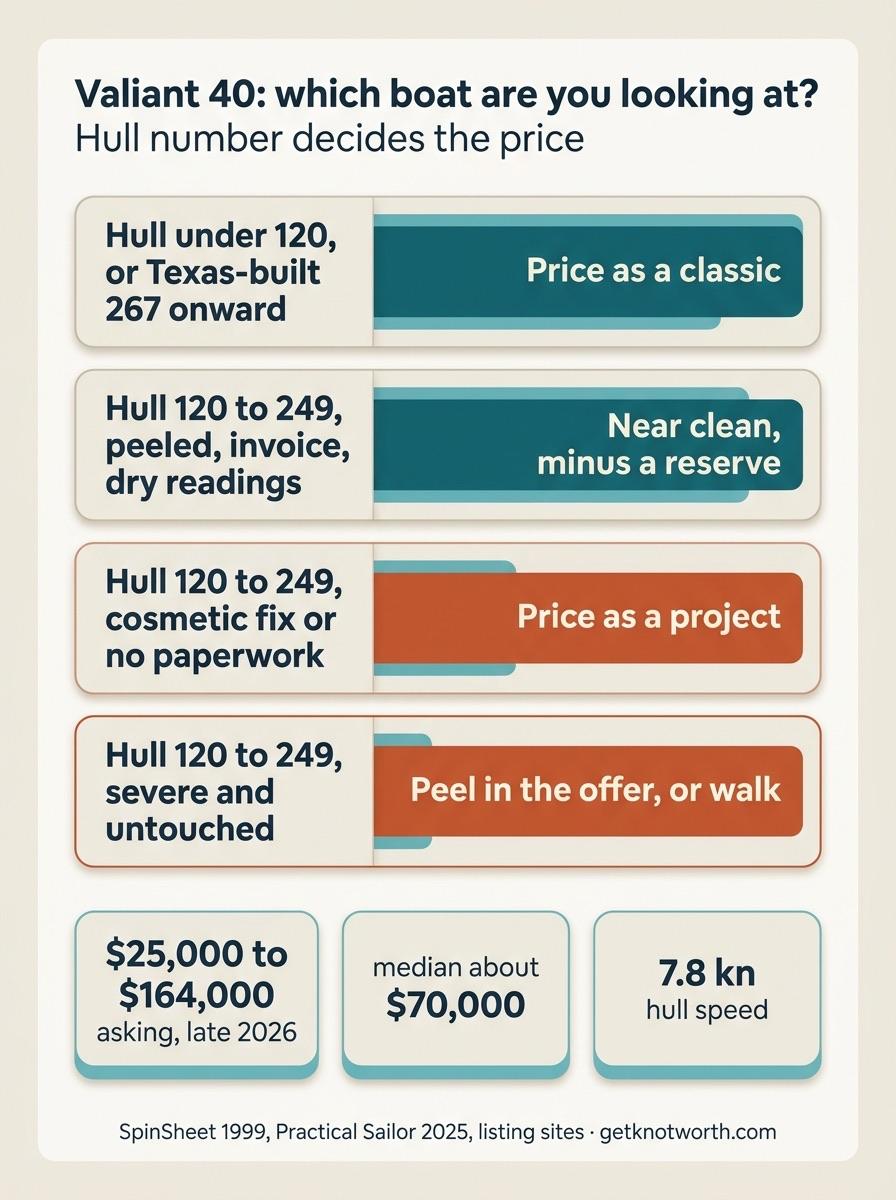
| The boat | What it means | How to price it |
|---|---|---|
| Hull under 120, or Texas-built (267 onward) | Outside the resin window. Texas boats got isophthalic resin and 21 mils of epoxy from new | Price as a classic. Normal survey |
| Hull 120 to 249, peeled and re-glassed, with invoice and recent dry moisture readings | The repair has held, so far | Price near the clean boats, minus a reserve, because the blisters have returned on many |
| Hull 120 to 249, cosmetic repairs only, or no paperwork | Assume they are back or coming back | Price as a project: the full peel in the offer, and a surveyor who knows Valiants |
| Hull 120 to 249, severe and untouched | The under-20% case | Only at a price that leaves room for a $25,000 to $40,000 bottom, or walk |
The brand hub has the history behind the resin. The buyer's version is one line: the listing will not tell you the hull number, so ask for it before you ask the price.
What else goes wrong on a Valiant 40?
The things a balsa-decked, lead-keeled, forty-year-old cutter shares with its peers: wet deck core around the chainplates and hardware, keel bolts that can only be judged by their signs, aluminium fuel tanks, original engines, and the age items. Plus two of her own: seacocks threaded onto through-hulls, and a chain pipe that jams.
| Known issue | What it means, and what it costs |
|---|---|
| Balsa-cored deck | Meter around the chainplate slots, the mast, the bowsprit and every fitting. A recore is priced by area in the true-cost guide |
| Chainplates | Stainless straps through V-cut deck slots to glassed-in knees. The sealant in the slot is the barrier; weeping below deck means the core is wet |
| Keel bolts | External lead keel on cast-in bolts: the lead-keel case in our keel bolts guide. Read the signs; a drop is $5,000 to $12,000 |
| Seacocks | Bronze, threaded straight onto the through-hulls rather than flanged, per Practical Sailor. Work every one; replacing them with flanged units is a haul-out job |
| Fuel tanks | 90 to 110 gallons of aluminium. Ask the age and whether they have been pressure tested; the Pacific Seacraft pages explain why aluminium in the bilge matters |
| Engine | Westerbeke, Perkins or Volvo, some turbocharged, which Practical Sailor notes many mechanics consider too complex for a small boat. Hours, records, and a cold start |
| Chain pipe | PVC, prone to jamming. Cheap to fix, telling about the rest |
| Age items | Standing rigging, three sails on a cutter, running rigging, canvas, electronics. At 40 feet the rig is the largest line |
Sources: Practical Sailor for construction, seacocks, chain pipe, engines and tanks; SpinSheet for the blisters and the chop. Assumption: a boat on which the work has not been done.
Looking at one right now? Paste the listing and the free pre-check lists which of these the ad is silent on.
Free on every boat, no card. You only pay to unlock a full report.
How much does a Valiant 40 cost?
On US listing sites in October and November 2026, 1974 to 1977 boats asked $25,000 to $80,000, a 1981 pilothouse $75,000, a refitted 1983 boat $164,000, and 1989 to 1992 boats $115,000 to $120,000. Aggregators put the twelve-month median at about $70,000. The sample is small, eight boats, and the Boat Trader figures are broker asking prices.
| Build year | Recent asking price | Where |
|---|---|---|
| 1974 | $25,000 | Camden, Maine (private) |
| 1976 | $39,900 | Green Cove Springs, Florida |
| 1976 | $69,900 | Green Cove Springs, Florida (private) |
| 1977 | $80,000 | Everett, Washington |
| 1981 pilothouse | $75,000 | Port Aransas, Texas (private) |
| 1983 | $164,000 (down from $174,000) | Edmonds, Washington |
| 1989 | $119,900 | Green Cove Springs, Florida |
| 1992 | $115,000 | Galesville, Maryland |
Boat Trader and SailboatListings via search results, November 2026; the 1983 and 1989 to 1992 boats also appear in Practical Sailor's July 2025 market scan. Twelve-month median from ListingSport. Asking, not sold. No YachtWorld pull exists for this model yet.
Four of the eight boats were built inside the blister window, and the table shows what that does: two 1976 boats in the same Florida yard at $39,900 and $69,900. The guide to what a used sailboat is worth is the way to put them on one line, and on a Valiant 40 the bottom line of that method is literally the bottom.
From the true-cost guide at 40 feet, a 1970s boat with nothing dated carries a re-rig, three sails, running rigging, an engine reserve, tanks, seacocks, survey and haul-out, tax and a contingency, before the peel. That bill can run $45,000 to $70,000 on a $40,000 boat. The $164,000 boat is paying for someone else having done it.
Valiant 40 or Tayana 37?
The Valiant for speed and a fin-and-skeg underbody that points and passages; the Tayana for a full keel, more boat for the money and a simpler ownership story once the teak decks are settled. Both are Perry designs from the same decade. The Valiant costs more for a clean hull and less for a blistered one; the Tayana 37 has no resin question but has decks to price.
The bluewater shortlist puts the two side by side: the Valiant at displacement-to-length 256 and hull speed 7.8 knots, the Tayana at 337 and 7.5. The Pacific Seacraft 37 is the third option at similar money, slower than the Valiant, cleaner than either on construction history.
Is the Valiant 40 a bluewater boat?
It is close to the definition of one. Capsize screening 1.75, comfort ratio 34, displacement-to-length 256, a canoe stern, a skeg rudder, and circumnavigations on record. It is also the fastest boat on the shortlist, which is the point of the design.
| Ratio | Value | Reading |
|---|---|---|
| Capsize screening | 1.75 | Under the 2.0 offshore threshold; published value 1.74 |
| Comfort ratio | 34 | High; published value 34.3 |
| Displacement / length | 256 | Moderate for a cruiser, light for a double-ender; the speed comes from here |
| Sail area / displacement | 15.1 | Moderate, on the 753 sq ft figure; higher on 810 |
| Ballast / displacement | 34% | Adequate; the form stability does the rest |
| Hull speed | 7.8 knots | how it is calculated |
Computed from LWL 34.0 ft, LOA 39.92 ft, beam 12.33 ft, displacement 22,500 lb, ballast 7,700 lb and sail area 753 sq ft as published. The design ratios guide explains each screen; the free calculators run them for the boat you are looking at.
Which Valiant 40 should you buy?
A Texas-built boat (hull 267 onward, 1984 to 1992) if the budget reaches $100,000 and up. A Bellingham boat below hull 120 if it does not. A blister boat only with the peel invoice, dry readings and a price that still leaves a reserve. Shoal keel if your waters need it; the Texas yard built drafts from 5 ft 2 in, and Perry updated the keel twice over the run.
The design changed little; the builder and the resin changed everything. The Texas boats add an epoxy barrier coat from new, later engines and the option list of a small yard that would build the keel to your draft. The early Bellingham boats are the purest and the cheapest. The middle is the window.
What to check before you buy one
- Hull number. Inside or outside 120 to 249. Ask before the photographs; it is stamped on the boat and on the documentation.
- Bottom. On a blister boat: the peel invoice, who did it, when, and the surveyor's moisture readings today. On any boat: the barrier coat history.
- Deck core. Meter around the chainplate slots, mast, bowsprit and hardware.
- Keel bolts. Signs in the bilge, per the keel bolts guide.
- Seacocks. Count, work, and note which are flanged.
- Tanks. Age and test history of the aluminium fuel tanks.
- Engine. Which one, hours, records, cold start; extra care on a turbo.
- Rig and sails. Three sails on a cutter and the age of the wire. The inspection checklist covers the rest, and a boat at this price gets a survey by someone who has surveyed Valiants before.
How Knotworth reads a specific Valiant 40
This page describes the model. The product reads the boat. Paste a listing URL and the free pre-check matches it to the Valiant 40's reference record, flags the resin window as a model-specific fault with the hull-number question attached, runs her design numbers, and lists which of the known issues above the advertisement is silent on. The $39 report carries a bottom reserve sized to a peel until an invoice and dry readings clear it.
Paste the URL. The free pre-check tells you whether this build year sits in the resin window, what to ask the seller, and what a peel would do to the all-in price. No card until you unlock the full report.
FAQ
Which Valiant 40s have blister problems?+
Boats built by Uniflite between 1976 and 1981, hull numbers 120 to 249, which were laid up in a fire-retardant resin that reacted with the fiberglass sizing. Blisters appear across the hull and deck, not just below the waterline, and have returned on many repaired boats. Hulls before 120 and all Texas-built boats from 1984 are not affected.
How much does it cost to fix Valiant 40 blisters?+
SpinSheet's surveyor put a proper repair at well over $12,000 in 1999 and reported most repairs failing within two years. Today a full peel, dry-out, re-glass and barrier coat on a 40-footer is quoted by owners of other boats at $20,000 to $25,000 and up; spot repairs run $250 to $500 per linear foot. All owner-reported; get a quote from a yard that has done a Valiant.
How much does a Valiant 40 cost?+
In late 2026, from about $25,000 for a 1974 boat sold privately to $164,000 for a refitted 1983 boat, with 1989 to 1992 boats at $115,000 to $120,000 and a twelve-month median asking price near $70,000. The hull number and the bottom history move the price more than the year.
Is the Valiant 40 a good bluewater boat?+
Yes. Capsize screening 1.75, comfort ratio 34, a canoe stern and skeg rudder, 140 gallons of water, and a record of ocean passages going back to the 1970s. It is the fastest boat on our bluewater shortlist, which was the design's purpose.
What is the difference between the Uniflite and the Texas Valiant 40s?+
The builder and the resin. Uniflite built the boat in Bellingham, Washington from 1973 to about 1984, including the 1976 to 1981 blister hulls. Valiant Yachts built it in Gordonville, Texas from 1984 to 1992, hull 267 onward, in isophthalic resin with an epoxy barrier coat from new, and then replaced it with the Valiant 42 on the same hull.
Valiant 40 or Tayana 37?+
The Valiant for speed, pointing and a fin-and-skeg underbody; the Tayana 37 for a full keel, more boat for the money and no resin question, at the cost of teak decks to price. Both are Perry designs. A clean Valiant costs more than a Tayana of the same age; a blistered one costs less.