The Catalina smile: what the keel crack means, which years get it, and what it costs to fix
By Itzhak Fuhrman·Built and maintains Knotworth's cost model·Updated 23 October 2026
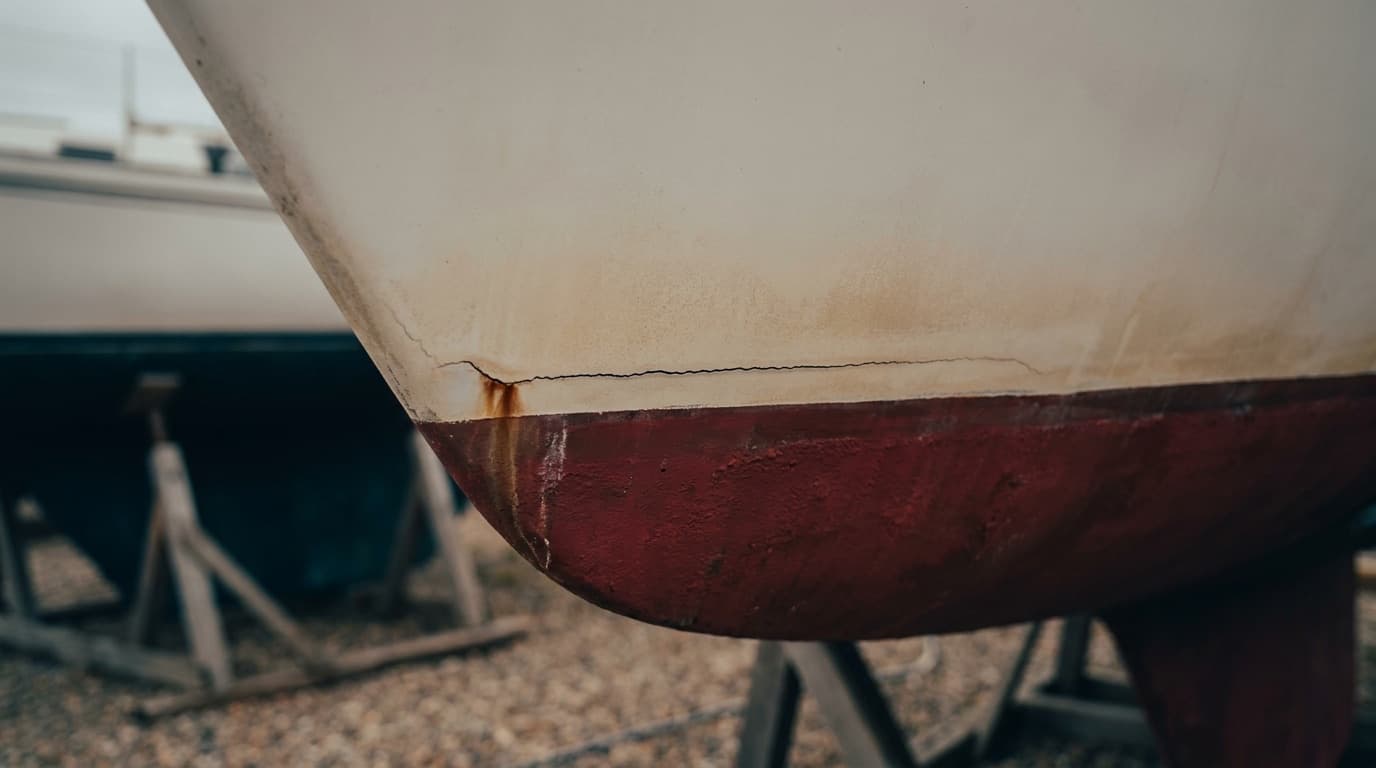
Every Catalina listing older than the buyer has a photograph taken from the dock, and every one of them is silent about the inch of hull that matters most.
That inch is the keel joint. On a fin keel boat the lead or iron keel is bolted to a fiberglass stub, and after enough years of flexing a thin horizontal crack appears along the seam, curving up at the ends. Owners call it the smile. Surveyors see it on most old boats with a bolt-on keel.
The reason it has Catalina's name on it is specific, and it is the reason this page exists. For about twelve years the builder put plywood inside the keel stub. When that plywood gets wet, the smile stops being cosmetic.
What is a Catalina smile?
A thin crack in the fairing compound and gelcoat along the hull-to-keel joint, where a rigid metal keel is bolted to a fiberglass hull that flexes. It shows after haul-out as a dark line with rust staining, often opening slightly at the leading edge. Any boat with a bolt-on keel can develop one, and the same crack on other builders' boats is called a keel smile or, on C&Cs, a C&C smile.
The mechanics are simple. Under sail the hull works and the keel does not, so the joint between them moves a fraction of a millimetre on every wave. Fairing compound and gelcoat have no give, so they crack. Marine author Don Casey, answering a reader in Sail magazine's Ask SAIL column, calls the crack in the reader's photo more or less normal for a thirty-year-old boat with a bolt-on keel, and adds that Catalina has no special claim to the problem.
So the first thing to understand is that the crack itself is not the finding. What is under it is.
Which Catalina years get the smile, and why
Catalinas built before mid-1988 have two layers of plywood laminated inside the keel stub, under the keel bolt washers. Water that gets in through the crack or the bilge rots or compresses the plywood, the keel pulls the bolts down into the softened wood, and the smile widens. From 1988 the stub was built as solid laminate. Later boats still get smiles, from groundings, bad blocking or loose bolts, but far less often.
This is the one fact that separates a Catalina smile from any other keel smile, and it comes from owners rather than the factory. Long-time members of the sailboatowners.com Catalina forum describe the construction directly: two layers of plywood in the keel stub with a thin layer of fiberglass over the top on nearly every boat built before mid-1988, replaced by solid laminate after that. A Cruisers Forum thread on a 1980s Catalina 30 puts the change at 1987 to 1988 for that model. Casey's column dates the plywood era to "about 1987-88" as well.
The sequence those owners describe is the one to picture when you look at a pre-1988 boat:
- A small crack opens at the joint, from normal flexing or a grounding.
- Water reaches the plywood, through the crack, through the keel bolt holes, or from a wet bilge above.
- The plywood softens. The keel bolts, which were torqued against it, lose their preload.
- The keel's weight pulls the bolts down into the soft wood. The smile widens. More water gets in.
That is why "it is just cosmetic" is true on one boat and expensive on the next, and why the model year is the first thing to check. Our Catalina 30, Catalina 27 and Catalina 22 guides all cover boats that straddle the change; the Catalina 36, introduced in 1982, has early hulls on the wrong side of it.
Is a Catalina smile cosmetic or structural?
Cosmetic if the crack is hairline, dry, does not widen from one haul-out to the next, and the keel bolts are bright and torqued. Structural if it keeps coming back wider, weeps rust, the bilge around the bolts is wet, the bolt heads or nuts are corroded, or the keel moves on its blocks. On a pre-1988 boat, assume structural until the stub has been opened or a surveyor has tested it.
Casey's rule for an owner is to watch it every year: if the crack stays the same width, it is cosmetic, and if it widens, the bolts need re-torquing or worse. A buyer does not have a year, so the job is to read the evidence that is there on survey day.
| What you see hauled out | What it usually means |
|---|---|
| Hairline crack, no stain, bottom paint intact over most of it | Fairing compound has cracked over a sound joint. Cosmetic |
| Rust weeping from the crack or around the keel bolts | Water is reaching the bolts. On a pre-1988 boat, water is probably in the plywood too |
| Crack opening wider at the front than the back | Classic grounding signature: the keel's leading edge was pushed up and aft. Ask when |
| Crack that has clearly been filled before and has reopened | Whatever is under it is still moving. The fill was a cosmetic fix on a structural problem |
| Bilge wet or stained around the bolt heads, nuts rusted | Water has been standing on the stub. Expect the surveyor's moisture meter to read high |
| Keel rocks or the crack changes when the boat is lifted in slings | Loose bolts or rotten stub. Not a boat to buy without a yard quote in hand |
A sailor on the Cruisers Forum thread about a smile on a prospective purchase puts the buyer's risk plainly: with a few thousand pounds of ballast hanging off the joint, a crack treated as cosmetic by one owner can migrate to structural by the next. In most cases it is cosmetic. The cases where it is not are the ones that cost money, and nothing on the listing tells you which case you are in.
Looking at one right now? Paste the listing and the free pre-check lists which of these the ad is silent on.
Free on every boat, no card. You only pay to unlock a full report.
What does a Catalina smile cost to fix?
Three tiers. A cosmetic fill, grinding the crack out and filling with flexible epoxy or polyurethane, is a few hundred dollars in materials and a day on the hard. Adding or replacing keel bolts without dropping the keel has drawn yard quotes of $1,200 to $1,800. Dropping the keel, cutting the plywood out of the stub, rebuilding it in solid glass and rebedding the keel on new bolts runs $5,000 to $12,000 at a yard, plus haul-out, and about $2,000 more if the mast has to come out for the lift.
All of these figures are owner-reported yard quotes from forum threads, most of them several years old, and they vary by yard rate and by how much of the stub is rotten. Treat them as the shape of the bill, not the bill. Get two quotes, and get them before the offer, not after.
| Tier | What it involves | Reported cost |
|---|---|---|
| 1. Cosmetic fill | Grind the crack to bright metal and sound laminate, prime with epoxy, fill with a flexible product (3M 5200 or G/flex 655), fair and paint. Does nothing for the bolts or the stub | About $300 in materials for an owner doing it on a Catalina 30; add the haul-out if the boat is not already out |
| 2. Keel bolts without dropping the keel | Leave the original bolts, add new ones alongside through the stub ("sister" bolts), re-torque, fill the smile. Yards call it the Catalina fix | $1,200 to $1,800 quoted by two yards for a Catalina 30 |
| 3. Drop the keel and rebuild the stub | Haul, lift the hull off the keel, cut out the plywood, rebuild the stub in solid laminate, inspect or replace bolts, rebed the keel in sealant, re-torque with new nuts to spec | $5,000 quoted to drop and repair a 1980s Catalina 30 in 2022, plus $2,000 to pull and restep the mast; $9,000 to $12,000 quoted elsewhere for the full stub rebuild; about $7,000 all-in for an owner doing it at a DIY yard alongside other work |
Sources: sailboatowners.com for the materials figure and the proper repair sequence; Cruisers Forum for the 2022 yard quote and the DIY-yard figure; SailNet and sailboatowners.com for the sister-bolt and stub-rebuild quotes; Epoxyworks and Sail magazine for the cosmetic method.
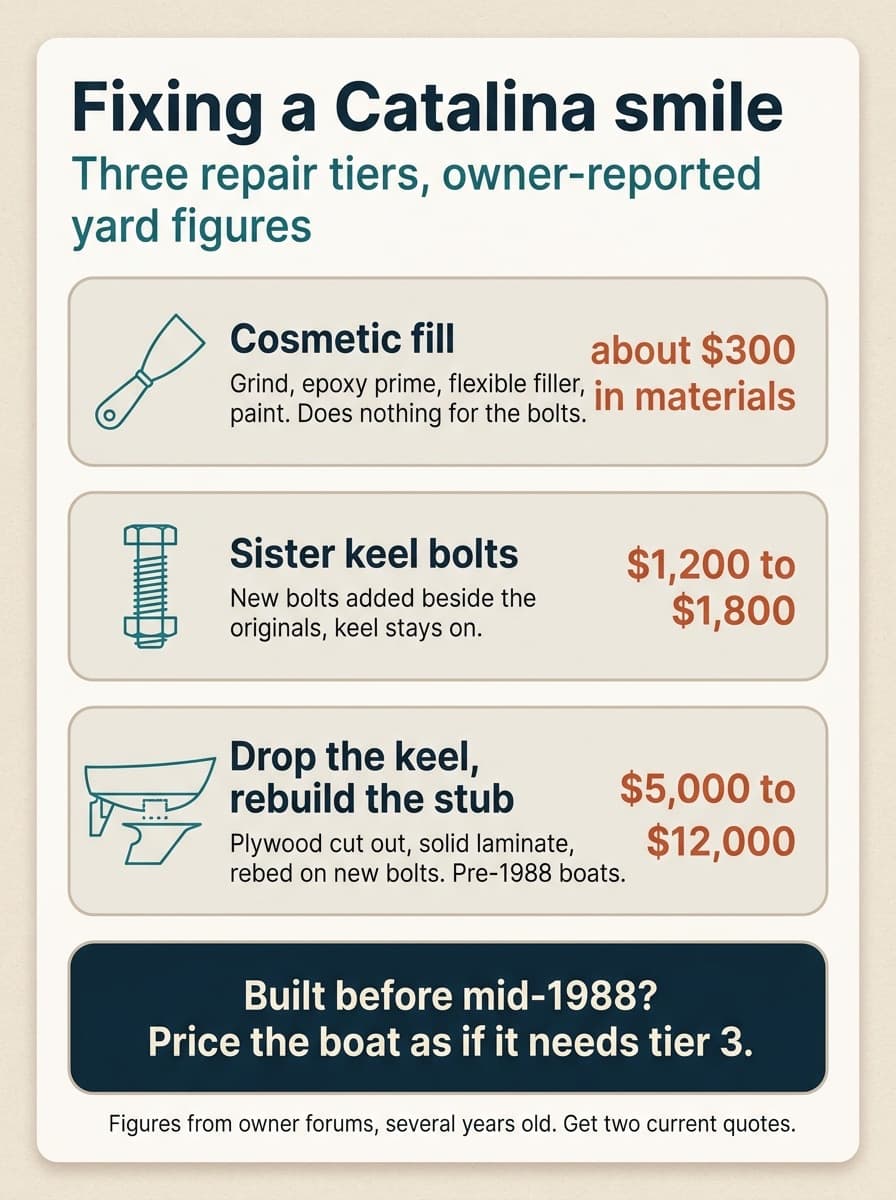
Two things about the table matter more than the numbers.
The first is that tier 3 on a $15,000 boat is a third to most of the asking price. The true-cost guide prices every other catch-up item on a boat this age; the keel stub is the one that can outrun all of them together, which is why it belongs in the offer rather than in the first season's budget.
The second is that a tier 1 fill in the listing photos is not a repair, it is paint. If the seller says "the smile was fixed", ask which tier, by whom, and for the invoice. The answer tells you whether you are looking at a solved problem or a hidden one.
What to ask the seller before you travel
The joint cannot be seen with the boat in the water, so these questions do the first survey for you. Every one of them has a cheap answer and an expensive answer, and a seller who has the cheap answer will give it quickly.
- What year and hull number? Before or after the 1988 change is the whole question for the plywood.
- Has she ever grounded hard, and was she hauled afterwards? A grounding on a plywood-era stub is the usual start of a structural smile.
- When were the keel bolts last torqued, by whom, and were they inspected? A yard invoice with a torque figure is the best answer. "They look fine" is not an answer.
- Has the keel ever been dropped or the stub repaired? If yes, ask for the invoice and whether the plywood was removed. A smile that was filled is a different thing from a stub that was rebuilt.
- Is the bilge dry? Standing water over the stub on a pre-1988 boat is how the plywood gets wet from above.
- Can you send a photo of the keel joint from the last haul-out? Most owners have one. A seller who cannot or will not is telling you to budget for a haul before you offer.
Put the answers next to the inspection checklist, which covers the rest of the hull, and hand both to the surveyor.
What to look at hauled out
On survey day, the surveyor will do this. If you are looking at the boat on the hard before you have hired one, you can do most of it with a torch and a screwdriver handle.
- Sight along the joint from the bow. A fair line is good; a step or a gap at the leading edge points to grounding.
- Tap the stub above the joint and listen for the dull note that means wet laminate or wood.
- Look for rust bleeding from the crack, especially at the front and at the bolt positions.
- Go below, lift the sole boards, and look at the keel bolt nuts and washers. Bright stainless on a dry stub is the answer you want. Rust, pitting, or washers that have sunk into the floor are not.
- Ask the yard to lift the boat a few inches in the slings and watch the joint. Movement, or a crack that opens as the keel hangs, ends the conversation.
- Ask the surveyor to take moisture readings on the stub and to state the keel bolt condition in the report. Lenders and insurers read that line.
How Knotworth reads the smile on a specific boat
The free pre-check knows which Catalina models and years carry the plywood stub. Paste a listing and it flags the keel-to-hull joint as a model-specific fault on the boats where it applies, with the seller questions attached, and the full report carries a keel reserve until a haul-out photo, a yard invoice or a survey clears it.
That is exactly what happened on the 1988 Catalina 30 we ran through the report: the plywood spacer in the keel-to-hull joint came up as one of four model-specific faults, with a source and a seller question, before anyone had looked at the boat. On a 1988 hull the answer could go either way, which is the point. The report does not decide for you; it refuses to let the listing's silence count as good news.
Paste the listing. The free pre-check tells you whether this model and year carries the plywood keel stub, what to ask the seller, and what the repair would do to the all-in price.
FAQ
How do you fix a Catalina smile?+
It depends on what is under it. A cosmetic smile is ground out to sound material, primed with epoxy and filled with a flexible sealant or a flexible epoxy such as G/flex, then faired and painted. A structural smile on a plywood-era boat means dropping the keel, cutting the plywood out of the stub, rebuilding it in solid laminate, and rebedding the keel on inspected or new bolts torqued to specification.
Which Catalina years have the smile?+
Any Catalina with a bolt-on keel can develop a cosmetic smile at any age. The structural version is a problem of boats built before mid-1988, when the keel stub contained two layers of plywood under the keel bolts. From 1988 the stub was solid laminate and the problem became much rarer.
Is a Catalina smile dangerous?+
A hairline crack on a sound stub is not. A smile that is widening, weeping rust, or sitting over wet plywood means the keel bolts are losing their grip, and that is a keel attachment problem on a boat with thousands of pounds of ballast. It needs a yard, not a tube of sealant.
Can you sail a boat with a Catalina smile?+
Owners sail with cosmetic smiles for years and re-fill them at each haul-out. The condition to sail on is a crack that does not change width between haul-outs, dry keel bolts, and a dry bilge. If any of those changes, stop and have the joint inspected.
Should I buy a boat with a Catalina smile?+
Yes, if the price reflects what is under it. A pre-1988 Catalina with a smile and no keel work on record should be priced as if the stub needs rebuilding, which is $5,000 to $12,000 at a yard, and the survey should include moisture readings on the stub. A later boat with a cosmetic smile and torqued bolts is an ordinary old boat with an ordinary old-boat joint.
How much does it cost to repair a Catalina smile?+
Reported figures run from about $300 in materials for an owner filling a cosmetic crack, through $1,200 to $1,800 for a yard to add keel bolts without dropping the keel, to $5,000 to $12,000 for a keel drop and stub rebuild, plus haul-out and about $2,000 if the mast has to come out. All are owner-reported yard quotes, some several years old, so get two current quotes for the boat in question.