Pacific Seacraft sailboats: a used buyer's guide to the Crealock boats
By Itzhak Fuhrman·Built and maintains Knotworth's cost model·Updated 23 October 2026
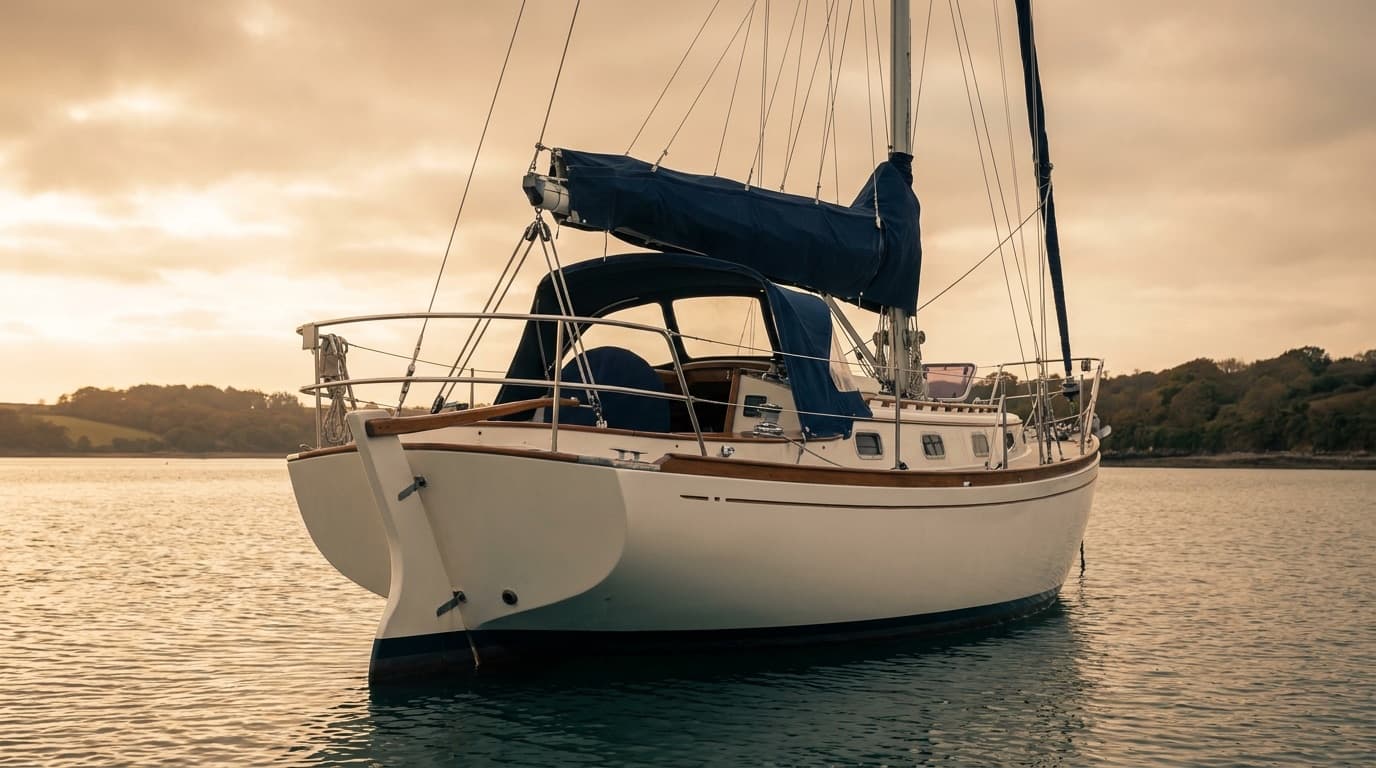
Most builders on this site made boats to a price. Pacific Seacraft made boats to a drawing, and the drawing was Bill Crealock's.
That is why used Pacific Seacrafts cost what they cost. A 1988 Pacific Seacraft 34 asks three times what a 1988 Catalina 34 does, and buyers pay it for a solid hull, a skeg-hung rudder, a canoe stern and a reputation for 150-mile days that owners keep confirming. The brand is a different purchase from most of the boats in our used sailboat brands section.
It is not a purchase without homework. These are 25-to-40-year-old boats with 1980s fuel tanks in the bilge, 1980s hatches in the deck and, on the early hulls, 1980s gelcoat. This hub covers what runs across the range, what the company's history means for parts and support, and which of the two popular models is the one you want. The model pages price the specific faults.
Is Pacific Seacraft still in business?
Yes, in a much smaller form. The original company, founded in Fullerton, California in 1976, went through a Hong Kong owner and then bankruptcy. Stephen Brodie bought the assets at auction in September 2007 for $85,000, moved molds, tooling and five hulls to Washington, North Carolina, and restarted in 2008 with a dozen employees. The US Coast Guard's manufacturer record still lists Pacific Seacraft LLC as in business as of February 2026, building and refitting boats in small numbers.
The history matters to a used buyer for one reason: support. Practical Sailor's review of the 34 and 37 traces the company from Henry Morschladt and Mike Howarth's 25-foot daysailers in 1976 through the Singmarine ownership after the 1980s downturn to the 2007 auction. Boating Industry reported the sale in October 2007: a company that once employed about 140 people building 120 boats a year, restarting with 12.
On the company's own site, Brodie writes that the relocation brought a hand-picked group of long-time employees east, including the production and mold shop managers, and that the intent is a limited number of traditional bluewater boats rather than volume. The site lists the 31, 34, 37, 40 and 44 and a refit service.
What that means in practice: the builder exists, knows the boats, and can be asked about hull numbers and original specifications. It is not a parts counter in the Catalina Direct sense, and the company's own output is small, so the market for these boats is almost entirely used.
Is Pacific Seacraft a good boat?
By build quality, among the best production boats America has made. Solid fiberglass hulls with extra laminate at the chainplates, keel and rudder stock; a bonded and through-bolted hull-deck joint on four-inch centres; a lead keel on a solid stub; a skeg-hung rudder with a steel plate protecting it. The trade-offs are the ones that come with a narrow, heavy, seakindly hull: small interiors, modest light-air speed, and prices that reflect the reputation.
Practical Sailor's construction notes read like a specification sheet for how to build a cruising boat: a vinylester skin coat against blisters, biaxial roving in isophthalic resin, a bottom laminate seven-eighths of an inch thick, hardware bolted through epoxy-sealed holes onto stainless backing plates, keel bolts with epoxy-bedded backing plates and epoxy-locked nuts. Its reviewer, who dislikes molded interior pans on principle, concedes Pacific Seacraft's are better than most.
Sailing Magazine adds that few if any 37s have reported structural hull damage, even after hard groundings, and that deck delamination is rarely reported on boats over twenty years old despite the plywood core. Those two sentences are worth more than most brochures.
The honest other half: the 34's cockpit is tight, the 37's footwell is 28 inches wide, neither has a shower stall, the quarter berths are singles whatever the brochure said, and the molded pan limits access to the hull. These are boats for two people going somewhere, not for six people at a dock.
What are the common problems with a used Pacific Seacraft?
Four, and they repeat across the range: aluminium fuel tanks in the bilge that corrode from the outside in, osmotic blisters on hulls from the early to mid 1980s, Bowmar overhead hatches that leak, and water tanks molded into the liner that are hard to inspect. The deck core is plywood, which has held up well but concentrates any moisture around hardware.
| Known issue | What it means, and what it costs |
|---|---|
| Aluminium fuel tank in the bilge | Reported on the 37 by SpinSheet and Sailing Magazine, and the same practice applies across the range: the tank sits in the bilge where sea water reaches it through the fittings and corrodes the outside. A new tank is a yard job that may mean lifting the cockpit sole or cutting the liner. Ask whether the tank has been replaced, and with what |
| Osmotic blisters, early to mid 1980s hulls | SpinSheet reports several 1980s boats with significant blistering, cosmetic rather than structural. Vinylester in the skin coat came in around 1988 on the 37. A pre-1988 hull that has never been peeled and barrier-coated should be priced as if it needs it |
| Bowmar overhead hatches | Sailing Magazine calls them poorly built and known to leak. Replacement hatches are off-the-shelf; the deck core under a leaking hatch is the real cost |
| Water tanks in the liner | Integral to the molded pan on the 37. Inspect what you can reach, taste the water, and ask about the tank cleaning history. A failed integral tank is a bigger project than a failed fuel tank |
| Plywood-cored deck | Unusual for the class and durable, but plywood that does get wet rots rather than delaminating. Meter the deck around every fitting, especially the hatches above |
| Outboard chainplates | Through-bolted through the topsides, easy to inspect from outside, and dependent on their bedding. Weeping stains below a chainplate on the hull are the tell |
| Fuel capacity | 38 to 40 gallons on the 34 and 37 is short for a boat sold as a voyager. Owners carry jerry cans on deck. Not a fault, but a reason the engine hours may be lower than you expect |
| Age-driven items | Standing rigging, sails, running rigging and the engine on the same intervals as any boat; see the true-cost guide. The Yanmars fitted from the late 1980s are long-lived; early 37s had Volvo or Universal diesels and may have been repowered |
Sources: SpinSheet's Pacific Seacraft 37 used boat review for the fuel tank and blister findings; Sailing Magazine for the hatches, water tanks, deck core and laminate history; Practical Sailor for construction and tankage. Assumption: a boat on which the work has not been done, which on a 1980s hull is the safe assumption until the seller produces the invoice.
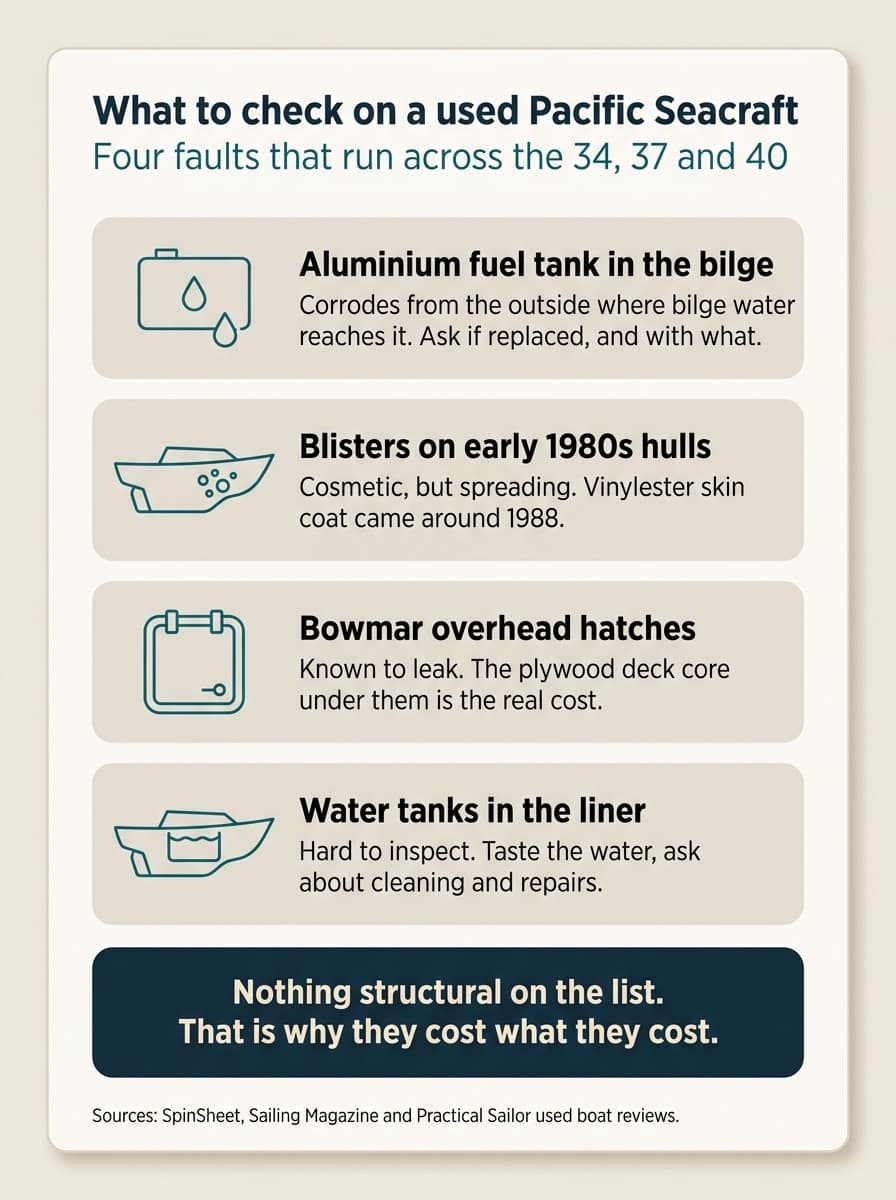
None of these is a reason not to buy one. All of them are reasons to ask the seller a question before you travel, and the fuel tank question is the one to ask first.
Looking at one right now? Paste the listing and the free pre-check lists which of these the ad is silent on.
Free on every boat, no card. You only pay to unlock a full report.
Pacific Seacraft 34 or 37?
The 34 for a couple; the 37 for a couple who carry crew, gear or a second cabin's worth of guests. The two hulls have nearly identical displacement-to-length and sail-area ratios, so they sail the same way. The 37 has a bigger cockpit, a bigger galley, more tankage and an optional second cabin; the 34 has the better V-berth and the better helm seat and costs about half as much on the used market.
| Pacific Seacraft 34 | Pacific Seacraft 37 | |
|---|---|---|
| Built | 1984 or 1985 to date, in small numbers | 1978 to date; Crealock 37 for the first 16 hulls |
| Length overall · waterline | 34 ft 1 in · 26 ft 3 in | 36 ft 11 in · 27 ft 9 in |
| Beam · draft | 10 ft 0 in · 4 ft 11 in (4 ft 1 in shoal) | 10 ft 10 in · 5 ft 6 in to 5 ft 10 in (4 ft 5 in to 4 ft 11 in shoal) |
| Displacement · ballast | 13,500 lb · 4,800 lb lead | 16,000 lb · 6,200 lb lead |
| Sail area | 533 sq ft | 618 sq ft |
| Capsize screening · comfort ratio | 1.68 · 34 | 1.72 · 34 |
| Engine | Yanmar 3JH2E, 35 to 38 hp | Yanmar 4JH2E, about 50 hp (early boats Volvo or Universal) |
| Fuel · water | 38 gal · 75 gal | 40 gal · 95 gal |
| Berths | 4 to 6; true V-berth converts to a queen | 6; offset double forward, optional second cabin |
| Cockpit seat length | 6 ft 5 in | 8 ft 10 in |
| US asking, October 2026 | $53,000 to $185,000, median $60,000 (11 listings) | $65,000 to $165,000, median $124,450 (12 listings) |
Practical Sailor's reviewer would take the 37 to carry people and gear and calls the 34 "more than commodious" for a couple. Our read of the market is the same with a price attached: the 34s from the late 1980s cluster at $53,000 to $72,000, and a 37 of the same vintage starts where the 34s stop.
What does a used Pacific Seacraft cost?
On the US brokerage market in October 2026, the 34 asks $53,000 to $75,000 for 1983 to 1990 boats and up to $185,000 for a 2009 hull; the 37 asks $65,000 to $165,000 for 1989 to 2000 boats, median about $124,000. These boats hold their value because the build is the value; the catch-up bill is the same list as any boat of the age, with the fuel tank added.
| Model | Year | Recent asking price |
|---|---|---|
| Pacific Seacraft 34 | 1987 | $53,000 to $55,000 |
| Pacific Seacraft 34 | 1988 to 1990 | $54,900 to $72,000 |
| Pacific Seacraft 34 | 1994 | $90,000 |
| Pacific Seacraft 34 | 2009 | $185,000 |
| Pacific Seacraft 37 | 1989 to 1994 | $65,000 to $140,000 |
| Pacific Seacraft 37 | 1995 to 1998 | $99,000 to $135,000 |
| Pacific Seacraft 37 | 2000 | $165,000 |
YachtWorld, US listings, first results page per model, 23 October 2026. The spread within a year is the refit history: a $65,000 1994 37 and a $140,000 1994 37 were on the market the same day.
What a used Pacific Seacraft is worth to you is the asking price plus what has not been done, and on these boats the list is short enough that a seller with invoices can show you all of it. Our guide to what a used sailboat is worth sets out the arithmetic; the true-cost guide prices the rigging, sails and engine lines by length.
What to check before you buy one
- Fuel tank. Original aluminium in the bilge, or replaced? With what, when, by whom.
- Hull, if built before 1988. Barrier coat history. Ask for the last haul-out photos and the surveyor's moisture readings.
- Hatches and the deck under them. Meter around every Bowmar hatch and every piece of deck hardware.
- Water tanks. Taste, inspect, ask.
- Chainplates. Look at the topsides below each one for weeping.
- Rig, sails, engine. Dates and invoices. The inspection checklist covers the rest, and a boat at this price always gets a survey.
Paste the URL. The free pre-check reads the specs, matches the model, runs the design numbers and lists which of the known Pacific Seacraft issues the ad is silent on, with the seller questions ranked by money.
FAQ
Is Pacific Seacraft still in business?+
Yes, as a small builder and refitter in Washington, North Carolina. Stephen Brodie bought the bankrupt company's assets at auction in 2007, moved them from California, and restarted in 2008 with about a dozen employees. The Coast Guard's manufacturer record listed the company as in business in February 2026.
Who designed Pacific Seacraft boats?+
William "Bill" Crealock designed the 34, 37, 40 and 44 and the Dana 24. Earlier models came from other hands: the Flicka 20 from Bruce Bingham and the Orion 27 and Mariah 31 from within the company. The 34 and 37 were originally sold as the Crealock 34 and 37.
Are Pacific Seacraft boats good for bluewater sailing?+
They were designed for it and owners use them for it. The 37 has a capsize screening value of about 1.7 and a comfort ratio of about 34, the hull is solid laminate, the rudder is on a skeg, and owners report 150-mile days. Our bluewater shortlist includes the 37 for exactly those reasons.
What is the difference between the Pacific Seacraft 34 and 37?+
Three feet, a cabin and about $60,000. The 37 has a larger cockpit and galley, more tankage and an optional second stateroom; the 34 has a better forward berth and helm seat and the same sailing ratios. For a couple the 34 is enough; for a couple with crew the 37 is the one.
How much does a used Pacific Seacraft 34 cost?+
On the US brokerage market in October 2026, late-1980s 34s asked $53,000 to $72,000, a 1994 boat $90,000 and a 2009 boat $185,000. Add the fuel tank, any barrier coat work and the usual rig, sails and engine items before comparing two of them.