Valiant sailboats: a used buyer's guide to the Perry double-enders
By Itzhak Fuhrman·Built and maintains Knotworth's cost model·Updated 18 November 2026
Every Valiant conversation gets to the blisters in the second sentence, so this page will too. Then it will say what the blisters are not: they are not the whole brand, they are not every hull, and on the boats that have them they are a known, priced problem rather than a mystery.
Valiant matters to a used buyer for the same reason the Pacific Seacraft and Tayana boats do: these are the American cruising designs that still go offshore, still hold value, and still sell to people who have read the reviews. Bob Perry drew the Valiant 40 in 1973 as a cruising boat with a racing underbody, and the sailing press has called it the first performance cruiser ever since. The Valiant 40 guide prices the specific boat. This hub covers what runs across the range: the two builders, the resin, and the other models you will see listed.
Is Valiant Yachts still in business?
No. The company stopped building new boats in early 2011, when the Worstell family's Valiant Yachts in Gordonville, Texas closed its production line, citing the economy. There is no successor builder. Support comes from the owners' community, from yards that know the boats, and from Perry's own writing on them. Parts are generic marine parts; there is no factory catalogue.
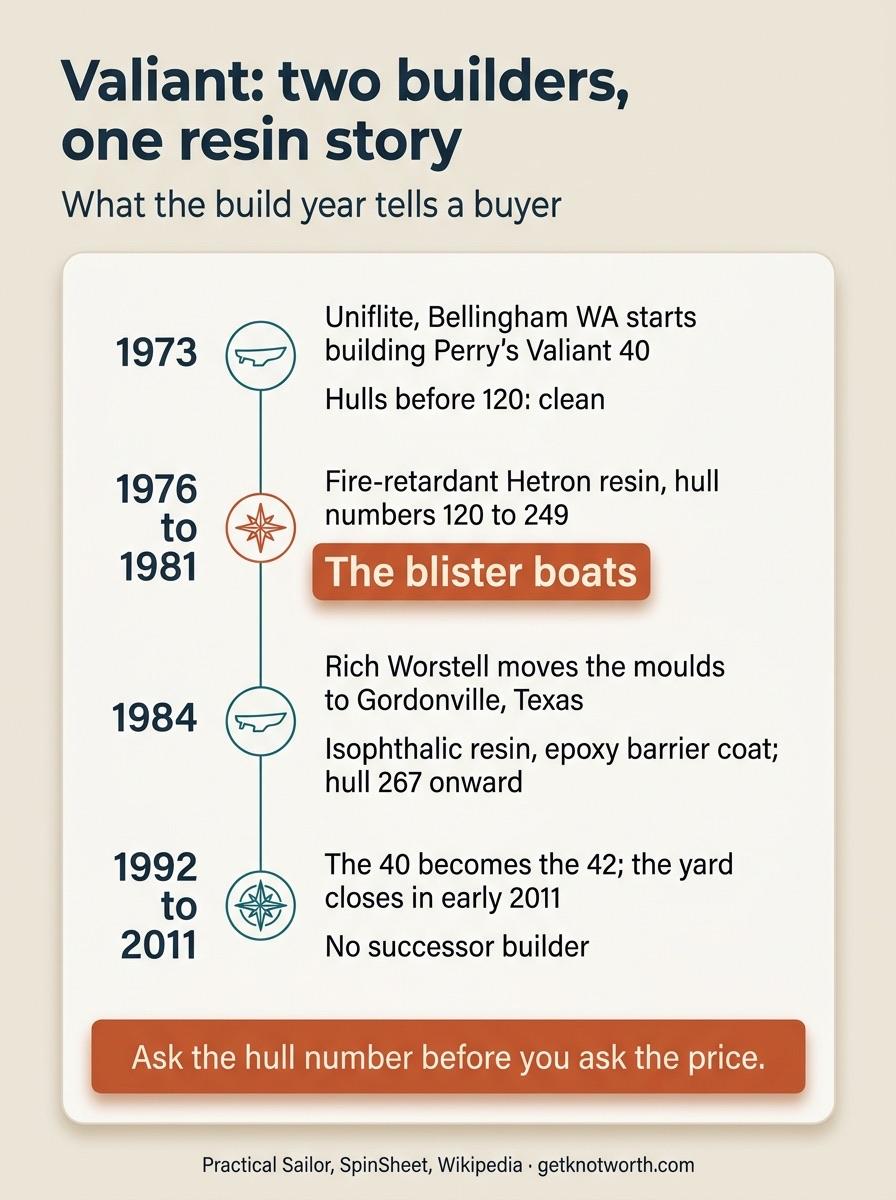
Two companies built Valiants. Practical Sailor's review traces the first: Nathan Rothman's Valiant Yachts contracted Uniflite Corporation, a powerboat builder in Bellingham, Washington, to build the 40 from 1973. Uniflite's resin choice in 1976 is the blister story below, and after litigation and business trouble the Washington production ended. In 1984 Rich Worstell, a Valiant dealer and marina owner on Lake Texoma, bought the company and moved the moulds to Texas. Practical Sailor records that Worstell switched to an isophthalic resin and reported no blistering after 1984.
Wikipedia's entry gives the end: production ceased in early 2011. The US Coast Guard's manufacturer record still lists the Gordonville address with a Worstell as company official, which is a registry entry, not a factory.
What that means in practice: a Texas-built Valiant (hull 267 onward on the 40, then the 42, 47 and 50) was built by a small yard that cared about resin and epoxy barrier coats; a Uniflite boat needs its hull number read before anything else; and nobody is going to answer the phone about either one.
The blister hulls, 1976 to 1981
From 1976 Uniflite used a fire-retardant resin sold as Hetron, which reacted with the sizing on the glass and produced severe blistering across the hull, deck and cabin on Valiant 40s built between 1976 and 1981: hull numbers 120 to 249. SpinSheet's surveyor reports blisters up to eight inches across, repairs well in excess of $12,000, and blisters returning within two years on most repaired boats. Fewer than 20% of the boats are reported as severe. Later hulls are not affected.
That paragraph is the reason the brand hub exists. SpinSheet's used boat review, written by surveyor Jack Hornor in 1999, is the clearest account: the problem was first blamed on the fire-retardant resin alone, and later research showed it was the combination of that resin with the sizing on the fiberglass. Blisters were not osmotic and not confined to the bottom. Most repairs he knew of had failed. No boat is known to have sunk from them.
Wikipedia adds the hull-number range and the note that many blisters have returned despite major repairs, and describes the usual attempt: peel the outer layers, dry the hull for months, re-glass in vinylester or polyester. The Esprit 37 went through its own version of the story: boats built by Nordic Yachts from 1977 to 1980 stayed largely clear, and some built by Uniflite in 1980 to 1982 blistered.
For a buyer the rule is simple and the Valiant 40 page applies it in money: ask the hull number first, then ask what was done about it and when, then price the boat as one of three things. Outside the range. Inside the range and repaired with an invoice and a dry survey. Inside the range and untouched.
The range
One famous boat and a family around it. The Valiant 40 (1973 to 1992, about 200 built) is the one with a search volume and a page. The Valiant 42 (from 1992) is the same hull with a new deck and interior, built in Texas and free of the resin story. The 47 (1981 to 1992, 17 built) and the 50 that grew from it are the big boats. The 32 and the Esprit 37 are the small and the odd ones.
| Model | Years | What to know |
|---|---|---|
| Valiant 40 | 1973 to 1992 | The design that made the brand. About 200 built; hulls 120 to 249 are the blister boats. Pilothouse and centreboard versions exist in small numbers. 590 searches a month, and the page prices it |
| Valiant 42 | 1992 onward, Texas | The 40's hull under a new deck and interior, the boat Worstell built for the rest of the company's life. Isophthalic resin and an epoxy barrier coat from new. Prices sit above the best 40s |
| Valiant 47 | 1981 to 1992 | 17 built and delivered, per Blue Water Sailing. Launched just before the Bellingham yard closed; the later ones are Texas boats |
| Valiant 50 | Texas era | Perry's update of the 47 for Worstell. Semi-custom, rare, and priced accordingly |
| Valiant 32 | mid 1970s | Perry's small double-ender from the Uniflite years. Listings exist; check the build year against the resin window |
| Esprit 37 | 1977 to about 1982 | Built first by Nordic Yachts, then by Uniflite; the Uniflite boats share the blister risk. A Valiant in all but name |
Sources: SpinSheet for the 40's count and end date; Practical Sailor for the 42 and the Texas resin; Blue Water Sailing for the 47 and 50. Build counts for the 32, Esprit 37, 42 and 50 are not published anywhere we could verify; treat them as small.
The rule from our sailboats section applies: a model gets a page when it has the searches and three true things to say that the hub cannot. The 40 clears that. The 42 is a candidate once its listings and searches justify it. The rest are hub rows.
Looking at one right now? Paste the listing and the free pre-check lists which of these the ad is silent on.
Free on every boat, no card. You only pay to unlock a full report.
What to check on any Valiant
Hull number first, then the bottom, then the things any 30-to-50-year-old Perry double-ender shares: stainless chainplate straps through a balsa deck, an external lead keel on bolts, a steel skeg inside fiberglass, bronze seacocks threaded straight onto the through-hulls, and aluminium fuel tanks.
- Hull number and build year. Inside or outside 120 to 249. Ask before the photographs.
- Bottom. On a blister boat: what was done, when, by whom, and the surveyor's moisture readings now. On a Texas boat: the epoxy barrier coat Worstell applied from new, and whether it has been maintained.
- Keel bolts. The keel is an external lead casting, so the keel bolts guide applies: cast-in bolts, inspect by the signs.
- Chainplates. Stainless straps through the deck to knees glassed to the hull; Practical Sailor notes Valiant V-cut the deck slots so sealant could be forced in. Look for weeping below deck.
- Deck. Balsa-cored. Meter around the chainplates, the mast and the hardware.
- Seacocks. Bronze, threaded directly onto the through-hull fittings rather than flanged, which Practical Sailor flags. Count them and work every one.
- Engines. Westerbeke, Perkins and Volvo over the years, some turbocharged. Hours and records.
- Tanks. Aluminium fuel tanks of 90 to 110 gallons; the Pacific Seacraft pages explain why aluminium in the bilge is a question.
The inspection checklist covers the rest, and the survey cost guide prices the day.
What do Valiants cost?
The 40 runs from $25,000 for a 1974 boat sold privately to $164,000 for a refitted 1983 boat with a broker, with a twelve-month median asking price of about $70,000. The 42 and the big boats sit above that. The blister range, the builder and the refit list explain the spread better than the year does.
The Valiant 40 page has the listings by year and location. The brand-level point: Valiants depreciate on reputation rather than on age. A Texas-built boat or a Bellingham boat outside the resin window prices like a Pacific Seacraft; a blister boat with a documented, dry repair prices like a good old boat; a blister boat with no paperwork prices like a project, and should.
Where a Valiant fits
On the bluewater shortlist the Valiant 40 is the fast one: capsize screening 1.75, comfort ratio 34, displacement-to-length 256, hull speed 7.8 knots. It is the boat to buy if you want to cross oceans at seven knots instead of six and can read a hull number. The Tayana 37 and Pacific Seacraft 37 are the slower, simpler alternatives at similar money.
Paste the URL. The free pre-check reads the specs, matches the model, runs the design numbers and lists which of the known Valiant issues the ad is silent on, with the seller questions ranked by money.
FAQ
Is Valiant Yachts still in business?+
No. Valiant Yachts in Gordonville, Texas stopped building new sailboats in early 2011. The Worstell family's company had built Valiants there since 1984, after the original Uniflite production in Bellingham, Washington ended. There is no successor builder; support comes from owners, yards and the designer's writing.
Which Valiants have the blister problem?+
Valiant 40s built by Uniflite between 1976 and 1981, hull numbers 120 to 249, which used a fire-retardant resin that reacted with the fiberglass sizing. Some Uniflite-built Esprit 37s from 1980 to 1982 share it. Texas-built boats from 1984 onward used a different resin and an epoxy barrier coat and are not affected.
Is a Valiant 40 a good boat?+
Yes, and the sailing press has said so since 1973: Bob Perry's cutter-rigged double-ender with a fin keel and skeg rudder is credited with inventing the performance cruiser and was named Cruising Sailboat of the Decade by the American Sailboat Hall of Fame in 1997. The caveat is the hull number, which decides whether you are buying a classic or a resin problem.
What is the difference between a Valiant 40 and a Valiant 42?+
The same hull. The 42 is the 40's hull with a new deck and interior, introduced by Valiant Yachts in Texas in 1992 when the 40 went out of production, built with isophthalic resin and an epoxy barrier coat from new. It has no resin history and prices above the best 40s.
How much does a Valiant 40 cost?+
In late 2026, from about $25,000 for a 1974 boat sold privately to $164,000 for a refitted 1983 boat with a broker, with a twelve-month median asking price of roughly $70,000 across listing sites. The hull number, the bottom history and the refit list set the price more than the year.