Cape Dory 36 buyer's guide: what she is, what she costs, what breaks
By Itzhak Fuhrman·Built and maintains Knotworth's cost model·Updated 18 November 2026
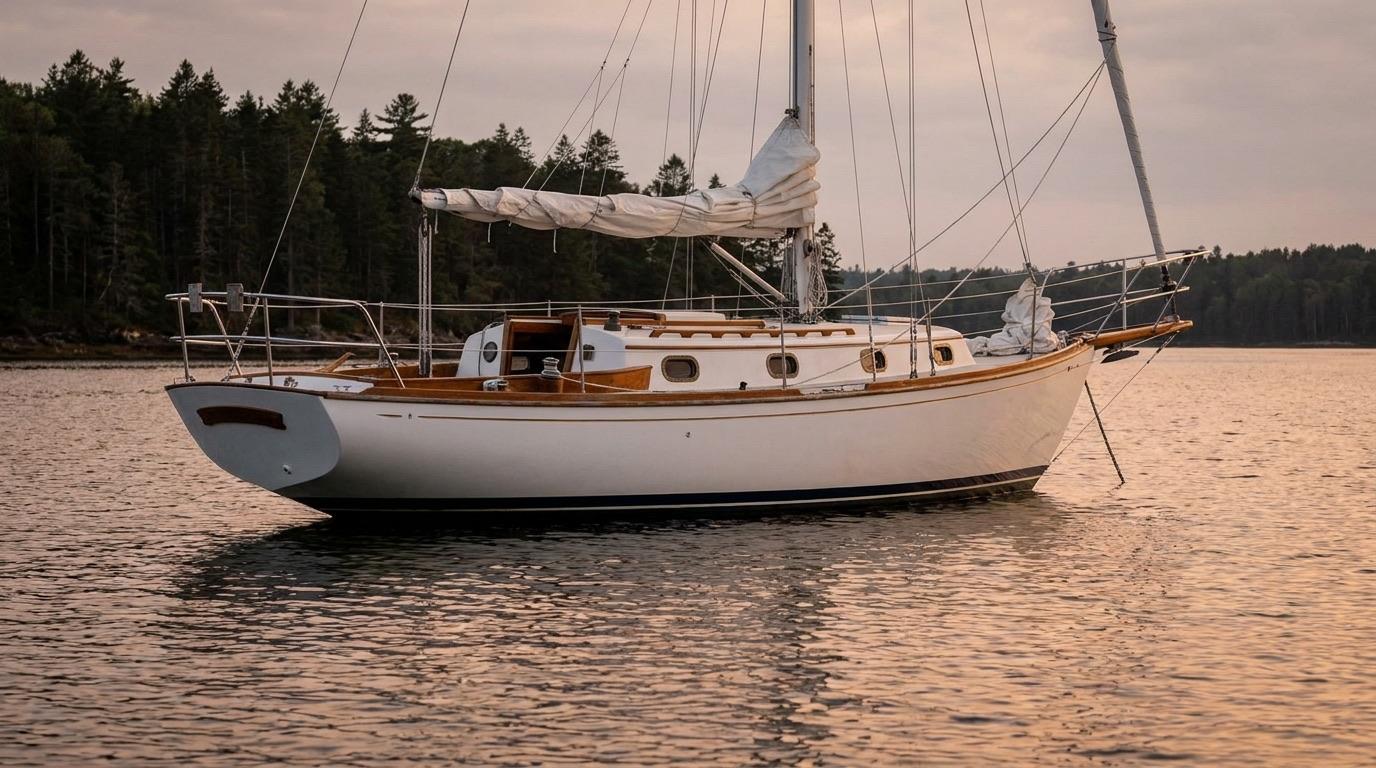
Cape Dory 36 specifications
| Specification | Figure |
|---|---|
| Length overall | 36 ft 1 in (about 42 ft with the bowsprit) |
| Waterline length | 27 ft 0 in, 75% of the overall length; the overhangs are nine feet |
| Beam | 10 ft 8 in |
| Draft | 5 ft 0 in |
| Displacement | 16,100 lb |
| Ballast | 6,050 lb lead, 38%, cast in two pieces and encapsulated inside the keel |
| Sail area | 622 sq ft, cutter |
| Rig | Cutter with club-footed staysail standard; a few sloops from the factory; keel-stepped, single-spreader, heavily stayed mast; bronze opening ports |
| Hull | Solid fiberglass, hand laid in a one-piece rotating mould, alternating mat and woven roving; full keel with attached rudder; aperture propeller |
| Deck | Balsa-cored, solid glass, plywood or aluminium at the load points; hull-deck joint on an inward flange, through-bolted on 12-inch centres |
| Headroom | 6 ft 4 in |
| Auxiliary | Perkins 4-108, about 50 hp, standard; Robinhood boats a 37 hp Yanmar |
| Tanks | Fuel 43 gal in a fiberglass tank, some retrofitted in aluminium · water figures vary by boat; ask |
| Built | 1978 to 1990 by Cape Dory Yachts, 165 hulls; Robinhood Marine, Georgetown, Maine, built a few more from the same moulds from the 1990s to about 2006 |
| Designer | Carl Alberg |
Sources: the Cape Dory owners' association specification page, Sailing Magazine's used boat review for construction, engine and headroom, Wikipedia for production, a 2001 Robinhood 36 listing for the Robinhood engine and fuel figure.
Sailing Magazine's reviewer wrote that she tracks well and resists pounding in a seaway, and that she heaves-to very well, which he called reassuring for bluewater sailors. That sentence is the Cape Dory 36 in one line: a narrow, heavy, long-keeled Alberg hull drawn for motion at sea rather than for the dock.
The 36 is the biggest Alberg Cape Dory most buyers will see for sale, and the one the owners' forum treats as the voyager of the range. It is also a 35-to-45-year-old boat with balsa in the deck, a rudder made of two half-shells and, on the first seventy hulls, steel in the chainplate knees. This page is the part the reviews and the brand hub leave out: what each of those costs, and how to tell the $36,500 boat from the $80,000 one when both were built in the same decade.
Is the Cape Dory 36 a good boat?
For going somewhere in comfort, yes. Solid hand-laid hull, encapsulated lead so there are no keel bolts to inspect, a keel-stepped and heavily stayed rig, bronze ports, and an aperture propeller protected by the keel. She is not fast or close-winded, she carries weather helm, the saloon is narrow for her length, and the cockpit is shallow. Buyers who want her know all that.
The construction notes in Sailing Magazine's review are the ones to keep. The hull is laid up in a one-piece mould, so there is no centreline seam. The ballast is cast lead in two pieces, dropped into the keel cavity and glassed over, which is why this boat sends you to our keel bolts guide only to read that she has no keel bolts to inspect. The hull-deck joint is an inward flange, through-bolted on 12-inch centres and bonded with mastic; the reviewer notes that fewer bolts means fewer places to leak.
How she sails is the trade. Wide sheeting angles, a moderate-aspect rig and the long keel keep her from pointing high. She is steady, she tracks, and she hoves-to. Most boats carry enough weather helm that owners prefer the wheel to the tiller. The mainsheet traveller rides on a bridge over the companionway, which clears the cockpit and puts the sheet where a short-handed crew can reach it.
What are the problems with a Cape Dory 36?
Three that are specific to the boat. Chainplates before hull 71 were tied to a mild steel web that rusts; later boats got an aluminium angle glassed under the deck. The rudder, two fiberglass half-shells around a polyester fill, has delaminated on some boats. The balsa deck is the usual core question. Then the range-wide items from the hub: fuel tank mounting, crazing around hardware, teak and rig age.
| Known issue | What it means, and what it costs |
|---|---|
| Chainplates, hulls before 71 | Sailing Magazine names it the main issue: early boats tied the chainplates to a mild steel web below deck, prone to rust and corrosion. From hull 71 an aluminium angle bar was glassed in below the deck flange. On an early boat, ask whether the knees have been opened and the steel replaced; if not, that is a rig-safety item and a yard quote, not a tube of sealant |
| Rudder delamination | Two fiberglass half-shells filled with polyester compound around a 1.5-inch stock. Some owners have had the shells separate. Tap it hauled out; a rebuilt rudder is a yard job that includes dropping it through the aperture |
| Balsa-cored deck | Solid at the load points, balsa elsewhere. Meter around the chainplate covers, stanchions, the mast partners and the handrail bolts. Wet balsa is the most expensive line on any 1980s boat of this size; the true-cost guide prices a recore by area |
| Fuel tank | A fiberglass tank as built, which does not corrode; some owners retrofitted aluminium. If aluminium, the hub's warning about tanks on wooden bases applies. Ask which tank and when |
| Crazing around deck hardware | The brand's consistent tell, per SpinSheet on the 28; investigate rather than fill |
| Engine access | The Perkins 4-108 sits behind the companionway with just enough room to work; the electrical panel lives under the steps. Not a fault, but ask how the last impeller change went |
| Teak | Handrails, toerail and the coaming boards the reviewer found hard on the back. A large number of hours or a large invoice if neglected |
| Age items | Standing rigging, three sails on a cutter, running rigging, canvas, electronics. At 36 feet the rig and sails are the largest lines |
Sources: Sailing Magazine for the chainplates, rudder, deck, tank and engine findings; the Cape Dory hub and SpinSheet's Cape Dory 28 review for the range-wide items. Assumption: a boat on which the work has not been done, which on a 1980s hull is the safe assumption until the seller produces the invoice.
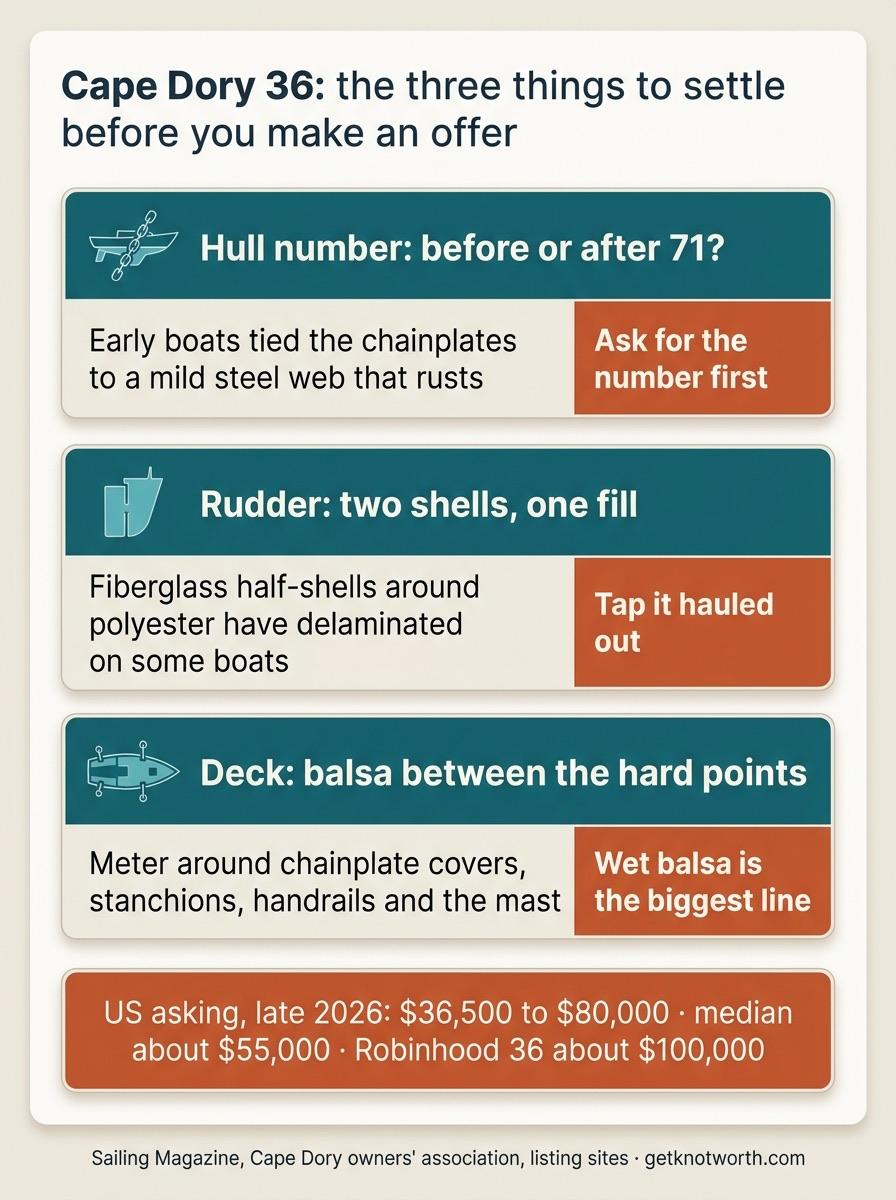
The chainplate row is the one to read twice. A hull number is the first thing to ask for, and "before 71 and never opened" is a line in the offer, not a note in the survey.
Looking at one right now? Paste the listing and the free pre-check lists which of these the ad is silent on.
Free on every boat, no card. You only pay to unlock a full report.
How much does a Cape Dory 36 cost?
On US listing sites in October and November 2026, 1979 to 1990 boats asked $29,900 to $80,000, with most between $36,500 and $75,000 and a twelve-month median of about $55,000. Robinhood-built boats from the 1990s and 2000s ask $98,000 to $112,000. A late Cape Dory in Maine and an early one in Texas can be $45,000 apart for the same hull.
| Build year | Recent asking price | Where |
|---|---|---|
| 1979 | $62,000 | Edgartown, Massachusetts |
| 1979 | $35,000 | League City, Texas |
| 1980 | $65,000 | Texas |
| 1981 | $36,500 | Clinton, Arkansas |
| 1984 | $29,900 | Deltaville, Virginia |
| 1986 | $75,000 | Annapolis, Maryland |
| 1986 | $44,500 | Georgia |
| 1987 | $79,500 | Newington, Virginia |
| 1988 | $57,250 | Indiantown, Florida |
| 1990 | $80,000 | South Freeport, Maine |
| 2001 Robinhood 36 | $98,000 to $112,000 | Rhode Island |
YachtWorld US listings, first results page, 23 October 2026 (Edgartown, Annapolis, Indiantown, South Freeport rows), and the ListingSport aggregate of 18 live listings, November 2026, for the rest; the Robinhood boat from Denison, since marked off market. Asking, not sold. One 1983 boat in Panama at $29,900 is excluded.
The spread is refit history, as it is on every boat on this site. A 1986 boat at $44,500 and a 1986 boat at $75,000 are the same hull; what differs is the chainplates, the rudder, the deck readings, the rig date and the sails. The guide to what a used sailboat is worth is the way to put those two listings on one line.
From the true-cost guide at 36 feet, a 1980s boat with nothing dated carries a re-rig, three sails, running rigging, the chainplate job if early, a rudder reserve, survey and haul-out, tax and a contingency. That bill can run $30,000 to $45,000 on a $45,000 boat, which is how the cheap one and the dear one meet.
Cape Dory 36 or Cape Dory 28?
The 36 if you are going offshore with two people and want standing headroom, a real galley and a boat that heaves-to; the 28 if the budget is a third of the price and the sailing is coastal. They share the designer, the full keel, the encapsulated ballast and the deck-hardware crazing. The 36 adds the chainplate cut-off, the rudder question and a four-cylinder Perkins.
The Cape Dory 28 guide covers the smaller boat and its own powerboat namesake. The hub has the range table with production numbers: 1,982 Typhoons, 165 of the 36. That scarcity is why 36 prices hold.
Is the Cape Dory 36 a bluewater boat?
By the numbers and the record, yes. Capsize screening about 1.7, comfort ratio about 36, displacement-to-length about 360, a full keel with the rudder attached and the propeller in an aperture. Sailing Magazine's reviewer calls her a proven conservative design with an impressive offshore track record. Her limits are speed, pointing and tankage.
| Ratio | Value | Reading |
|---|---|---|
| Capsize screening | 1.69 | Well under the 2.0 offshore threshold |
| Comfort ratio | 36 | High; seakindly |
| Displacement / length | 365 | Heavy displacement (Sailing Magazine publishes 356 on its own basis) |
| Sail area / displacement | 15.6 | Moderate; she needs wind |
| Ballast / displacement | 38% | Solid, and encapsulated |
| Hull speed | 7.0 knots | how it is calculated |
Computed from LWL 27.0 ft, LOA 36.08 ft, beam 10.67 ft, displacement 16,100 lb, ballast 6,050 lb and sail area 622 sq ft as published. The design ratios guide explains each screen; the free calculators run them for the boat you are looking at. Against the Westsail 32 she is lighter and faster; against the Pacific Seacraft 37 she is the same weight with a full keel instead of a fin and skeg, and about half the price. The bluewater shortlist explains where that trade sits.
Which Cape Dory 36 should you buy?
A hull numbered 71 or later for the aluminium chainplate knees, or an early one with an invoice for the steel coming out. A cutter, which is most of them. A boat whose rudder has been tapped and whose deck has been metered. A Robinhood 36 if the extra $40,000 buys you a 2000s engine and twenty fewer years of balsa.
The boat changed little over twelve years, so the year buys you hull number and equipment rather than a different design. The Robinhood 36s, built in Georgetown, Maine from the original moulds after the founder took them north, are the same hull with later engines; owners on the Cape Dory forum note slightly more freeboard at the bow and a different bowsprit angle. Only a handful were built.
What to check before you buy one
- Hull number. Before or after 71. Ask for it before the photographs.
- Chainplate knees. On an early boat, whether the steel web was ever replaced, and by whom.
- Rudder. Tap the full length hauled out; look for a seam opening along the trailing edge.
- Deck core. Meter around every fitting, especially the chainplate covers and handrails.
- Fuel tank. Fiberglass as built, or a retrofit, and how it is mounted.
- Engine. Perkins hours and records; how it starts cold; whether the panel under the steps has been rewired.
- Rig and sails. Three sails on a cutter and the age of the wire. The inspection checklist covers the rest, and a boat at this price gets a survey.
- Is she the sailboat? Ask plainly if the listing is vague. The flybridge is a different boat.
How Knotworth reads a specific Cape Dory 36
This page describes the model. The product reads the boat. Paste a listing URL and the free pre-check matches it to the Cape Dory 36's reference record, tells the sailboat from the powerboat, runs her design numbers, lists which of the known issues above the advertisement is silent on, and ranks the seller questions by money. On a 36 the hull number, the rudder and the deck come first, and the $39 report prices all three against the asking price before you travel.
Paste the URL. The free pre-check reads that boat's specs, runs her ratios, and tells you which of the known Cape Dory 36 questions the ad leaves open. No card until you unlock the full report.
FAQ
What are the problems with a Cape Dory 36?+
Chainplates on hulls before 71, which were tied to a mild steel web that rusts; a rudder built from two fiberglass half-shells that has delaminated on some boats; and a balsa-cored deck that needs metering around hardware. The range-wide items are crazing around deck fittings, fuel tank mounting if an aluminium tank was retrofitted, teak and rig age.
How much does a Cape Dory 36 cost?+
On US listing sites in late 2026, 1979 to 1990 boats asked $29,900 to $80,000, most between $36,500 and $75,000, with a twelve-month median of about $55,000. Robinhood-built 36s from the 1990s and 2000s asked $98,000 to $112,000. The spread is refit history, so compare all-in prices.
Is the Cape Dory 36 a good bluewater boat?+
Yes. Capsize screening about 1.7, comfort ratio about 36, a full keel with the rudder attached, encapsulated ballast and a record of heaving-to well. Her limits are speed, pointing ability and tankage, not seaworthiness.
How many Cape Dory 36s were built?+
165, from 1978 to 1990, plus a handful of Robinhood 36s built from the same moulds in Georgetown, Maine, after the Cape Dory founder took the tooling north. The Robinhood boats are the same hull with later engines.
Is the Cape Dory 36 a cutter or a sloop?+
Most left the factory as cutters with a club-footed staysail; a few were sloops. Many staysails have since been converted to furling. Some listings call the boat a ketch, which usually means the listing is wrong or describes a one-off; check the boat.
Is there a Cape Dory 36 powerboat as well?+
Yes, a flybridge sedan built from 1987 to 1990, 14 of them, and listing sites mix it in with the sailboat. A "Cape Dory 36" at $70,000 described as a sedan or flybridge is the powerboat. This page covers the Alberg sailboat only.