The wasted trip: what US sailboat buyers spend each year travelling to see boats they could have ruled out from the listing
By Itzhak Fuhrman·Built and maintains Knotworth's cost model·Updated 18 November 2026

Key findings
- The average US used-sailboat buyer makes one and a half trips to boats they could have ruled out at the desk, and spends about $1,230 on them: fuel, flights, hotels and, one time in five, a survey that kills the deal. Add roughly 20 hours of their time.
- Across the 11,100 used sailboats of 25 feet and over sold in the US in 2024, that is $13.7 million a year in avoidable travel, within a range of $4.5 million to $37.5 million depending on how many boats a buyer sees and how far they go.
- Distance is the reason the number is large. In our October 2026 pull of YachtWorld listings for 17 popular models, 84% to 91% of a model's US listings sat more than 300 miles from a buyer in the ten biggest sailing states, and about three quarters sat more than 600 miles away. A buyer who wants a specific model flies to see it.
- The listing is where the money is lost, not the survey. When we ran three real listings through Knotworth's cost model, the all-in first-year price came out 24% to 106% above the asking price, and one of the three crossed the buyer's hard ceiling before the boat had been seen. None of that was in the ad.
- A fly-in viewing costs about $900 in cash and $750 in time at 2026 prices, before the survey. A survey that fails adds about $1,425 (a 35-foot pre-purchase survey plus the short haul).
Why we counted this
Knotworth exists because its founder spent two years and more trips than he will admit flying to sailboats that were wrong for him in ways the listing had already said, if you knew how to read it. A keel stub with plywood in it on a Catalina built before 1988. Standing rigging that was "original" on a 28-year-old boat, which is a $8,000 line. A draft that would never clear the home channel. The buying guide on this site has a rule, do not fly for this one, and this report is the attempt to put a national number on what ignoring it costs.
Nobody collects that number. The National Marine Manufacturers Association counts used boats sold (867,059 in 2025, worth $10.8 billion) but not how many were viewed and rejected. Brokers know their own fall-through rates and do not publish them. Surveyors know how many surveys end a deal and do not publish that either. So we built a model from the public pieces, published every input, and marked the assumptions as assumptions. If you have better data, the address is on the about page, and we will update the page and credit you.
How big is the market this happens in?
About 11,100 used sailboats of 25 feet and over changed hands in the US in 2024, according to Sail America's Economic Outlook Report as reported by Practical Sailor, down 12.6% on 2023. The registered fleet in that size band is 121,876 boats. Brokers handled a minority of the sales: Boats Group's year-end index counts 3,270 sailboats sold through its brokerage network in North America in 2025, at an average price of $141,769. The rest moved through owner listings, club noticeboards and word of mouth.
| Figure | Value | Source |
|---|---|---|
| Used sailboats 25 ft and over sold, US, 2024 | 11,100 (down 12.6%) | Sail America Economic Outlook Report 2025, via Practical Sailor, March 2026 |
| New sailboats 25 ft and over sold, US, 2024 | 616 | Same |
| Registered sailboats 25 ft and over, US | 121,876 | Same |
| Sailboats sold through brokers, North America, 2025 | 3,270, average price $141,769, down 13.8% | Boats Group Year-End Market Index, via Denison Yachting, March 2026 |
| Average days on market, used boats, North America, 2025 | 139 | Same |
| All pre-owned boats sold, US, 2025 | 867,059, $10.8 billion | NMMA, June 2026 |
| Registered recreational vessels, US, 2024 | 11,674,073 | US Coast Guard Recreational Boating Statistics 2024 |
We use the 11,100 figure as the number of purchases, which means the number of buyers who finished the process in a year. Buyers who looked and gave up are not counted, which makes the estimate conservative. Sailboats under 25 feet are also excluded, because they are rarely flown to.
Where the boats are: why buyers travel
For any one model, the boats for sale are scattered across a dozen states. In our October 2026 YachtWorld pull of 174 US listings across 17 models, the typical model had listings in nine to sixteen states, and 84% to 91% of them were more than 300 miles from a buyer in any of the ten largest sailing states. A buyer who has settled on a Catalina 30 or a Tartan 37 is choosing among boats a flight apart.
We pulled the first results page for each model from YachtWorld on 12 and 23 October 2026 and kept the US listings with a price (the method is in the methodology section below). Then we measured the distance from the centre of ten big sailing states to the centre of the state each boat was in. The distances are approximate by design, state centre to state centre, and they understate the real drive for a boat on the far side of a big state.
| Model | US listings | States | Share beyond 300 mi | Beyond 600 mi |
|---|---|---|---|---|
| Catalina 30 | 26 | 12 | 91% | 81% |
| Catalina 36 | 24 | 12 | 89% | 82% |
| Catalina 250 and 25 | 30 | 16 | 87% | 71% |
| Tartan 37 | 14 | 9 | 89% | 75% |
| Pacific Seacraft 37 | 12 | 6 | 85% | 73% |
| Catalina 42 | 12 | 9 | 84% | 76% |
| Pacific Seacraft 34 | 11 | 6 | 87% | 78% |
The ten buyer states are Florida, California, Maryland, New York, Texas, Michigan, Washington, Massachusetts, Illinois and Colorado. The nearest-listing view is starker. A Tartan 37 buyer in California had no listing within 700 miles. A Catalina 42 buyer in Florida had none within 780. A Pacific Seacraft 34 buyer in Texas was more than 1,000 miles from the nearest one. Boats cluster where sailors cluster, and the buyer who wants a particular hull goes to it.
| Buyer in | Catalina 30 | Catalina 36 | Tartan 37 | Pacific Seacraft 34 | Catalina 42 |
|---|---|---|---|---|---|
| Florida | 0 (4) | 0 (4) | 0 (5) | 0 (4) | 787 (0) |
| California | 0 (9) | 0 (11) | 707 (0) | 467 (0) | 0 (2) |
| Maryland | 0 (3) | 0 (3) | 0 (4) | 0 (4) | 0 (4) |
| New York | 193 (2) | 193 (3) | 182 (3) | 278 (3) | 0 (5) |
| Texas | 0 (1) | 815 (0) | 736 (0) | 1,029 (0) | 0 (1) |
| Michigan | 0 (2) | 223 (1) | 0 (1) | 223 (1) | 355 (0) |
Nearest listing in miles (state centre to state centre; 0 means a listing in the buyer's own state), with the count within 300 miles in brackets. Source: Knotworth YachtWorld pull, October 2026. First results page per model only, so 28 listings at most; the full market is larger but the geography is the same.
What a viewing trip costs in 2026
A local drive to see a boat costs about $145 in mileage and six hours. A regional drive with a night away costs about $610 and two days. A fly-in viewing costs about $900 in cash and most of two working days, before anyone has paid a surveyor. Valued at the US average wage, the time is worth another $230 to $760 a trip.
| Trip | What is in it | Cash | Time at $37.81 an hour |
|---|---|---|---|
| Local drive | 200 miles round trip at the IRS rate of 72.5 cents | $145 | 6 hours, $227 |
| Regional drive | 600 miles round trip plus one hotel night at $173.76 | $609 | 16 hours, $605 |
| Fly-in | Average domestic fare $436, two hotel nights, $120 ground transport | $904 | 20 hours, $756 |
| A survey that kills the deal | 35-foot pre-purchase survey at $30 a foot plus a $375 short haul | $1,425 | a day, already counted |
Sources: IRS standard mileage rate, 2026; Bureau of Transportation Statistics average domestic air fare, first quarter 2026 ($436 inflation-adjusted, revised; $445 in the second quarter) from the BTS air fares series; CoStar US hotel average daily rate for June 2026; BLS average hourly earnings, total private, September 2026; survey and haul-out figures from our own survey cost guide, which cites published surveyor rate cards. The ground transport figure is our assumption.
The time value is reported separately throughout, because a weekend spent looking at a boat is not money out of a bank account. It is still two days the buyer does not get back.
Looking at one right now? Paste the listing and the free pre-check lists which of these the ad is silent on.
Free on every boat, no card. You only pay to unlock a full report.
How many boats does a buyer see before buying?
Nobody has surveyed it. Sailors who answer the question on forums say between one and sixty, with most answers between two and ten. We use four in-person viewings per purchase as the central case, three as the low case and six as the high, which means three, two or five trips per buyer that end without a boat.
The anecdotes are consistent in shape, and the best single source is a Cruisers Forum thread from December 2015 in which a first-time buyer asked exactly our question: how many boats did you go aboard before you found the one? The answers, with the poster's home port:
- Washington State: "maybe 8-10", after a year of looking for a first boat.
- Seattle: about 20 boats looked at, five seriously, offers on two rejected, the sixth bought.
- Texas: about 60 boats visited to learn what he wanted, then four months to find the right one, and a surveyor flown across the country to inspect it.
- Jacksonville: four boats for the first purchase, one for the second.
- Edmonton, 2,000 miles from the nearest ocean: online shopping and two boat shows, then two boats in person.
- Tampa: one boat for the first purchase; for the last, "too many to count".
- New Orleans: "unless you live in Florida, expect that boat will be non-local", and his own last purchase was a six-hour drive with a cashier's cheque, sight unseen.
- Salisbury, UK: five yachts in Italy, Holland, Greece and Spain over a year, each trip treated as a short holiday, and the boat they bought was the one that had not been advertised.
A UK forum thread adds a buyer who looked at half a dozen over twelve months before a Bavaria 38, one who spent eighteen months travelling the length of the country just looking, and one who found two boats in an evening and bought one. A reader commenting on a US cruising couple's buying guide took eight years and every boatyard in three states; a Trawler Forum member reported more than forty boats over thirteen months.
Four is deliberately modest against those stories. Every viewing except the last is, by definition, a trip that did not produce a boat. The question that matters is how many of those were avoidable.
Which trips could the listing have prevented?
We call a trip avoidable when the reason the boat was wrong was already knowable from the listing, the model's documented faults and the boat's true cost, before travel. Our central assumption is that half of unsuccessful viewings are avoidable by that test, with 35% and 65% as the low and high cases. The evidence for "half" is what happened when we ran real listings through a cost model.
In September 2026 we took three live YachtWorld listings and ran each through Knotworth's cost model end to end, with the seller's answers to the standard questions. The results are published in full on the model pages.
| Boat | Asking | All-in | Difference | Silent on |
|---|---|---|---|---|
| 1988 Catalina 30 | $24,595 | $50,615 | +106% | Rigging age, sail age, barrier coat, keel-stub plywood era |
| 2014 Beneteau Oceanis 41 | $185,000 | $229,372 | +24% | Original sails, rig history; landed within 10% of the buyer's ceiling |
| 2010 Jeanneau Sun Odyssey 42 DS | $179,000 | $255,389 | +43% | Crossed the buyer's hard ceiling before the boat had been seen |
Source: Knotworth worked examples, September 2026, on the model pages linked and in the value guide. Seller replies in those examples are illustrative, as the pages state.
Three boats is an illustration, not a sample, which is why the share is an assumption and is given as a range. The point it illustrates is that the reasons a boat fails a buyer are mostly in four groups, and three of the four can be settled from a desk:
- The true cost crosses the budget. Rigging, sails, engine hours, barrier coat and the survey itself, priced from the boat's age and the listing's silences. The cost guide does this by hand; the pre-check does it from the listing URL.
- The model and year carry a known fault the buyer will not accept. Plywood keel stubs on pre-1988 Catalinas, teak decks on a Tayana 37, a gasoline Atomic 4 on a boat the insurer will not like, blisters on a 1980s hull.
- The boat does not fit the mission. Draft against the home channel, headroom against the crew, a racer's rig for a cruiser, a bluewater boat for a lake. The design ratios say most of this from the spec sheet.
- The boat is not as described. Condition worse than the photographs, undisclosed damage, a seller who was not straight. This is the group a desk check cannot catch, and it is the reason the high case is 65% and not 100%.
The estimate
In the central case, US used-sailboat buyers make about 33,300 viewing trips a year that end without a purchase, of which 16,650 were avoidable. At a weighted $820 in cash per trip, including the one survey in five that fails, that is $13.7 million a year, plus $8.6 million in buyers' time. Per buyer: 1.5 avoidable trips, $1,230 and about 20 hours.
| Low | Central | High | |
|---|---|---|---|
| Viewings per purchase | 3 | 4 | 6 |
| Share of failed viewings avoidable at the desk | 35% | 50% | 65% |
| Trip mix (local / regional / fly) | 50 / 30 / 20 | 35 / 35 / 30 | 25 / 35 / 40 |
| Failed viewings that reached a survey | 10% | 20% | 30% |
| Avoidable trips a year | 7,800 | 16,650 | 36,100 |
| Cash per avoidable trip, travel plus weighted survey | $578 | $820 | $1,038 |
| National cash cost of avoidable trips | $4.5 million | $13.7 million | $37.5 million |
| National time cost | $3.5 million | $8.6 million | $20.6 million |
| Per buyer, cash | $405 | $1,230 | $3,374 |
| Per buyer, time | $312 | $777 | $1,856 |
| All failed viewings, cash (avoidable or not) | $12.8 million | $27.3 million | $57.6 million |
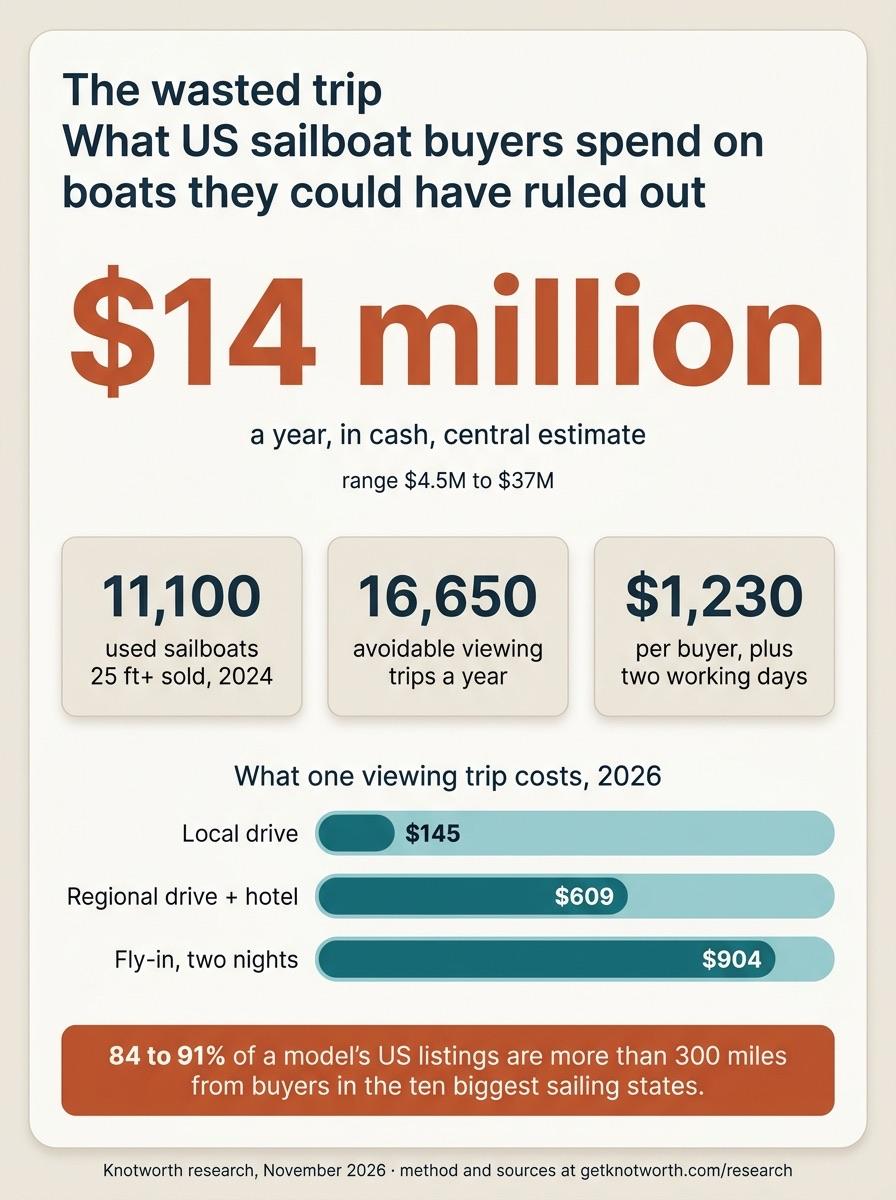
The model is eleven lines of arithmetic and is published with this page. Change the number of viewings and everything moves in proportion; change the trip mix and the per-trip cash moves between $436 and $611 before the survey. The headline is a central estimate inside a wide range, and we would rather say that than pretend to a precision the data does not have.
What this means if you are about to book a flight
Seven checks, from a desk, before travel. Each one is free, each takes less than an hour, and each one has sent at least one Knotworth user home without a ticket.
- Price the catch-up bill from the boat's age. Rigging over twelve years, sails over ten, an engine over 2,000 hours or with no hours stated, barrier coat never mentioned. The cost guide has the intervals and the prices.
- Look up the model's known faults and the years they apply to. Our model pages list them with sources. If the listing is silent on one, that is a question, not good news.
- Run the design numbers against your mission. Draft, comfort ratio, capsize screen, hull speed. The calculators take two minutes.
- Ask the seller the model's six questions by email, and ask for a haul-out photo. The cheap answers come fast. Silence is an answer too.
- Add the survey, haul and tax to the asking price before you decide it is in budget. On a 35-footer that is about $1,500 before the first repair.
- Check the geography honestly. If the nearest acceptable boat is a flight away, the viewing costs $900 before the survey, and that is a line in the offer.
- Then decide whether she has earned the trip. The buying guide's phrase is the right one: the point of the desk work is to be able to say, with evidence, "do not fly for this one."
Methodology, inputs and limitations
Inputs. Every figure in the model and its source:
| Input | Value | Source | Type |
|---|---|---|---|
| Used sailboats 25 ft+ sold, US, 2024 | 11,100 | Sail America via Practical Sailor, Mar 2026 | Published |
| Viewings per purchase | 3 / 4 / 6 | Forum self-reports (YBW, Cruisers Forum, Trawler Forum, Good Old Boat, Sailing Soulianis) | Assumption |
| Share of failed viewings avoidable at the desk | 35% / 50% / 65% | Knotworth worked examples, Sep 2026; buyer interviews | Assumption |
| Trip mix, local / regional / fly | see table | Knotworth listing geography, Oct 2026 | Assumption informed by data |
| Failed viewings that reached a survey | 10% / 20% / 30% | Anecdotal (BoatUS, forums) | Assumption |
| IRS mileage rate | 72.5 cents a mile | IRS IR-2025-128, 29 Dec 2025 | Published |
| Local and regional round trips | 200 and 600 miles | Knotworth | Assumption |
| Average domestic air fare | $436 (Q1 2026, revised, inflation-adjusted) | BTS | Published |
| Hotel average daily rate | $173.76 (June 2026) | CoStar/STR via Hotel Online | Published |
| Ground transport on a fly-in | $120 | Knotworth | Assumption |
| Average hourly earnings | $37.81 (Sep 2026) | BLS Employment Situation, 2 Oct 2026 | Published |
| Hours per trip | 6 / 16 / 20 | Knotworth | Assumption |
| Pre-purchase survey, 35 ft | $1,050 at $30 a foot | Knotworth survey cost guide, published rate cards | Published |
| Short haul for survey | $375 | Same | Published |
Listing geography. YachtWorld search results, first page per model (up to 28 cards), fetched 12 and 23 October 2026, US listings with a displayed price, 174 rows across 17 models. Distances are great-circle, state geographic centre to state geographic centre, so a listing in the buyer's own state counts as zero miles.
What we do not know, and would like to. The real distribution of viewings per purchase; the share of surveys that end a deal, which brokers and surveyors hold and could share anonymously; the share of buyers who travel by air versus road; and the number of buyers who look and never buy, whose trips are all wasted and are not in this model. A brokerage or a surveyors' association that shares aggregate figures gets a named credit and a revised page.
What this is not. It is not a measurement. It is a published, reproducible estimate with its assumptions in the open, built because the alternative was no number at all.
Paste the listing. The free pre-check prices the catch-up bill from the boat's age, lists the model's known faults and what the ad is silent on, and tells you whether she has earned the trip. The result may well be "don't fly."
FAQ
How many boats should you look at before buying a sailboat?+
There is no right number, and buyers report anything from two to forty. What matters is how many you rule out before travelling. A buyer who prices the catch-up bill, checks the model's known faults and asks the seller six questions by email can usually see three or four boats and buy one; a buyer who travels on the photographs sees ten.
How much does it cost to go and see a boat?+
At 2026 prices about $145 in mileage for a local drive, about $610 for a regional drive with a night away, and about $900 for a fly-in with two hotel nights, before the survey. A pre-purchase survey with a short haul adds about $1,425 on a 35-footer, and it is paid whether or not you buy.
Is it worth flying to see a used sailboat?+
Yes, once the boat has earned it. For most popular models the nearest listing is a flight away for most buyers, so flying is normal. The waste is flying before the desk work: pricing the true cost, checking the model's faults for that year, and getting the seller's answers and a haul-out photo first.
What is the biggest hidden cost when buying a used sailboat?+
The catch-up bill: standing rigging, sails, engine work, barrier coat and the survey itself, priced from the boat's age and the listing's silences. On the three boats we ran through the model it added 24% to 106% to the asking price, which is why the budget question has to be answered before the trip, not after.
Where does the $14 million figure come from?+
From 11,100 used sailboats of 25 feet and over sold in the US in 2024, four viewings per purchase, half of the failed viewings judged avoidable from the listing, and 2026 travel costs weighted across local, regional and fly-in trips plus the one survey in five that kills a deal. The low case is $4.5 million and the high case $37.5 million; all inputs are on this page.