Buying a sailboat with an Atomic 4: what the engine is, what to check, and what a rebuild or repower costs
By Itzhak Fuhrman·Built and maintains Knotworth's cost model·Updated 18 November 2026
No listing yet, or already own her? Pick the model and the year to see whether she is likely to carry an Atomic 4.
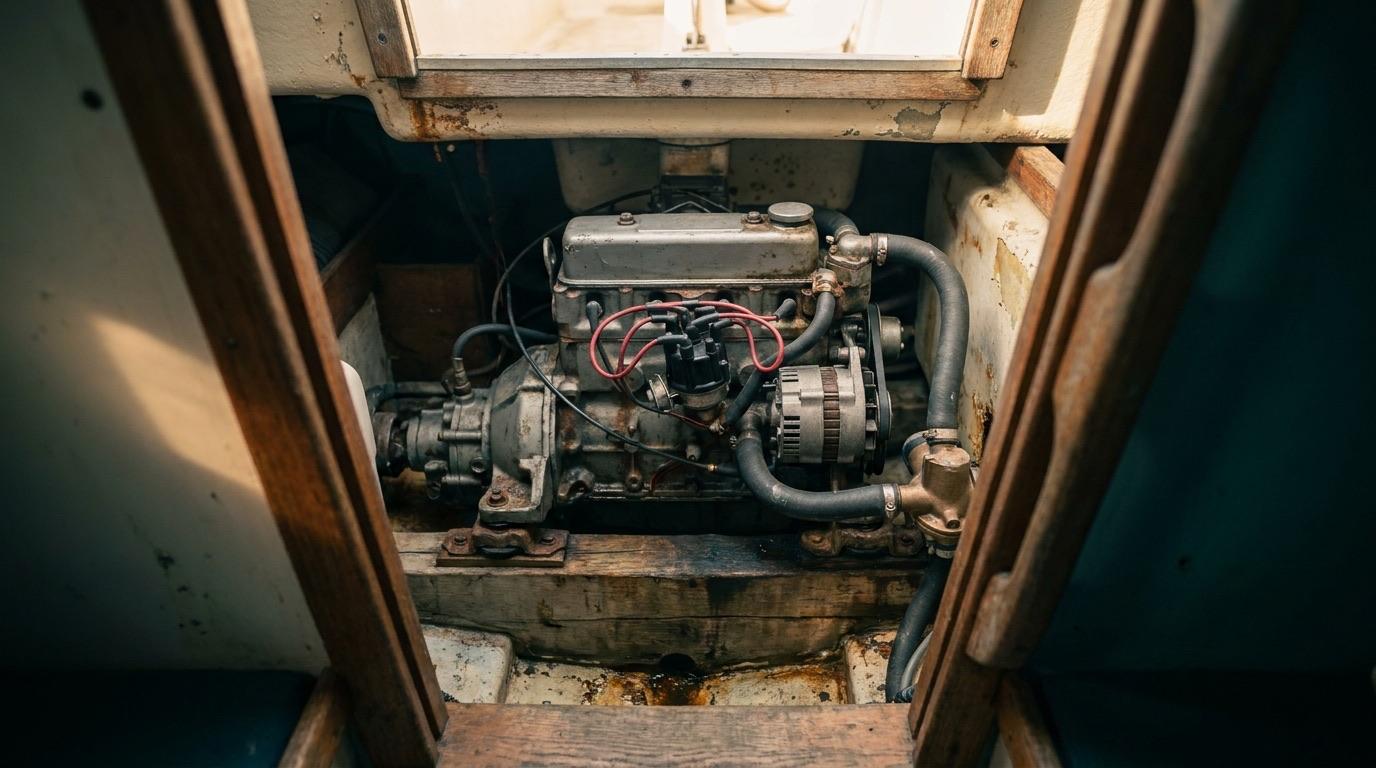
Open the engine box on a Catalina 27, a Pearson, an Ericson or a C&C from the 1970s and the odds are good you will find a squat grey block with a distributor cap on it. That is the Atomic 4, and on a boat built before 1985 the listing often does not mention it at all. "Inboard, runs well" is the usual phrase.
Whether that engine is a reason to buy or a reason to walk depends on four things a buyer can check from the dock and a fifth that needs a mechanic. This page is those five, plus the two bills that sit behind them: the cost of keeping an Atomic 4 alive, and the cost of taking it out.
What is the Atomic 4?
A four-cylinder, side-valve gasoline engine of 64 cubic inches built by the Universal Motor Company of Oshkosh, Wisconsin, descended from a wartime lifeboat engine. Rated at 30 hp at 3,500 rpm, with a direct-drive or 2:1 reduction gearbox, raw-water cooled as built, running on regular gasoline and straight SAE 30 oil. Production ran from 1949 to 1984 by most accounts; Catalina fitted it until the 1985 model year.
The scale is what makes it matter to a buyer. Wikipedia's entry puts production at over 40,000 units with an estimated 20,000 still in use, and Good Old Boat's long-running Atomic 4 article, republished in November 2026, gives the same two figures. Charles Doane, writing as Wave Train in a piece he titled Bomb Squad, says the engine had most of the US sailboat auxiliary market to itself for a generation.
The builders who used it read like the used-boat market: Catalina, C&C, Pearson, Ericson, Cal, Columbia, Ranger, Tartan, Whitby. Our Catalina 27 and Catalina 30 guides both cover boats that carry it. On the 30, the Universal diesel was a factory option from about 1978 and became standard in the middle 1980s, so a 1978 to 1985 Catalina 30 could have either, and a buyer has to look rather than assume.
Is the Atomic 4 a good engine?
Yes, within its design. Good Old Boat's assessment is that it is not a particularly unreliable engine in its original form, and the one specialist still rebuilding them has seen little evidence of the broken crankshafts the engine is famous for. Its weaknesses are the ones that come with age and raw-water cooling: a corroded water-jacketed exhaust that lets water into the cylinders, stuck exhaust valves, a mechanical fuel pump whose diaphragm can put gasoline in the crankcase, and points ignition that dislikes a damp boat.
Each of those has a known cure, and the cures are what a buyer looks for. A water-lift muffler in place of the jacketed exhaust. An electric fuel pump with an oil-pressure cut-out. Electronic ignition in place of points. A fresh-water cooling conversion that keeps salt out of the block. Practical Sailor's Catalina 30 review rates the Atomic 4 one of the two most desirable engines fitted to that boat, alongside the Universal M25 diesel, and calls it relatively quiet and powerful.
The honest other side is that the engine is a forty-year-old design kept alive by one company, Moyer Marine in Pennsylvania, and a small aftermarket. Routine parts are abundant. Blocks, cranks and camshafts are salvaged, not made, and Good Old Boat's warning that the supply may not be forever was written in 1998. Indigo Electronics, the other long-time supplier, announced in 2026 that its XR3000 ignition module had been discontinued by its manufacturer, with a replacement unit offered. The engine is supportable. It is not mainstream.
The gasoline question
An Atomic 4 is a petrol inboard in an enclosed space, which means a blower that must run before every start, fuel lines and a tank that must be sound, and a nose for fumes. Properly installed and maintained it has a long safety record, and Wave Train's author could find no case of one exploding. The risk is a neglected installation: a forty-year-old tank, perished hoses, a leaking fuel pump diaphragm, a blower that does not work. Those are what the survey has to prove absent.
Good Old Boat's piece puts the hazard in a sentence worth remembering: a quarter cup of gasoline vapour has the energy of several sticks of dynamite. The same article notes that the Coast Guard's fire statistics from the 1990s were dominated by spilled fuel or vapour igniting, not by engines failing, which is the point. The engine is not the danger. The fuel system around it is, and the fuel system is what ages.
A buyer should treat the installation as part of the engine:
- Tank. Age, material and access. Some early boats had tanks built into the hull; a Pearson Triton owner on the sailboatowners.com forum described a bronze tank moulded in with no inspection plate.
- Hoses and clamps. Marine fuel hose has a date on it. Forty-year-old hose is a finding.
- Blower. It must run, and the owner must use it. Ask.
- Fuel pump. A mechanical pump with a diaphragm can leak fuel into the crankcase; Good Old Boat says the sign is a strong gasoline smell on the dipstick. An electric pump with an oil-pressure safety switch is the modern cure and part of every Moyer rebuild.
- Insurance. Ask your insurer before the offer whether a gasoline inboard changes the premium or the survey they require. Some do not care; some want a current fuel-system inspection.
What to check at the viewing
Five things. Which exhaust it has (water-jacketed or water-lift). Which cooling (raw water or a fresh-water conversion). Which ignition (points or electronic). Which fuel pump (mechanical or electric with a cut-out). And a compression test, which is the one that needs a mechanic and the one that tells you whether the engine is a $500 tune-up or a $4,000 core swap.
| Check | Good answer | Finding |
|---|---|---|
| Exhaust | Water-lift muffler, hoses dated within ten years | Original water-jacketed exhaust: corrosion can put water in the cylinders, and Good Old Boat's rebuilder ties most broken cranks to it |
| Cooling | Fresh-water cooling kit fitted (Moyer lists kits at $1,245 to $1,275) | Raw-water cooled: scale and salt in a forty-year-old block; ask when the block was last flushed and whether it overheats |
| Ignition | Electronic ignition, named module | Points and condenser: workable, but a damp-boat failure point and a sign nothing else was upgraded |
| Fuel pump | Electric pump with oil-pressure safety switch | Mechanical diaphragm pump; smell the dipstick |
| Compression | Numbers in hand from a recent test, even across cylinders | "Runs great" with no numbers. Stuck exhaust valves and worn rings both show here first |
| Starting and running | Starts within a few seconds, idles smooth, no blue or white smoke, no water in the oil | Hard start, rough idle, smoke, milky oil |
| Hours | Less useful than on a diesel; service history matters more | No records at all |
Two habits of a well-kept Atomic 4 are worth asking about, because they say more about the owner than the hours do. The first is closing the raw-water seacock before cranking an engine that is not going to start, so the exhaust does not fill with water. The second is shutting the fuel valve when the engine is off, because a sticking carburettor float can flood the engine.
What an Atomic 4 costs to keep
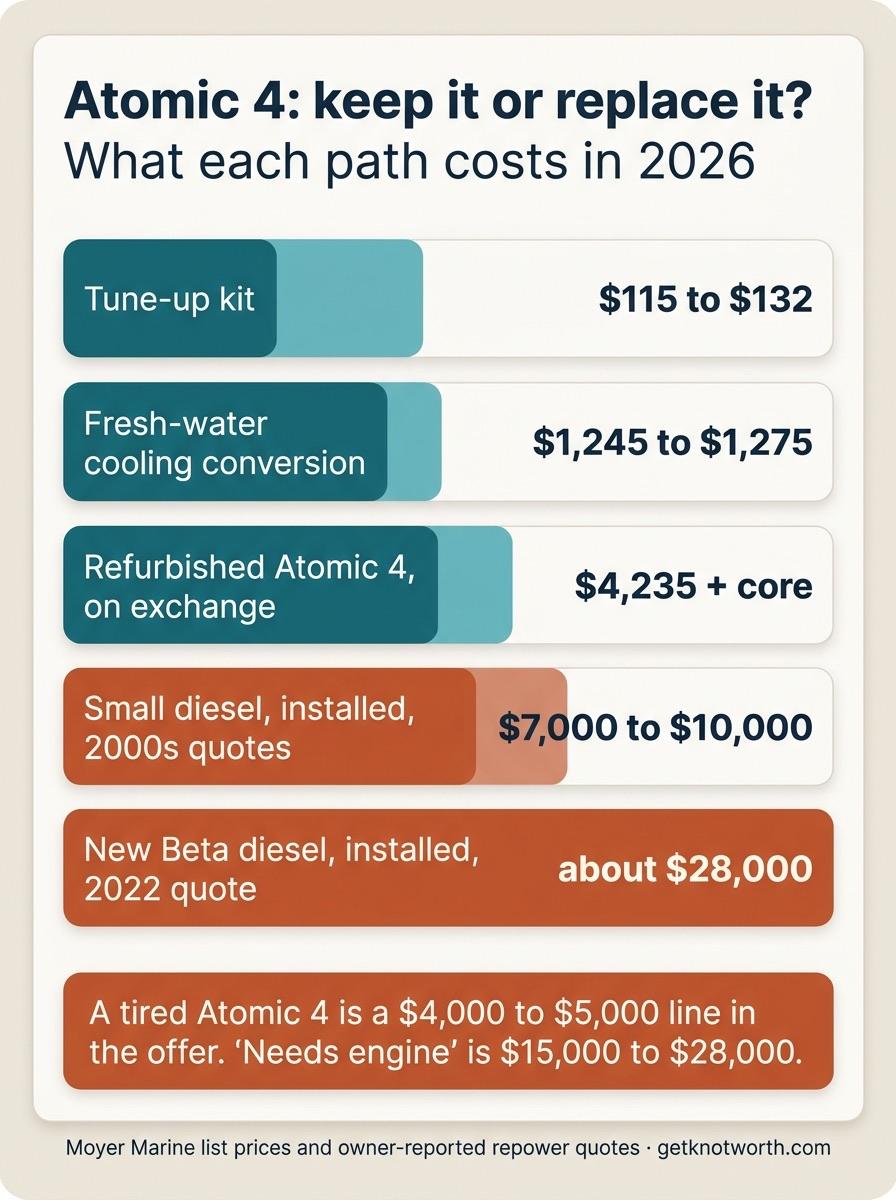
The parts are cheap by marine standards. A full gasket set is $169.50 and a tune-up kit $115 to $132 at Moyer Marine. The upgrades that fix the known weaknesses run from about $415 for the electric fuel pump kit to about $1,250 for fresh-water cooling. A refurbished engine on exchange is $4,235 plus an $800 core charge that comes back when the old engine goes in. Yards doing the same rebuild have been quoted far higher.
| Item | Price | Source |
|---|---|---|
| Tune-up kit (plugs, points or module, condenser, cap, rotor) | $115 to $132 | Moyer Marine, 2026 |
| Complete gasket set | $169.50 | Moyer Marine, 2026 |
| Electric fuel pump kit with oil-pressure safety switch | $415 | Moyer Marine, 2026 |
| Sea water pump kit | $615 to $695 | Moyer Marine, 2026 |
| Fresh-water cooling conversion kit | $1,245 to $1,275 | Moyer Marine, 2026 |
| Refurbished Atomic 4, direct drive, on exchange | $4,235 plus $800 refundable core | Moyer Marine, 2026; includes electronic ignition, new carburettor, electric fuel pump, 65 A alternator; early-model cores not accepted |
| Owner DIY rebuild, parts only | about $800 | Reader comment, Wave Train, 2017 |
| Yard rebuild quote | $8,000 | Same reader, same engine, 2017 |
Sources: Moyer Marine rebuild services and kits (vendor prices as listed, November 2026); Wave Train reader comments. The refurbished-engine figure is for direct drive; reduction-gear and V-drive versions are priced on request, and Moyer no longer accepts early-model engines as cores, which matters on a 1960s boat.
Set against the asking prices in our Catalina 27 guide, where most boats list between $5,000 and $15,000, a refurbished engine is a third to most of the boat. That is why the compression test belongs before the offer.
What a diesel repower costs
More than the engine. Owners who have done it report $6,000 to $7,000 for a small diesel in 2005 money, a Yanmar installed for close to $10,000 twenty years ago, and a Beta Marine dealer quoting about $28,000 installed in 2022. Electric drive estimates in the same thread were $15,000, and an outboard on a bracket $6,000 to $7,000. Wave Train's 2011 rule still holds: the repower usually costs more than the boat gains in value.
The reason the engine is the smaller half of the bill is everything that has to change with it. Good Old Boat's repowering guide lists them: engine beds, mounts, a new shaft or at least a new coupling, a propeller matched to the new engine and possibly turning the other way, the exhaust, the fuel tank and lines (gasoline to diesel), a water separator, the instrument panel and controls. Practical Sailor notes that the diesel sits about three inches taller than the Atomic 4 in a Catalina 30, and owners of other models report the same fit problem.
| Option | Reported cost | When |
|---|---|---|
| Keep it: refurbished Atomic 4 on exchange | $4,235 plus core, plus fitting | 2026 |
| Small new diesel, engine only | $6,000 to $7,000 | 2005 |
| Yanmar 2GM20F installed with shaft and folding prop | close to $10,000 | about 2002 |
| New diesel installed, Wave Train's range | $7,000 to $10,000 | 2011 |
| Beta Marine, dealer quote installed | about $28,000 | 2022 |
| Electric drive, estimate | $15,000 | 2022 |
| Outboard on a bracket | $6,000 to $7,000 | 2022 |
Sources: sailboatowners.com, Beta diesel to replace Atomic 4 (2005); Ericson Yachts forum, Atomic 4 died, what next (2022); Wave Train (2011). Owner-reported, not quotes to you. The 2022 Beta figure is a dealer's installed price on an Ericson and is the most current.
Looking at one right now? Paste the listing and the free pre-check lists which of these the ad is silent on.
Free on every boat, no card. You only pay to unlock a full report.
For a buyer the arithmetic is simple. A sound Atomic 4 with the upgrades fitted is an engine that costs a few hundred a year to keep. A tired one is a $4,000 to $5,000 line in the offer. A boat advertised "needs engine" is a five-figure line, about $28,000 on the most recent dealer quote, unless you plan to fit a refurbished Atomic 4 yourself, and the true-cost guide prices that against the rest of the boat.
What to ask the seller before you travel
- Is it the original Atomic 4, a rebuilt one, or a replacement? When, and by whom? A Moyer invoice is the best answer.
- Raw-water or fresh-water cooled? If raw, when was the block last flushed?
- Which exhaust? Water-lift muffler, or the original jacketed exhaust?
- Points or electronic ignition? Mechanical or electric fuel pump?
- When was the last compression test, and what were the numbers?
- How old are the fuel tank and hoses? Does the blower work?
- Does it start cold on the first try? Ask for a short video of a cold start.
Take the answers to the inspection checklist and hand both to the surveyor, who should run the engine and may recommend a separate mechanical survey; on a gasoline inboard that is money well spent.
How Knotworth reads an Atomic 4 boat
The free pre-check knows which models and years carried the Atomic 4 as standard, which offered a diesel option, and when each builder switched. Paste a listing that says "inboard" and it tells you which engine the boat most likely has, flags the gasoline fuel system as a survey item, and the full report carries an engine reserve sized to a refurbished exchange engine until a recent rebuild invoice or compression numbers clear it.
On our Catalina 27 page the engine table does this by hand: Atomic 4 from 1973, Universal diesel later, outboard well on early boats. The report does it for the specific hull, with the seller questions above attached.
Paste the listing. The free pre-check tells you whether this model and year most likely carries an Atomic 4, what to ask the seller, and what a tired one does to the all-in price.
FAQ
Is the Atomic 4 a reliable engine?+
In its original form it is not an unreliable engine, and the specialist who rebuilds them has seen little evidence of the broken crankshafts it is known for. Its real weaknesses are age-related: corroded water-jacketed exhausts, stuck exhaust valves, mechanical fuel pumps and points ignition. An engine with a water-lift muffler, electronic ignition, an electric fuel pump and fresh-water cooling has had all four fixed.
How much does a rebuilt Atomic 4 cost?+
Moyer Marine lists a refurbished direct-drive Atomic 4 at $4,235 plus an $800 core charge that is refunded when the old engine is returned, as of November 2026. Reduction-gear and V-drive versions are priced on request. Fitting it is extra, and a yard quoted one owner $8,000 to rebuild his own engine that he then rebuilt himself for about $800 in parts.
Is a gasoline inboard safe in a sailboat?+
A properly installed and maintained one has a long record, and the energy of gasoline vapour is the reason every start begins with the blower. The danger is the forty-year-old fuel system around the engine: tank, hoses, pump and blower. Those should be inspected, dated and, if original, priced for replacement before you buy.
How much does it cost to replace an Atomic 4 with a diesel?+
Owners report small diesels at $6,000 to $7,000 for the engine alone in 2005, about $10,000 installed twenty years ago, and a Beta Marine dealer quote of about $28,000 installed in 2022. The engine is usually less than half the bill because the shaft, propeller, exhaust, fuel tank, mounts and controls change with it.
How many horsepower is an Atomic 4?+
30 hp at 3,500 rpm in the common version, from 64 cubic inches and a 6.3 to 1 compression ratio. An 18 hp version was also made. In a 27 to 30 foot boat that is ample for harbour work and motoring in a calm, which is what the engine was designed for.
Which sailboats have an Atomic 4, and when did builders stop fitting it?+
Catalina, C&C, Pearson, Ericson, Cal, Columbia, Ranger, Tartan, Whitby and many others fitted it from the 1950s to the mid 1980s. Catalina is usually cited as the last builder to fit it, through the 1985 model year, with the Universal diesel an option on the Catalina 30 from about 1978 and standard by the middle of the decade.