Pacific Seacraft 34 buyer's guide: what she is, what she costs, what breaks
By Itzhak Fuhrman·Built and maintains Knotworth's cost model·Updated 23 October 2026
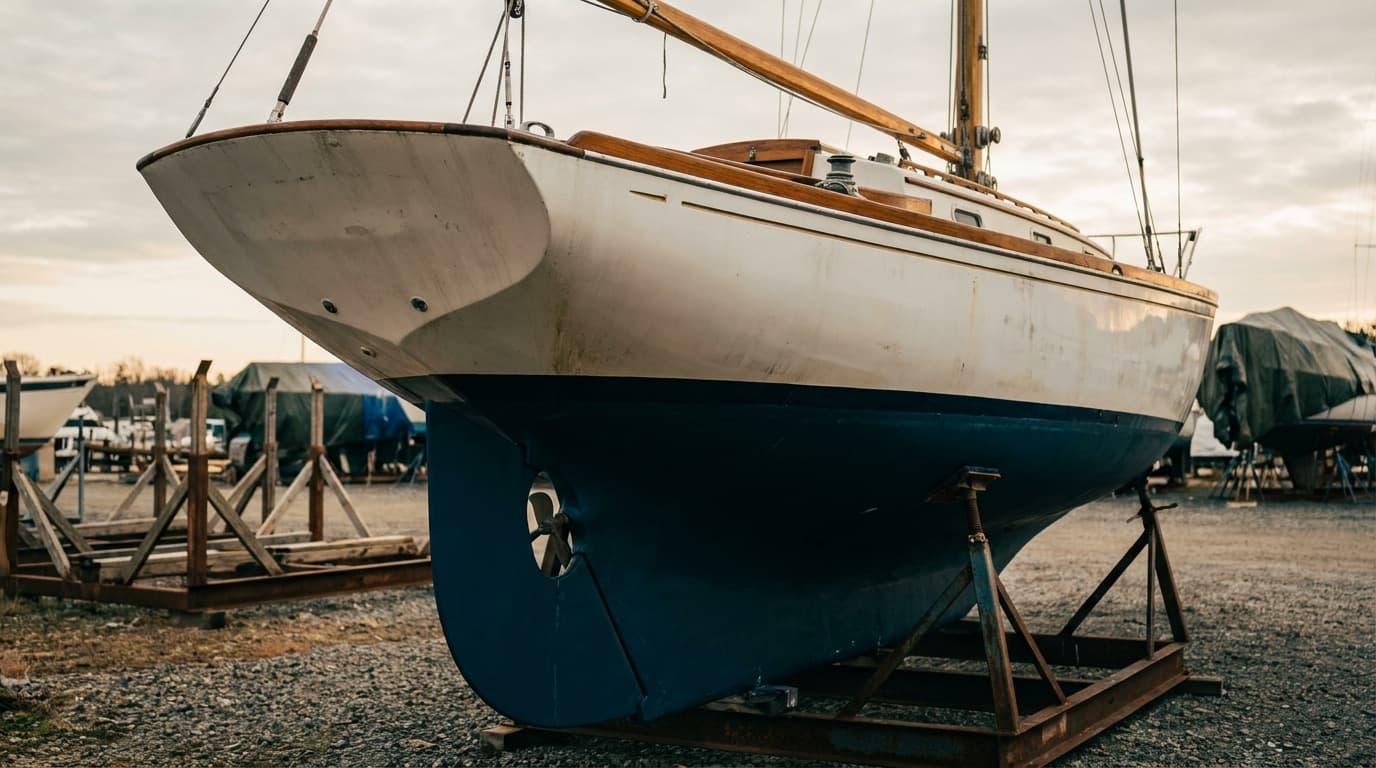
Pacific Seacraft 34 specifications
| Specification | Figure |
|---|---|
| Length overall | 34 ft 1 in |
| Waterline length | 26 ft 3 in |
| Beam | 10 ft 0 in |
| Draft | 4 ft 11 in standard fin · 4 ft 1 in shoal (Scheel keel) |
| Displacement | 13,500 lb (the shoal keel version is heavier than published) |
| Ballast | 4,800 lb lead, 36% |
| Sail area | 533 sq ft, cutter |
| Rig | Masthead cutter with running backstays for the staysail · I 40.3 ft · mast about 48 ft above the water |
| Hull | Solid fiberglass, vinylester skin coat, fin keel on a solid stub, skeg-hung rudder, canoe stern |
| Deck | End-grain balsa with plywood at hardware, hull-deck flange bedded in 5200 and bolted on 4 in centres |
| Tanks | Fuel 38 gal · Water 75 gal |
| Auxiliary | Yanmar 3JH2E diesel, 35 to 38 hp |
| Built | From 1984 or 1985 (sources differ) to date; a Circumnavigator 34 edition with extra equipment in 1988 |
| Designer | William I. B. Crealock; sold as the Crealock 34 at first |
Sources: sailboatdata, the factory specification page and Practical Sailor. Practical Sailor lists the engine at 38 hp in its table and 35 hp in its text. Good Old Boat notes the shoal-draft ballast is heavier and not reflected in the published displacement.
Every review of this boat ends up at the same number, and it is not the price.
It is 1.68, the capsize screening value, the lowest of any boat in Good Old Boat's comparison of small offshore cruisers. Ten feet of beam on 13,500 pounds is the kind of hull designers drew before marketing departments measured interiors, and it is why a 34-footer from the 1980s still asks what a new production 34 asked a decade ago.
So the question on this boat is rarely "is she good." It is whether this particular hull, at this particular price, has had the three or four things done that a 35-year-old Pacific Seacraft needs, and what the gap costs if she has not. That is what this page is for.
Is the Pacific Seacraft 34 a good boat?
For a couple going offshore on a budget that stops short of a 37, she is one of the best choices built in America. Solid hull, skeg rudder, outboard chainplates you can inspect, a hull-deck joint Practical Sailor doubts will ever leak, and a motion owners describe as a swisher rather than a pounder. She is not fast in light air, not roomy, and not cheap.
Practical Sailor sailed a ten-year-old 34 on her original Dacron in 8 to 12 knots and found she met or beat her polar predictions: 4.5 to 5 knots within 50 to 60 degrees of the apparent wind, 5.2 to 5.5 knots at 70 degrees, dropping to 3.5 knots deeper than 120 degrees. Under power she cruised at 6 to 6.5 knots burning about 0.6 gallons an hour. The reviewer's summary is that these boats make 150-mile days in typical ocean conditions, which is the number that matters on a passage.
What she gives up is volume. The cockpit seats are 6 ft 5 in long, the quarter berth is a sea berth or a locker rather than a double, the head is small and there is no shower stall. The Pacific Seacraft hub sets out why that trade is deliberate; for two people it is the right one.
What are the common problems with a Pacific Seacraft 34?
Fewer than most, and the same four as the rest of the range: an aluminium fuel tank low in the boat, blisters on hulls from before the vinylester skin coat, leaking Bowmar hatches, and water tanks that are hard to inspect. Then the age items every 1980s boat carries. On a well-documented 34 the list is short enough that the seller can show you all of it.
| Known issue | What it means, and what it costs |
|---|---|
| Fuel tank | Pacific Seacraft's practice of putting aluminium tanks in the bilge is documented on the 37, and the 34 was built the same way in the same years. Bilge water corrodes the tank from outside. A replacement is a yard job sized by what has to come out to reach it. Ask whether it has been done and with what material |
| Blisters on early hulls | SpinSheet reports significant blistering on early-to-mid 1980s Pacific Seacrafts, cosmetic rather than structural. The vinylester skin coat that Practical Sailor describes came later in the decade. A 1985 to 1987 boat with no barrier coat history should be priced as if it needs a peel and barrier coat |
| Bowmar overhead hatches | Sailing Magazine's verdict on the range: poorly built and known to leak. The hatches are a catalogue purchase; the deck core under a leaking one is the real risk |
| Deck core around hardware | Balsa with plywood inserts at the hardware, which is the right way to do it, but 35 years of fittings means 35 years of bedding. Meter around the hatches, chainplate covers and stanchions |
| Water tanks | Inspect, taste, ask. Integral or liner-mounted tanks are a project if they fail |
| Outboard chainplates | Through the topsides, easy to see, dependent on bedding. Look for weeping on the hull below each one |
| Running backstays | Fitted for the staysail. On a boat that has been sailed as a sloop for years they may be seized or missing. Check the tackle and the chainplates aft |
| Engine | Yanmar 3JH2E, long-lived and well supported. Treat hours as honest and ask for the service record; a 35-year-old boat with 2,000 hours has had an easy life and may need the same injector and heat exchanger work as one with 6,000 |
| Age items | Standing rigging, sails, running rigging, canvas and electronics on the usual intervals. From the true-cost guide, a re-rig on a boat this size is the largest of them |
Sources: SpinSheet and Sailing Magazine on the 37, which share construction and tankage practice with the 34; Practical Sailor for construction, tankage and engines. Assumption: a boat on which the work has not been done. Where a finding is documented on the 37 rather than the 34, the table says so.
What is not on the list is as telling as what is. No keel joint problem, no rudder bearing problem, no hull-deck leak, no structural deck issue, no engine beds, no chainplate failures. That is unusual for a boat of this age on this site, and it is the reason the asking prices look the way they do.
Looking at one right now? Paste the listing and the free pre-check lists which of these the ad is silent on.
Free on every boat, no card. You only pay to unlock a full report.
How much does a Pacific Seacraft 34 cost?
On the US brokerage market in October 2026, 1987 to 1990 boats asked $53,000 to $72,000, a 1994 boat $90,000, a refitted 1992 boat $160,000 and a 2009 boat $185,000. Median across eleven listings: $60,000. The boat holds her value because the build is the value; the gap between two 1988 boats is the refit, not the hull.
| Build year | Recent asking price | Where |
|---|---|---|
| 1983 | $75,000 | Oregon |
| 1987 | $53,000 | Florida |
| 1987 | $55,000 | Maryland |
| 1988 | $60,000 | Washington |
| 1989 | $54,900 | Florida |
| 1990 | $60,000 | Florida |
| 1990 | $72,000 | Florida |
| 1992 | $160,000 | Maryland |
| 1994 | $90,000 | Wisconsin |
| 2000 | $56,000 | North Carolina |
| 2009 | $185,000 | Maryland |
YachtWorld, US listings, first results page, 23 October 2026.
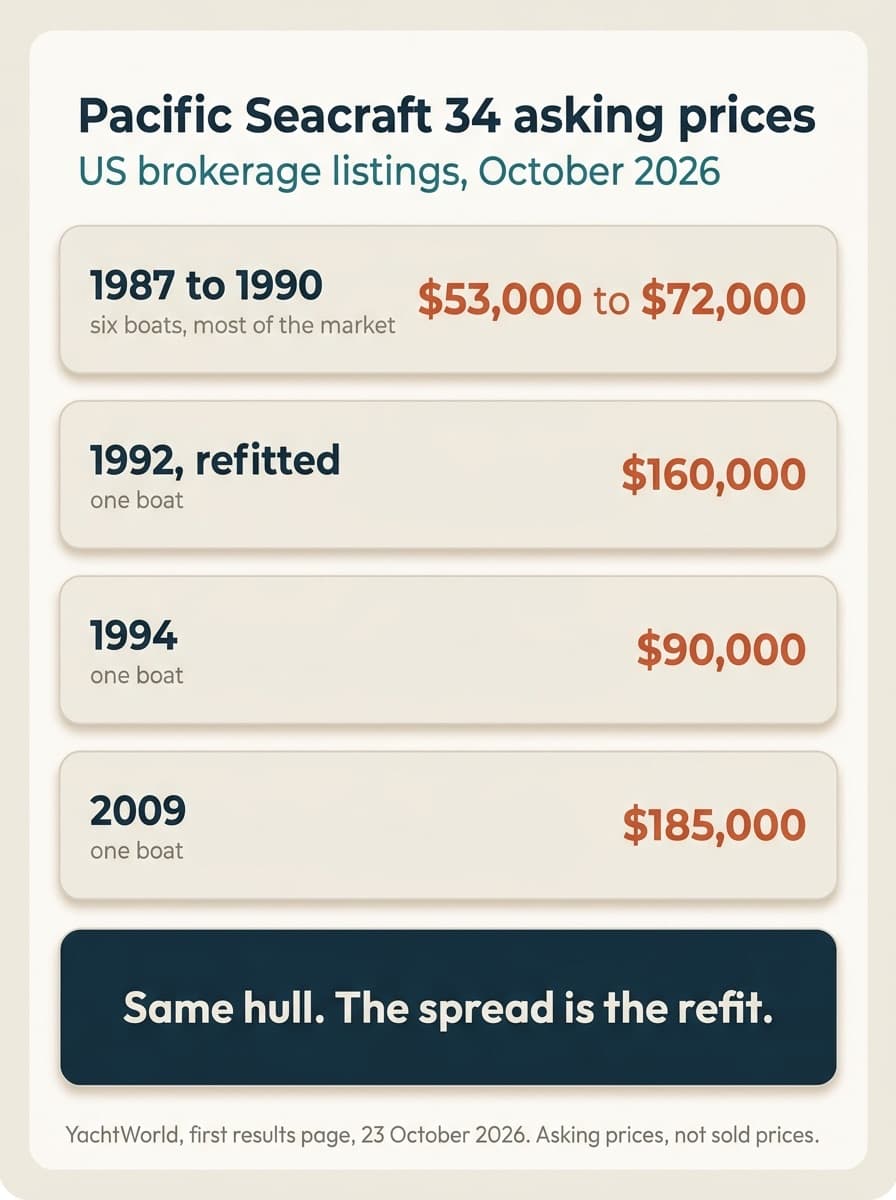
Two listings in that table explain the whole market. A 1992 boat at $160,000 and a 2000 boat at $56,000 are not a mistake; one has been refitted to go somewhere and one has not. On this boat the refit is the price, and the arithmetic in our guide to what a used sailboat is worth applies with unusual force: the all-in number on the cheap boat and the dear boat can be the same.
What the sticker leaves out, from the true-cost guide at 34 feet: standing rigging, a mainsail and a yankee, running rigging, a survey and haul-out, sales tax, and on this boat the fuel tank and a possible barrier coat. A 1988 34 at $55,000 with none of it done is a $75,000 to $85,000 boat all-in. One at $72,000 with the invoices is probably the cheaper of the two.
Pacific Seacraft 34 or 37?
The 34 for two people; the 37 for two people who carry crew, want a second cabin or the bigger cockpit and galley. They sail alike, with nearly identical displacement-to-length and sail-area ratios. The 34 has the better V-berth and the arched helm seat; the 37 has 8 ft 10 in cockpit seats against 6 ft 5 in, more tankage, and used prices that start where the 34's stop.
Practical Sailor's reviewer would take the 37 for carrying many people and gear and calls the 34 "more than commodious" for a couple. The Pacific Seacraft 37 guide has the full comparison; the hub has the table. The short version is that the 34 is the same boat with less of it, and for most couples less of it is enough.
Is the Pacific Seacraft 34 a bluewater boat?
Yes, by design and by record. Capsize screening 1.68, comfort ratio 34, a solid laminate hull, a skeg-protected rudder, a canoe stern that handles following seas, and tankage and sea berths laid out for passages. Her limits are the ones that come with 34 feet: 38 gallons of fuel, a small galley, and a crew of two.
Running the published figures through the standard screens:
| Ratio | Value | Reading |
|---|---|---|
| Capsize screening | 1.68 | Well under the 2.0 offshore threshold. The lowest in Good Old Boat's small-cruiser comparison |
| Comfort ratio | 34 | High. A seakindly motion for her length |
| Displacement / length | 335 | Heavy displacement; the narrow hull heels early and lengthens her waterline |
| Sail area / displacement | 15.1 | Moderate, honest for a cutter; add a drifter or cruising spinnaker for light air |
| Ballast / displacement | 36% | Moderate; stability comes from the hull form and the lead's depth as much as its share |
| Hull speed | 6.9 knots | how it is calculated |
Computed from LWL 26.21 ft, beam 10.0 ft, displacement 13,500 lb, ballast 4,800 lb and sail area 533 sq ft as published. The shoal keel version is heavier, which moves displacement-to-length up and sail-area-to-displacement down a little. The design ratios guide explains each screen, and the free calculators run them for the boat you are looking at.
Read against the Westsail 32, the other heavy cruiser on this site, the 34 is lighter, faster and far better to windward for a similar comfort ratio, which is roughly the difference between a 1971 design and a 1984 one.
Which Pacific Seacraft 34 should you buy?
The one with the fuel tank done, the bottom barrier-coated and the hatches replaced, whatever its year. Between otherwise equal boats: post-1988 for the vinylester skin coat, the standard fin unless you need the shoal draft, and the Yanmar over any earlier engine. A Circumnavigator 34 is a standard boat with more equipment, not a different hull.
The year matters less than on most boats because the hull did not change much and the company did not cut corners when it was struggling. What changed is the resin in the skin coat around 1988 and, gradually, the equipment list. A 1987 boat that has been peeled and barrier-coated is a better buy than a 1990 boat that has not.
What to check before you buy one
- Fuel tank. Material, age, replacement invoice. Lift the sole and look at the top of the tank and its fittings for corrosion.
- Bottom. Haul-out photos, barrier coat history, moisture readings on a pre-1988 hull.
- Hatches and the deck under them. Every Bowmar hatch, metered around.
- Chainplates. Weeping on the topsides below each one; bedding age.
- Water tanks. Taste and inspect.
- Running backstays. Present, free, and with the tackle.
- Rig, sails, engine. Dates and invoices; the inspection checklist covers the rest and a boat at this price always gets a survey.
How Knotworth reads a specific Pacific Seacraft 34
This page describes the model. The product reads the boat. Paste a listing URL and the free pre-check matches it to the Pacific Seacraft 34's reference record, runs her design numbers, flags which of the known issues above the advertisement is silent on, and ranks the seller questions by money. On a 34 the fuel tank and the bottom come first.
Paste the URL. The free pre-check reads that boat's specs, runs her ratios, and tells you which of the known Pacific Seacraft 34 questions the ad leaves open. No card until you unlock the full report.
FAQ
What is the price of a Pacific Seacraft 34?+
On the US brokerage market in October 2026, 1987 to 1990 boats asked $53,000 to $72,000, a 1994 boat $90,000, a refitted 1992 boat $160,000 and a 2009 boat $185,000. The spread within a year is the refit history, so compare the all-in price including the fuel tank, bottom and rig, not the asking price.
Is the Pacific Seacraft 34 a good boat?+
Among the best small offshore cruisers built in America. Solid hull, skeg-hung rudder, the lowest capsize number in her class and a motion owners describe as a swisher rather than a pounder. The trade-offs are a small interior, modest light-air speed and prices that reflect the reputation.
What are the problems with a Pacific Seacraft 34?+
Few, and shared across the range: an aluminium fuel tank low in the boat that corrodes from outside, blisters on early-to-mid 1980s hulls, leaking Bowmar overhead hatches, and water tanks that are hard to inspect. Then the standing rigging, sails and engine items every boat of the age carries.
What is the difference between the Pacific Seacraft 34 and 37?+
Three feet, a cabin and roughly $60,000 on the used market. The 37 has a bigger cockpit and galley, more tankage and an optional second stateroom; the 34 has the better V-berth and helm seat and sails the same way, with nearly identical design ratios.
How fast is a Pacific Seacraft 34?+
Hull speed is about 6.9 knots. Practical Sailor measured 4.5 to 5 knots close-hauled and 5.2 to 5.5 knots reaching in 8 to 12 knots of wind on original sails, and 6 to 6.5 knots under power. Owners report 150-mile days on passage, which is the figure that matters for this boat.