MacGregor sailboats: a used buyer's guide to the Venture and MacGregor trailer sailers
By Itzhak Fuhrman·Built and maintains Knotworth's cost model·Updated 18 November 2026
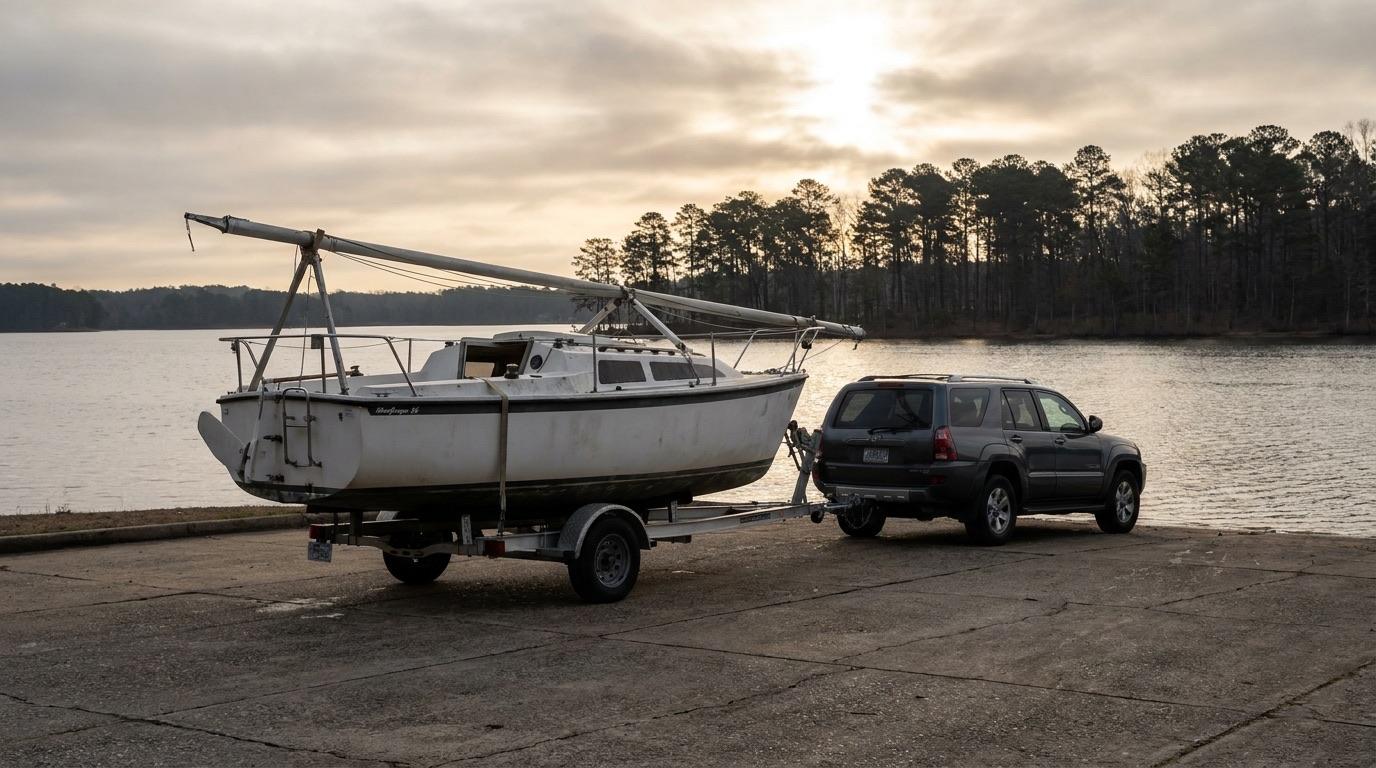
MacGregor built boats for people who were not yet sailors. That was the whole business plan, and it started as a Stanford MBA thesis: boatbuilders would do better if they built efficiently and sold cheap. Practical Sailor called it corner-cutting in 1987 and admitted by 1995 that the numbers proved the point.
The result is a used market unlike any other on this site. Thousands of Ventures and MacGregors sell every year for the price of a used car, mostly on Craigslist, mostly to first-time owners, and the listings are written by people who may not know what a gate valve is. This hub covers the company, what runs across the range, and what happened after 2013. The MacGregor 26 guide prices the boat most buyers are actually looking at.
Is MacGregor Sailboats still in business?
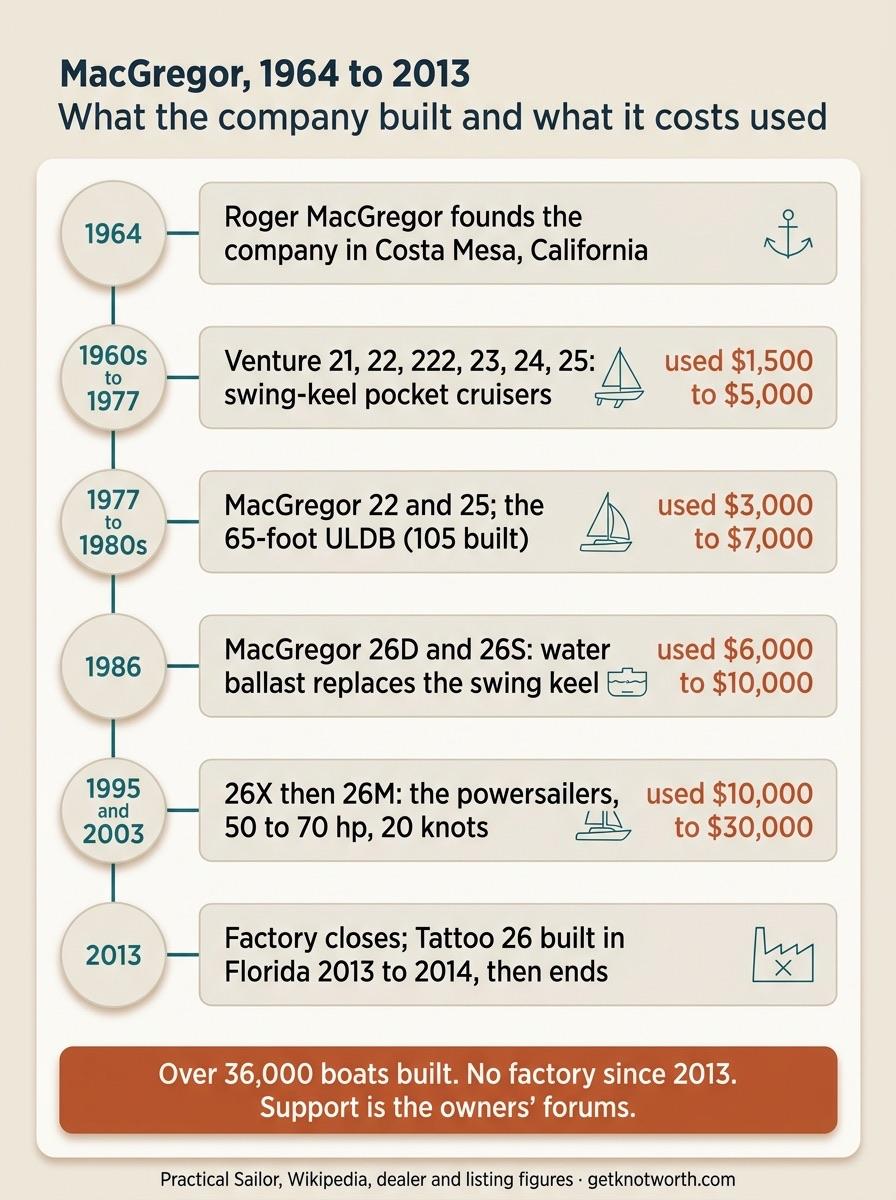
No. Roger MacGregor founded the company in 1964, ran it from Costa Mesa for nearly fifty years, and retired in early 2013, closing the factory. His daughter Laura MacGregor Sharp bought the tooling for the 26M, moved it to Stuart, Florida, and built the boat as the Tattoo 26 in 2013 and 2014. A Tattoo dealer reports that Tattoo Yachts has since ended production of the 26 and is not building new boats, while developing a smaller 22. As of November 2026 there is no factory.
The history is short and well documented. Practical Sailor's 1995 owner survey has MacGregor's own account: the company began as a thesis, became a business in 1967, sold the early boats as Ventures, and by the mid 1990s was taking the original 26 out of production after about 7,000 hulls to make room for the 26X. Wikipedia's company page puts total output over 36,000 boats and records the 2013 retirement, the closure, and the Tattoo succession. Blue Water Yachts, a long-time dealer, states that the Tattoo 26 was built during 2013 and 2014 and that Tattoo has ended production.
For a buyer that means three things. There is no factory to call about a hull number. The parts chain is the owners' community: the MacGregor section of sailboatowners.com holds manuals, a knowledge base and the forum where every ballast-valve question has been asked, and macgregorsailors.com is the other large owners' site. And the 26M was built in such numbers, by MacGregor and then Tattoo, that the boat is better supported dead than most live models.
What MacGregor built
Trailer sailers almost without exception. The Venture 21, 22, 222, 23, 24 and 25 of the 1960s and 1970s, swing-keel pocket cruisers sold under the Venture name until about 1977. The MacGregor 22, 25 and 26 that followed. The 19 Powersailer. Two exceptions: a 36-foot catamaran and the MacGregor 65, an ultra-light 65-foot sloop built in about 105 hulls that remains the most numerous big yacht ever produced.
Practical Sailor's survey lists the lineage. The Ventures were entry-level boats marketed to beginning sailors, the company's niche from the start. The first was the V-21, a pocket cruiser with a swing keel, and the MacGregor 25 that grew from the line was a conventional swing-keel trailer sailer that owners on the forums still praise. The 26, introduced in 1986, replaced the swing keel with water ballast, and the 26X of 1995 added the powerboat hull. The 65, built from the 1980s, was a different idea entirely: a light, fast, cheap big boat, and it sold.
On the used market the Ventures and the MacGregor 22 and 25 sit in the same place as the Catalina 22: a few thousand dollars, a swing keel to inspect, an outboard and a trailer that may be worth more than the boat. The Catalina 22 guide and the Catalina 25 guide cover that inspection in detail and most of it transfers.
Why do sailors argue about MacGregors?
Because the company built to a price and said so. Practical Sailor's reviewers called the fittings flimsy and the liner thin, then printed pages of owners saying the boat was the best value on the water. The 26X and 26M, half sailboat and half powerboat, sharpened the argument: critics said a boat that tries to be both is the worst of both, and owners motored home at 20 knots while the critics were still tacking.
Practical Sailor's 2026 video asks whether the MacGregor 26 is a terrible sailboat, a brilliant compromise, or a misunderstood boat that solved problems most sailors will not admit to. The American Sailing Association's spotlight makes the same point with a straight face: eyes roll at the name, and the company sold more cruising sailboats than anyone. Sailing Magazine quotes Roger MacGregor on the reason, dock space and moorings at a premium in Newport, and the answer, a boat that lives on a trailer.
The buyer's version of the argument is simpler. A MacGregor is a sound boat for sheltered water with two conditions attached, and both are on the 26 page: the ballast tank must be full when she sails, and the engine and trailer are most of the money.
What runs across the range: water ballast
From the 26 onward, MacGregors have no keel. Stability comes from a tank of sea water under the sole, filled through a transom valve after launch and drained on the ramp, so the boat is light on the trailer and ballasted on the water. It works, with one rule the manual repeats on its first page: do not sail or power the boat with the tank less than full. An unballasted MacGregor is not self-righting.
Practical Sailor's 1987 reservation about centreline water ballast, and the owners' letters that answered it, are the clearest account of the trade. Water is not dense and the tank is not low, so the boat is tender and heels early; reef the main above 12 knots and shorten the headsail at 6 to 8, and she is a pleasant light-air boat. Sailing Magazine's safety note is the other half: failing to fill the boat with ballast can be dangerous, and so can running under engine with the tank empty and too much weight above deck. The capsizes owners report on the forums were empty-tank boats.
For a buyer the system is three parts: the gate valve, the vent plug and the tank. All three leak with age, most of the tank is behind the liner, and the test is to fill the tank, close the valve, and haul the boat. The 26 page's problems table has the details and the owners' threads.
What does a used MacGregor cost?
Venture 21s and 22s and MacGregor 22s ask $1,500 to $5,000, a MacGregor 25 $3,000 to $7,000, a 26D or 26S $6,000 to $10,000, a 26X $10,000 to $15,000, and a 26M or Tattoo 26 $20,000 to $30,000. MacGregor owners report losing about a third of the value in ten years, less than most boats the size, and a late 26M with a good outboard and trailer holds its price.
| Model | Years | Typical asking | What sets the price |
|---|---|---|---|
| Venture 21, 22, 222, 23 | 1960s to 1970s | $1,500 to $5,000 | Trailer, outboard, swing keel condition |
| MacGregor 22 and 25 | 1970s to 1980s | $3,000 to $7,000 | Same, plus sails |
| MacGregor 26D and 26S | 1986 to 1995 | $6,000 to $10,000 | Ballast valve, trailer, outboard |
| MacGregor 26X | 1995 to 2003 | $10,000 to $15,000 | The 50 hp outboard and its hours |
| MacGregor 26M | 2003 to 2013 | $20,000 to $30,000 | Engine, trailer, freshwater history |
| Tattoo 26 | 2013 to 2014 | $22,500 to $27,000 | As the 26M |
Sources: Boat Trader and YachtWorld listings, October and November 2026, with the model-by-model figures on the 26 page; Practical Sailor's January 2025 price read; the Venture and 22/25 figures are our read of owner-market listings and should be treated as a range, not a quote. Most of these boats sell privately, below brokerage prices.
Price a MacGregor the way the true-cost guide prices any trailer sailer: the hull is the cheap part, the engine and trailer are the money, and the catch-up list is sails, canvas, electrics and the ballast valve. Our guide to what a used sailboat is worth sets out the arithmetic.
Looking at one right now? Paste the listing and the free pre-check lists which of these the ad is silent on.
Free on every boat, no card. You only pay to unlock a full report.
What to check before you buy one
- Ballast system, on a 26. Fill, close the valve, haul, look for drips. Ask whether the owner filled it.
- Swing keel, on a Venture, 22 or 25. Pivot, cable, winch, hauled out, as on the Catalina 22.
- Outboard. Hours, service, salt or fresh, cold start on video.
- Trailer. GVWR plate, brakes, bearings, tyres, frame corrosion.
- Hull-deck joint and liner. Water tracks at the sheer; stress cracks in the sole are normal, soft spots are not.
- Rig and sails. Dinghy-grade fittings on early boats; ask what has been upgraded. The inspection checklist covers the rest, and a 26M gets a survey.
Paste the URL. The free pre-check reads the specs, matches the model, runs the design numbers with the ballast full, and lists which of the known MacGregor issues the ad is silent on, with the seller questions ranked by money.
FAQ
Is MacGregor Sailboats still in business?+
No. Roger MacGregor retired in 2013 and closed the Costa Mesa, California factory after nearly fifty years. His daughter's company, Tattoo Yachts of Stuart, Florida, built the 26M mould as the Tattoo 26 in 2013 and 2014 and has since ended production. Support comes from the owners' communities on sailboatowners.com and macgregorsailors.com.
Are MacGregor sailboats any good?+
For sheltered water and a trailer, yes, and for the money, better than most. They were built to a price: solid hand-laid hulls and through-bolted hull-deck joints, with light fittings and thin liners that owners upgrade. Practical Sailor's owner surveys in 1995 and 2025 both end the same way: good value for the intended use, with limitations the owners understand.
Why do sailors hate the MacGregor 26?+
Because the 26X and 26M are half powerboat, with a 50 to 70 hp outboard and a hull that planes at 20 knots, and traditional sailors see a boat that is neither one thing nor the other. Owners see a boat that sails in light air, motors home ahead of the squall, and lives on a trailer. Practical Sailor's 2026 video on the argument calls it one of the most polarising boats in sailing.
What is the difference between a Venture and a MacGregor?+
Same company, two names. The boats were sold as Ventures until about 1977 and as MacGregors after, and several models spanned the change. The Ventures were swing-keel day sailers and pocket cruisers from 21 to 25 feet; the MacGregor name went on the later 22, 25 and 26, the 19 Powersailer and the 65-foot sloop.
How much is a used MacGregor 26?+
A 26D or 26S from the late 1980s or early 1990s asks $6,000 to $10,000, a 26X from 1995 to 2003 $10,000 to $15,000, and a 26M from 2003 to 2013 $20,000 to $30,000, with the outboard and trailer a third to a half of the price. The MacGregor 26 guide has the listings behind those ranges.