Catalina 25 buyer's guide: what she is, what she costs, what breaks
By Itzhak Fuhrman·Built and maintains Knotworth's cost model·Updated 23 October 2026
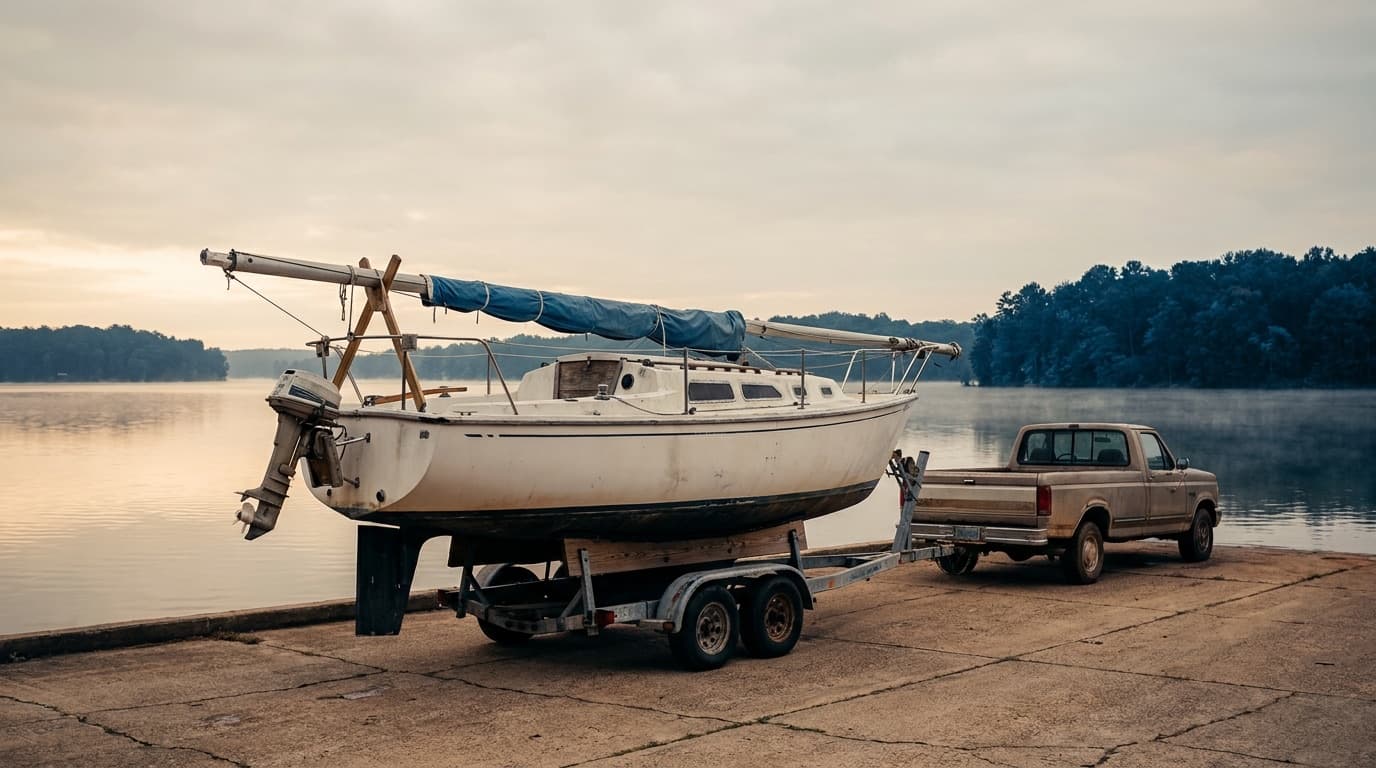
Catalina 25 specifications
| Specification | Figure |
|---|---|
| Length overall | 25 ft 0 in |
| Waterline length | 22 ft 2 in |
| Beam | 8 ft 0 in |
| Draft | Fin keel 4 ft 0 in · Wing keel 2 ft 10 in · Swing keel 2 ft 8 in up, 5 ft 0 in down |
| Displacement and ballast | Fin 4,550 lb (1,900 lb lead) · Wing 4,400 lb (1,750 lb) · Swing 4,150 lb (1,500 lb cast iron) |
| Sail area | 270 sq ft standard rig · about 295 sq ft tall rig |
| Rig | Masthead sloop, deck-stepped on a hinge · I 29.0 ft standard, 31.0 ft tall · mast about 30 ft above the waterline |
| Headroom | 5 ft 6 in; 6 ft 4 in with the pop-top raised (optional until 1987, standard after) |
| Towing weight | About 6,000 to 7,800 lb all-up with trailer, outboard and gear. Owners use half-ton pickups and large SUVs |
| Auxiliary | Outboard of 4 to 9.9 hp on a transom bracket; long shaft recommended. A few late boats had inboards |
| Built | 1976 to 1991, about 6,000 hulls (sources range from 5,332 sold to 5,866 built). Succeeded by the Catalina 250 in 1995 |
| Designer | Frank Butler, with Gerry Douglas |
| PHRF | About 228 standard rig, 222 tall rig |
Sources: sailboatdata for hull, keel and rig figures; Wikipedia for the keel variants; Good Old Boat for towing weights and headroom; Practical Sailor for PHRF and the 5,332 sales figure. Catalina production has been paused since October 2025; the brand changed hands in July 2026 with no restart date announced.
Ask anyone who has owned one and you get the same word: reasonable. Good Old Boat's reviewer reached for it four times in one sentence. Reasonably spacious, reasonably built, sails reasonably, reasonably priced.
That is exactly the right word, and it is also the problem with buying one. Six thousand reasonable boats were built over fifteen years with three keels, two rigs, two interiors and a pop-top that was optional for eleven of those years. The $3,000 one and the $9,000 one are not the same boat, and the listing will not tell you which you are looking at.
This guide is about telling them apart. What breaks on a Catalina 25 and what each fix costs at 2026 prices, which keel to buy and why, what she really weighs behind the car, and the question half the people reading this are actually asking, which is whether to buy this boat or the 22.
Is the Catalina 25 a good boat?
Yes, in the way the 22 is a good boat, with one more step of comfort. She is stable, predictable and simple, roughly 6,000 were built so parts and advice are everywhere, and the pop-top gives her standing headroom that no other boat this cheap has. She is slow, her helm loads up when she heels past 15 degrees, and she is a coastal and inland boat, full stop.
Practical Sailor's used boat review opens with the verdict most owners would give: "the 25 represents good value for the money." It then spends two thousand words on what is adequate rather than exceptional about her, which is the honest way to read this boat.
On the water she balances well with the sails trimmed and can be unforgiving when they are not. Several owners in that review report heavy weather helm in a breeze, and the boat rounding up once heeled past about 15 degrees. The tall rig adds light-air speed and makes both habits worse. Reef early and she is a pleasant boat; sail her flat.
What makes her a sound purchase is the same thing that makes the 22 one: the fleet. The Catalina, Capri and 25s International Association keeps owner-written technical tips, manuals and a forum, and Catalina Direct stocks keel pins, winches, rudders, ports and rigging for a boat that has been out of production for 35 years. Almost nothing else at this price comes with that.
What are the common problems with a Catalina 25?
On a swing keel boat, the keel pivot, the lifting cable and the winch, all of which live underwater or in salt spray and all of which need the boat out of the water to inspect. On every boat, leaking ports and hull-deck joint, rudder hardware and transom stress cracks, early blistering, and the corroding closed-barrel turnbuckles that Practical Sailor flags. The rest is age.
This is the section the listing will not write for you.
| Known issue | What it means, and what it costs |
|---|---|
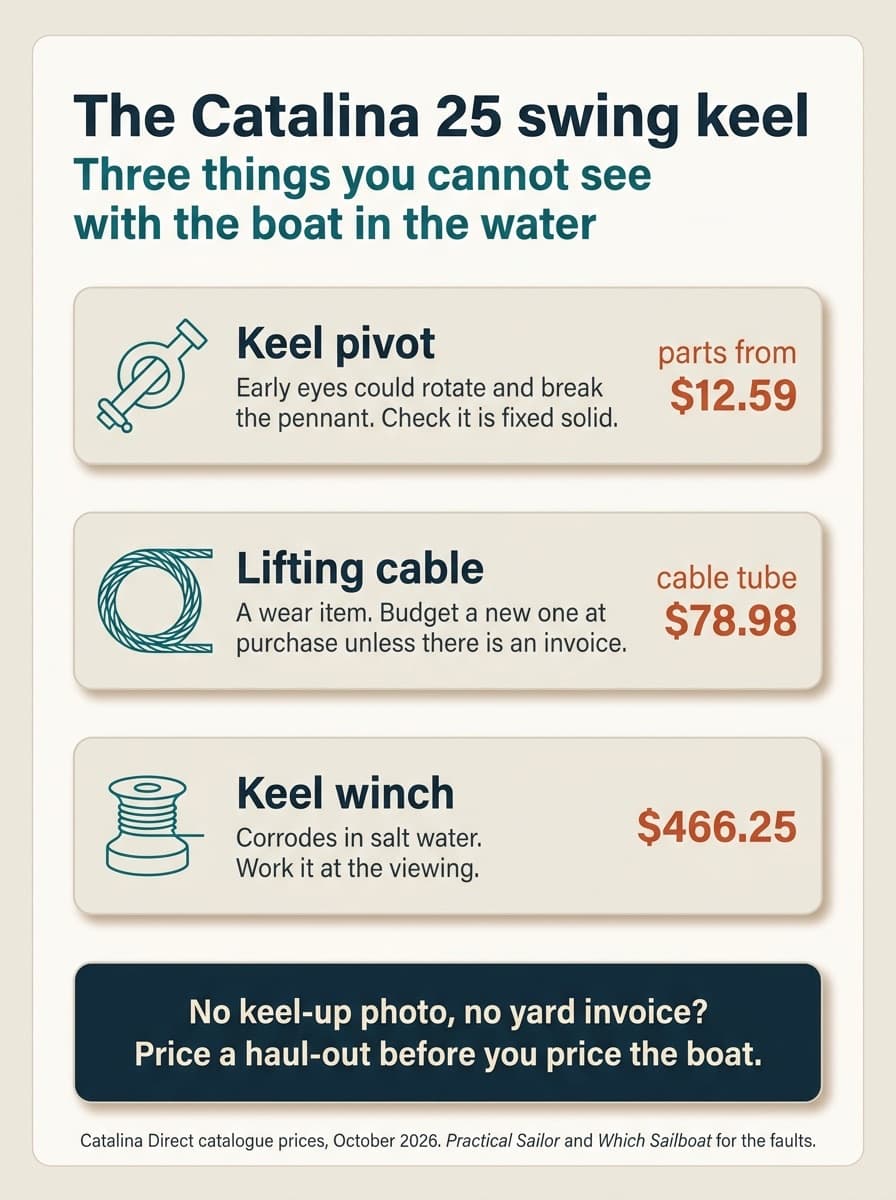
| Swing keel pivot | The keel hangs on a pin through a cast-iron eye. On early boats the eye could rotate and break the lifting pennant; Practical Sailor says to check the pivot is fixed solidly and notes retrofits exist. Pin bushing $12.59, keel fastener kit $13.70, eyebolt retrofit assembly $54.94. The parts are cheap; the haul-out to reach them is not |
| Keel lifting cable and winch | The cable is a wear item and the winch corrodes, especially in salt water. Which Sailboat recommends inspecting the pivot pin every two years in salt. Keel winch with quick-release handle $466.25, keel cable tube $78.98, turning ball kit $26.91. Budget a new cable at purchase unless there is an invoice |
| Swing keel banging in the trunk | No mechanical lock, so the keel knocks at anchor and in a chop. Owners live with it or fit a lock. Not a fault, but the noise alarms first-time buyers at the viewing |
| Fixed keel bolts and anodes | Early fin keel bolts were not stainless and rusted; cast-iron fin and swing keels need sacrificial anodes that swing keels often left the factory without. Ask when the bolts were last inspected |
| Hull-deck joint | Some boats used self-tapping screws rather than through-bolts and leak along the rail in rain and spray. Look for water tracks inside the hull liner at the sheer |
| Leaking ports and hatches | Original aluminium-framed windows leak; a reseal kit is the standard fix. The forward hatch on pre-1983 boats was held with screws that loosened. Stained headliner under a window is the giveaway |
| Rudder and transom | Gudgeons and pintles break or loosen, transoms crack at the attachment points, rudders delaminate and split, tillers split. Gudgeon retrofit with three-bolt pattern $49.88; Catalina Direct lists standard, deep and balanced replacement rudders. The original rudder is unbalanced and heavy on the helm; a balanced blade is the common upgrade |
| Closed-barrel turnbuckles | Early boats used closed-barrel turnbuckles that corrode inside where you cannot see. Practical Sailor names them; Good Old Boat says replace them and the spreader brackets on older boats. Treat original standing rigging on a 1980s boat as due |
| Hull blistering | Common on hulls that never had an epoxy barrier coat, less so year by year through the 1980s. Which Sailboat calls it hit or miss on early boats and largely gone by the end. Assume a pre-1983 boat needs a barrier coat unless shown otherwise |
| Gelcoat crazing and chips | At stressed corners and hardware. Cosmetic, but a tell for a boat that has been worked hard or stored badly |
| Icebox and small leaks | Icebox was poorly insulated and drained overboard before 1983, so water can come in when heeled. Companionway rain leaks and water pooling in the head ports are reported |
| Pop-top | Heavy enough that some owners never raise it, and sailing with it up is limited to light air because the vang comes off. Check the hinges, the canvas skirt and that it latches down properly |
| The trailer | On a 6,000 lb package the trailer's bearings, brakes, tyres and bunks carry more load than a 22's and age the same way. If the listing includes a trailer, inspect its GVWR plate and its brakes before you inspect the boat |
Sources: Practical Sailor for the pivot eye, hull-deck fasteners, turnbuckles, rudder and transom findings; Good Old Boat for the buyer checklist and the turnbuckle and spreader advice; Which Sailboat for the pivot inspection interval, keel bolt and anode notes; Catalina Direct catalogue prices, checked 23 October 2026. Assumption: a boat that has not already had the work done, which on an unmodified 1980s hull is the safe assumption until the seller says otherwise.
Read the swing keel rows together. Every one of them is invisible with the boat afloat and invisible with the keel down. A seller who cannot show you a keel-up inspection photo or a yard invoice has not told you what you are buying, and on this boat that is the whole price.
Looking at one right now? Paste the listing and the free pre-check lists which of these the ad is silent on.
Free on every boat, no card. You only pay to unlock a full report.
How much does a Catalina 25 cost?
Most usable boats ask $3,000 to $10,000, with late pop-top boats in good order reaching the mid-teens. Below $4,000 the equipment is worth more than the hull, and a $3,000 listing with original sails, a tired outboard and an unknown keel cable costs more to own than a $9,000 boat with all three done.
| Build year | Recent asking price |
|---|---|
| 1976 | $3,500 |
| 1983 | $4,500 |
| 1983 | $4,950 |
| 1987 | $3,000 |
| 1988, wing keel, dealer | $7,995 |
Boat Trader, YachtWorld and a dealer listing, 23 October 2026. The brokerage sites carry only a handful of 25s at any time; most change hands on owner-to-owner sites and Facebook, where Which Sailboat puts the typical range at $4,000 to $15,000 and Good Old Boat at $5,000 to $10,000.
What the sticker leaves out is the same list as on every boat this age, scaled to 25 feet:
| Item | Published replacement cost |
|---|---|
| Mainsail | $885 to $1,085 |
| Working jib | $770 to $925 |
| 150% genoa | $1,080 to $1,695 |
| 6 hp long shaft outboard | $1,830 |
| Keel winch, swing keel boats | $466.25 |
| Keel pivot bushing, fastener kit and eyebolt retrofit | $81.23 |
| Gudgeon retrofit, rudder hardware | $49.88 |
Sail prices from The Sail Warehouse, outboard from Online Outboards, keel and rudder parts from Catalina Direct, all checked October 2026.
A main, a jib and an outboard come to about $3,500 before touching the boat. Add a keel winch and cable on a swing keel boat, a reseal of the ports and a set of turnbuckles and you have spent the asking price of the cheap boat again. The true-cost guide sets out the same arithmetic for every length; on a 25-footer the lesson is that the boat is the cheap part.
Which keel should you buy: swing, fin or wing?
Swing keel if you will trailer and launch from ramps, and you accept keel maintenance as a line item. Fin keel if the boat lives in a slip and you want her to point. Wing keel if you need 2 ft 10 in of draft and will rarely tow. Over half of production was swing keel, which is why the keel gear dominates the problems table.
The three keels are three different boats under the same deck.
- Swing keel (4,150 lb, 1,500 lb cast iron): 2 ft 8 in up, 5 ft down. Stiffest of the three by Which Sailboat's account, swings back if grounded, and launches from a ramp without a tongue extension. Slower to windward with the exposed cable adding drag. Everything in the first three rows of the problems table applies.
- Fin keel (4,550 lb, 1,900 lb lead): 4 ft draft. Points better and sails closer to her rating, especially above ten knots. Needs a tongue extension or a deep ramp. Early boats had iron keels and non-stainless bolts; later boats a lead fin, the last ones glass-encased.
- Wing keel (4,400 lb, 1,750 lb lead): 2 ft 10 in draft. The shoal option for thin water. Less stiff than the other two. Wing conversion kits are no longer made, so a wing boat is a wing boat for life.
Running the published fin keel figures through the standard screens:
| Ratio | Value | Reading |
|---|---|---|
| Capsize screening | 1.93 (swing keel 1.99) | Just under the 2.0 threshold on paper. A coastal boat with a narrow beam, not an offshore one |
| Comfort ratio | 19.1 | Low. Light and lively in a chop |
| Displacement / length | 186 (swing keel 170) | Light to moderate |
| Sail area / displacement | 15.7 (swing 16.7, tall rig about 17.8) | Moderate. Underpowered in light air on the standard rig |
| Ballast / displacement | 42% fin · 40% wing · 36% swing | Reasonable for the size; the swing keel gives up the most |
| Hull speed | 6.3 knots | how it is calculated |
Computed from LWL 22.17 ft, beam 8.0 ft, sail area 270 sq ft and the displacement and ballast figures in the specifications table. The design ratios guide explains each screen, and the free calculators will run them for the exact boat you are looking at.
Is a Catalina 25 trailerable?
Yes, and most owners do not. The boat alone is 4,150 to 4,550 lb; with trailer, outboard, gear and provisions owners report 6,000 to 7,800 lb, which is half-ton pickup or large SUV territory. Stepping the mast needs an A-frame and a tackle and takes a couple of hours each way. She is a boat you move between seasons, not one you day-sail off the trailer.
That is the honest difference between "trailerable" in the brochure and in the driveway. A 22 is a weekend-on-the-trailer boat behind a mid-size SUV. A 25 is a once-or-twice-a-year move behind a truck, and the fin keel version wants a tongue extension at most ramps. If you want the small boat that genuinely travels, read the Catalina 22 guide first.
If the listing includes a trailer, it is part of the purchase in the same way the keel is. Dual axles and brakes are what a 6,000 lb package needs; a single-axle trailer under a 25 is a trailer that was bought for something smaller.
Catalina 22 or Catalina 25?
The 22 if you will tow regularly, launch from ramps, or keep the budget under $7,000. The 25 if you will sleep aboard more than a night at a time, want standing headroom and a proper head, and have a truck or a slip. Both are slow, both are forgiving, and both have the same fleet behind them. The 25 costs more to move and about the same to keep.
| Catalina 22 | Catalina 25 | |
|---|---|---|
| Typical asking | $2,500 to $7,000 | $3,000 to $10,000 |
| Boat weight | 2,250 to 2,490 lb | 4,150 to 4,550 lb |
| All-up towing weight | about 3,300 to 3,600 lb | about 6,000 to 7,800 lb |
| Tow vehicle | mid-size SUV | half-ton pickup or large SUV |
| Headroom | sitting | 5 ft 6 in, 6 ft 4 in under the pop-top |
| Head | portable | enclosed or curtained, with sink on many |
| Berths | 4, tight | 4 to 5, the quarter berth is a child's |
| Capsize screening | 2.26 | 1.93 |
| Hull speed | 5.9 kn | 6.3 kn |
| Keel maintenance | swing keel pivot, hangers, cable | swing keel pivot, cable, winch, plus fin and wing options |
The sailing difference is smaller than the living difference. Both are PHRF-slow pocket cruisers that reward being sailed flat. The 25 has a slightly better motion and a slightly better capsize number, and three feet more boat to pay the yard for. If the question is which one to learn on, either. If the question is which one to spend a week aboard, the 25.
What about the Catalina 250?
A different boat with the same number. The 250 replaced the 25 in 1995 with a wider, lighter, water-ballasted or wing keel hull designed to be towed, which the 25 never really was. If towing is the point, the 250 answers it. If the price is the point, the 25 is still the cheaper boat by a wide margin.
The 250 is 25 ft overall on a 21 ft 3 in waterline, 8 ft 6 in of beam, 4,200 lb with 1,050 lb of ballast in the wing keel version, and a mast 33 ft above the water, per sailboatdata. A water-ballast version was built to bring the towing weight down further. Brokerage listings on the day we looked ran from about $6,400 for a 1995 boat into the mid-teens for later ones, with few on the market at any time.
The 250 gets a section rather than a page because the search demand for it is a third of the 25's and the buying questions are the same: ballast system, trailer, outboard, sails. Run a 250 listing through the pre-check and it is read against its own reference record, not the 25's.
What to check before you buy one
See the keel up and out of the water, work the keel winch, look at the turnbuckles and the rudder hardware, walk the deck for soft spots, and open every port after a hose test. Then read the trailer's plate. The inspection checklist covers the rest of the boat.
- Keel, hauled. Pivot pin and eye, cable, winch, and on a fixed keel the bolts and anode. If the boat is afloat and the seller has no haul-out photo, price a haul before you price the boat.
- Standing rigging. Closed-barrel turnbuckles and original spreader brackets on a 1980s boat are due regardless of how they look.
- Rudder and transom. Gudgeons, pintles, cracks at the fastenings, and a rudder that flexes or sounds hollow.
- Ports, hatch, hull-deck joint. Hose the boat and look inside. Stains on the liner at the sheer and under the windows tell the story.
- Deck. Tap around the mast step, stanchions and chainplates. Soft decks are uncommon on this boat, which makes a soft one a reason to walk away rather than to negotiate.
- Pop-top. Raise it. Check the hinges, the latches, the skirt.
- Outboard and sails. The two items most likely to be worth more than the boat. Run the engine under load; unroll every sail.
- Trailer. GVWR plate, brakes, bearings, tyres, bunks. A 25 on a trailer that cannot legally carry her is a boat that cannot leave.
Pay a surveyor on a boat over about $6,000 or on any boat you cannot see hauled. The survey cost guide has the rate cards; at 25 feet it is a small fraction of what the keel gear can cost.
How Knotworth reads a specific Catalina 25
This page describes the model. The product reads the boat. Paste a listing URL and the free pre-check matches it to the Catalina 25's reference record, identifies which keel from the draft and displacement in the ad, runs the ratios for that keel, and lists which of the known issues above the advertisement is quiet about, with the seller questions ranked by money.
On a swing keel 25 that means the keel cable and winch are flagged as unknown until the seller produces a date, the standing rigging is flagged as due on an original 1980s boat, and the outboard and sails are carried as reserves until an invoice or a photo clears them. The $39 report prices all of it against the asking price and tells you what the boat costs all-in before you drive to see her.
Paste the URL. The free pre-check reads that boat's specs, works out which keel she has, runs her design numbers, and flags which of the known Catalina 25 issues the ad stays quiet about. No card until you unlock the full report.
FAQ
How much does a Catalina 25 cost?+
Used Catalina 25s mostly ask $3,000 to $10,000 in 2026, with late pop-top boats in good order reaching the mid-teens. On a boat this cheap the sails, the outboard and the trailer are often worth more than the hull, so the all-in price of a $3,000 boat with none of them sorted is usually higher than that of a $9,000 boat with all three done.
Is a Catalina 25 trailerable?+
Yes, but it is a half-ton pickup job, not an SUV job. The boat alone weighs 4,150 to 4,550 lb depending on the keel, and owners report 6,000 to 7,800 lb all-up with trailer, outboard and gear. Stepping the mast takes an A-frame and a couple of hours, so most owners move her between seasons rather than day-sailing off the trailer.
Which boat is better, the Catalina 22 or the 25?+
The 22 if you will tow regularly or want to stay under $7,000; the 25 if you will sleep aboard and want standing headroom under the pop-top, an enclosed head and a better motion. Both sail slowly and forgivingly, both have the same owner support, and the 25 costs more to move and about the same to keep.
How many Catalina 25s were built?+
About 6,000 between 1976 and 1991. Sources vary: Practical Sailor cites 5,332 sold through 1990, sailboatdata lists 6,031 built, and Wikipedia gives 5,866. By any count she is one of the most produced boats of her size, which is why parts and advice are easy to find.
Are Catalina sailboats any good?+
For the money, yes. Catalinas are production boats built to a price, with adequate rather than exceptional finish, and they are supported by owner associations and an independent parts dealer better than almost any other used boat. Our Catalina brand guide covers the builder's history, the faults that run across the range, and the company's status after its 2026 sale.
How fast can a Catalina 25 go?+
Hull speed is about 6.3 knots and that is the practical ceiling under sail. Owners report 5 to 6 knots in ten knots of breeze, slower in light air on the standard rig, and about 5.5 knots under a 6 hp outboard. PHRF ratings of 228 for the standard rig and 222 for the tall rig put her among the slower boats of her length.