MacGregor 26 buyer's guide: the four models, what breaks, what she costs, and the ballast question
By Itzhak Fuhrman·Built and maintains Knotworth's cost model·Updated 18 November 2026
MacGregor 26 specifications, by model
| 26D (1986 to 1989) · 26S (1990 to 1995) | 26X (1995 to 2003) | 26M (2003 to 2013) | |
|---|---|---|---|
| Length overall · waterline | 25 ft 10 in · about 23 ft | 25 ft 10 in · 23 ft 0 in | 25 ft 10 in · about 23 ft |
| Beam | 7 ft 11 in | 7 ft 10 in | 7 ft 9 in |
| Board | 26D vertical daggerboard · 26S pivoting centerboard, 25 to 50 lb | Pivoting centerboard | Vertical daggerboard |
| Draft, board up · down | about 1 ft · 5 ft 6 in | 9 in · 5 ft 6 in | 1 ft 0 in · 5 ft 9 in |
| Dry weight | about 1,650 lb | 2,250 lb | 2,550 lb |
| Ballast | 1,200 lb water | 1,400 to 1,500 lb water | 1,150 lb water plus 300 lb fixed |
| Displacement, ballast full | about 2,850 lb | about 3,700 lb | 4,000 lb |
| Rig | Masthead sloop | Masthead sloop | 7/8 fractional, rotating mast, air draft about 35 ft |
| Rudder | Single kick-up | Twin kick-up | Twin kick-up, retract under power |
| Engine | 8 to 9.9 hp outboard in a transom well | Up to 50 hp long-shaft outboard, remote controls | Up to 60 hp (owners fit 70), remote controls |
| Speed under power | 5 to 6 knots | 18 to 22 knots, planing | 18 to 22 knots, planing |
| Hull speed under sail | about 6.4 knots | about 6.4 knots | 6.45 knots |
| Built | about 6,000 (D and S combined; Practical Sailor was told 7,000) | about 5,000 to 5,200 | about 3,000 to 5,000 |
Sources: Wikipedia for the model table and production estimates; Practical Sailor's 26M used boat review (January 2025) quoting sailboatdata for the 26M; Practical Sailor's 1995 owner survey for the original 26's 1,200 lb ballast and the 7,000 figure; Murray Yacht Sales' series review (September 2026) for the 26X and 26M ballast and draft; Foghorn Lullaby for 26X dimensions; Sailing Magazine for the 26X and 26M production counts (5,200 and 3,000). Where sources disagree on ballast weight the table shows the range. The 26D and 26S share a hull and differ only in the board.
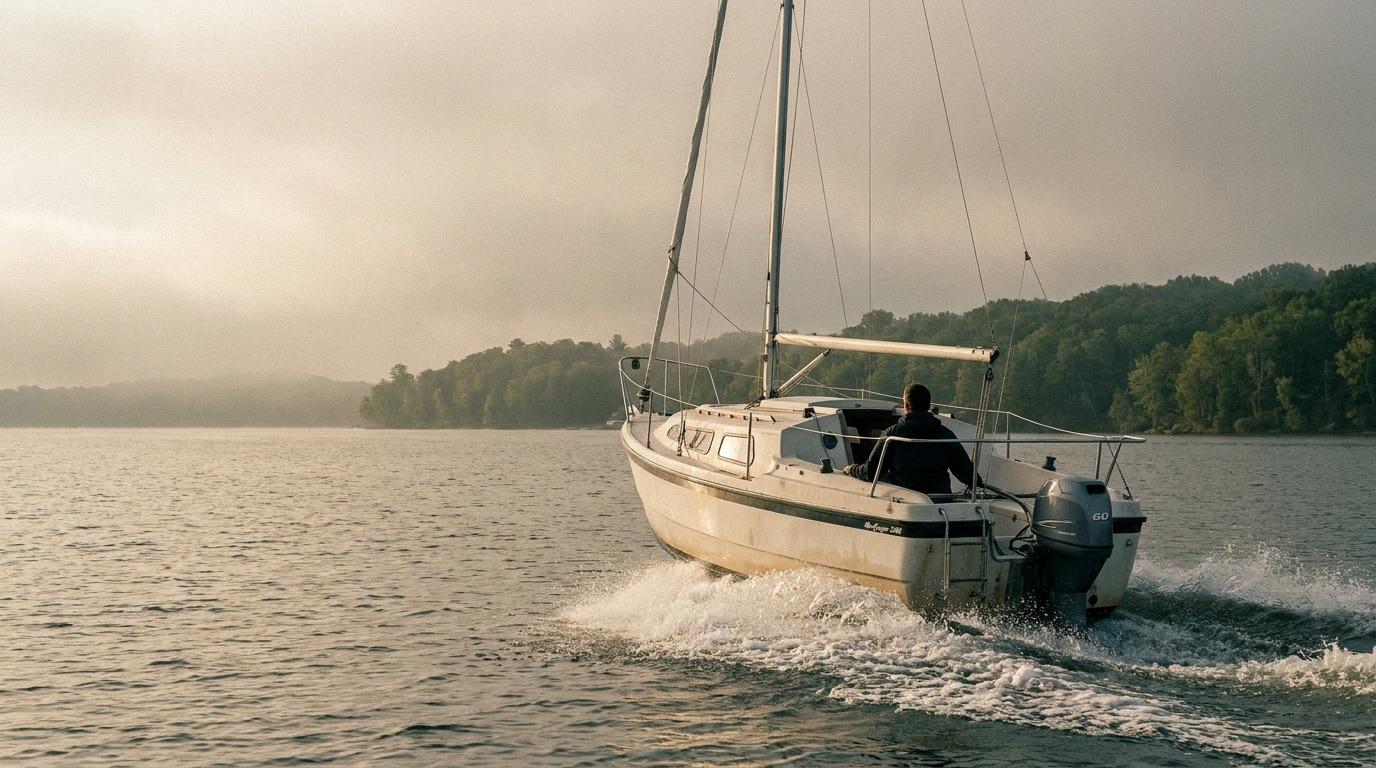
Sailors have an opinion about the MacGregor 26 before they have seen one. Practical Sailor's video on why sailors love to hate her has the honest framing: a poor design, a clever compromise, or a solution to problems most sailors will not admit they have.
For a buyer the argument is beside the point. About sixteen thousand of these boats exist, the American Sailing Association calls her the best-selling cruising sailboat there is, and she holds her value better than most 26-footers. The buying question is not whether she is a real sailboat. It is which of the four MacGregor 26s you are looking at, whether the ballast system and the trailer are sound, and whether the asking price knows the difference between a 1992 26S and a 2010 26M with a 70 hp Suzuki on the back.
Which MacGregor 26 is which?
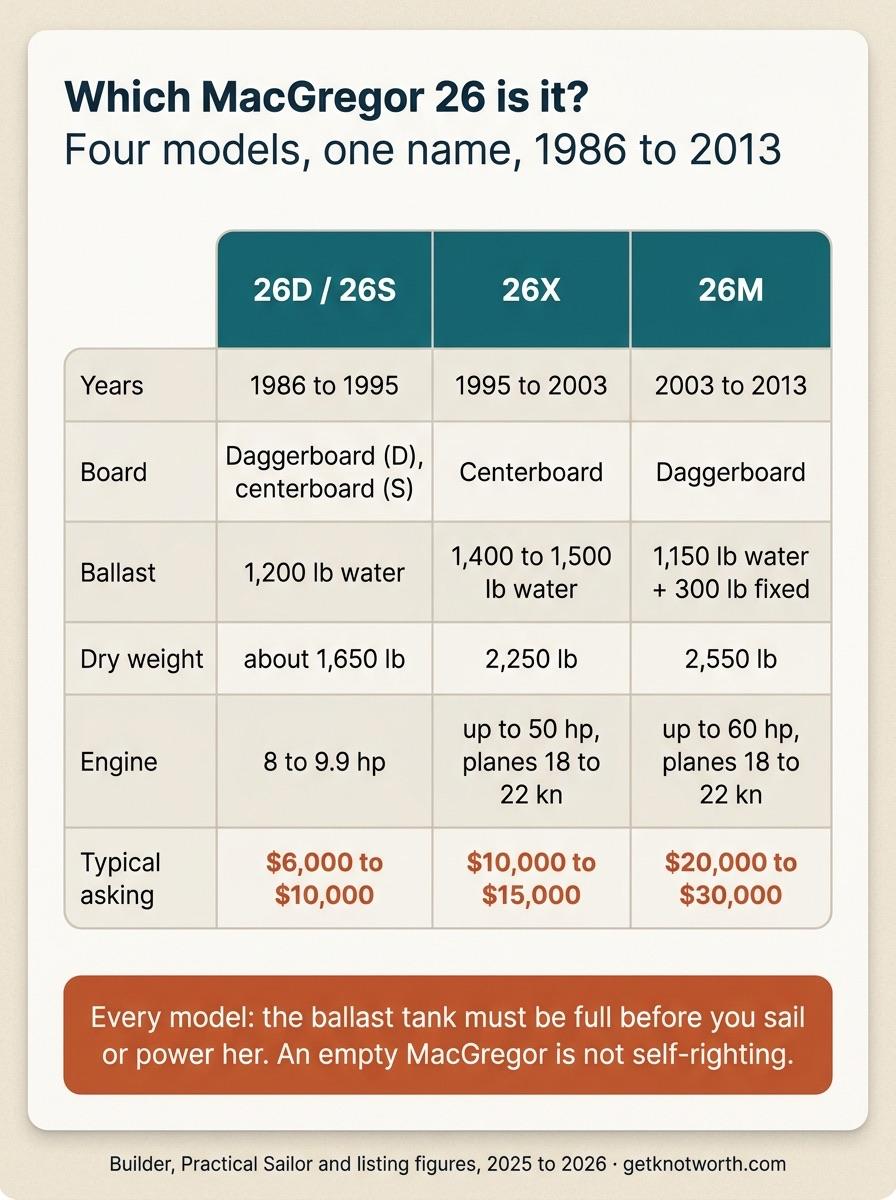
Two families. The 26D and 26S are sailboats first: light, water-ballasted, an 8 hp outboard, a single rudder, a conventional mast. The 26X and 26M are powersailers: a flatter, wider hull that planes under a 50 to 70 hp outboard, twin rudders, remote engine controls, standing headroom, and on the M a rotating mast and 300 lb of fixed ballast. The letters are on the hull identification number and the transom badge; the engine on the back usually gives it away first.
The lineage matters because the boats are priced and criticised as one model and behave as two. Practical Sailor's 1995 owner survey of the original 26 is full of sailors who bought a cheap, quick, light-air boat and spent a few hundred hours and a few thousand dollars making it theirs. The 26X, introduced that spring at $13,990 with trailer and sails, took off so fast that Roger MacGregor stopped building the 65-foot ULDB and the 19 to make room for it. The 26M that followed in 2003 answered the X's critics with a daggerboard, a rotating mast, a more conventional sheerline and a smaller transom, and ran until the company closed in 2013.
Our MacGregor brand guide covers the company, the Venture years and what happened after 2013. This page is about the four boats.
Is the MacGregor 26 a good boat?
For what she was built to do, yes: a boat you can tow behind a mid-size SUV, rig in fifteen minutes, launch at a ramp, sail in a light breeze, and motor home at 20 knots when the wind dies or the squall comes. She is tender, slow to windward on the X, lightly built in the fittings, and she is a coastal and lake boat. Owners who understand that are the most loyal in the sport.
The praise and the criticism come from the same sources. Practical Sailor's 1995 survey has an owner who could not sail within sight of her PHRF rating and cruised at 5 knots, and another who called her a fun, quick weekender that would blow the boards off floating parlours of similar length. The deck hardware, gooseneck and mainsheet were called flimsy; the hull is solid hand-laid glass and the hull-deck joint is through-bolted. The same review says the boat is a kit: the basic boat, sold cheap, with the owner adding what they want.
The 26M review from January 2025 reads the same way thirty years on. Owners reef the main above 12 knots and shorten the headsail at 6 to 8, the water ballast works when it is used, and the boat is good value for its intended use. Sailing Magazine's review puts the resale case plainly: owners report about a third of the price gone after ten years, which is better than most boats this size, and most of the X and M boats built are still sailing.
What she is not is a sea boat. Owners in both reviews say they never take her offshore and seldom sail her in more than 15 knots. The design ratios guide explains why: a displacement-to-length ratio in the 90s on the original and a capsize screening number near 2.0 on the M describe a light, beamy boat that depends on her ballast tank for stability. That is the next section.
The water ballast rule, and what happens when it is broken
The MacGregor 26 has no keel. Her stability comes from 1,200 to 1,500 lb of sea water in a tank under the sole, filled through a transom valve after launch and drained on the ramp. The owner's manual says not to sail or power her unless the tank is completely full, because an unballasted boat is not self-righting. The capsizes that owners report, including a 26X that turtled on San Francisco Bay after a wake caught her under power with the tank draining, were boats with empty or partly empty tanks.
This is the one fact on the page that is about safety rather than money, so it gets its own section.
The manufacturer's warning appears at the front of every manual: do not raise sail or power the boat without confirming the ballast tank is full; a boat heeled past about 60 degrees without ballast may not come upright; and do not power above walking pace with sails up, because the apparent wind can capsize her. The manual, reproduced in the owners' knowledge base on sailboatowners.com, also limits crew weight for the same reason. Sailing Magazine's safety line is shorter: failing to fill the boat with ballast can be dangerous, as can draining it and running under engine with too much weight above deck.
Owners on the MacGregor forum tell the same story about every capsize they know of: the tank was not full. One describes the San Francisco case in detail, a 26X heading home under power and draining her ballast on the way, caught beam-on by a large wake and rolled to a full turtle. She did not sink, which is the other half of the design: the cabin has positive flotation built in.
For a buyer the rule turns into three checks: does the ballast tank hold water, does the transom valve seal, and does the seller know the rule. A seller who says "we never bother filling it on the lake" has told you how the boat was used.
What are the common problems with a MacGregor 26?
The ballast valve and vent plug, which leak; the ballast tank itself, which is mostly inaccessible and can leak into the bilge; the board trunk; stress cracks in the thin liner and cockpit sole; the hull-deck foam seal on early boats; the steering cable linkage on X and M boats with heavy outboards; and the two things most listings never mention, the trailer and the outboard, which together can be worth more than the hull.
| Known issue | What it means, and what it costs |
|---|---|
| Ballast valve and vent plug | The transom gate valve and the forward vent plug are the only things between the tank and the sea. Owners report loose plugs, worn gaskets and a big rubber washer that perishes. A leaking valve loses ballast while sailing, which is the stability hazard above. Test: haul with the valve closed and the tank full and watch for drips. Gaskets and a valve are cheap; a boat sold without a working valve is a boat that may have been sailed empty |
| Ballast tank leaking into the hull | One owner found the bilge water level tracked the tank level, a leak between tank and hull. About 90 percent of the tank is behind the liner, so finding the leak means cutting. Walk away from a tank that will not hold water unless the price assumes the repair |
| Centerboard or daggerboard trunk | A 26X owner found no leaks anywhere visible, yet water poured out when the boat was hauled with the gate valve closed: a trunk leak. Boards also jam with mud on the S; owners carry a pry bar |
| Liner stress cracks | Practical Sailor warned in 1995 to expect stress cracks early in the cockpit and cabin sole and later elsewhere. Cosmetic on most boats; a tell for hard use on some |
| Hull-deck joint | Through-bolted, good; sealed with foam weather-stripping on the original 26, which owners said leaks. Look for water tracks inside the hull at the sheer |
| Flimsy fittings | Gooseneck, mainsheet attachment, cam cleats and the dinghy-grade rigging on early boats. Most owners have replaced them; ask what has been upgraded and look at what has not |
| Steering linkage on X and M | Cable linkage between wheel, twin rudders and a heavy outboard wears and goes slack, especially on boats run fast in salt water without flushing. Murray Yacht Sales lists it as the series' second check after the ballast seals |
| Rotating mast fittings on the M | A rotating spar puts its loads through a different set of fittings from a fixed mast. Check the mast base, the partners and the raising winch for wear, and ask whether the mast raising system has been used recently and by whom |
| The outboard | A 50 to 70 hp four-stroke is $8,000 to $12,000 new and often the most valuable thing in the listing. Hours, service history and whether it was run in salt matter more than the boat's age |
| The trailer | Surge brakes, bearings, tyres, the extended tongue, and corrosion on a salt-water boat. Murray Yacht Sales notes that freshwater, trailer-stored boats sell for more than salt-moored ones for this reason |
| Age-driven items | Sails on a 20-year-old boat, running rigging, the canvas, the electrical system. The true-cost guide prices them by length |
Sources: owner threads on sailboatowners.com on water getting into the ballast tank, leaky ballast and a leaky 26X centerboard trunk; Practical Sailor, 1995 for the liner, hull-deck seal and fittings; Murray Yacht Sales for the X and M series checks. Outboard prices are our estimate for a new 50 to 70 hp four-stroke with controls; confirm against a dealer quote.
Read the first three rows together. None of them can be checked with the boat in the water and the tank drained, which is how most MacGregors are shown. Ask the seller to launch, fill, and haul with the valve closed, or to send a video of it. That one test answers the question the whole page is about.
Looking at one right now? Paste the listing and the free pre-check lists which of these the ad is silent on.
Free on every boat, no card. You only pay to unlock a full report.
How much does a MacGregor 26 cost?
A 26D or 26S from the late 1980s or early 1990s asks $6,000 to $10,000. A 26X from 1995 to 2003 asks $10,000 to $15,000 with a working outboard and trailer. A 26M from 2003 to 2013 asks $20,000 to $30,000, and the 2013 to 2014 Tattoo 26 built from the same mould asks the same. The outboard and the trailer are usually a third to a half of the price, and the listing that says "motor and trailer included" without hours or a GVWR has not told you what they are worth.
| Model | Year | Asking price | Source |
|---|---|---|---|
| MacGregor 26 (S) | 1992 | $6,300 | Boat Trader, San Antonio, 18 Nov 2026 (28 MacGregor 26 listings on the site that day) |
| MacGregor 26X | 1996 | $10,900 and $12,900 | YachtWorld, Memphis, two boats, 23 Oct 2026 |
| MacGregor 26X | 1998 | about $12,100 | YachtWorld, Ontario, 23 Oct 2026 |
| MacGregor 26M | 2010 | about $24,900 | YachtWorld, Ontario, 23 Oct 2026 |
| MacGregor 26 | various | from $16,995 | YachtWorld US listings, 18 Nov 2026 |
| Tattoo 26 (26M mould) | 2014 | $22,500 to $26,900 | Sailboat Listings and a dealer listing, undated |
| MacGregor 26M, used | 2024 | $20,000 to $30,000; older models under $15,000 | Practical Sailor, Jan 2025 |
| MacGregor 26M, new, loaded | 2013 | about $35,000 | American Sailing Association |
Sources: Boat Trader and YachtWorld listings; Practical Sailor; American Sailing; Blue Water Yachts for the Tattoo. Most 26s change hands on Craigslist and Facebook, where prices run below the brokerage figures.
What the sticker leaves out, scaled to a 26-foot boat with an outboard and a trailer:
- Outboard. A tired 50 hp two-stroke on a 1998 26X is a $8,000 to $12,000 line when it fails; a 26S with an 8 hp outboard is a $2,500 line.
- Trailer. Bearings, brakes and tyres every few years; a frame that has lived in salt is a replacement at several thousand dollars.
- Sails. A main and genoa for a 26 run about $2,000 to $3,000 from the lofts that sell for the Catalina 25, a close match in size.
- Ballast valve, gaskets and a vent plug. Cheap parts, but the haul-out to test them is not.
The true-cost guide does the arithmetic for every length. On a MacGregor the lesson is the same as on any trailer sailer: the boat is the cheap part, and the engine and trailer decide the bill.
How heavy is a MacGregor 26, and what does it take to tow one?
Dry, a 26D or 26S weighs about 1,650 lb, a 26X 2,250 lb and a 26M 2,550 lb. On the trailer with the engine on, owners put a 26S around 2,200 lb, a 26X around 3,000 lb, and a 26M with a 50 hp outboard and a 710 lb trailer around 3,500 lb before fuel, water and gear, so 3,500 to 4,000 lb loaded. A mid-size SUV tows the S; the X and M want a vehicle rated well above 3,500 lb. The number that counts is the GVWR on the trailer's decal.
The figures above come from owners on the MacGregor towing thread and are labelled as such: one owner itemises a new 26M at 2,550 lb empty, 221 lb for a Honda 50 and 710 lb for the trailer, and warns that a Subaru Forester is not the vehicle for it; a 26S owner tows with a Honda Pilot and calls it easy. The 26M manual asks for 250 to 300 lb on the hitch. Ballast must be drained before towing, which the manual also requires, and a steep ramp with a two-wheel-drive car is the one place owners in the 1995 survey admitted defeat.
For the comparison with the other trailer sailers on this site, the Catalina 22 tows at 3,300 to 3,600 lb all-up and the Catalina 25 at 6,000 to 7,800 lb. The MacGregor is the lightest 26-footer you can buy because the ballast stays in the lake.
How fast does a MacGregor 26 sail?
Under sail, like any 23-foot-waterline boat: hull speed is about 6.4 knots and owners report 5 knots cruising and quick light-air performance on the D and S. Under power the X and M are a different vehicle: 18 to 22 knots on a plane with a 50 hp outboard, 24 knots with a 70, fast enough to tow a water-skier, with a range of about 84 miles at 21 mph on the 24-gallon tank.
The ratios explain both halves.
| Ratio | 26S | 26M | Reading |
|---|---|---|---|
| Displacement / length | about 96 (Practical Sailor) | about 150 ballast full | Ultra-light on the S; light on the M |
| Sail area / displacement | about 19 | moderate | Lively in light air, reef early |
| Capsize screening | about 2.3 ballast full | 1.96 ballast full | Both above the 2.0 line or near it; coastal boats |
| Hull speed | about 6.4 knots | 6.45 knots | how it is calculated |
The capsize screening and comfort ratio only mean anything on a water-ballast boat when the tank is full, because the displacement used in the formula is the full-tank displacement. Run them on the dry weight and the numbers are nonsense; run them on the sailing weight and they say what owners say: a light, beamy boat for sheltered water. The design ratios guide explains each screen, and the calculators will run them for the boat in your listing.
MacGregor 26X or 26M?
The M if you can afford it: daggerboard, rotating mast, twin retracting rudders, 300 lb of fixed ballast, a wider and flatter hull, and the last decade of the builder's improvements. The X if the budget is under $15,000 and the boat will mostly motor. The D and S if you want a sailboat that happens to be towable and have no interest in going 20 knots.
| MacGregor 26X | MacGregor 26M | |
|---|---|---|
| Years | 1995 to 2003 | 2003 to 2013 (Tattoo 26 to 2014) |
| Board | Pivoting centerboard | Vertical daggerboard |
| Mast | Fixed masthead | Rotating 7/8 fractional, foam-filled U-beam deck under it |
| Ballast | 1,400 to 1,500 lb water | 1,150 lb water plus 300 lb fixed |
| Rudders | Twin kick-up | Twin kick-up, retractable under power |
| Engine | Up to 50 hp | Up to 60 hp, 70 fitted by owners |
| Typical asking | $10,000 to $15,000 | $20,000 to $30,000 |
| Upwind | Modest | Better, per Practical Sailor and owners |
Practical Sailor's 2025 review credits the M's daggerboard and rotating mast with better upwind performance and its wider, flatter bottom with better stability, and quotes an owner who sails her on the main alone. Sailing Magazine's advice is the practical one: the improvements on the M are the list of what to look at on a used X.
What to check before you buy one
Fill the ballast tank and haul the boat with the valve shut. Look at the valve, the vent plug and the bilge. Run the outboard under load and read its hours. Read the trailer's GVWR plate and look at its brakes. Then walk the deck, work the board, raise the mast, and open every locker. The inspection checklist covers the rest.
- Ballast system. Fill it, close the valve, haul, watch for drips. Check the gate valve, the vent plug and the rubber washer. Ask how the boat was used and whether the tank was filled.
- Bilge. Water in the bilge with the tank full and the boat afloat means a tank or trunk leak.
- Outboard. Hours, service invoices, salt or fresh, cold start on video.
- Trailer. GVWR decal, brakes, bearings, tyres, tongue extension, frame corrosion.
- Steering linkage (X and M). Slack at the wheel, worn cables, play in the twin rudders.
- Mast and raising system (M). Mast base, partners, the brake winch, and whether it has been raised recently.
- Liner and sole. Stress cracks are normal; soft spots are not.
- Sails, canvas, electrics. The items most listings call "good".
Pay for a survey on any boat over about $15,000, which means every 26M; the survey cost guide has the rate cards.
How Knotworth reads a specific MacGregor 26
This page describes the four models. The product reads the boat. Paste a listing URL and the free pre-check matches it to the right MacGregor 26 record from the year and the engine in the ad, runs the ratios on the ballast-full displacement, and lists which of the known issues above the advertisement is quiet about, with the ballast test and the trailer and engine questions ranked by money.
On a 1998 26X that means the outboard's hours and the trailer's GVWR are flagged as unknown until the seller answers, the ballast valve test is the first seller question, and the full report carries an engine reserve until an invoice clears it. The $39 report prices all of it against the asking price before you hitch up.
Paste the URL. The free pre-check works out which of the four models she is, runs her numbers with the ballast full, and flags what the ad leaves out, starting with the valve test. No card until you unlock the full report.
FAQ
How fast does a MacGregor 26 sail?+
Under sail about 5 knots cruising and 6.4 knots at hull speed, like any boat with a 23-foot waterline. The 26X and 26M are also powerboats: with a 50 hp outboard they plane at 18 to 22 knots, and with a 70 hp engine owners report 24 knots and a range of about 84 miles at 21 mph on the 24-gallon tank.
How many MacGregor 26S were made?+
About 6,000 of the 26D and 26S combined between 1986 and 1995, according to the production table on Wikipedia; Roger MacGregor told Practical Sailor in 1995 that he had built about 7,000 of the original 26. The 26X added about 5,000 to 5,200 and the 26M about 3,000 to 5,000, so roughly 16,000 MacGregor 26s exist.
What is the difference between a MacGregor 26X and a 26M?+
The 26M, built from 2003, has a vertical daggerboard instead of the X's pivoting centerboard, a rotating fractional mast, twin rudders that retract under power, 300 lb of fixed ballast alongside the water tank, a wider and flatter hull, and a 60 hp engine rating against the X's 50. Owners and Practical Sailor report better upwind sailing and stability on the M.
How heavy is a MacGregor 26?+
Dry, about 1,650 lb for a 26D or 26S, 2,250 lb for a 26X and 2,550 lb for a 26M, before the outboard and before the 1,150 to 1,500 lb of water ballast that is only aboard when she is afloat. On the trailer with the engine, owners put a 26S around 2,200 lb and a 26M with a 50 hp outboard around 3,500 lb before gear.
Is MacGregor Sailboats still in business?+
No. Roger MacGregor retired in 2013 and closed the Costa Mesa, California plant. His daughter Laura MacGregor Sharp bought the 26M tooling and built the boat as the Tattoo 26 in Stuart, Florida, in 2013 and 2014; her dealer reports that Tattoo has since ended production of the 26 and is not building new boats. Parts and advice come from the owners' community rather than a factory.
Is a MacGregor 26 safe?+
With the ballast tank full and the sails reefed early, yes, for coastal and lake sailing, and the cabin has positive flotation. The manual says not to sail or power her without a full tank because an unballasted MacGregor is not self-righting, and the capsizes owners report were boats with empty or draining tanks. Owners do not take her offshore.