How to tell if a cutless bearing is bad, and what replacing it costs
By Itzhak Fuhrman·Built and maintains Knotworth's cost model·Updated 18 November 2026
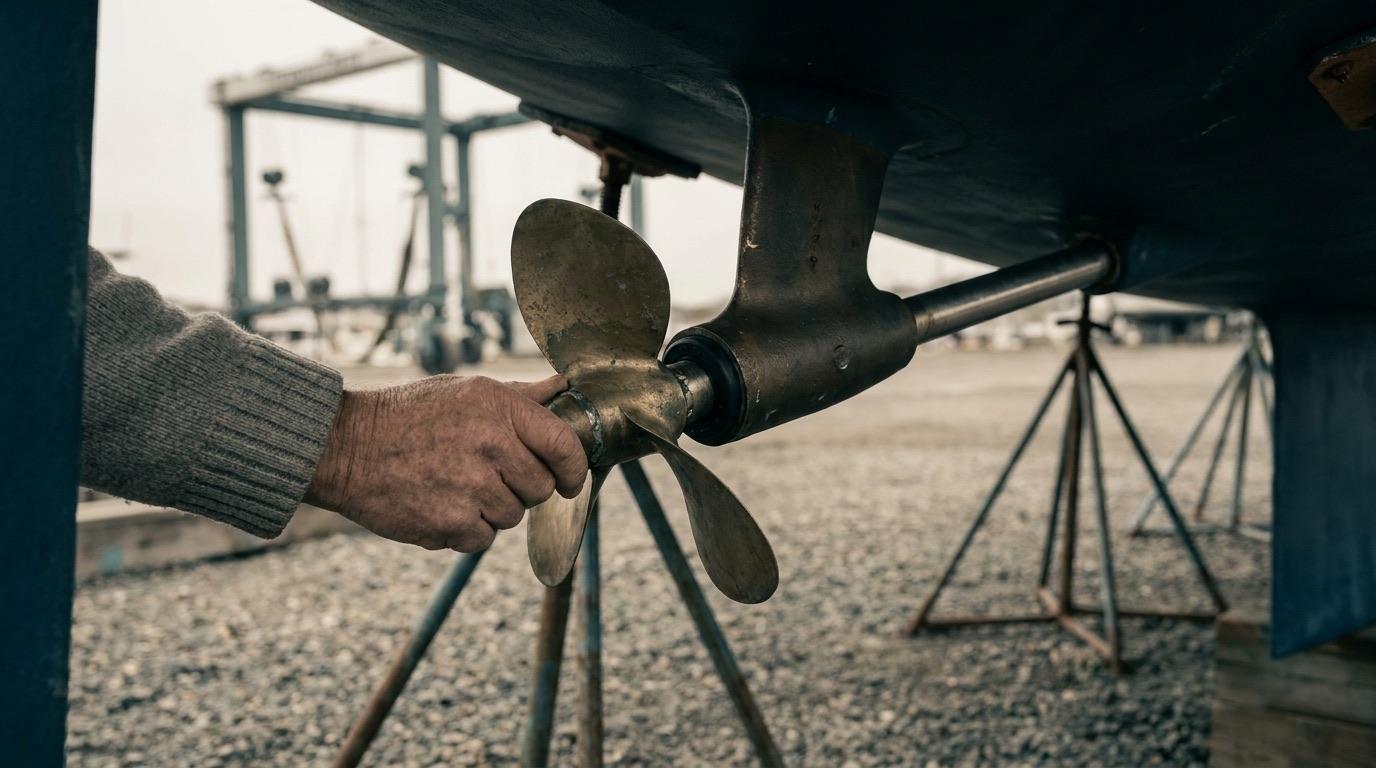
A worn cutlass bearing (the trade name is Cutless, after the Duramax brand, and both spellings are everywhere) is one of the few things on a used sailboat that a buyer can test with bare hands in ten seconds. It is also one of the jobs whose price ranges across a factor of five depending on how the boat was built, which is why "it needs a cutless bearing" in a survey report deserves a second question.
What does a cutless bearing do?
It supports the propeller shaft at the point where the shaft leaves the boat, either in a strut ahead of the propeller or in the stern tube itself. The bearing is a brass or fiberglass shell lined with grooved rubber, lubricated by the water flowing through the grooves. As the rubber wears the shaft gains play, and a shaft that can move wears the bearing faster, vibrates the engine, and eventually scores itself.
Wear comes from two places. Grit in the water, which is why boats in silty rivers wear bearings quickly, and misalignment between the engine and the shaft, which is the common cause on older boats whose engine mounts have sagged. A sailboatowners.com member whose bearing was still tight at nearly 700 hours attributed it to good alignment; another found the shaft worn along with the bearing at 750 hours.
How to tell if a cutless bearing is bad
Hauled out, grip the propeller and push the shaft sideways, then up and down, then try to lever it. A sound bearing has no play you can feel. A rule of thumb quoted from Nigel Calder allows about 1/16 inch of movement per inch of shaft diameter; experienced owners on the forums call 1/16 inch on a one-inch shaft too much and would accept 1/32 inch at worst. Afloat, the signs are a rumble or vibration under power that changes with revs.
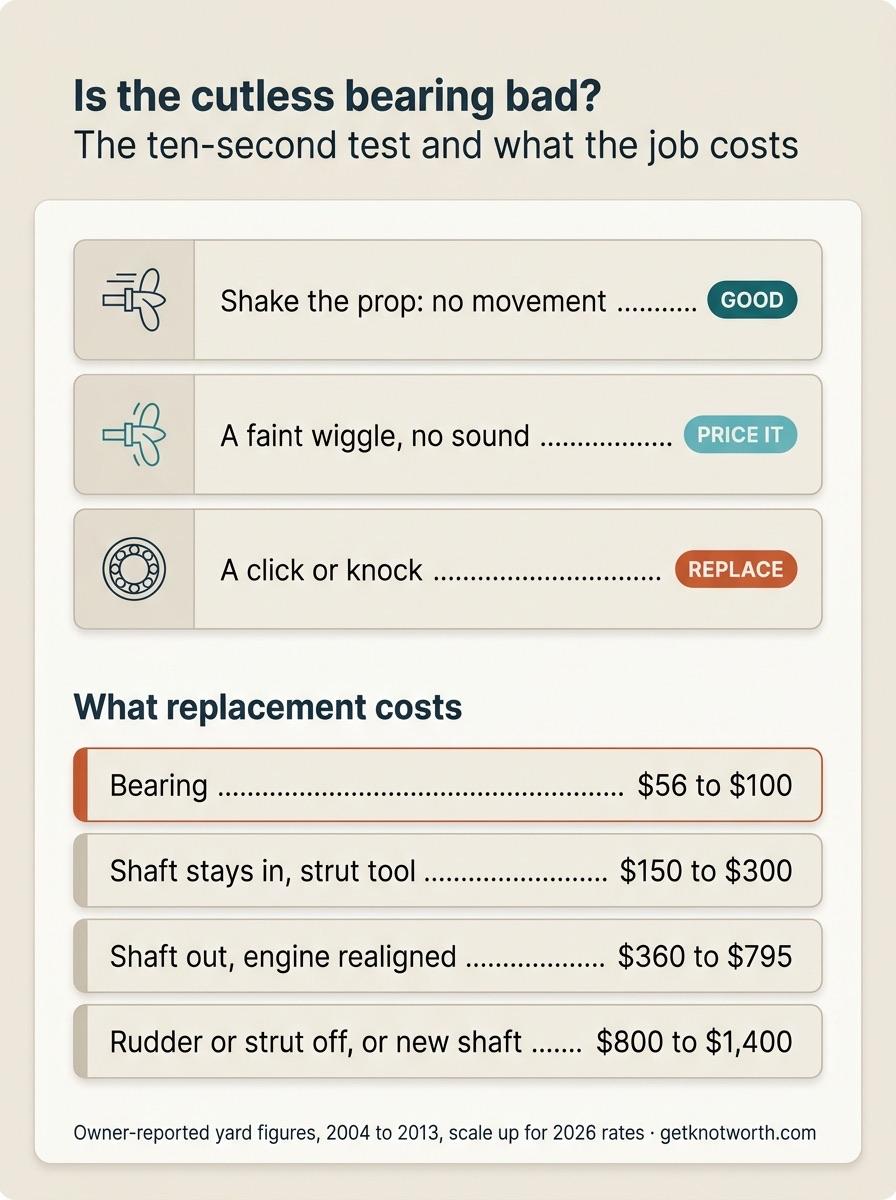
The forum shorthand is the best test description there is: no slop, no pop. Push on the propeller and there should be neither movement nor a sound. A knock when you shake it is a worn bearing. A grind or a scrape is a worn bearing and possibly a scored shaft.
| Test | What you find | What it means |
|---|---|---|
| Shake the prop side to side | No movement | Good |
| Shake the prop side to side | A faint wiggle, no sound | Early wear; fine for a season, price it |
| Shake the prop | A click or knock | Worn; replace at the next haul |
| Look at the bearing's end | Rubber fins cracked, bearing proud of the strut or recessed | Replace; check it was the right size |
| Look at the shaft where it enters the bearing | Scoring or a shiny worn band | Shaft may need replacing too: $400 to $600 extra |
| Under power on the sea trial | Rumble or vibration that changes with revs | Bearing, alignment or propeller; have the yard check all three |
Sources: sailboatowners.com threads on how much play and pre-emptive replacement; the Calder rule is quoted second-hand there. Practical Boat Owner describes the afloat symptom as a deep rumble felt through the hull under way.
How much does it cost to replace a cutless bearing?
The bearing is $56 to $100. Labour is where the range opens: 1 to 1.5 hours when the yard has a strut-mounted puller and the shaft stays in, 3 to 6 hours when it is a routine shaft-out job, and 8 to 13 hours when the coupling is seized, the strut has to come off, or the rudder has to drop to let the shaft out. Owner-reported totals run from about $150 to $300 for a simple job to $795 to $1,400 for a hard one, before the haul-out.
| Scenario | What it involves | Reported cost |
|---|---|---|
| Easy: shaft stays in | Prop off, bearing pressed out and in with a strut tool; some yards do it with the boat in the water and the prop removed | $150 to $300 labour plus the bearing (Catalina 320 in the water, $300; a yard's $150 estimate on a Hunter 27) |
| Routine: shaft out | Uncouple the shaft from the gearbox, slide it aft, press the bearing, refit, realign the engine | $360 to $795 (a $360 estimate with an $85 part at $100 an hour, 3 to 6 hours; $795 with shaft removal in 2008) |
| Hard: rudder off or strut off | Dig a hole or drop the rudder so the shaft clears it; or unbolt a bedded strut; seized coupling | $800 to $1,400 (an $850 job; $1,400 for bearing, new shaft and re-shimming) |
| Add a new shaft | Scored or worn shaft replaced | $400 to $600 extra |
| Haul-out if not already out | Short haul and relaunch | $8 to $15 per foot in 2010 posts; our survey cost guide puts a short haul at $280 to $500 today |
Sources: sailboatowners.com threads from 2004, 2008, 2010 and 2013; the Catalina 350 owners' forum for a bearing whose fiberglass shell crumbled and a shaft that would not clear the rudder. All owner-reported, most a decade or more old; yard rates have risen since, so scale the labour figures up.
Looking at one right now? Paste the listing and the free pre-check lists which of these the ad is silent on.
Free on every boat, no card. You only pay to unlock a full report.
What makes a boat fall into the hard column is fixed when it is built, and a buyer can read it from the dock:
- A rudder directly behind the propeller with little gap means the shaft cannot slide out without dropping the rudder or digging under it.
- A moulded-in strut can only be reached from one end.
- An older boat with a seized coupling adds hours; one owner's advice is to ask the yard how they will get the old bearing out, since thin-walled bearings often have to be cut and split.
How long does a cutless bearing last?
Owners quote about ten years with a well-aligned engine, and several report fifteen or more. There is no fixed interval. The bearing lasts as long as the shaft runs true through it, and dies fast when engine mounts sag or the boat lives in silty water. Check it at every haul-out and replace it on condition, not on the calendar.
The useful buyer's inference runs the other way. A bearing worn out at 500 hours is telling you about the engine mounts and alignment, not about the bearing, and the survey should look there. Forum veterans treat mounts over ten years old as suspect in any case.
What to ask the seller
- When was the cutless bearing last replaced, and was the engine realigned at the time?
- Any vibration under power? Ask for a short video at cruising revs.
- When were the engine mounts last replaced?
- Does the rudder have to come off to pull the shaft on this boat? An owner who has done it knows.
A yard quote is the right answer to a worn bearing; it is a small job on most boats and a half-day on a few. Put it on the inspection checklist with the rest of the running gear.
How Knotworth reads it
The free pre-check lists the running gear among the items a listing is silent on, and the full report carries a small reserve for the shaft, bearing and alignment on any boat over fifteen years old without a recent invoice. It is one of the cheaper lines in the true-cost model, and one of the easiest to clear with ten seconds at the propeller.
Paste the listing first. The free pre-check lists what the ad leaves unanswered, so the shake test is one of fifty things you check rather than the only one.
FAQ
How do I know if my cutlass bearing is bad?+
With the boat hauled, grab the propeller and push the shaft side to side and up and down. Any play you can feel, or a click when you shake it, means wear. Afloat, a rumble or vibration under power that changes with engine speed is the usual sign. A rule of thumb allows up to 1/16 inch of play per inch of shaft diameter, but experienced owners replace at less.
How much does it cost to replace a cutless bearing?+
The bearing itself is $56 to $100. Owners report labour from about $150 to $300 when the shaft can stay in, $360 to $795 when it has to come out, and $800 to $1,400 when the rudder or strut has to come off or the shaft is replaced too. Add the haul-out if the boat is not already out.
How often should cutless bearings be changed?+
On condition, not on a schedule. Owners report about ten years with a well-aligned engine and fifteen or more on some boats. Check it at every haul-out; a bearing that wears out quickly points to misalignment or worn engine mounts.
What is a cutless bearing on a boat?+
The water-lubricated, rubber-lined sleeve that supports the propeller shaft where it leaves the hull, fitted in a strut or in the stern tube. Cutless is the Duramax trade name; cutlass is the common spelling.
Can a cutless bearing be replaced without pulling the shaft?+
Often, if the yard has a strut-mounted puller and press, and sometimes with the boat still afloat once the propeller is off. Not when the bearing is seized, the strut is moulded in, or the design leaves no room for the tool, in which case the shaft comes out and the price goes up.